
Navigating Crypto News

CoinFeather
Navigating Crypto News
Quick market read from this story
The XRP Ledger's integration of Agent Commerce, enabling AI agents to transact autonomously, signals a significant shift towards programmable economies and machine-to-machine payments.
Ripple's $5 million investment in t54 underscores a strategic bet on AI-driven DeFi and the infrastructure required for autonomous transactions, potentially positioning XRPL as a key platform for future digital commerce.
This development aligns with broader industry trends, as highlighted by Coinbase's CEO, suggesting that autonomous agents, rather than human traders, may drive the next wave of crypto adoption and transaction volume.
By embedding trust layers like escrow and instant settlement, XRPL is building a foundation for a self-operating marketplace, reducing reliance on intermediaries and paving the way for trillions in on-chain payments.
Deep Dive
The XRP Ledger (XRPL) is emerging as a foundational platform for a new era of digital commerce, driven by autonomous AI agents rather than human interaction. This shift, termed Agent Commerce, transforms the XRPL into a self-operating marketplace where AI agents can independently accept tasks, execute them, and receive automated payments without human oversight.
Built on the Virtuals Protocol, Agent Commerce establishes a trust-driven flow where jobs are escrowed upfront, verified by independent evaluators, and settled instantly upon meeting predefined conditions. This system enables AI agents to transact natively in XRP and RLUSD through t54's x402 facilitator, eliminating delays between task completion and payment. For instance, an agent can analyze data, moderate content, or perform financial tasks and receive immediate on-chain payment upon verification, bypassing intermediaries.
Ripple has demonstrated significant commitment to this burgeoning field by investing $5 million in t54, underscoring a strategic focus on AI-powered Decentralized Finance (DeFi) and the necessary infrastructure for secure machine-to-machine transactions. This development aligns with the broader industry trend towards autonomous systems, positioning AI agents as active participants in digital economies.
By embedding trust mechanisms like escrow and third-party validation directly into its transaction flow, XRPL is establishing itself as a reliable backbone for machine-to-machine commerce. This programmatic enforcement of the entire transaction lifecycle, from task assignment to payment, minimizes the need for intermediaries, delayed settlements, and manual oversight.
Ripple CEO Brad Garlinghouse has indicated that 2026 could be a pivotal year for XRP, anticipating growth through international expansion, the integration of AI-driven capabilities, and the development of new XRPL tools to enhance payments and liquidity. This outlook is supported by observations from industry leaders, such as Coinbase's CEO, who suggest that future crypto growth may be driven by autonomous agents handling payments, rather than traditional traders.
XRPL's foray into Agent Commerce signifies a bet on the future of payments being fundamentally autonomous. As AI agents become more integrated into business operations, the underlying transaction infrastructure will be as crucial as the AI's intelligence itself, paving the way for an economy where machines execute, verify, and settle transactions without human intervention.
Source, catalyst, and sector overlap from the latest feed.
XRP is consolidating near a critical $1.45 support level, with increasing trading volume across major exchanges suggesting building momentum for a potential breakout. The asset's price action is tightening within a six-year compression pattern, indicating a significant expansion phase may be imminent, with analyst projections suggesting a potential $3-$8 range. Elevated trading volumes on platforms like Binance and Upbit, coupled with XRP recently surpassing BNB in market cap and strong regional demand in South Korea, signal growing institutional and retail interest.
Amundi's launch of a tokenized SAFO fund on Ethereum and Stellar signifies institutional adoption of blockchain for regulated financial products, leveraging dual-chain infrastructure for efficiency and transparency. The fund's structure, utilizing swap-based exposure and collateral from systemically important banks, highlights a conservative approach to yield generation within a regulated framework, potentially setting a precedent for similar institutional offerings. Despite the significant institutional development, ETH and XLM prices are experiencing downward pressure, indicating that broader market sentiment and technical factors are currently outweighing the positive news of this specific product launch.
Solana's price action is exhibiting a bearish fractal pattern mirroring January's rejection, suggesting sellers are maintaining control at key resistance levels and increasing downside risk. The rejection from the upper boundary of a rising channel indicates a potential move towards lower support zones, with a failure to hold these levels pointing to further downside. Traders should exercise caution as the current technical setup favors downside pressure, with a break of lower support potentially leading to deeper liquidity pockets.
Ethereum has entered a historical MVRV buy zone, suggesting a potential long-term value area for accumulation, though short-term price action remains pressured by resistance. The $2,150 support level is critical for ETH's immediate direction; failure to hold could lead to further downside towards $1,770, while a bounce might target the $2,400 resistance. While the MVRV metric indicates a potential bottoming phase, the recent rejection at $2,400 and break below mid-range structure suggest caution for short-term traders.
The launch of a tokenized Bitcoin Yield Fund on Base by Coinbase and Apex Group signifies a major step in bridging traditional finance with blockchain technology, potentially increasing institutional adoption of on-chain assets. The use of the ERC-3643 standard to embed compliance directly into the token demonstrates a viable model for regulatory adherence in tokenized funds, which could accelerate similar product launches across the industry. Coinbase's intention to extend this tokenized fund model to other products, including its US Bitcoin Yield Fund, suggests a strategic expansion into on-chain investment products, positioning them as a key player in the evolving digital asset landscape.
Ondo Finance's expansion to over 250 tokenized assets, including major institutional products like BlackRock's IBIT, signifies a maturing RWA market and increased adoption of tokenized securities. The integration of Ondo's offerings by major exchanges like Bitget and Binance, with Bitget capturing significant trading volume, highlights growing accessibility and demand for tokenized traditional assets within the crypto ecosystem. The RWA sector's substantial growth, reaching $27.35B in distributed value and demonstrating strong performance, positions tokenized stocks as a significant and rapidly expanding segment within digital finance.
A debate on Cardano's decentralization versus network usage, sparked by a researcher's 'ghost town' claim, highlights a key tension for investors evaluating its long-term utility. The partnership between Midnight Network and Worldpay signals a push towards real-world use cases and compliance in privacy-focused solutions, potentially boosting Cardano's adoption narrative. Despite ongoing development and new partnerships, the core debate around Cardano's low transaction volume versus its claimed decentralization creates uncertainty for near-term price action. Analysts suggest ADA may be in a long-term accumulation phase, but the current decentralization debate could influence investor perception and future price breakouts.
Strategy's significant $1.57 billion Bitcoin purchase, funded by new preferred stock, signals strong institutional conviction during a market dip, potentially boosting confidence in other crypto assets. The article highlights Pepeto's presale as a prime opportunity, emphasizing its existing cross-chain bridge and zero-fee exchange as differentiators that attract institutional-grade capital during periods of market fear. While BNB and SOL are presented as strong cycle holds, their potential upside is framed as less significant compared to the presale-to-listing gains anticipated for Pepeto, suggesting a focus on early-stage, high-growth potential assets.
Visa's new CLI tool enables AI agents to execute payments directly, bypassing traditional APIs and enhancing machine-to-machine transactions. Stripe-backed Tempo's blockchain launch focuses on high-throughput stablecoin payments for automated agents, signaling a push for specialized infrastructure. The simultaneous launches of Visa's CLI and Tempo's blockchain highlight a competitive race to establish standards for AI-driven payment systems. These developments indicate a significant shift towards programmable payments and autonomous financial agents, potentially impacting future transaction infrastructure.
Despite a hawkish Fed and Bitcoin's dip below $70,000, significant capital is flowing into the Pepeto presale, mirroring historical patterns of smart money accumulation during market fear. The Pepeto presale, led by a co-founder of the original Pepe coin, is attracting conviction capital with over $8 million raised, positioning it as a potential high-return opportunity compared to established assets like BTC and ETH. The current market sentiment, characterized by extreme fear and retail panic selling, presents a contrarian opportunity for traders to accumulate assets with strong development narratives, such as Pepeto, before potential future listings.
Bitcoin and Ethereum ETFs experienced significant net outflows totaling $90 million and $131 million respectively on March 19, signaling a reversal from earlier inflows and a cooling of institutional demand amid weakening price momentum. The broad-based outflows from major issuers like BlackRock and Fidelity suggest a shift in institutional sentiment, with investors becoming more reactive to short-term price movements and contributing to downside pressure. The alignment of negative ETF flows with consolidating spot prices for BTC and ETH indicates a potential loss of upward momentum, as the market relies less on ETF inflows to absorb selling pressure. While Solana ETFs saw minimal activity and XRP ETFs stalled, the overall trend of outflows from major crypto ETFs points to a cautious institutional stance, reflected in the 'extreme fear' sentiment and subdued Altcoin Season Index.
Stablecoins are increasingly viewed by global finance leaders as a strategic necessity for corporate treasury, indicating a significant shift from experimental use to core financial operations. The survey highlights that 74% of finance leaders see stablecoins as a tool to improve cash-flow efficiency and unlock working capital, suggesting a growing demand for their treasury applications beyond simple payment rails. Fintechs are leading the adoption of digital assets in treasury and payments, with a substantial portion already using or accepting stablecoins, signaling a potential competitive advantage for early adopters in the financial sector. Security and certifications like ISO and SOC 2 are paramount for institutional adoption, with 97% of respondents flagging them as critical, underscoring the need for robust infrastructure and compliance in the digital asset space.
Crypto.com's decision to cut 12% of its workforce signals a strategic pivot towards AI integration, potentially impacting operational efficiency and future product development. The layoffs indicate a broader trend within the crypto industry of cost-cutting and resource reallocation in response to market conditions and regulatory pressures. By prioritizing AI adoption, Crypto.com aims to gain a competitive advantage, suggesting a potential shift in focus from traditional exchange services to AI-enhanced offerings.
Live Feed
Loading the broader stream in the same flow as the homepage feed.
Global finance leaders increasingly view digital asset solutions as essential for competitiveness, indicating a significant shift in institutional adoption trends. Stablecoins are evolving beyond payment tools to become a primary treasury management instrument, with 74% of finance leaders recognizing their potential to enhance cash-flow efficiency. Fintech firms are leading the charge in digital asset integration, with a notable portion accepting stablecoin payments and driving demand for comprehensive custody and orchestration services. The strong demand for integrated custody and compliance solutions highlights a maturing institutional market seeking reliable infrastructure partners for digital asset operations.

Gemini's significant workforce reduction of 30% and integration of AI tools signal a strategic pivot towards cost optimization and operational efficiency amidst financial challenges. The exchange's reported net loss of nearly $585 million in 2025, coupled with declining revenue, indicates ongoing financial strain that may impact its competitive positioning and future growth. Gemini's continued restructuring, including previous exits from international markets, suggests a focus on core operations and potentially a more cautious approach to expansion.
Altcoin trading volumes have fallen to multi-month lows, indicating a significant decrease in investor interest and a more cautious market sentiment. Despite lower overall volumes, capital is rotating within crypto, with altcoins now comprising nearly 50% of total trading volume, suggesting a shift towards potentially higher-return assets. Historical data shows that altcoin volume spikes often precede market tops and FOMO-driven cycles, implying current low volumes could signal a period of consolidation or a potential shift in market dynamics. The current market environment, characterized by cautious sentiment and global uncertainty, is pushing traders away from riskier assets, impacting altcoin performance.
The recent 19% weekly surge in QNT, driven by its listing on Robinhood, indicates a strong shift in momentum with potential for further upside towards the $100 mark. The QNT price action shows a clear trend reversal from a downtrend to a potential uptrend, supported by accumulation signals and increasing trading volume. The convergence of improved accessibility via Robinhood, positive on-chain accumulation data, and a strengthening technical structure suggests QNT is well-positioned for sustained growth.

Bitcoin's current price action mirrors a previous pattern that preceded a significant drop to $60,000, suggesting a potential for further downside if key support levels fail. The observed 'counter-trend recovery' indicates weak conviction among buyers, signaling potential bullish exhaustion and a risk of a bearish trend re-establishing itself. A break below the current channel's lower trendline around $65,800 would confirm a bearish outlook, potentially triggering a sharp sell-off and impacting market sentiment.
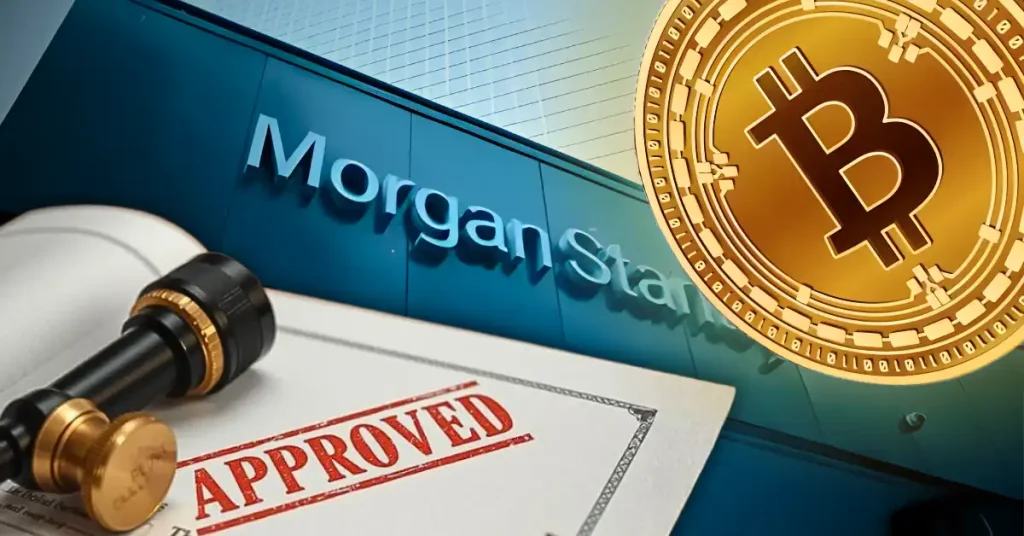
Morgan Stanley's updated S-1 filing for its spot Bitcoin ETF indicates continued institutional commitment and a potential significant capital inflow, given the firm's $1.8 trillion AUM. The filing, which includes details on seed investment and custody arrangements, signals progress in the race among major U.S. financial institutions to offer Bitcoin ETFs. Despite recent outflows from existing Bitcoin ETFs, the potential entry of a large player like Morgan Stanley could re-ignite demand and support Bitcoin's price by reducing available supply.
Geopolitical tensions and Federal Reserve rate pauses are creating market uncertainty, leading capital to rotate away from risk assets like Bitcoin towards traditional sectors such as energy and infrastructure. Kevin O'Leary suggests that despite short-term crypto volatility driven by macro factors, long-term adoption trends remain intact, implying a potential 'buy the dip' opportunity for strong assets. O'Leary's investment focus on energy, commodities, and alternative assets like collectibles highlights a broader market shift towards stability and tangible value during periods of global instability. The current market environment suggests crypto is moving in tandem with macro conditions, making it crucial for traders to monitor global events and their impact on liquidity and risk appetite.
Gemini's significant 30% workforce reduction and executive departures signal severe financial distress, driven by a substantial $585 million net loss and a failed IPO strategy that misjudged market timing. The exchange's pivot to new ventures like prediction markets, despite ongoing controversy and lawsuits, indicates a desperate attempt to find a new business model amidst operational challenges. These drastic cost-cutting measures and strategic shifts suggest Gemini is in a critical restructuring phase, with its future viability dependent on the success of these new, unproven ventures.
Galaxy Digital's analysis suggests that while quantum computing poses a real threat to crypto, most wallets are not currently vulnerable, mitigating immediate systemic risk. The core development is the ongoing work by Bitcoin Core developers and the broader ecosystem on quantum-resistant solutions, indicating proactive mitigation rather than an imminent crisis. Despite the technical challenges of implementing post-quantum cryptography due to Bitcoin's decentralized governance, aligned incentives among network participants are expected to facilitate a solution.
FTX's upcoming $2.2 billion creditor distribution, starting March 31, brings total payouts towards $10 billion, offering full recovery for some creditor classes based on 2022 crypto prices. While some creditors achieve 100% recovery, the valuation is based on 2022 prices, meaning they have missed significant market gains, potentially impacting their net realized value. The legal proceedings surrounding Sam Bankman-Fried continue, with prosecutors refuting his bid for a new trial, reinforcing the conviction and indicating no immediate clemency is expected. The distribution process requires creditors to have completed KYC and tax forms by a specific record date, with payouts managed through approved providers like BitGo and Kraken, offering flexibility in payout currency.
Signal context only. Validate with price action, liquidity, and risk limits before taking a position.
