
Navigating Crypto News

CoinFeather
Navigating Crypto News
Source, catalyst, and sector overlap from the latest feed.
Cardano's DeFi ecosystem has achieved a new record with over 520 million ADA locked, driven by the successful launch of USDCx and recent regulatory clarity from the SEC classifying ADA as non-security. The combination of a robust stablecoin offering (USDCx) and reduced regulatory uncertainty is expected to attract further liquidity, potentially propelling Cardano's TVL towards the one billion ADA milestone in the near future. Anticipation for the upcoming v11 hard fork, which aims to boost Cardano's transaction throughput to 1,000 TPS, adds another layer of fundamental development supporting potential growth in DeFi activity.
Live Feed
Loading the broader stream in the same flow as the homepage feed.

Bitcoin's open interest surge alongside a price drop and declining CVD indicates aggressive selling pressure, potentially driven by new short positions and long liquidations. The BTC price is testing a critical support zone between $69,000 and $70,000, with a breakdown potentially leading to a significant correction, while holding support could signal a renewed upward push. Recent outflows from spot Bitcoin ETFs, totaling $163.5 million on March 18, suggest a temporary cooling of institutional demand, coinciding with broader market risk-off sentiment.

Derivatives markets are signaling increased demand for downside protection, with rising skew and backwardation indicating traders are bracing for near-term volatility events. Despite a brief oil-driven risk-on sentiment, broader market fragility persists as indicated by falling equity futures, suggesting caution for crypto assets. While major cryptocurrencies remain range-bound, pockets of strength in altcoins like QNT and FET, driven by specific catalysts such as listings, suggest selective opportunities may emerge. The stabilization of Bitcoin open interest and normalized funding rates indicate a pause in speculative fervor, but the cautious institutional conviction suggests a lack of strong directional bias.

The upcoming $1.7 billion Bitcoin options expiry near the $70,000 'max pain' level introduces significant short-term price uncertainty as market makers aim to minimize payouts. Ongoing selling pressure from short-term holders, with over 28,000 BTC sent to exchanges at a loss, suggests potential capitulation that could precede a market bottom, though confirmation is pending. Bitcoin's relative resilience against geopolitical pressures impacting gold and equities indicates a potential maturation of crypto as an asset class, though this remains to be seen. The approaching critical threshold on the Realized Cap Impulse indicator, particularly the long-term version nearing negative territory, historically signals the mid-phase of a bear market, warranting close observation.

The BTC/Gold ratio is exhibiting classic bottoming signals with oversold RSI recovery and an impending MACD bullish cross, historically preceding significant Bitcoin rallies against gold. Bitcoin's price action is at a critical juncture, needing to defend the $68,000-$70,000 support zone, which includes the 200-week EMA, to avoid a potential retest of lower range lows. Technical indicators suggest a potential macro bottom for Bitcoin relative to gold, mirroring patterns from previous cycles that led to substantial price appreciation.

Central banks, including the Fed and ECB, are revising inflation forecasts upward due to rising energy prices, signaling a potential shift towards a 'higher-for-longer' interest rate environment. Bitcoin's recent dip below $70,000 is interpreted as a direct market reaction to the repricing of global monetary policy expectations, highlighting its sensitivity to macro liquidity conditions. The narrative of imminent interest rate cuts is being challenged by persistent inflation concerns, suggesting that Bitcoin's primary macro tailwind may be weakening, potentially leading to further downside if energy prices remain elevated. The market is now pricing in a higher probability of interest rate hikes rather than cuts from major central banks, forcing a reassessment of risk asset valuations, with Bitcoin acting as an immediate barometer for this liquidity recalibration.

The expiration of $2.1 billion in Bitcoin and Ethereum options today introduces potential short-term volatility as markets may gravitate towards 'max pain' levels of $70,000 for BTC and $2,150 for ETH. While options expiries can cause price swings, the current expiry value is slightly lower than the previous week's, potentially moderating the immediate impact on market dynamics. Recent outflows from spot Bitcoin ETFs add a layer of caution, suggesting some investor hesitancy that could influence price action around the options expiry event.

Bitcoin ETFs experienced significant outflows totaling $163.5 million, breaking a seven-day streak of inflows, which suggests a potential shift in institutional sentiment and could pressure BTC price downwards in the short term. The outflows from Bitcoin ETFs, particularly from major players like Fidelity and BlackRock, coincide with broader market volatility driven by geopolitical tensions, indicating that macro factors are currently outweighing positive ETF demand. The breaking of the inflow streak and subsequent price dip below $70,000, coupled with increased liquidations, signals a potential short-term bearish trend for Bitcoin as leveraged positions are unwound. Ethereum ETFs also saw outflows, suggesting a broader risk-off sentiment affecting not just Bitcoin but also other major digital assets, potentially indicating a temporary cooling of institutional interest across the crypto market.

Hyperliquid's market cap surge past Cardano highlights a market rotation towards platforms demonstrating strong user activity and revenue generation, potentially signaling a shift in investor preference. Arthur Hayes' $150 price target for HYPE, based on its revenue-sharing buyback model, suggests a bullish outlook for exchanges with sustainable tokenomics, contrasting with slower-growing ecosystems. While Cardano shows a technical buy signal, its slower ecosystem growth and current market cap underperformance relative to Hyperliquid indicate a need for renewed adoption to regain momentum.

Dogecoin's price action is diverging from whale accumulation, indicating a potential lack of retail interest and reliance on speculative momentum rather than fundamentals. Remittix is presented as a utility-focused alternative to meme coins like Dogecoin, targeting the $19 trillion payments market with a live product and exchange listings. The narrative suggests a shift from 'attention economy' meme coins to 'necessity economy' protocols, implying a potential rotation of capital towards projects with tangible use cases.
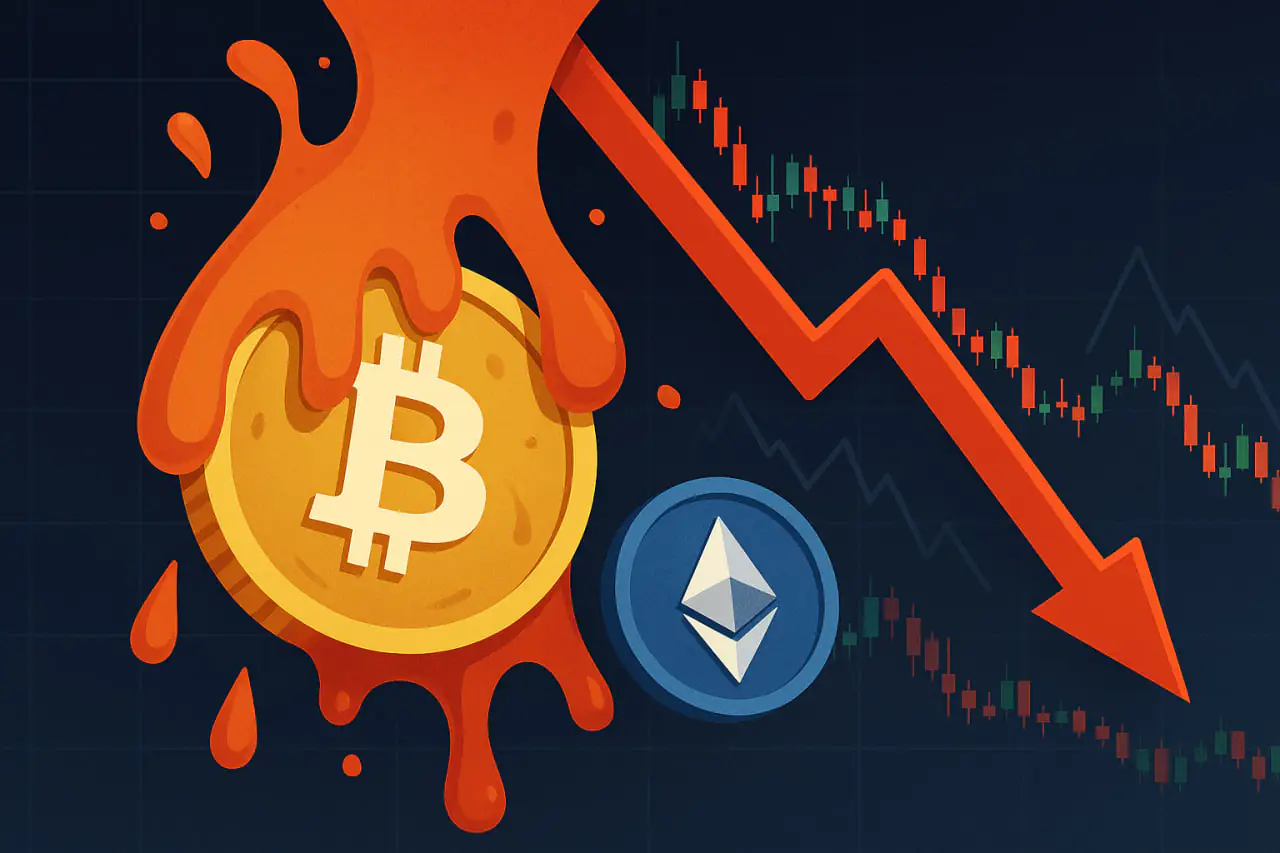
Bitcoin and Ethereum ETFs experienced significant net outflows totaling $90 million and $131 million respectively on March 19, signaling a reversal from earlier inflows and a cooling of institutional demand amid weakening price momentum. The broad-based outflows from major issuers like BlackRock and Fidelity suggest a shift in institutional sentiment, with investors becoming more reactive to short-term price movements and contributing to downside pressure. The alignment of negative ETF flows with consolidating spot prices for BTC and ETH indicates a potential loss of upward momentum, as the market relies less on ETF inflows to absorb selling pressure. While Solana ETFs saw minimal activity and XRP ETFs stalled, the overall trend of outflows from major crypto ETFs points to a cautious institutional stance, reflected in the 'extreme fear' sentiment and subdued Altcoin Season Index.
XRP is consolidating near a critical $1.45 support level, with increasing trading volume across major exchanges suggesting building momentum for a potential breakout. The asset's price action is tightening within a six-year compression pattern, indicating a significant expansion phase may be imminent, with analyst projections suggesting a potential $3-$8 range. Elevated trading volumes on platforms like Binance and Upbit, coupled with XRP recently surpassing BNB in market cap and strong regional demand in South Korea, signal growing institutional and retail interest.

The launch of BlackRock's staked ETH ETF, attracting hundreds of millions in inflows, signals strong institutional demand for Ethereum's yield-generating capabilities and is a key driver of its recent price surge. While ETF inflows are boosting ETH price, analysis suggests that approximately 75% of recent gains are driven by this liquidity rather than core network usage, indicating a potential for volatility if inflows slow. The Remittix (RTX) presale success, raising over $29.7 million, highlights strong retail interest in payment-focused tokens and their potential to bridge blockchain technology with real-world financial transactions. The confluence of institutional ETF demand for ETH and retail interest in payment solutions like Remittix suggests a dual-pronged market narrative: institutional yield-seeking and grassroots payment adoption.

Ondo Finance's expansion to over 250 tokenized assets, including major institutional products like BlackRock's IBIT, signifies a maturing RWA market and increased adoption of tokenized securities. The integration of Ondo's offerings by major exchanges like Bitget and Binance, with Bitget capturing significant trading volume, highlights growing accessibility and demand for tokenized traditional assets within the crypto ecosystem. The RWA sector's substantial growth, reaching $27.35B in distributed value and demonstrating strong performance, positions tokenized stocks as a significant and rapidly expanding segment within digital finance.
XRP's potential $3 price target in April hinges on a confluence of catalysts including Fed rate decisions and the CLARITY Act, coupled with sustained low open interest, mirroring conditions that previously fueled a significant rally. While XRP's price action is tied to macroeconomic factors and regulatory developments, Remittix presents an alternative investment thesis focused on immediate revenue generation from its live payment infrastructure, aiming for substantial returns independent of XRP's speculative drivers. The article contrasts XRP's reliance on external catalysts and market momentum with Remittix's operational revenue model, suggesting that projects with tangible utility and early traction in large markets like cross-border payments offer a more predictable and potentially higher upside than established assets awaiting broader market shifts.
Signal context only. Validate with price action, liquidity, and risk limits before taking a position.
Quick market read from this story
Global finance leaders increasingly view digital asset solutions as essential for competitiveness, indicating a significant shift in institutional adoption trends.
Stablecoins are evolving beyond payment tools to become a primary treasury management instrument, with 74% of finance leaders recognizing their potential to enhance cash-flow efficiency.
Fintech firms are leading the charge in digital asset integration, with a notable portion accepting stablecoin payments and driving demand for comprehensive custody and orchestration services.
The strong demand for integrated custody and compliance solutions highlights a maturing institutional market seeking reliable infrastructure partners for digital asset operations.
Deep Dive
A new survey by Ripple indicates that global finance leaders are rapidly integrating cryptocurrencies, stablecoins, and tokenization into their operations. The survey, which polled over 1,000 executives from banks, asset managers, fintech companies, and corporate finance departments, found that 72% of respondents believe offering digital asset solutions is now essential for remaining competitive.
Financial institutions are increasingly viewing stablecoins as more than just a tool for cross-border payments. The survey revealed that 74% of finance leaders are convinced stablecoins can significantly enhance cash-flow efficiency and unlock trapped working capital. Consequently, stablecoins are being directly integrated into treasury management by key institutional players.
Fintech companies are leading the charge in adopting digital assets, significantly outpacing traditional financial institutions and corporations. Nearly a third of fintech firms are already accepting payments directly in stablecoins. The majority of finance leaders surveyed expressed a preference for a comprehensive infrastructure provider that offers integrated custody, orchestration, and compliance services. 89% of respondents identified digital asset storage and custody as their highest priority, highlighting a strong demand for experienced partners to guide them through the implementation process.
Gemini's significant 30% workforce reduction and executive departures signal severe financial distress, driven by a substantial $585 million net loss and a failed IPO strategy that misjudged market timing. The exchange's pivot to new ventures like prediction markets, despite ongoing controversy and lawsuits, indicates a desperate attempt to find a new business model amidst operational challenges. These drastic cost-cutting measures and strategic shifts suggest Gemini is in a critical restructuring phase, with its future viability dependent on the success of these new, unproven ventures.
