
Navigating Crypto News

CoinFeather
Navigating Crypto News
Quick market read from this story
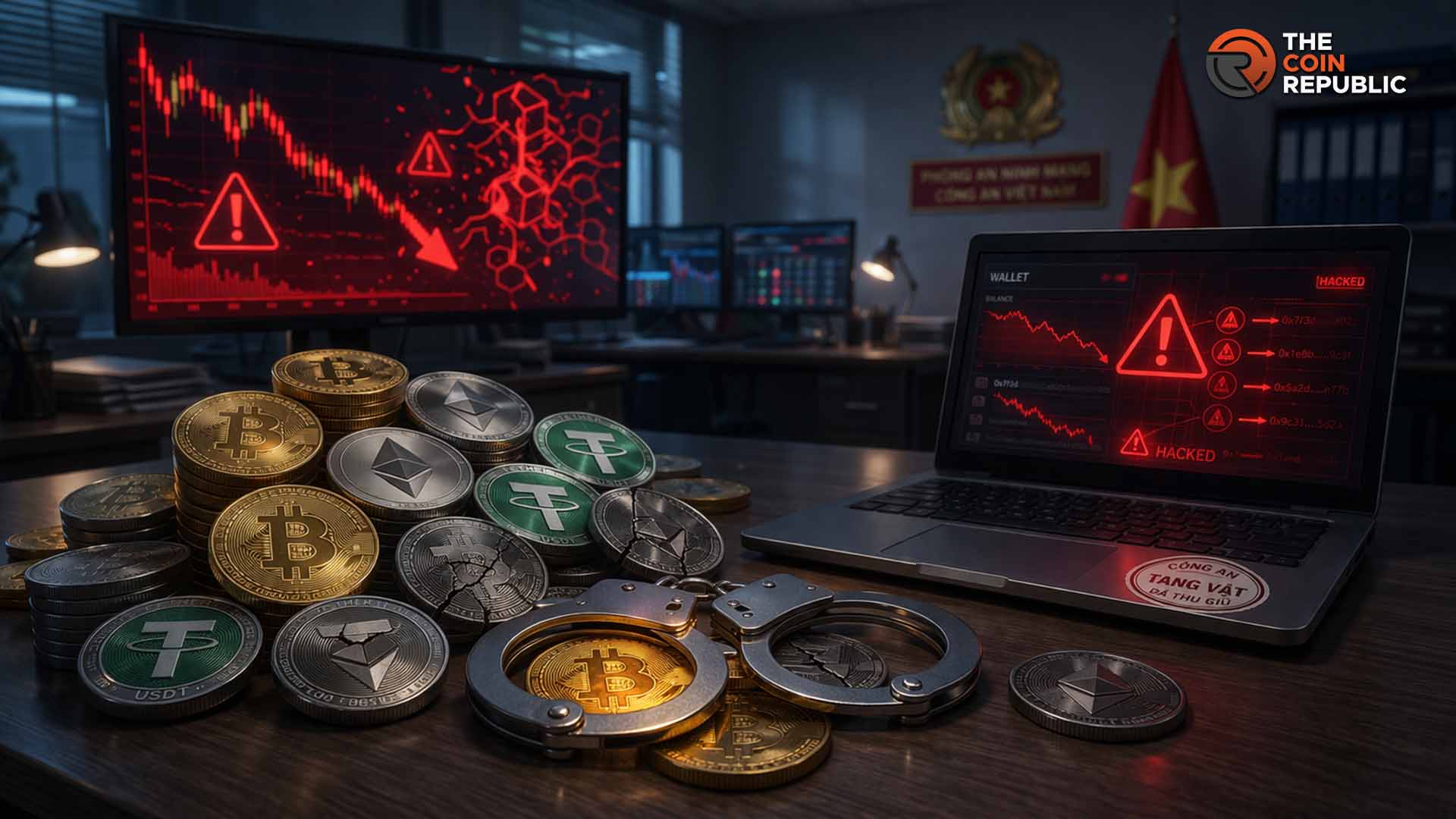
The arrest of seven individuals in Vietnam for a large-scale crypto scam linked to the ONUS ecosystem signals increased regulatory scrutiny in the region, potentially impacting investor confidence and market activity.
The alleged manipulation of tokens VNDC, ONUS, and HNG highlights the risks associated with controlled trading tactics and aggressive token promotions, underscoring the need for due diligence in emerging crypto markets.
Despite Vietnam's relatively open stance on crypto compared to some neighbors, this significant crackdown indicates a tightening regulatory environment, suggesting potential future enforcement actions against fraudulent activities.
Deep Dive
Vietnamese authorities have arrested seven individuals in connection with a large-scale crypto scam linked to the ONUS ecosystem. Investigators allege the group used aggressive token promotions and manipulated trading tactics to mislead investors, making this one of the country's most significant crypto-related crackdowns.
The Ministry of Public Security initiated its investigation on March 23, 2026, responding to claims of fraudulent activities in Hanoi and other regions. The primary suspects identified are Vuong Le Vinh Nhan, Tran Quang Chien, and Ngo Thi Thao. Authorities state the group operated the ONUS platform by secretly controlling token supply, which allowed them to manipulate market conditions and deceive investors.
While an official estimate of total losses has not been released, initial reports suggest the scheme may have involved billions of dollars. Police allege that since 2018, Vuong and his associates created fake cryptocurrencies and sold them through the ONUS platform, defrauding users.
The scammers employed organized marketing efforts and specific trading methods to present manipulated tokens, including VNDC, ONUS, and HNG, as legitimate investment opportunities. By manipulating token prices through their trading activities, they aimed to create artificial market demand and the appearance of growth. The group leveraged its control over system-based assets to acquire users and funds while concealing its operational control.
This case emerges as Vietnam is recognized as a dynamic cryptocurrency market, ranking fourth globally in crypto adoption according to a 2025 Chainalysis index. The country has seen an increase in crypto scams amidst this expansion, highlighting the risks associated with unregulated platforms. Authorities are focused on investor protection and ensuring transparent operations, signaling that crypto-related offenses will face severe penalties.
Unlike China, which bans digital currencies, Vietnam permits blockchain and crypto operations within a less defined legal framework. The investigation into the ONUS platform involved questioning over 140 individuals before the arrests were made.
Source, catalyst, and sector overlap from the latest feed.
Historical data indicates April has been XRP's strongest month, with an average return of 24.8% since 2014, suggesting potential for a significant price rally. Despite historical bullishness in April, current market uncertainty due to geopolitical tensions (US-Iran conflict) and XRP's recent March decline introduces significant downside risk. Analysts are divided on XRP's near-term trajectory, with some anticipating a rebound based on seasonal trends and others predicting a continued decline mirroring last year's performance. The median April gain for XRP is only 2%, indicating that the high average return is driven by a few outlier years, suggesting that a broad-based rally is not guaranteed.
Ondo Finance's strategic partnership with Franklin Templeton to tokenize ETFs signifies a major influx of traditional finance assets into the crypto space, potentially unlocking trillions in new capital flows. The collaboration positions Ondo Finance to further solidify its dominant 60% market share in tokenized stocks, indicating strong institutional adoption of its RWA infrastructure. Despite the significant fundamental development, ONDO's price action remains range-bound, suggesting a potential accumulation phase before a broader market recognition of the partnership's value. This development signals a growing trend of TradFi integration with crypto, where tokenized assets offer 24/7 access and DeFi composability, enhancing investor accessibility and market efficiency.
Geopolitical tensions stemming from the US-Iran conflict are directly impacting the crypto market, causing sustained volatility and a significant drop in overall market capitalization. Major cryptocurrencies like Bitcoin, Ethereum, and XRP are experiencing sharp declines, reflecting a broader market downturn driven by increased selling pressure and investor risk aversion. The market's sensitivity to global events, particularly the ongoing conflict and potential escalation involving Saudi Arabia and Israel, suggests that geopolitical risks will remain a key factor influencing crypto prices in the near term.
Ripple CEO Brad Garlinghouse's comparison of stablecoins to a 'ChatGPT moment' for corporate finance signals a significant potential shift in business treasury and payment strategies. The projected growth of stablecoin flows to $56.6T by 2030, with RLUSD emerging as a challenger, indicates a substantial market opportunity and increasing competition in the stablecoin sector. Ripple's strategic expansion into stablecoins with RLUSD, now the 10th largest, positions the company to capitalize on the growing demand for efficient digital payment solutions in corporate finance. The ongoing discussion around US stablecoin regulation, highlighted by Garlinghouse's concerns, suggests that regulatory clarity could be a major catalyst for broader adoption and market development.
Cardano's ADA price is testing a significant 2-year support level around $0.24, historically a strong rebound zone, suggesting potential for a short-term bullish relief rally. Despite recent bearish price action, whale activity shows $31 million in net longs on perps, indicating accumulation at lows that could support a price reversal if sustained. Subdued network activity, with daily active users struggling to surpass 900, highlights Cardano's difficulty in capitalizing on current market narratives compared to peers, posing a risk to sustained recovery. While ADA has lost its top 10 market cap position, its history of sharp bounces from support combined with recent holder growth suggests potential for accumulation at discounted levels, contingent on broader market improvement.
Google's significant investment in Anthropic's data center infrastructure signals a deepening partnership and a substantial commitment to AI development, potentially impacting demand for related compute and hardware resources. The judicial block on the Pentagon's directive against Anthropic suggests a more stable regulatory environment for AI firms, allowing for continued operations and potential government contracts. The dual developments of major infrastructure investment and regulatory reprieve for Anthropic indicate a strengthening position for the AI company, which could translate to increased demand for its services and underlying technologies.
US regulatory scrutiny on Bitmain, driven by national security concerns over potential espionage and grid sabotage, could significantly disrupt the Bitcoin mining hardware market where Bitmain holds an 80% share. Bitmain's strategic move to establish US and Southeast Asian manufacturing facilities aims to mitigate tariffs and political pressure, positioning it to navigate potential restrictions while continuing global operations. The US faces a dilemma: its reliance on Bitmain hardware for mining and AI infrastructure clashes with national security imperatives, suggesting a period of heightened regulatory oversight and potential market shifts. China's development of its indigenous blockchain chip (ChainMaker) on RISC-V architecture signifies a strategic push for technological self-sufficiency, potentially reducing reliance on foreign hardware and impacting global supply chains.
The potential passage of the Digital Asset Market Clarity Act presents a binary catalyst for XRP, with analysts projecting significant institutional inflows between $4B-$8B if enacted, potentially driving a substantial price repricing. Failure of the Clarity Act to pass could lead to extended consolidation for XRP, confining its price within a narrower range and making it more susceptible to broader market sentiment rather than project-specific catalysts. Ripple CEO Brad Garlinghouse's comments suggest that U.S. banks are poised to increase their engagement with the crypto market once regulatory clarity is established, highlighting the CLARITY Act's importance for broader institutional adoption beyond XRP. The next few weeks are deemed critical for XRP's future, as legislative progress on the CLARITY Act by late spring could unlock new financial products and increased liquidity, while delays may prolong current market conditions.
Wall Street's renewed focus on tokenization, driven by BMO, Nasdaq, and regulatory developments, signals a significant shift towards integrating digital assets into traditional finance for enhanced efficiency and 24/7 operations. The push for tokenization by major financial institutions like BlackRock and JPMorgan highlights a strategic move to leverage blockchain for faster settlement and more mobile collateral, aiming to improve market liquidity and reduce friction during stressed periods. Regulatory bodies and Congress are actively engaging with tokenization, indicating a move towards adapting existing securities laws and potentially creating new frameworks to govern digital assets, which could reshape market structure. While institutions are embracing tokenization for efficiency and control, challenges like fragmentation and interoperability remain, suggesting that the full realization of promised improvements may take time and face hurdles.
Detroit's decision to support Michigan in the Coinbase prediction market lawsuit introduces a local government economic perspective to the ongoing jurisdictional debate. The court's allowance for Detroit to file an amicus brief is a procedural step, not a ruling on the merits, indicating the legal fight over whether prediction markets are gambling or commodities is still developing. This development highlights the potential for prediction markets to impact existing regulated gaming revenue streams, explaining Detroit's vested interest in the case.
The CEO of a Kraken-backed SPAC suggests crypto is more resilient to AI disruption than traditional SaaS, implying a potential shift in investor focus towards digital assets as AI dominates software innovation. While AI is presented as the primary growth narrative, crypto, particularly stablecoins and payments, is identified as a strong secondary thematic for investment, indicating continued relevance despite market cycles. The SPAC is actively seeking crypto-native deals valued between $2B-$10B, signaling institutional interest in funding and potentially consolidating promising projects within the crypto ecosystem. The potential for tokenization to finance expensive AI infrastructure build-outs presents a novel intersection of AI and crypto, suggesting new avenues for yield generation and investment.
Ripple's RLUSD stablecoin saw significant minting on the XRP Ledger alongside burns on Ethereum, indicating a potential supply rebalancing effort by the company. Increased RLUSD activity and Ripple's focus on its utility as a settlement asset for enterprise use cases, including trade finance pilots, suggest a strategic push for broader adoption. A recent survey highlighting strong institutional preference for stablecoins, with 74% seeing potential for cash-flow efficiency, provides a favorable backdrop for RLUSD's development.
Live Feed
Loading the broader stream in the same flow as the homepage feed.
XRP Ledger demonstrated robust scalability by sustaining over 120 TPS with low fees, indicating strong performance under load that could be crucial for upcoming bull market activity. The network's ability to handle high transaction volumes without congestion or fee spikes suggests underlying efficiency improvements or increased DEX activity, providing a positive signal for its capacity. While generally positive, a user report of fee increases at 200 TPS highlights potential scaling limits that warrant monitoring as transaction demand grows. Recent developments in XRPL security enhancements and stablecoin testing by Ripple Labs, coupled with this throughput surge, suggest proactive preparations for increased network utility and adoption.

Despite Solana's network demonstrating significant developer growth, surpassing Ethereum, its token price action is showing weakness, indicating a divergence between fundamental development and market sentiment. Technical analysis reveals Solana's price has faced repeated rejections from a supply zone around $250, with cooling futures volume suggesting waning demand and a potential downside target towards the $52-$58 range. The article highlights a paradox where strong on-chain fundamentals like high developer count and transaction throughput are not translating into bullish price action for SOL, suggesting broader market conditions and technical resistance are currently overriding ecosystem strength.
Declining XRP exchange reserves to 2.75 billion indicate strong holder accumulation, suggesting potential for a price breakout driven by sustained demand despite recent price consolidation. The shift of XRP from exchanges to private wallets is a bullish signal for price appreciation, as it typically reflects a long-term holding sentiment and reduced selling pressure. Despite positive on-chain signals for XRP, the lack of institutional inflow into XRP ETFs, with potential for first monthly outflows, suggests a divergence between retail accumulation and institutional sentiment.

AI agents are increasingly dominating arbitrage opportunities in prediction markets due to their speed, capturing short-lived mispricings that humans cannot exploit. The growing sophistication of AI in prediction markets raises concerns about potential market manipulation and the need for regulatory guardrails. The evolution from simple execution bots to advanced AI systems signifies a fundamental shift in trading, favoring participants who leverage automation and AI. While AI enhances access to complex trading strategies for retail participants, it also intensifies competition with institutional players already utilizing similar technologies.
Short-term bearish analysis suggests a potential retest of the $60 demand zone due to persistent selling pressure and capped upside attempts above $100. Long-term optimistic outlook views the current ~77% drop from ATH as a strategic accumulation phase near the 0.618 Fibonacci retracement, with potential targets of $500-$1,000. Solana is at a critical juncture, balancing immediate bearish technicals with long-term bullish accumulation narratives, making it a watchlist candidate for volatility expansion.

Anthropic's leaked AI model, Capybara, signifies a potential leap in AI capabilities, raising concerns about cybersecurity risks within DeFi and smart contract auditing. The advancement of centralized AI models like Anthropic's Capybara could widen the competitive gap with decentralized AI networks such as Bittensor, potentially impacting the valuation of AI tokens. The leak of a highly capable AI model, despite its cybersecurity implications, highlights human error in data management, creating an ironic cautionary tale for tech companies.
Bitcoin is currently at a critical support zone, with two distinct analyst views suggesting either a short-term bounce followed by a further decline or a potential relief rally if support holds. The immediate price action for Bitcoin hinges on the $65,000-$66,000 support level, with a hold potentially leading to a 6-8% rally, while a break could signal a move towards $60,000 or lower. Traders should monitor the $66,170 area and Fibonacci resistance levels around $69,483-$74,894 for potential short-term selling pressure, as a sustained breakout is not yet indicated by current technicals. The market sentiment remains cautious, with analysts warning of potential irrational price movements and the risk of early positioning, emphasizing the need for confirmation before committing to significant trades.
The TD Sequential indicator flashing a sell signal on the 3-day timeframe suggests potential trend exhaustion and a local top for TAO, indicating that the recent rally may be nearing its peak and traders should anticipate profit-taking or a correction. Despite strong narrative hype positioning TAO as the 'next Bitcoin of AI,' the article highlights potential bias from proponents with financial exposure, suggesting that the current market enthusiasm might be driven by speculative interest rather than fundamental accumulation, increasing volatility risk. TAO price is facing critical resistance around the $360-$380 range, and a failure to break above this level, coupled with the bearish technical signal, implies a shift towards distribution and a potential downside move towards support levels like $300 or $260-$280.
Bitcoin's price has fallen below a critical short-term support level, driven by significant outflows from U.S. spot Bitcoin ETFs and broader macro uncertainty, signaling increased downside risk. The breakdown below the ascending trendline and key moving averages suggests a potential shift in market structure, with the $65.6K level now acting as a crucial support to defend against a deeper correction toward $63.9K or $62.5K. With the monthly close approaching and Bitcoin trading below key resistance zones, the probability of a bearish monthly close increases, especially if the $68.4K-$69.2K area remains a ceiling. While the Stochastic RSI indicates oversold conditions potentially leading to a short-term bounce, the overall technical picture suggests caution, with leveraged positions between $67K-$69K and $64K-$65K acting as potential volatility drivers.
Cardano's technical indicators suggest a potential 'death cross' formation, which, contrary to its name, can signal a bullish reversal if market forces align, potentially trapping short sellers. Despite a recent price dip attributed to a large ADA deposit on Binance, the 'death cross' pattern presents a contrarian bullish signal for traders anticipating a rebound. Charles Hoskinson's call for community engagement to 'make Cardano better' highlights a need for increased on-chain activity, which is currently lacking as many holders are 'underwater'.
Bitcoin's recent drop below $66,000 is driven by macroeconomic pressures, specifically an oil supply shock and rising inflation expectations, which are diminishing hopes for near-term Federal Reserve rate cuts. The current macro environment presents a dual challenge for Bitcoin, as it acts as a risk asset sensitive to tightening financial conditions while failing to establish itself as a consistent inflation hedge. Technical analysis suggests Bitcoin is in a short-term bearish trend, with key support at $64,000-$65,000; a break below this level could signal further downside, while reclaiming $70,000 is needed to shift momentum. The market is increasingly pricing in a prolonged pause or even potential rate hikes by the Fed, a significant shift from earlier expectations of cuts, creating a fragile macro setup that impacts risk assets like Bitcoin.
Despite a generally bearish market with Bitcoin down over 6% and Ethereum below $2,000, specific altcoins like Chainlink, Hedera, Kaspa, Sui, and Aptos are identified as having strong 10x potential setups. Chainlink's institutional partnerships and on-chain data streams position it as a critical infrastructure play, while Hedera's stablecoin launch and McLaren partnership signal institutional adoption. Kaspa's upcoming hard fork introducing programmability, Sui's multiple ETFs, and Aptos's robust transaction volume and stablecoin growth suggest these Layer-1s are building fundamental value independent of broader market sentiment. The article suggests that periods of market fear, characterized by price drops and negative sentiment, can present accumulation opportunities for fundamentally strong altcoins that may not require new all-time highs to deliver significant returns.
Signal context only. Validate with price action, liquidity, and risk limits before taking a position.
