
Navigating Crypto News

CoinFeather
Navigating Crypto News
Source, catalyst, and sector overlap from the latest feed.
X's new anti-scam policy, which auto-locks accounts posting crypto content for the first time, aims to significantly reduce the economic incentive for hackers targeting social media platforms. The implementation of identity verification for first-time crypto posts on X directly addresses the prevalent issue of account takeovers used for crypto scams, potentially deterring attackers. X's proactive stance on crypto scams, including criticism of Google's phishing protection, highlights a growing trend of platforms implementing their own security measures to protect users from illicit activities.
Live Feed
Loading the broader stream in the same flow as the homepage feed.

Ethereum price is showing signs of weakness, retreating over 5% and threatening to fall below $2,000, driven by cooling geopolitical optimism and declining open interest in derivatives markets. The decrease in Ethereum's open interest suggests investor indecisiveness and a potential bearish turn, especially as leveraged positions are unwinding and ETF flows have turned negative. Despite recent price weakness, the combination of low open interest and reduced liquidations could historically precede a market comeback, contingent on a substantial increase in spot demand, which is currently lacking according to ETF data. Bearish sentiment in Ethereum ETFs, with significant outflows in early April, indicates that broader macroeconomic conditions are likely to continue pressuring ETH price action and the overall crypto market.

New research suggests quantum computers could crack Bitcoin's cryptography with significantly fewer qubits than previously estimated, raising concerns about the security of existing BTC holdings. Unlike centralized systems that can implement post-quantum upgrades, Bitcoin's decentralized nature presents a significant challenge for adopting new cryptographic standards, potentially leading to forks or vulnerabilities. The 'harvest now, decrypt later' threat means that even if quantum computers are not yet capable of cracking current encryption, data collected today could be compromised in the future, highlighting the urgency for Bitcoin to adapt. While the quantum threat affects most internet infrastructure, Bitcoin's unique governance model makes its adaptation process more complex and potentially slower than that of traditional financial and governmental systems.

A Bank of Canada study indicates Aave V3's design successfully prevented lender bad debt through overcollateralization and automated liquidations, a positive for protocol stability. The study highlights a significant tradeoff: Aave V3's risk management model shifts losses onto borrowers, potentially leading to substantial losses (10-30%) during liquidation events, impacting capital efficiency. Recursive leverage, accounting for over 20% of borrowed volume, amplified borrower risk and contributed to concentrated liquidation waves, suggesting increased volatility for leveraged users.

The Ethereum Foundation has completed its 70,000 ETH staking target, converting dormant treasury assets into a yield-generating position estimated to produce $3.9M-$5.4M annually. This strategic shift from potential ETH sales to staking aims to create a self-sustaining treasury for research and grants, reducing prior valuation pressure from foundation sell-offs. While the foundation has now staked a significant portion of its ETH, it still holds over 100,000 unstaked ETH, leaving open the possibility of further staking expansion or maintaining liquid reserves.
The Reserve Bank of India's approval for Emirates NBD to acquire up to 74% of RBL Bank signifies a significant cross-border M&A event in the financial sector, potentially impacting RBL Bank's operational structure and market positioning. While the deal is substantial at $3 billion, RBL Bank's stock saw only a marginal uptick, suggesting the market may have already priced in the regulatory approval or views the immediate repricing potential as limited. The regulatory greenlight for a foreign bank subsidiary structure indicates a favorable environment for foreign investment in India's banking sector, though specific compliance requirements will shape future operations.

Algorand's significant price surge is directly linked to its citation in a Google research paper for post-quantum cryptography implementation, establishing a new narrative driver for the asset. The Google paper validates Algorand's technical advancements in quantum-resistant signatures, positioning it as a potential leader in a nascent but structurally important market theme. While Algorand shows strong momentum, the broader market remains cautious due to geopolitical factors, suggesting potential for profit-taking or volatility despite the positive catalyst. Render also saw gains, benefiting from AI demand and its adjacency to the post-quantum narrative, indicating a potential spillover effect within related tech sectors.

Cathie Wood's assertion that Bitcoin will no longer experience 85%+ drawdowns suggests a maturing asset class, potentially reducing perceived risk for institutional investors. The prediction of a $34,000 price bottom, representing a 72% drawdown, offers a specific target for market participants to monitor, contrasting with broader consensus ranges. Historical April price action data indicating a potential recovery during bearish phases, coupled with Wood's commentary, could signal a near-term bullish inflection point for BTC.

Geopolitical tensions and rising oil prices are creating macro headwinds, pressuring Bitcoin's price consolidation around $66,600 despite consistent institutional ETF inflows. Despite steady ETF inflows, a net distribution by large holders and a significant portion of circulating Bitcoin trading at a loss suggest underlying demand weakness, potentially increasing volatility in thin holiday liquidity. The article highlights a divergence between institutional demand via ETFs and on-chain data showing large holder distribution, indicating a complex market structure that warrants caution.
Escalating geopolitical tensions in the Persian Gulf, particularly concerning the Strait of Hormuz, are driving crude oil prices to multi-year highs, signaling significant supply disruption fears. Despite discussions of potential OPEC+ output increases, logistical constraints and ongoing geopolitical uncertainty limit the near-term impact, suggesting sustained price volatility. President Trump's threats of escalated attacks on Iran, coupled with reports of strikes and military movements, are injecting fresh anxiety into energy markets, potentially leading to broader regional instability.
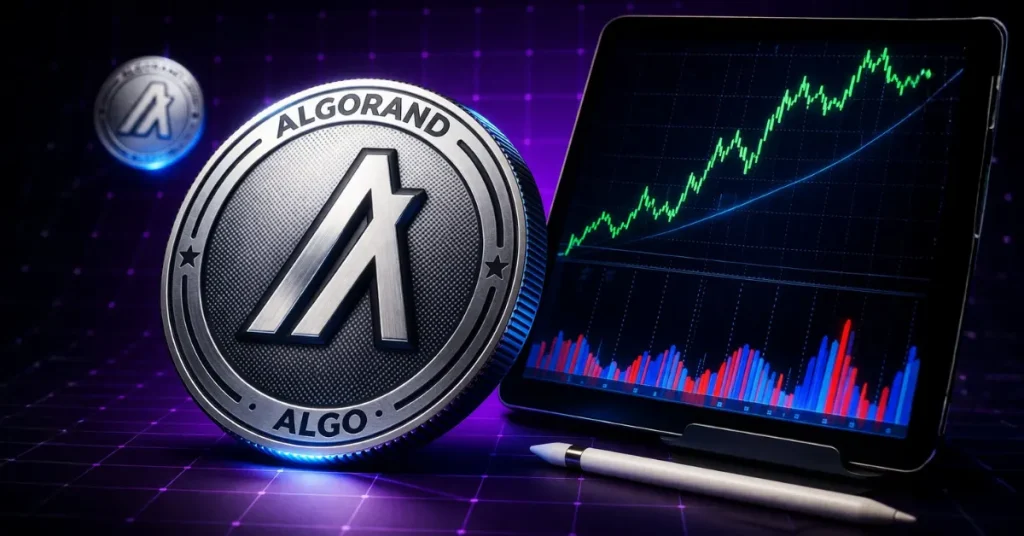
Algorand's decisive trendline breakout on expanding volume suggests a bullish reversal, with the $0.10 level acting as a key support for continued upside momentum. NEAR Protocol is consolidating near a critical $1.40-$1.42 resistance, indicating a potential breakout that could lead to a 50% price increase if sustained above this level. The analysis highlights a rotation into specific altcoins like Algorand and Near Protocol, suggesting traders are seeking opportunities beyond the broader market consolidation.

Bitcoin's price rejection at the 50 SMA, coupled with on-chain data showing 'Supply in Profit' entering historical bottom discovery territory, suggests that while selling pressure may be exhausting, new capital has not yet entered the market to drive a sustained recovery. The current market dynamic indicates a divergence between exhausted short-term sellers and inactive long-term holders, creating a scenario where price could be susceptible to amplified downward volatility from the derivatives market if macro shocks occur, despite underlying supply-side strength. The decline in stablecoin supply on spot markets, contrasted with rising reserves in derivatives exchanges without increased Open Interest, signals a lack of new capital inflow and suggests existing participants are increasing leverage, posing a risk to the current price consolidation. While on-chain metrics historically point to a low probability of significant further downside from current levels, the absence of fresh spot demand and the risk from leveraged derivative positions mean a new catalyst is required to break Bitcoin's $67,000 consolidation.

The Ethereum Foundation's shift to funding operations via staking yield instead of periodic ETH sales removes a consistent source of sell pressure, representing a structural positive for ETH supply dynamics. Despite the Foundation's move to reduce sell pressure, ETH is struggling to break above $2,000 due to declining user retention and significant outflows from Ethereum ETFs, indicating cautious institutional sentiment. The repeated inability of ETH to sustain levels above $2,000, coupled with concerns about its #2 position, suggests a lack of strong demand catalysts despite the positive supply-side development. While the Foundation's staking strategy is a long-term positive, the immediate market reaction is muted, highlighting the need for renewed demand drivers to overcome technical resistance and current bearish sentiment.
XRP's liquidity and turnover on Binance have fallen to multi-month lows, indicating a significant cooling of trading activity and potentially lower price volatility in the short term. The decline in XRP's market activity suggests reduced investor interest or a shift in trading strategies, which could pressure the asset's price if sustained. Ripple's RLUSD donation to Accion Opportunity Fund has demonstrably supported small businesses, creating jobs and economic activity, highlighting the utility of its stablecoin beyond pure trading.

Strong spot buying of $451 million contrasts with bearish futures positioning, suggesting a potential short squeeze if resistance breaks. Sustained accumulation indicated by net outflows from exchanges and rising spot CVD points to underlying demand absorbing selling pressure. The divergence between spot demand and futures shorts creates an imbalance, historically leading to sharp price movements once positioning unwinds. XRP's compression within a descending channel near the $1.25-$1.30 support zone suggests a breakout is imminent, with upside resistance at $1.38-$1.45.

The US regulatory body OCC is actively selecting crypto firms for national trust charters, focusing on custody, settlement, and stablecoin infrastructure, signaling a deliberate integration of specific crypto functions into the traditional banking system. This federal chartering process creates a clear distinction between firms operating within the regulated banking perimeter and those outside, directly impacting which entities can scale nationally and capture institutional capital flows. The trend towards re-intermediation suggests that firms providing essential backend infrastructure like custody and reserve management are becoming the critical "picks-and-shovels" for the growth of tokenized finance, potentially commanding significant fees on trillions in assets. While the OCC's approach offers regulatory clarity and national reach, it imposes substantial compliance and supervisory costs, likely favoring well-capitalized incumbents and compressing the field of potential national players.
Signal context only. Validate with price action, liquidity, and risk limits before taking a position.
Quick market read from this story
Ripple's stablecoin RLUSD has launched new trading pairs against tokenized gold (PAXG, XAUT) on Bitrue, expanding its utility beyond traditional fiat-backed stablecoins.
The integration with tokenized gold assets, coupled with strong trading volumes on Binance and Uniswap, and a recent Deloitte audit confirming over-collateralization, suggests growing confidence and adoption for RLUSD.
The expansion into tokenized commodities like gold, alongside integration into B2B payment channels like Convera, positions RLUSD as a potential bridge asset between crypto and traditional finance, indicating a medium-term growth narrative.
Deep Dive
Ripple's stablecoin, RLUSD, has significantly expanded its market accessibility by launching on the Bitrue exchange with unique trading pairs against tokenized gold: PAXG and XAUT. These tokens represent gold assets issued by Paxos and Tether, respectively, bridging traditional assets with the cryptocurrency market.
RLUSD demonstrates strong liquidity across major platforms. Binance leads as the primary liquidity hub, with the RLUSD/USDT pair generating over $29.3 million in daily volume, representing approximately 10% of RLUSD's total trading activity. On decentralized exchanges, Uniswap V3 shows $9.43 million in volume for the RLUSD/USDC pair, while Curve Finance pools hold $7.47 million in RLUSD liquidity. This indicates deep integration within the Ethereum ecosystem, where over half of the stablecoin's supply circulates.
The stablecoin's growth is underpinned by robust transparency and expanding utility. A recent audit by Deloitte, published on April 2, confirmed that RLUSD's reserves total $1.56 billion, exceeding its market supply of $1.49 billion. Furthermore, payments giant Convera began integrating RLUSD into its B2B channels, which handle a turnover of $170 billion, signaling sustained demand beyond the speculative crypto market.
Long traders have suffered more losses as the crypto market liquidation almost hit $300 million.
