
Navigating Crypto News

CoinFeather
Navigating Crypto News

Quick market read from this story
The US regulatory body OCC is actively selecting crypto firms for national trust charters, focusing on custody, settlement, and stablecoin infrastructure, signaling a deliberate integration of specific crypto functions into the traditional banking system.
This federal chartering process creates a clear distinction between firms operating within the regulated banking perimeter and those outside, directly impacting which entities can scale nationally and capture institutional capital flows.
The trend towards re-intermediation suggests that firms providing essential backend infrastructure like custody and reserve management are becoming the critical "picks-and-shovels" for the growth of tokenized finance, potentially commanding significant fees on trillions in assets.
While the OCC's approach offers regulatory clarity and national reach, it imposes substantial compliance and supervisory costs, likely favoring well-capitalized incumbents and compressing the field of potential national players.
Deep Dive
On April 2, Coinbase received conditional approval from the Office of the Comptroller of the Currency (OCC) for a national trust charter. This approval places Coinbase among at least eight firms that have been moved toward federal trust-charter status since December 2025, indicating a deliberate federal strategy to integrate specific aspects of the cryptocurrency ecosystem into the supervised banking system.
The OCC's recent approvals, including those for Circle, Ripple, BitGo, Fidelity, and Paxos on December 12, 2025, followed by Bridge and Crypto.com in February, and now Coinbase in April, reveal a concentrated focus on core functions such as custody, reserve management, stablecoin infrastructure, and settlement. This wave of approvals signifies a shift in US regulation from broad oversight to the selective integration of crypto functions within the traditional banking perimeter, defining which entities can scale nationally and capture institutional flows.
A national trust charter grants firms federal reach under a single OCC supervisor, enabling them to operate across all 50 states without needing a complex patchwork of state-specific approvals. These national trust banks are authorized to hold client assets and facilitate settlement under a fiduciary mandate, providing a clear federal framework for these critical operations.
The OCC's current comfort level lies with functions related to custody, reserves, and settlement. Crypto.com's charter, for instance, covers client asset management and trade settlement. Bridge's approval focused on stablecoin issuance, orchestration, and reserve management. Similarly, Circle's approval encompassed digital-asset custody and reserve management services tied to its fiduciary activities, while Coinbase indicated potential support for tokenized securities and stablecoins.
This approach establishes a regulatory perimeter around essential functions for tokenized finance, extending supervisory authority over firms providing asset custody, stablecoin reserve backing, and settlement infrastructure. This strategic move positions custodians, reserve managers, and stablecoin infrastructure operators as key players in the evolving landscape.
Supporting this trend, US bank regulators in March 2026 clarified that tokenized securities would not face additional capital charges, adopting a technology-neutral framework. The SEC has also facilitated intraday trading of tokenized shares for a money-market fund and approved tokenized trading proposals from Nasdaq and NYSE in partnership with Securitize, aligning with the OCC's charter wave and institutional infrastructure focus.
While crypto's initial promise was to disintermediate traditional finance, the OCC's approvals are leading to a re-intermediation. Commercially viable crypto firms are increasingly seeking to become regulated intermediaries. This is evident in significant investments, such as Mastercard's agreement to acquire stablecoin infrastructure firm BVNK for up to $1.8 billion, and OpenFX raising $94 million to scale its cross-border money movement services, which have seen rapid growth in payment volume.
The global stablecoin market reached over $310 billion in February 2026, with significant capital flowing into backend infrastructure like custody, settlement, and reserve management. Currently, Anchorage is the only digital asset company with a full national trust bank charter, while the recent approvals are conditional or preliminary, requiring firms to demonstrate capital adequacy, governance, and operational controls to the OCC.
The future trajectory depends on the OCC's final stablecoin implementation and the operationalization of tokenized securities by institutions. In a bull case, tokenized securities pilots on Nasdaq and NYSE could lead to live settlement infrastructure, and firms like Mastercard could accelerate stablecoin rail adoption globally. If stablecoins reach projections like Standard Chartered's $2 trillion forecast by 2028, federally supervised crypto utilities could become essential infrastructure for digital finance, with chartered custodians and reserve managers earning fees on trillions of dollars in assets.
Conversely, a bear case scenario involves slower approvals due to objections from bank trade groups, leading the OCC to impose stricter conditions on reserve buffers and liquidity. In this scenario, the stablecoin market might align more closely with JPMorgan's $500 billion by 2028 forecast, with state trust structures and bank partnerships remaining practical alternatives. This would position the federal lane as a premium niche rather than a broad standard.
Washington is strategically categorizing crypto functions into those it intends to supervise, such as asset custody, stablecoin reserve backing, and settlement, and those it does not. The OCC charter approvals, stablecoin reserve rules under the GENIUS Act, and the technology-neutral treatment of tokenized securities collectively form a regulated framework for crypto-native financial infrastructure.
Operating under a federal charter involves significant supervisory costs, including monthly public reserve disclosures for stablecoin issuers and full OCC examination authority. Firms that meet these requirements will operate nationally under a single supervisor, manage institutional assets, and process tokenized settlements within a framework acceptable to traditional finance. Those unable to meet these standards will likely remain within the state-licensed layer, indicating an ongoing sorting process within the industry.
Source, catalyst, and sector overlap from the latest feed.
The Cardano Foundation's strategic shift to diversify its treasury away from ADA towards Bitcoin and cash signals a reduced direct financial linkage to ADA's price performance, potentially altering internal alignment and feedback loops. A significant decrease in ADA holdings from 76.7% to 51.6% of the Cardano Foundation's reserves, coupled with an increase in Bitcoin and cash, indicates a strategic de-risking and a move towards a more diversified treasury management approach. The Foundation's increased focus on technology, adoption, and governance spending, including initiatives in digital identity and RWA, suggests a strategic pivot to bolster Cardano's ecosystem infrastructure and attract institutional interest, independent of ADA's direct price action.
Bitcoin is functioning as a continuous price discovery mechanism for geopolitical risk over the Easter holiday weekend, while traditional markets are closed, highlighting its availability as a key market structure component. The current geopolitical tensions and oil price surge are transmitting macro stress through Bitcoin, linking it to inflation, yields, and liquidity conditions, which will be tested by traditional market reopenings and upcoming economic data. While Bitcoin's availability provides an immediate venue for price expression during market closures, its signal requires validation from traditional markets and cross-asset confirmation on Monday to determine durability.
Despite XRP's longest losing streak in a decade, Ripple's aggressive expansion into institutional finance and treasury management via GTreasury and HyperliquidX suggests a strategic build-out that could eventually drive demand. Ripple's integration of XRP and RLUSD into GTreasury's $13 trillion payment system aims to embed digital assets into corporate finance workflows, potentially shifting demand drivers from speculation to utility. The market's current disconnect between Ripple's enterprise progress and XRP's price weakness highlights a lack of immediate repricing catalysts, suggesting a 'wait-and-see' approach for traders. Ripple's expansion into institutional trading via HyperliquidX and partnerships in payments with Convera signal a broader strategy to position XRPL and its stablecoin infrastructure as a regulated layer for global financial operations.
A new framework for reserve assets is emerging, prioritizing accessibility and portability under geopolitical stress over traditional metrics like stability, potentially positioning Bitcoin as a 'sovereignty insurance' asset. The discussion around Bitcoin as a reserve asset is shifting from a pure hedge against monetary debasement to a strategic tool for maintaining access to funds during sanctions or conflict, a concept gaining traction with central banks diversifying away from USD. While Bitcoin's volatility and governance remain challenges, the 'access risk' argument, supported by real-world events like Russian fund freezes, suggests a potential for marginal adoption by politically exposed states, which could have outsized price impacts due to Bitcoin's market cap. The debate acknowledges Bitcoin's limitations, suggesting its most credible role may be as a small insurance sleeve alongside gold, rather than a primary reserve asset, as traditional assets like gold and diversified sovereign paper are still favored by many reserve managers.
XRP's core value proposition as a payment and settlement asset is being tested by current macro conditions, specifically rising oil prices and dollar strength, which are causing it to behave like a high-beta risk asset rather than a utility-driven solution. Despite Ripple's expanding institutional footprint and product launches like GTreasury, XRP's price action is currently dominated by macro factors, raising questions about when its fundamental utility will translate into token value capture. Upcoming macro data releases, including employment and CPI reports, will be critical in determining whether XRP can reclaim its infrastructure narrative or continue to trade as a macro-correlated speculative asset.
Cambodia's new draft law imposing severe penalties, including life imprisonment, for crypto scam kingpins signals increased global regulatory pressure on illicit financial activities. While the crackdown aims to curb crypto fraud, experts suggest it may lead to the displacement of these operations rather than their eradication, highlighting the industry's portability and the need for broader international cooperation. The extensive use of crypto for cross-border illicit fund movement and laundering by these scam networks underscores the ongoing challenges for regulators in tracking and seizing digital assets, as evidenced by significant US seizures.
The OCC's expansion of federal crypto custody oversight through national trust charters signifies a maturing regulatory framework, potentially increasing institutional confidence in digital asset custodianship. Conditional approvals for Coinbase and Crypto.com to operate as federally regulated custodians, following earlier approvals for Ripple, Circle, BitGo, Paxos, and Fidelity Digital Assets, indicate a clear regulatory path for established firms in the US. While these charters grant broader reach than state-level structures, they do not confer traditional banking powers like deposit-taking or lending, focusing instead on custody and settlement under federal supervision.
The Reserve Bank of India's approval for Emirates NBD to acquire up to 74% of RBL Bank signifies a significant cross-border M&A event in the financial sector, potentially impacting RBL Bank's operational structure and market positioning. While the deal is substantial at $3 billion, RBL Bank's stock saw only a marginal uptick, suggesting the market may have already priced in the regulatory approval or views the immediate repricing potential as limited. The regulatory greenlight for a foreign bank subsidiary structure indicates a favorable environment for foreign investment in India's banking sector, though specific compliance requirements will shape future operations.
Coinbase's conditional OCC approval for a national trust charter signals a move towards greater regulatory integration for its institutional custody and market infrastructure operations. This development provides a clearer regulatory path for Coinbase's institutional business, potentially attracting more institutional capital seeking supervised access to digital assets. Despite the positive regulatory news, COIN stock remains in a weak recovery phase, trading below key moving averages and indicating that market sentiment is cautious and awaiting further confirmation of an uptrend. The conditional nature of the approval means Coinbase must still meet OCC requirements, keeping the focus on execution and follow-through for full operational integration and market impact.
Ripple CTO David Schwartz argues that a truly freeze-proof stablecoin cannot exist due to the fundamental legal obligation of redemption, suggesting that attempts to achieve this may undermine the core value proposition of stablecoins. Recent events, including Circle's freezing of wallets and the Drift protocol hack, highlight the practical challenges and controversies surrounding stablecoin control mechanisms, raising questions about issuer accountability and operational processes. The GENIUS Act mandates stablecoin issuers to have the technical capability to freeze funds when legally required, indicating that 'neutral' stablecoins, as proposed by some, are not currently viable in the U.S. regulatory landscape.
The launch of BlackRock's staked Ethereum ETF transforms ETH into a yield-bearing asset, potentially attracting traditional investors and signaling renewed institutional interest despite short-term macro pressures. Regulatory uncertainty, particularly the stalling of US crypto legislation, continues to act as a cap on ETH's upside, creating a push-and-pull dynamic with improving institutional infrastructure. Upcoming network upgrades like Glamsterdam, coupled with broader ecosystem growth in Layer 2, stablecoins, and RWA tokenization, reinforce Ethereum's long-term fundamental value as a dominant smart contract platform. Ethereum is transitioning from a hype-driven asset to a core component of global financial infrastructure, with staking ETFs and network enhancements driving structural transformation rather than immediate speculative rallies.
Ripple CTO Emeritus David Schwartz questions the viability of a 'no-freeze' stablecoin strategy, highlighting that court orders legally dissolve redemption obligations, suggesting such a model could lead to fractional reserves and first-come, first-served redemption issues. The XRP Ledger's implementation of a 'deep freeze' feature in 2025 enhances compliance for stablecoin issuers and RWA providers by enabling the blocking of illicit transfers, which contrasts with the theoretical 'no-freeze' stablecoin model discussed. The debate around stablecoin differentiation and legal obligations, spurred by Omid Malekan's prediction and Schwartz's response, indicates ongoing market discussion about regulatory compliance versus user appeal in the stablecoin sector.
edgeX's recent launch and exchange listings have injected fresh liquidity, driving speculative price discovery in its EDGE token. The platform's strong trading volumes exceeding $200 million daily indicate genuine usage, supporting the narrative of a high-performance perpetual DEX. While currently in a momentum-driven expansion phase, the sustainability of edgeX's rally hinges on continued volume and support levels, with a risk of sharp pullbacks if momentum fades. edgeX's positioning as a high-speed, self-custody perpetual DEX aligns with current market rotation into advanced decentralized trading platforms.
A Bank of Canada study indicates Aave V3's design successfully prevented lender bad debt through overcollateralization and automated liquidations, a positive for protocol stability. The study highlights a significant tradeoff: Aave V3's risk management model shifts losses onto borrowers, potentially leading to substantial losses (10-30%) during liquidation events, impacting capital efficiency. Recursive leverage, accounting for over 20% of borrowed volume, amplified borrower risk and contributed to concentrated liquidation waves, suggesting increased volatility for leveraged users.
Live Feed
Loading the broader stream in the same flow as the homepage feed.
A significant XRP short position opened on Hyperliquid with 20x leverage highlights bearish sentiment among some large players, though it carries extreme liquidation risk. Japanese analysts warn of a potential Bitcoin "black swan" event, suggesting a collapse to $10,000 driven by global liquidity crises and geopolitical tensions, underscoring Bitcoin's sensitivity to macro factors. The Ethereum Foundation's strategic shift to staking 70,000 ETH ($143 million) signals a new operational funding model, potentially reducing future ETH sell pressure and demonstrating confidence in network security. The current market faces a "liquidity vacuum" due to the Easter holiday, increasing vulnerability to sharp price movements for assets like Bitcoin, which is currently trading below key resistance levels.
Global stock markets shut on Good Friday 2026. Here’s what’s closed, what’s open, and what traders should expect next.
Shiba Inu faces significant bearish pressure as it fails to break key resistance around $0.0000060, indicating a potential continuation of the downtrend. Weakening market structure, characterized by lower highs and increased selling pressure evidenced by exchange inflows, suggests that short-term strength is being met with profit-taking. Potential downside targets are identified at $0.00000562 and $0.00000523, implying a 6% to 12% decline from current levels if the bearish trend persists. A sustained close above $0.00000630 is required to invalidate the current bearish technical setup and signal a potential shift in momentum.

Ethereum's derivatives market has reset to 2023 bear market lows with Open Interest collapsing to $13.4B and funding rates turning negative, indicating a significant deleveraging event that could fuel a sharp rally on positive catalysts. ETH is currently testing a critical support level at $2,060, identified as the last meaningful floor before a potential 25% drop to $1,551 or further to $1,070, with the geopolitical situation in the Middle East acting as the primary deciding variable. The market has shifted from a persistently long-biased derivatives structure to neutral-to-short-biased, meaning any positive catalyst could trigger a disproportionate short squeeze, potentially driving ETH towards the $2,970 resistance level. While the derivatives market has largely absorbed leveraged positions, a continued escalation of the Iran conflict could lead to sustained spot selling pressure, driving ETH down through key support levels without the moderating effect of futures liquidations.

Stronger-than-expected US jobs data in March, with 178,000 jobs added versus expectations of 60,000, suggests a resilient economy. The positive jobs report did not significantly move Bitcoin from its $67,000 level, indicating that market participants are currently prioritizing other macro factors like Middle East tensions and oil prices over domestic economic growth for rate hike expectations. Fed Chairman Powell's recent comments suggest the central bank will not rush to raise rates based on short-term oil price fluctuations, providing a degree of stability for risk assets despite inflationary pressures.
XRP has experienced its longest monthly losing streak since 2014, shedding over 55% of its value since October 2025, indicating significant bearish pressure and potential for continued downside if support levels fail. Despite the prolonged downtrend, technical analysis suggests a potential bullish reversal with a breakout from a local wedge pattern and a confirmed bull flag on the 3-month chart, signaling strong buying interest above key support. The immediate focus for XRP is the $1.38 resistance level; a decisive break above this could unlock further upside potential by tapping into "primary liquidity," while failure to do so may reinforce bearish sentiment.
Despite a 300% surge in trading volume over the past week, the Midnight (NIGHT) token is experiencing a price decline, suggesting distribution rather than accumulation and indicating a lack of buyer conviction. The current market structure for NIGHT shows lower highs and consolidation near local lows, with major moving averages sloping downward, reinforcing a bearish sentiment despite increased trading activity. While Midnight's privacy-focused fundamentals are sound, short-term market behavior is dominated by flows and positioning, with exchange long/short ratios favoring shorts, implying further downside or sideways movement is likely. Traders should interpret the increased volume as a potential distribution signal in a downtrend, cautioning against assuming strength and expecting continued consolidation or a further leg down unless key resistance levels are broken.
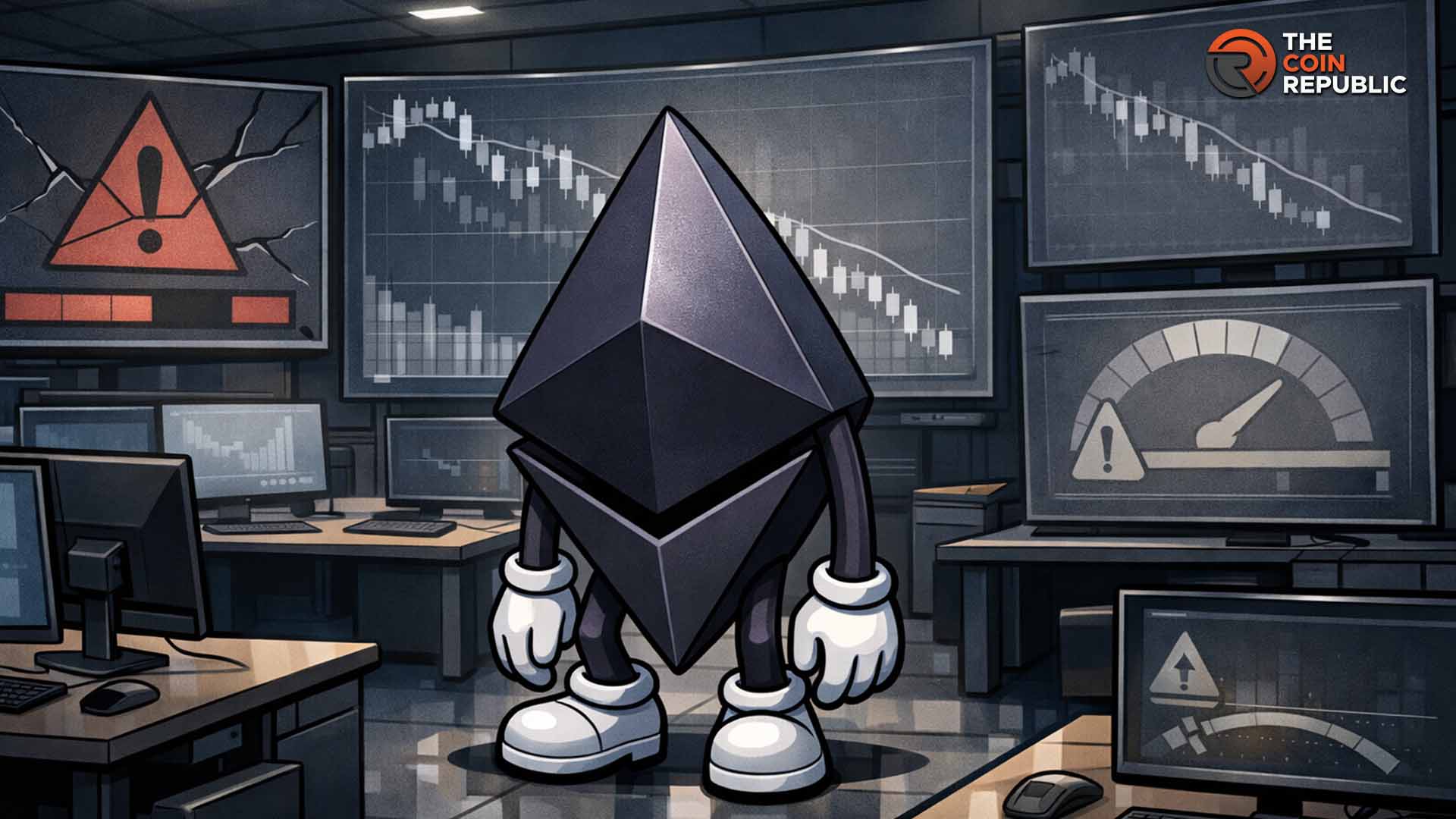
Ethereum price is showing signs of weakness, retreating over 5% and threatening to fall below $2,000, driven by cooling geopolitical optimism and declining open interest in derivatives markets. The decrease in Ethereum's open interest suggests investor indecisiveness and a potential bearish turn, especially as leveraged positions are unwinding and ETF flows have turned negative. Despite recent price weakness, the combination of low open interest and reduced liquidations could historically precede a market comeback, contingent on a substantial increase in spot demand, which is currently lacking according to ETF data. Bearish sentiment in Ethereum ETFs, with significant outflows in early April, indicates that broader macroeconomic conditions are likely to continue pressuring ETH price action and the overall crypto market.

New research suggests quantum computers could crack Bitcoin's cryptography with significantly fewer qubits than previously estimated, raising concerns about the security of existing BTC holdings. Unlike centralized systems that can implement post-quantum upgrades, Bitcoin's decentralized nature presents a significant challenge for adopting new cryptographic standards, potentially leading to forks or vulnerabilities. The 'harvest now, decrypt later' threat means that even if quantum computers are not yet capable of cracking current encryption, data collected today could be compromised in the future, highlighting the urgency for Bitcoin to adapt. While the quantum threat affects most internet infrastructure, Bitcoin's unique governance model makes its adaptation process more complex and potentially slower than that of traditional financial and governmental systems.

The Ethereum Foundation has completed its 70,000 ETH staking target, converting dormant treasury assets into a yield-generating position estimated to produce $3.9M-$5.4M annually. This strategic shift from potential ETH sales to staking aims to create a self-sustaining treasury for research and grants, reducing prior valuation pressure from foundation sell-offs. While the foundation has now staked a significant portion of its ETH, it still holds over 100,000 unstaked ETH, leaving open the possibility of further staking expansion or maintaining liquid reserves.

Algorand's significant price surge is directly linked to its citation in a Google research paper for post-quantum cryptography implementation, establishing a new narrative driver for the asset. The Google paper validates Algorand's technical advancements in quantum-resistant signatures, positioning it as a potential leader in a nascent but structurally important market theme. While Algorand shows strong momentum, the broader market remains cautious due to geopolitical factors, suggesting potential for profit-taking or volatility despite the positive catalyst. Render also saw gains, benefiting from AI demand and its adjacency to the post-quantum narrative, indicating a potential spillover effect within related tech sectors.

Cathie Wood's assertion that Bitcoin will no longer experience 85%+ drawdowns suggests a maturing asset class, potentially reducing perceived risk for institutional investors. The prediction of a $34,000 price bottom, representing a 72% drawdown, offers a specific target for market participants to monitor, contrasting with broader consensus ranges. Historical April price action data indicating a potential recovery during bearish phases, coupled with Wood's commentary, could signal a near-term bullish inflection point for BTC.
Signal context only. Validate with price action, liquidity, and risk limits before taking a position.
