
200+ crypto news providers in one place.

CoinFeather
200+ crypto news providers in one place.
Fast Read
Deep Dive
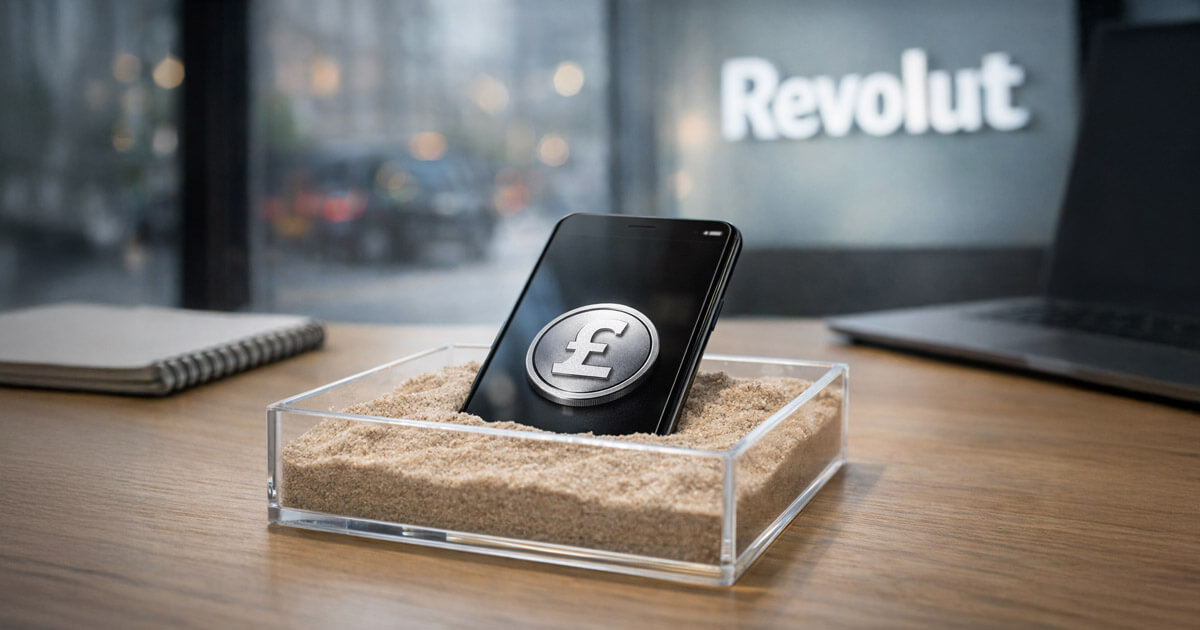
Revolut is preparing to trial a pound-backed stablecoin within the UK's regulated stablecoin sandbox, with testing anticipated this quarter. While this may appear as another fintech pilot, its significance lies in Revolut's established distribution network, boasting over 12 million UK users who engage with the app daily for various financial activities. The success of a stablecoin integrated into such a large user base hinges on product clarity and robust supervision to ensure user understanding.
The Financial Conduct Authority (FCA) selected four firms, including Revolut, for this trial, framing it as a real-world testing initiative with safeguards to inform policy development based on live user behavior. This supervised path is crucial for transitioning crypto from a concept to regulated payment methods in the UK.
For most users, payments involve maintaining a balance, transferring funds, and completing transactions. Integrating a stablecoin into Revolut transforms this sequence into a series of choices with distinct rights, risks, and operational mechanics. A stablecoin balance represents a claim on reserve assets, pegged 1:1 with the pound, promising users that £10 deposited can be withdrawn as £10. Supervisors focus on ensuring the durability of this promise through reserve quality, custody, redemption rights, and operational controls.
Transfers can occur internally within Revolut's ledger or externally onto public blockchains. The FCA's sandbox documentation describes Revolut's concept as a product customers can buy, hold, sell, and transfer both within the platform and across the broader crypto ecosystem, functioning as both a payment balance and a crypto-native instrument.
Spending can be facilitated in two ways: the app can convert stablecoins to fiat at the point of sale, using existing payment rails, or it can enable merchants to accept the stablecoin directly as the settlement unit. The former simplifies merchant adoption, while the latter offers potential for lower settlement costs, programmable payments, and streamlined cross-border transactions.
A primary risk when stablecoins move into consumer finance apps is user confusion, as they can feel like cash but carry different legal and prudential protections than bank deposits. Regulators emphasize distinct branding for stablecoins to prevent confusion with deposit protection, ensuring users understand the entity backing the balance and the recourse available in a failure scenario.
The Bank of England has suggested distinct branding for stablecoins to differentiate them from deposit protection. Governor Andrew Bailey has expressed a preference for tokenized deposits over stablecoins, as tokenized deposits remain within the traditional banking perimeter. Stablecoins, conversely, can operate outside bank balance sheets, necessitating clear definitions of
Source, catalyst, and sector overlap from the latest feed.
Bitcoin initially acted as a risk asset during US-Iran tensions, but historical data and new ETF structures suggest potential for a rebound if oil prices stabilize. BlackRock analysis shows Bitcoin historically outperforms gold and equities 60 days post-shock, with outcomes dependent on oil price trajectory and inflation fears.
Bitcoin surged over 6% to near $70k during U.S. market open, driven by U.S. hours liquidity and institutional flows via ETFs and CME futures, not liquidations. A sustained CME premium above 1% suggests ongoing institutional demand, while oil price volatility and ETF inflows remain key factors to watch.
Spot Bitcoin ETFs concentrate custody and operational control with a few custodians, creating single points of failure. This structure shifts authority from direct key control to institutional contracts, potentially creating a 'class system' of exposure holders versus owners. The significant scale of ETF assets ($54B+) makes these structural risks system-relevant.
US crypto investment products experienced five consecutive weeks of outflows totaling $4 billion, driven by regulatory uncertainty and a desire for liquidity. Meanwhile, Europe and Canada collectively saw inflows, indicating a regional divergence in risk appetite. This shift in marginal buying, particularly during lower volume periods, could influence price action and rally formation.
Bitcoin is facing pressure from geopolitical tensions surrounding Iran and potential oil supply disruptions, which could impact its price action as U.S. markets reopen. The key focus will be on U.S. spot Bitcoin ETF flows, which are expected to provide a significant test for the recent rebound. Traders are watching key price levels, with a sustained energy shock potentially pushing BTC lower, while strong ETF inflows could support a continued rally.
South Korea is overhauling its management of seized cryptocurrencies following security failures, including a 22 BTC loss and a $4.8 million theft due to a data leak. This reform includes a nationwide audit and stricter controls, alongside broader regulatory advancements integrating crypto into the formal financial system.
Turkey's ruling party proposed a 10% income tax on crypto gains and income, with the president able to adjust the rate between 0-20%. This follows significant crypto adoption in Turkey driven by economic conditions, with transaction volumes reaching $200 billion in a recent 12-month period.
JPMorgan forecasts a U.S. crypto market recovery in H2 2026 if the Clarity Act is approved by mid-year. The bill aims to end 'regulation by enforcement' and clarify SEC-CFTC jurisdiction, potentially easing compliance and boosting institutional access.
UK politicians are increasingly calling for a ban on cryptocurrency political donations due to concerns over foreign interference and illicit finance. Advocacy groups and parliamentary committees support stricter regulations or outright bans, citing the opaque nature of crypto assets. Reform UK remains the primary party accepting crypto donations.
Banking lobbyists have stalled the U.S. Senate's Digital Asset Market Clarity Act by arguing stablecoin rewards threaten traditional lending. The OCC's interpretation of the GENIUS Act adds complexity, leaving the crypto industry at a crossroads regarding concessions on rewards versus the potential loss of the Clarity Act.
Solana's daily transactions hit 108.8 million, significantly outpacing rivals and reaching a 7-month high, indicating strong network adoption. Despite this, net inflows have halved since September, and SOL faces technical resistance around the 50-day SMA, suggesting a volatile outlook.
Transaction speed in crypto is a combination of platform processing and network confirmation, not just block time. Litecoin offers steadier transfers, Bitcoin is widely supported, and Ethereum confirms quickly but faces fee volatility. Users should consider predictability and platform support when choosing a network for payments.
Live Feed
Loading the broader stream in the same flow as the homepage feed.

Binance open interest has dropped 25% as traders deleverage due to macro and geopolitical risks, with leverage ratios falling below 0.15. Bitcoin shows resilience near $69,000 despite a cautious derivatives market, while spot ETFs see significant inflows.
Shibarium, the Shiba Inu layer-2 network, is experiencing wallet and explorer connectivity issues. The team attributes these problems to user-side RPC settings and explorer indexing delays, assuring users that assets remain secure and network operations are stable. Users are advised to clear wallet cache and re-add the network.

Vitalik Buterin has proposed new mechanisms like FOCIL and transaction encryption to combat centralization in Ethereum's block building and mitigate "toxic MEV." These efforts aim to prevent censorship and unfair profit extraction by dominant builders as Ethereum scales.

Northern Trust Asset Management has launched a tokenized share class for its Treasury Instruments Portfolio, marking its entry into the digital assets market. This move expands the tokenized U.S. Treasurys market, which now holds nearly $11 billion in assets on public blockchains.
Ripple Prime, formerly Hidden Road, is now live on the DTCC's NSCC directory, paving the way to move institutional post-trade volume to the XRP Ledger. This integration follows Ripple's $1.25 billion acquisition of Hidden Road and aims to leverage XRPL's efficiency for traditional finance.
Bitcoin reclaimed $69K driven by significant institutional buying, with MicroStrategy and ProCap Financial increasing their BTC holdings. Analysts suggest potential upside to $79K if resistance breaks, while a dip to $65K is possible if support fails.

Experts assess Iran's Bitcoin mining share as minimal (below 1%), suggesting geopolitical conflict will not materially impact global hashrate or network security. While Iranian crypto outflows surged 700% post-airstrikes, the market impact is deemed limited due to Iran's small mining footprint.
Bitcoin rallied to $70K as short-term holder selling pressure decreased to a two-week low amid geopolitical tensions. BTC futures open interest has declined 25%, indicating deleveraging, while spot markets show aggressive bidding. Attention is now on the $71,500 liquidity band.
Bitcoin surged to a two-week high near $70,000, recovering from weekend lows. The price action correlated with a broader market recovery in risk assets, driven by geopolitical developments and a shift in market sentiment regarding regional stability.
Palantir (PLTR) stock surged over 6% driven by increased demand for its AI and defense analytics amid heightened geopolitical tensions. The company's dual role as a defense contractor and AI innovator positions it to benefit from potential increases in government spending and defense contracts.

Bitcoin governance is facing a critical juncture with the mining of a block supporting BIP-110, a proposal to restrict non-monetary data. Critics warn of potential blockchain splits and a violation of neutrality principles, while proponents aim to preserve Bitcoin's monetary infrastructure.
Bitcoin price has recovered above $70,000, supported by increased derivatives volume and open interest. Short-term holders show reduced selling pressure, and key weekly support at $65,000 is holding, suggesting potential for further upside towards $75,000-$80,000.

HyperLiquid's HYPE token has gained 23.9% YTD, outperforming BTC and ETH, as its derivatives exchange volume exceeds $200B/month. The platform's non-custodial model and 24/7 trading, including synthetic equities, attract retail traders in bear markets. Despite a past governance controversy, the vault TVL has recovered to $380M.
Shiba Inu (SHIB) is testing a critical support level around $0.00000565 amidst a bearish weekly chart structure. A breakdown below this zone could lead to a significant drop towards $0.00000138, indicating potential downside risk.
Signal context only. Validate with price action, liquidity, and risk limits before taking a position.
