
200+ crypto news providers in one place.

CoinFeather
200+ crypto news providers in one place.

Quick market read from this story
US spot Bitcoin ETFs saw $1.4 billion in inflows over 5 days
Bitfinex analysts suggest ETF inflows may not translate to immediate spot market buying
ETF creation/redemption mechanics can cause a lag between demand and actual BTC purchases
This lag may explain Bitcoin's price stagnation despite significant ETF inflows.
Deep Dive
Despite recent significant inflows into U.S.-listed spot Bitcoin exchange-traded funds (ETFs), totaling $1.4 billion over five days, Bitcoin's spot price has remained relatively stagnant. Analysts at the cryptocurrency exchange Bitfinex propose that the mechanics of ETFs themselves might explain this discrepancy.
Bitfinex analysts explained that ETF inflows can be misinterpreted as immediate spot demand. The structure of ETFs often introduces a delay between when investors pour money into the ETF and when the fund managers actually purchase the underlying asset, in this case, Bitcoin. This lag can cause bullish pressure on prices to manifest later, leaving the spot price temporarily unaffected.
Spot Bitcoin ETFs, which debuted in the U.S. in January 2024 and have since attracted over $55 billion in cumulative inflows, are designed to track the value of Bitcoin. Shares of these ETFs are created and redeemed by specialized financial institutions known as authorized participants (APs). When ETF demand increases, its share price may trade above its net asset value. To bridge this gap, APs create new ETF shares, sell them to investors, and simultaneously acquire the underlying Bitcoin. However, APs can sometimes short ETF shares before acquiring the corresponding Bitcoin, leading to a situation where ETF demand rises even if actual Bitcoin purchases in the spot market are delayed until the next business day.
This delay means that the actual buying of Bitcoin in the spot market might not occur immediately when ETF inflows are reported. By the time these purchases do happen, they can be counterbalanced by other selling pressures in the market, potentially mitigating the upward price impact and keeping Bitcoin trading within a narrower range.
According to Bitfinex's analysts, this ETF structure likely accounts for the recent trend of high inflows coupled with subdued price action. "The result is that the ETF grows, but the actual BTC price doesn’t rise because there has been no buying in the spot market. This can make the BTC price feel ‘stuck’ or suppressed," the analysts stated.
While generally not causing significant market disruption, the analysts noted that in times of severe market dislocation, the gap between ETF demand and actual spot buying (or vice versa) could lead to brief periods of market mispricing.
Source, catalyst, and sector overlap from the latest feed.
Ray Dalio stated bitcoin lacks central bank support and faces quantum computing threats. On the day of Dalio's comments, gold dropped 3% while bitcoin fell less than 1%. Bitcoin has shown less volatility than gold during the recent geopolitical crisis. Dalio holds 1% of his portfolio in bitcoin for diversification.
Bitcoin failed to hold $70,000, now trading around $67,600. Ether and Solana experienced declines, with Solana being the worst weekly performer. Asian equities saw significant drops, with South Korean stocks at multi-year lows due to Middle East tensions. Market sentiment is cautious, awaiting clarity on the Iran situation and its impact on traditional markets and oil prices.
Ripple expands payments platform to offer end-to-end stablecoin infrastructure. New capabilities include managed custody, virtual account collections, and fiat-to-stablecoin settlement. Ripple's payments platform has processed over $100 billion in total volume. The expansion positions Ripple as a single provider for enterprise digital asset payments across 60 markets.
Polymarket has removed nuclear detonation prediction markets due to public outcry and scrutiny. Concerns about insider trading on war and military actions have intensified. Previous nuclear detonation markets had significant trading volume, with one contract showing a 19% implied chance in 2023. Regulators are considering rules to bar event contracts tied to war and other sensitive topics.
Bitcoin rebounds toward $70,000 driven by short-covering after geopolitical fears did not escalate. BTC ETFs attracted $1.45 billion in net inflows over the past five trading days. On-chain and derivatives data show improving spot demand but cautious positioning. Momentum indicators are recovering but remain below neutral levels, indicating hesitant market conviction.
Strategy Inc. acquired an additional 3,015 BTC for $204 million, increasing its total holdings to 720,737 BTC. 470 million XRP were deposited on Binance in the past week, raising concerns of potential sell-offs. Dogecoin ETFs have recorded zero net inflows since February 3rd, indicating a lack of investor demand.
Bitcoin shows resilience decoupling from traditional equities and gold despite US dollar strength. Robust institutional demand evident with $1.5 billion in Bitcoin ETF net inflows over 7 days. Concerns arise from potential miner liquidations and a shift in focus towards AI data centers. A definitive breakout above $75,000 is needed to confirm the end of the bear market.
XRPL adoption is growing with tokenized funds and stablecoins, but XRP price has not reflected this due to stablecoins handling most settlement. XRP demand for fees and reserves provides a baseline utility, but does not scale with transaction value. XRP's price upside hinges on becoming the primary liquidity bridge for market makers and institutions. Spot XRP ETFs have locked up over $1 billion, reducing XRP's free float and potentially tightening supply.
Dogecoin ETFs recorded $779K in inflows, breaking a month-long drought. DOGE price remains consolidated around $0.09, showing limited reaction to ETF inflows. XRP ETF products continue to attract significantly higher investor demand, with over $1.2 billion in cumulative inflows. The $779K inflow is the highest since early January but remains small in the broader ETF market.
Donald Trump met with Coinbase CEO Brian Armstrong. Trump criticized big banks for blocking crypto market structure legislation. He urged lawmakers to pass the GENIUS Act and CLARITY Act ASAP.
Ark Invest purchased approximately $4.1 million in Coinbase shares and $12 million in Robinhood shares. The purchases occurred as broader markets declined due to geopolitical tensions related to the US-Iran conflict. Coinbase shares fell 1.55% and Robinhood shares fell 3.44% during the trading session. Ark Invest has recently shown a pattern of buying and selling Coinbase shares, with significant purchases last month.
1.3 billion XRP tokens moved by whales in 48 hours. XRP's 30-day realized volatility reached its highest point since March 2025. Historical data suggests high volatility and whale accumulation precede significant price movements. Market analysts suggest XRP is entering a critical phase with potential for sharp gains or corrections.
Ray Dalio states Bitcoin cannot be compared to gold due to privacy and quantum computing risks. Dalio holds ~1% of his portfolio in Bitcoin for diversification, not conviction. Central banks hold significantly more gold than Bitcoin's representation in reserves. Bitcoin's correlation with high-beta tech stocks disqualifies it as a reserve asset for Dalio.
Binance aims to secure five additional operational licenses in Asia by the end of 2026. The APAC region leads global crypto ownership with approximately 535 million adults. Binance already holds licenses in Australia, India, Indonesia, Japan, New Zealand, and Thailand. The exchange is finalizing its acquisition of South Korea's Gopax, adding to its licensed roster.
Live Feed
Loading the broader stream in the same flow as the homepage feed.

CFTC to authorize true crypto perpetual futures on U.S. exchanges within one month. Move aims to bring offshore liquidity and trading volume back to domestic exchanges. New framework will support contracts with no expiration date, differing from existing U.S. products. Effort is part of a coordinated interagency initiative called "Project Crypto" with the SEC.

SANAE token, a Solana-based meme coin, experienced a significant price drop of 75%. The decline followed a denial of any connection by Japan's Prime Minister, Sanae Takaichi. The token's market cap fell from nearly $30 million to $6 million. The meme coin was launched by a political YouTube channel aiming to modernize democracy with Web3 technology.
Bitcoin price holds near $68,200 amid global market volatility. South Korea's stock market experienced a significant crash, down over 10% in a single session. Geopolitical tensions in the Middle East and rising oil prices contribute to market uncertainty. BlackRock's Bitcoin ETF saw inflows of approximately $264 million in the past 24 hours.
22 of 36 top AI models favored Bitcoin over fiat in simulated economic tests No AI models selected fiat as their preferred currency AI models evaluated Bitcoin's properties for store of value, payments, and settlement efficiency
XRP experienced a 45% price drop in the past month, but network activity increased by 30%. Three AI models project XRP prices ranging from $1.50-$2 (utility-driven), $3-$5 (cyclical growth), to potential double-digit figures (liquidity shock scenario). Future price action depends on institutional adoption, broader market cycles, and XRP Ledger utility growth. Short-term price movements are heavily influenced by market sentiment, while long-term trends align with utility and adoption.
472 million XRP, valued at $652 million, moved to Binance, marking record February inflows. XRP is exhibiting resilience with higher highs and higher lows despite macro headwinds. Analysts suggest XRP is at a liquidity crossroads, facing potential volatility due to exchange inflows and macro risks. XRP transactions are confirmed immutable by Ripple CTO.

Circle minted $1 billion in USDC on Solana in hours. Total 2026 USDC issuance on Solana reaches $23.75 billion. Minting fuels liquidity for trading, DeFi, and new token launches on Solana. Surge viewed as significant 'dry powder' for market deployment.
Ethereum validator queue reaches 3.4 million ETH, a significant increase from 904,000 ETH in early January. New validators face an estimated 60-day wait to activate, indicating strong demand for staking. This surge suggests investors are choosing to stake ETH for yield rather than sell in current market conditions.

Tether's US stablecoin (USAT) passed its first independent reserve check by Deloitte. Reserves for USAT were $17.6 million against $17.5 million in circulation, a 100.57% backing ratio. Deloitte's attestation is for USAT reserves only, not Tether's broader operations. USAT is positioned as a regulated competitor to USDC in the US institutional market.

Upbit has listed the EDGE token. Trading pairs include KRW, BTC, and USDT. EDGE is an on-chain trading platform aggregator.

Binance plans to secure five additional regulatory licenses in Asia this year. Asia-Pacific region saw a 69% year-over-year increase in crypto transaction volume, reaching $2.36 trillion. Binance's strategy involves hyperlocalization to adapt operations to local regulatory standards. Seven Asian nations are among the top 10 in Chainalysis' Global Crypto Adoption Index.

Korean stock markets (Kospi, Kosdaq) dropped over 10%, triggering circuit breakers due to Middle East conflict. Global stock markets experienced significant losses, with Japan's Nikkei down nearly 4% and Hong Kong's Hang Seng down 3%. Crude oil prices surged, with Brent up 14% and WTI up 12%, impacting oil-importing nations like South Korea. Crypto market capitalization saw a minor dip of 0.5% despite the broader geopolitical shock.
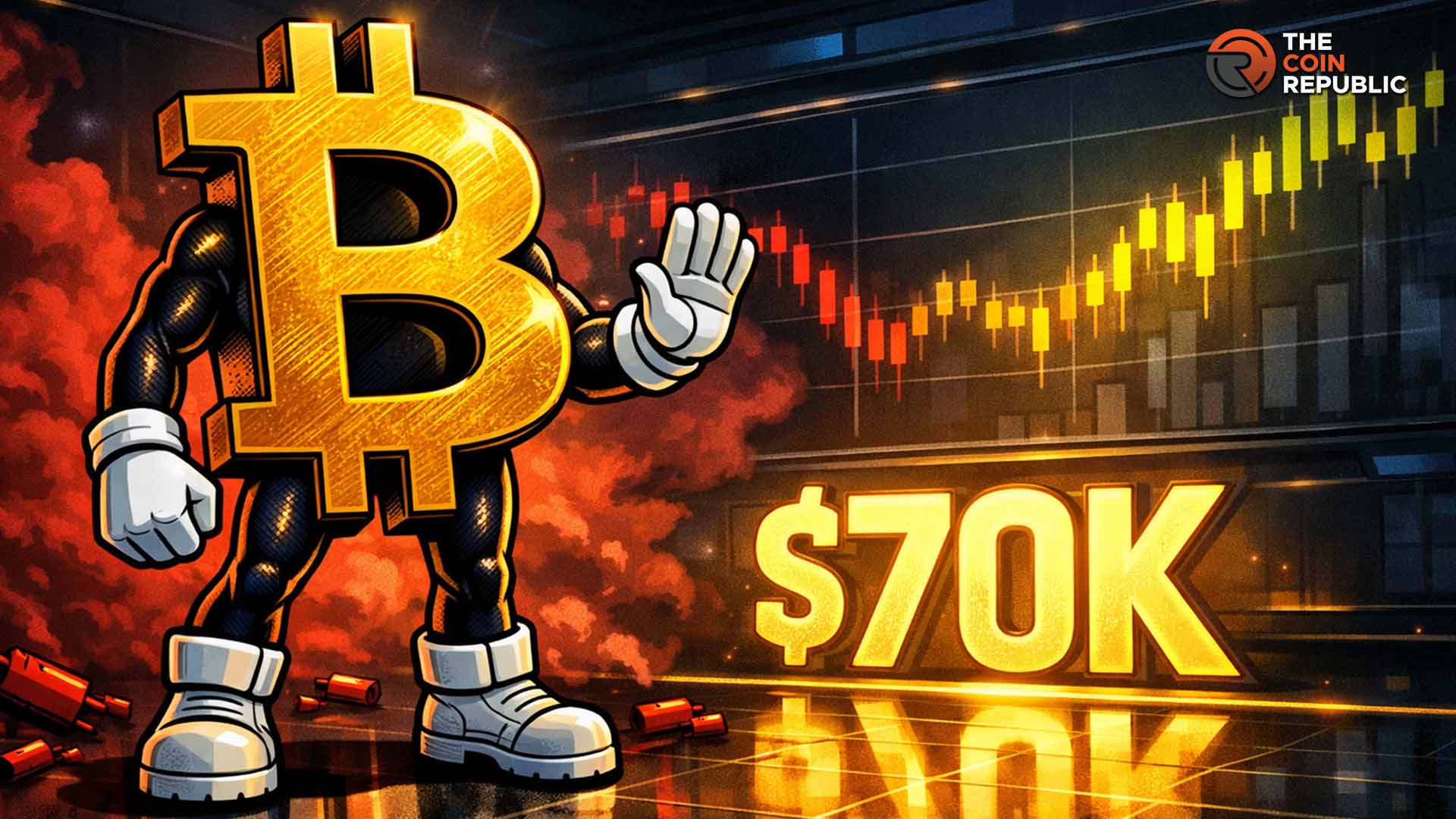
Selling pressure on Bitcoin has subsided as BTC approaches $70,000 after a drop to $59,000. Analysts at 10x Research suggest the worst phase of selling may be over, citing stable price action despite negative news. Bollinger Bands are tightening, indicating potential for a larger move, but the long-term trend remains bearish due to macro factors. Derivatives market funding rates and potential short squeezes are identified as key drivers of recent price stabilization.
Signal context only. Validate with price action, liquidity, and risk limits before taking a position.
