
200+ crypto news providers in one place.

CoinFeather
200+ crypto news providers in one place.
Quick market read from this story
Ethereum validator queue reaches 3.4 million ETH, a significant increase from 904,000 ETH in early January
New validators face an estimated 60-day wait to activate, indicating strong demand for staking
This surge suggests investors are choosing to stake ETH for yield rather than sell in current market conditions.
Deep Dive
Ethereum's validator entry queue has surged to approximately 3.4 million ETH, indicating significant interest from large investors, corporations, and crypto exchanges in staking their assets rather than selling them amidst recent market volatility. This has resulted in one of the longest staking queues observed since Ethereum's transition to Proof of Stake, with new validators facing an estimated 60-day waiting period for activation. This represents a substantial increase from around 904,000 ETH in early January, highlighting a growing trend of investors locking up ETH to earn yield and participate in network security.
Source, catalyst, and sector overlap from the latest feed.
Bitcoin price holds near $68,200 amid global market volatility. South Korea's stock market experienced a significant crash, down over 10% in a single session. Geopolitical tensions in the Middle East and rising oil prices contribute to market uncertainty. BlackRock's Bitcoin ETF saw inflows of approximately $264 million in the past 24 hours.
Live Feed
Loading the broader stream in the same flow as the homepage feed.

Binance aims to secure five additional operational licenses in Asia by the end of 2026. The APAC region leads global crypto ownership with approximately 535 million adults. Binance already holds licenses in Australia, India, Indonesia, Japan, New Zealand, and Thailand. The exchange is finalizing its acquisition of South Korea's Gopax, adding to its licensed roster.

CFTC to authorize true crypto perpetual futures on U.S. exchanges within one month. Move aims to bring offshore liquidity and trading volume back to domestic exchanges. New framework will support contracts with no expiration date, differing from existing U.S. products. Effort is part of a coordinated interagency initiative called "Project Crypto" with the SEC.

SANAE token, a Solana-based meme coin, experienced a significant price drop of 75%. The decline followed a denial of any connection by Japan's Prime Minister, Sanae Takaichi. The token's market cap fell from nearly $30 million to $6 million. The meme coin was launched by a political YouTube channel aiming to modernize democracy with Web3 technology.
472 million XRP, valued at $652 million, moved to Binance, marking record February inflows. XRP is exhibiting resilience with higher highs and higher lows despite macro headwinds. Analysts suggest XRP is at a liquidity crossroads, facing potential volatility due to exchange inflows and macro risks. XRP transactions are confirmed immutable by Ripple CTO.

Tether's US stablecoin (USAT) passed its first independent reserve check by Deloitte. Reserves for USAT were $17.6 million against $17.5 million in circulation, a 100.57% backing ratio. Deloitte's attestation is for USAT reserves only, not Tether's broader operations. USAT is positioned as a regulated competitor to USDC in the US institutional market.

US spot Bitcoin ETFs saw $1.4 billion in inflows over 5 days. Bitfinex analysts suggest ETF inflows may not translate to immediate spot market buying. ETF creation/redemption mechanics can cause a lag between demand and actual BTC purchases. This lag may explain Bitcoin's price stagnation despite significant ETF inflows.

Binance plans to secure five additional regulatory licenses in Asia this year. Asia-Pacific region saw a 69% year-over-year increase in crypto transaction volume, reaching $2.36 trillion. Binance's strategy involves hyperlocalization to adapt operations to local regulatory standards. Seven Asian nations are among the top 10 in Chainalysis' Global Crypto Adoption Index.

Korean stock markets (Kospi, Kosdaq) dropped over 10%, triggering circuit breakers due to Middle East conflict. Global stock markets experienced significant losses, with Japan's Nikkei down nearly 4% and Hong Kong's Hang Seng down 3%. Crude oil prices surged, with Brent up 14% and WTI up 12%, impacting oil-importing nations like South Korea. Crypto market capitalization saw a minor dip of 0.5% despite the broader geopolitical shock.
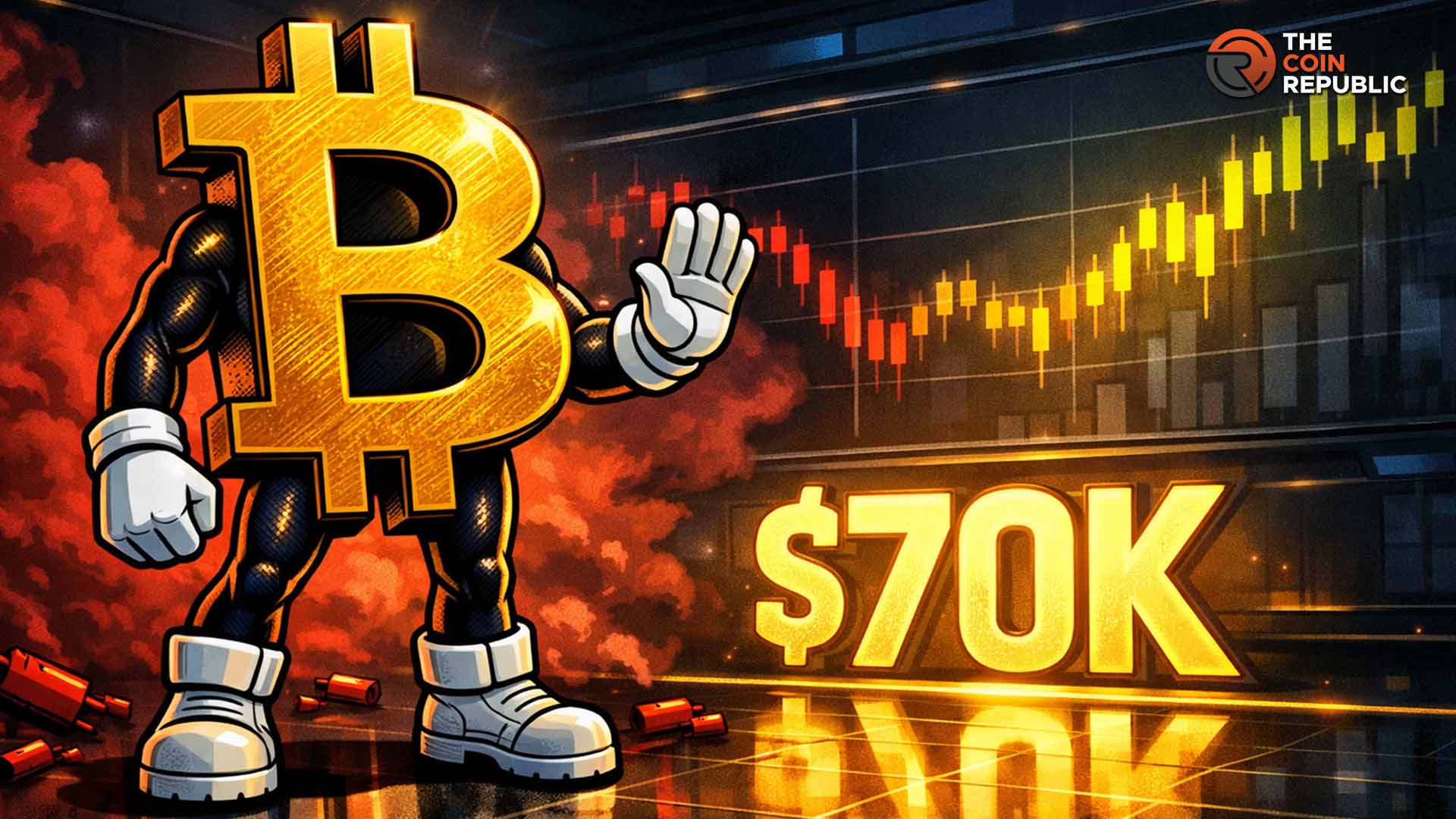
Selling pressure on Bitcoin has subsided as BTC approaches $70,000 after a drop to $59,000. Analysts at 10x Research suggest the worst phase of selling may be over, citing stable price action despite negative news. Bollinger Bands are tightening, indicating potential for a larger move, but the long-term trend remains bearish due to macro factors. Derivatives market funding rates and potential short squeezes are identified as key drivers of recent price stabilization.
Former LAPD officer convicted of kidnapping and stealing $350K in Bitcoin. Conviction stems from a 2024 home invasion where victim was threatened with death. Case highlights the increasing trend of violent 'wrench attacks' targeting crypto holders. CertiK reported a 75% increase in wrench attacks globally in 2025.

Indiana governor signed House Bill 1042 into law, allowing crypto in retirement plans. State retirement and savings plans must offer crypto investment options by July 2027. Bill also bars public agencies from enforcing rules against crypto payments, self-custody, or mining. Clarifies non-custodial transfers do not require a money transmitter license.
Signal context only. Validate with price action, liquidity, and risk limits before taking a position.
No explicit catalyst tagged.
22 of 36 top AI models favored Bitcoin over fiat in simulated economic tests No AI models selected fiat as their preferred currency AI models evaluated Bitcoin's properties for store of value, payments, and settlement efficiency
