
200+ crypto news providers in one place.

CoinFeather
200+ crypto news providers in one place.
Quick market read from this story
472 million XRP, valued at $652 million, moved to Binance, marking record February inflows
XRP is exhibiting resilience with higher highs and higher lows despite macro headwinds
Analysts suggest XRP is at a liquidity crossroads, facing potential volatility due to exchange inflows and macro risks
XRP transactions are confirmed immutable by Ripple CTO.
Deep Dive
Market analyst Kaan Kaya suggests XRP is entering a critical phase influenced by global macro pressures rather than its own fundamentals. He describes the current market as a "distribution vs. repositioning" battle, warning that shifting liquidity conditions could lead to sharp volatility. The XRP community should prepare for intensified price swings as the market determines capital flow.
Escalating geopolitical tensions involving the U.S., Israel, and Iran have introduced volatility into global markets, impacting risk assets. Crypto, often seen as a proxy for macro sentiment, has felt this pressure. On-chain data indicates a shift among XRP holders towards defensive positioning amid increasing uncertainty.
Despite macro headwinds, XRP has shown resilience, maintaining a pattern of higher highs and higher lows, suggesting underlying strength even with ongoing geopolitical risks.
A significant development is the sharp increase in exchange inflows, with approximately 472 million XRP, valued at around $652 million, moved to Binance. This represents the largest February inflow trend on record.
While exchange inflows do not guarantee an immediate sell-off, they increase the likelihood of discretionary selling by placing large volumes of XRP on trading platforms. In fragile macro conditions, this liquidity on exchanges becomes actionable supply, potentially amplifying volatility.
Market analyst Darkfost noted that this surge occurred just after traditional equity markets closed, a period when crypto liquidity typically thins and retail traders dominate. During these off-hours, even minor macro news can cause significant price swings, as digital assets often act as an initial pressure valve for risk-off sentiment.
XRP's short-term outlook is being shaped by liquidity dynamics. In stable markets, abundant liquidity tightens spreads and aids price discovery. However, in a risk-off environment, it can accelerate downside movements if sentiment deteriorates.
XRP is currently holding the $1.35 zone, according to CoinCodex data. However, elevated exchange balances amidst ongoing macro uncertainty suggest a sideways or downward price movement may be the path of least resistance.
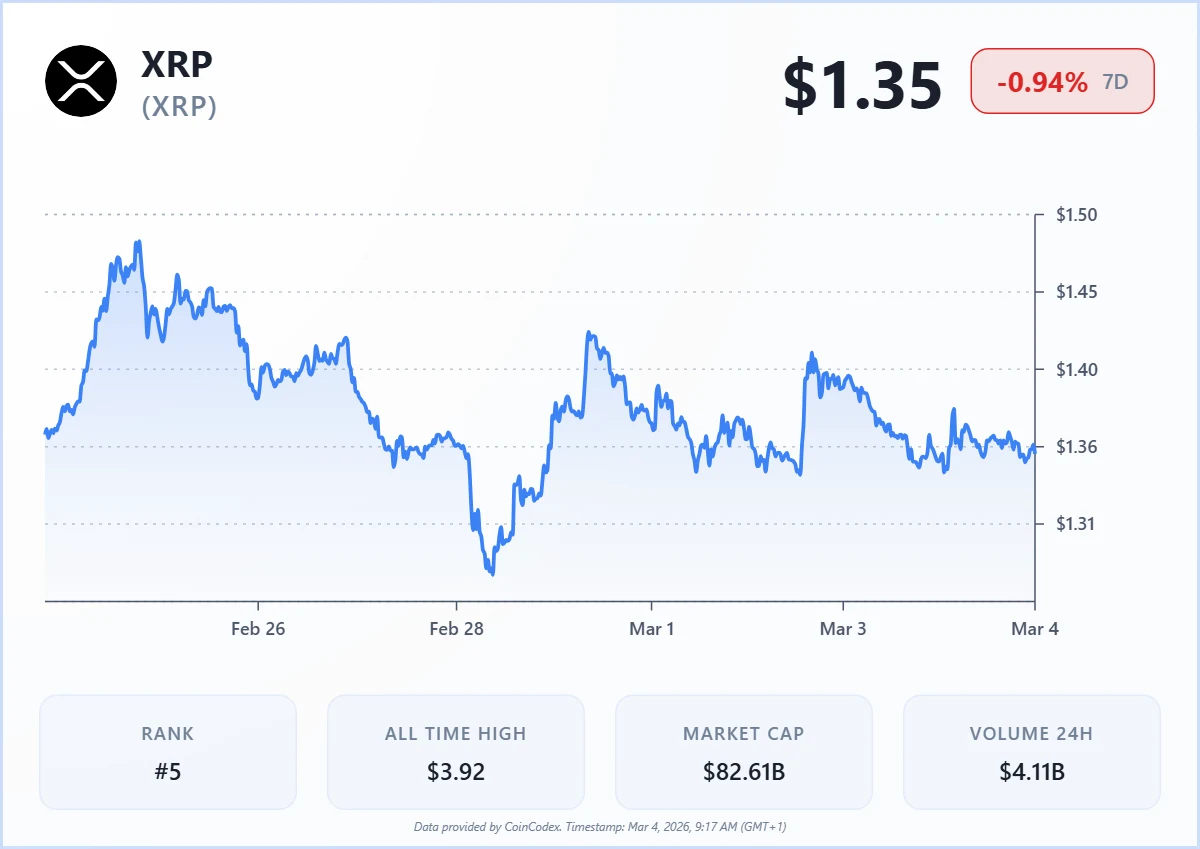
While not a confirmed distribution event, this setup warrants caution. If inflows indicate repositioning, price action may remain volatile. If they reflect broader de-risking by major holders, XRP could face a temporary liquidity overhang.
In an unstable global market, the location of liquidity is as crucial as its volume. XRP is currently at the center of this market test. Separately, Ripple CTO has confirmed that all XRP transactions are immutable and cannot be blocked by any party.
In the current macro-driven market, XRP's performance may depend more on global risk sentiment than its internal ecosystem. The recent influx of 472 million tokens to Binance has not yet triggered a sell-off but has positioned the market for potentially faster, more reactive price swings. With XRP near $1.35, the market is at a critical inflection point.
If geopolitical tensions ease, this liquidity could drive sharp rebounds and aggressive positioning. Conversely, increasing uncertainty might amplify downside momentum as holders seek to protect capital. XRP is now acting as a macro-sensitive asset, and upcoming sessions will indicate whether this is strategic repositioning for future opportunities or the initial phase of broader distribution.
Source, catalyst, and sector overlap from the latest feed.
1.3 billion XRP tokens moved by whales in 48 hours. XRP's 30-day realized volatility reached its highest point since March 2025. Historical data suggests high volatility and whale accumulation precede significant price movements. Market analysts suggest XRP is entering a critical phase with potential for sharp gains or corrections.
Ripple Payments expanded to over 60 markets with new stablecoin and fiat collection, custody, and liquidity tools. The platform now supports unified collections and advanced liquidity features, aiming to reduce vendor complexity for businesses. Over $100 billion in volume has been processed, with more than 75 licenses globally, targeting financial institutions and fintechs. XRP price action remains volatile, with analysts suggesting a potential fractal pattern indicating a move higher later in March.
Shiba Inu open interest increased by 15.74% to $61.62 million in 24 hours. Futures volume surged 36% to $179 million, indicating heightened trader activity. Spot volume rose 73.94% to $36.89 million, with a slight sell-side imbalance. SHIB price is trading sideways at $0.00000550, down 2.66% in the last 24 hours.
Shiba Inu futures netflow surged 1,724% in the past hour. Derivatives trading volume for SHIB increased by 71%. SHIB price continues a six-day decline, down 3.68% in 24 hours. Increased derivatives activity contrasts with weakening spot prices, indicating market uncertainty.
S&P 500 erases 2026 gains in post-open selloff as Iran war fears explode. Oil tops $80, Hormuz chokes supply: buy the dip or brace for worse?
Donald Trump met with Coinbase CEO Brian Armstrong. Trump criticized big banks for blocking crypto market structure legislation. He urged lawmakers to pass the GENIUS Act and CLARITY Act ASAP.
Ark Invest purchased approximately $4.1 million in Coinbase shares and $12 million in Robinhood shares. The purchases occurred as broader markets declined due to geopolitical tensions related to the US-Iran conflict. Coinbase shares fell 1.55% and Robinhood shares fell 3.44% during the trading session. Ark Invest has recently shown a pattern of buying and selling Coinbase shares, with significant purchases last month.
Ray Dalio states Bitcoin cannot be compared to gold due to privacy and quantum computing risks. Dalio holds ~1% of his portfolio in Bitcoin for diversification, not conviction. Central banks hold significantly more gold than Bitcoin's representation in reserves. Bitcoin's correlation with high-beta tech stocks disqualifies it as a reserve asset for Dalio.
Binance aims to secure five additional operational licenses in Asia by the end of 2026. The APAC region leads global crypto ownership with approximately 535 million adults. Binance already holds licenses in Australia, India, Indonesia, Japan, New Zealand, and Thailand. The exchange is finalizing its acquisition of South Korea's Gopax, adding to its licensed roster.
Live Feed
Loading the broader stream in the same flow as the homepage feed.

Ray Dalio stated bitcoin lacks central bank support and faces quantum computing threats. On the day of Dalio's comments, gold dropped 3% while bitcoin fell less than 1%. Bitcoin has shown less volatility than gold during the recent geopolitical crisis. Dalio holds 1% of his portfolio in bitcoin for diversification.
CFTC to authorize true crypto perpetual futures on U.S. exchanges within one month. Move aims to bring offshore liquidity and trading volume back to domestic exchanges. New framework will support contracts with no expiration date, differing from existing U.S. products. Effort is part of a coordinated interagency initiative called "Project Crypto" with the SEC.

SANAE token, a Solana-based meme coin, experienced a significant price drop of 75%. The decline followed a denial of any connection by Japan's Prime Minister, Sanae Takaichi. The token's market cap fell from nearly $30 million to $6 million. The meme coin was launched by a political YouTube channel aiming to modernize democracy with Web3 technology.
Bitcoin price holds near $68,200 amid global market volatility. South Korea's stock market experienced a significant crash, down over 10% in a single session. Geopolitical tensions in the Middle East and rising oil prices contribute to market uncertainty. BlackRock's Bitcoin ETF saw inflows of approximately $264 million in the past 24 hours.
22 of 36 top AI models favored Bitcoin over fiat in simulated economic tests No AI models selected fiat as their preferred currency AI models evaluated Bitcoin's properties for store of value, payments, and settlement efficiency
XRP experienced a 45% price drop in the past month, but network activity increased by 30%. Three AI models project XRP prices ranging from $1.50-$2 (utility-driven), $3-$5 (cyclical growth), to potential double-digit figures (liquidity shock scenario). Future price action depends on institutional adoption, broader market cycles, and XRP Ledger utility growth. Short-term price movements are heavily influenced by market sentiment, while long-term trends align with utility and adoption.
Circle minted $1 billion in USDC on Solana in hours. Total 2026 USDC issuance on Solana reaches $23.75 billion. Minting fuels liquidity for trading, DeFi, and new token launches on Solana. Surge viewed as significant 'dry powder' for market deployment.
Ethereum validator queue reaches 3.4 million ETH, a significant increase from 904,000 ETH in early January. New validators face an estimated 60-day wait to activate, indicating strong demand for staking. This surge suggests investors are choosing to stake ETH for yield rather than sell in current market conditions.

Tether's US stablecoin (USAT) passed its first independent reserve check by Deloitte. Reserves for USAT were $17.6 million against $17.5 million in circulation, a 100.57% backing ratio. Deloitte's attestation is for USAT reserves only, not Tether's broader operations. USAT is positioned as a regulated competitor to USDC in the US institutional market.
Upbit has listed the EDGE token. Trading pairs include KRW, BTC, and USDT. EDGE is an on-chain trading platform aggregator.

US spot Bitcoin ETFs saw $1.4 billion in inflows over 5 days. Bitfinex analysts suggest ETF inflows may not translate to immediate spot market buying. ETF creation/redemption mechanics can cause a lag between demand and actual BTC purchases. This lag may explain Bitcoin's price stagnation despite significant ETF inflows.

Binance plans to secure five additional regulatory licenses in Asia this year. Asia-Pacific region saw a 69% year-over-year increase in crypto transaction volume, reaching $2.36 trillion. Binance's strategy involves hyperlocalization to adapt operations to local regulatory standards. Seven Asian nations are among the top 10 in Chainalysis' Global Crypto Adoption Index.

Korean stock markets (Kospi, Kosdaq) dropped over 10%, triggering circuit breakers due to Middle East conflict. Global stock markets experienced significant losses, with Japan's Nikkei down nearly 4% and Hong Kong's Hang Seng down 3%. Crude oil prices surged, with Brent up 14% and WTI up 12%, impacting oil-importing nations like South Korea. Crypto market capitalization saw a minor dip of 0.5% despite the broader geopolitical shock.
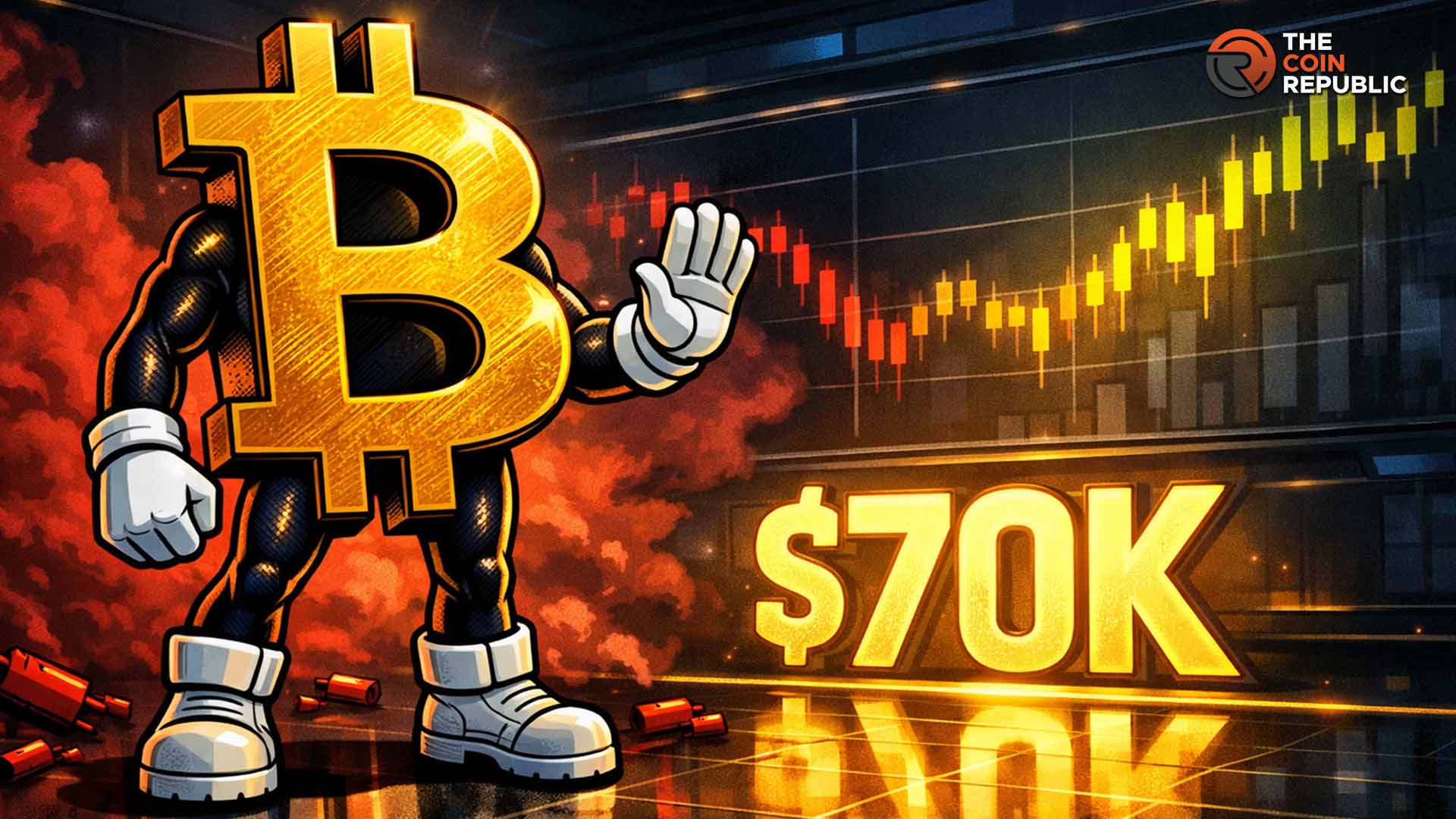
Selling pressure on Bitcoin has subsided as BTC approaches $70,000 after a drop to $59,000. Analysts at 10x Research suggest the worst phase of selling may be over, citing stable price action despite negative news. Bollinger Bands are tightening, indicating potential for a larger move, but the long-term trend remains bearish due to macro factors. Derivatives market funding rates and potential short squeezes are identified as key drivers of recent price stabilization.
Signal context only. Validate with price action, liquidity, and risk limits before taking a position.
