
Navigating Crypto News

CoinFeather
Navigating Crypto News
Source, catalyst, and sector overlap from the latest feed.
XRP's monthly chart indicates a bearish trend with the lower Bollinger Band at $0.6161, suggesting a potential 50% downside risk if the $1.30 support fails. The prolonged six-month bearish streak and price trading significantly below the long-term trend reference (middle Bollinger Band) confirm a dominant bearish cycle for XRP. Despite narratives around the Clarity Act, current chart dynamics suggest investors are not anticipating immediate gains and are preparing for a potential drift towards historical accumulation zones around $0.61. Failure to reclaim the $1.50 level in the coming weeks would solidify the $0.61 retest scenario, implying a substantial downside repricing event for XRP.
Live Feed
Loading the broader stream in the same flow as the homepage feed.

New US banking capital rules signal a regulatory admission that unrealized losses, as seen with SVB, remain a critical risk to bank stability, potentially influencing market confidence in regional banks. Despite broader capital requirement reductions, the continued mandate for large regional banks to account for unrealized losses suggests regulators perceive this as a persistent vulnerability, impacting their risk assessment and capital allocation. The explicit carve-out for regional banks regarding unrealized losses, directly linked to the SVB collapse, implies that while overall deregulation is occurring, specific lessons from past crises are being retained, creating a bifurcated regulatory environment.

The post Altcoins are Dying, But Not All of Them: Easter Weekend Crypto Watchlist appeared first on Coinpedia Fintech News The Crypto Fear & Greed Index is sitting at 11. The Altcoin Season Index at 38, firmly in Bitcoin Season territory. And the crypto community is more divided than it has been all year. On one side: “Most altcoins will die,” wrote Altcoin Daily today, a sentiment also echoed by Ash Crypto, who put it …

Tether's aggressive push for a $500 billion valuation in its latest fundraising round faces investor skepticism, potentially leading to a delay and signaling current market appetite for such high valuations. The outcome of Tether's fundraising efforts, particularly concerning investor demand at its target valuation, could impact market sentiment towards stablecoins and the broader crypto financial infrastructure. Tether's pursuit of a $500 billion valuation, significantly higher than its current stablecoin market cap, highlights its ambition to expand beyond stablecoins into diverse sectors like AI and commodities, though execution remains a key question. The simultaneous news of Tether hiring KPMG for its first full USDt audit suggests a move towards greater transparency, which could bolster confidence if the fundraising faces challenges.

Tether's aggressive push for a $500 billion valuation, with a strict 14-day investor deadline, signals a significant strategic pivot beyond stablecoin issuance, aiming for a valuation exceeding major traditional banks. The outcome of this funding round is critical for Tether's future growth trajectory and its ability to compete with emerging stablecoin players and traditional finance giants, with a full audit underway to bolster transparency. Despite its market leadership in stablecoins, the proposed valuation is substantially higher than its current market cap, indicating a strong focus on future expansion and potential diversification strategies.

Nevada's extension of the ban on Kalshi's sports prediction markets reinforces regulatory scrutiny on prediction platforms, potentially impacting similar entities operating in or seeking to operate in the US. The judge's ruling that Kalshi's sports contracts are indistinguishable from gambling highlights a key legal challenge for prediction markets, suggesting a continued battle with state regulators over classification and oversight. The ongoing legal disputes between prediction market providers like Kalshi and state regulators, alongside the CFTC's intervention, indicate a significant regulatory battleground that could shape the future of derivatives and event-based markets.

Chainlink completed its routine quarterly token unlock, releasing 19 million LINK tokens valued at approximately $165 million, with a significant portion directed to Binance, indicating potential short-term selling pressure. Despite the unlock and transfer of tokens to exchanges, LINK's price has remained relatively stable, suggesting that the market may have already priced in this regular event or that underlying demand is absorbing the supply. The simultaneous increase in large holders (whales) accumulating LINK, alongside the quarterly unlock, presents a mixed signal, potentially indicating a strategic accumulation phase by larger players despite increased circulating supply.
An ETF analyst predicts Bitcoin ETFs will surpass gold ETFs in AUM, citing Bitcoin's broader utility as a store of value, diversifier, and growth asset compared to gold's singular use case. The divergence in ETF flows, with Bitcoin ETFs attracting inflows while gold ETFs see outflows, suggests a potential capital rotation favoring digital assets over traditional safe havens. Despite recent price declines for both assets, the narrative of Bitcoin ETFs offering superior portfolio integration and growth potential could drive future investor demand and asset appreciation.

Google's research highlights a theoretical quantum computing threat to Bitcoin's private key security, estimating a nine-minute window to derive a key from a public key once it appears in the mempool. The primary risk identified is to the 6.9 million BTC in wallets with permanently exposed public keys, which are vulnerable to future quantum attacks without the time constraint of mempool transactions. While a functional quantum computer capable of this attack does not yet exist, the development underscores the long-term need for post-quantum cryptography in Bitcoin, a transition that has not yet begun. The Taproot upgrade, intended to enhance privacy, inadvertently increased the attack surface by making public keys visible on-chain by default, exacerbating the quantum threat for future transactions.

Gold and silver futures on Binance have rapidly gained traction, achieving fourth and fifth place in trading volume, indicating a significant shift in trader interest away from traditional crypto assets like Bitcoin. The surge in gold and silver futures volume, surpassing $130 billion by March 2026, suggests a growing demand for perceived safe-haven assets amidst geopolitical and economic uncertainties, potentially impacting crypto market liquidity. The increasing adoption of metal futures on Binance, leveraging features like 24/7 access and high leverage, highlights a convergence of traditional finance and crypto markets, potentially attracting new capital flows. Despite Bitcoin's recent underperformance relative to gold and silver, analysts suggest the long-term positive correlation between gold and Bitcoin remains intact due to their shared scarcity, implying a potential future convergence.

The Ethereum Foundation's near-completion of its 70,000 ETH staking goal signifies a strategic shift towards yield generation for ecosystem funding, potentially reducing reliance on token sales and signaling confidence in ETH's long-term value. The EF's increased participation in staking and DeFi, as outlined in their treasury policy, suggests a growing integration with the core Ethereum ecosystem's financial infrastructure, aiming to support development and grants through generated yield. Vitalik Buterin's caution regarding the Ethereum Foundation's staking potentially forcing positions in contentious hard forks highlights a subtle centralization risk that the EF is actively exploring mitigation strategies for, a point of interest for network governance discussions.

Charles Schwab's upcoming spot trading for Bitcoin and Ethereum signifies a major traditional finance institution embracing digital assets, potentially increasing accessibility and legitimacy for retail investors. The planned rollout, starting with a limited release before broader expansion, suggests a cautious approach by Schwab, indicating a focus on regulatory compliance and operational readiness. While the news is positive for broader crypto adoption, the direct market impact on BTC and ETH prices in the short term may be muted as the offering is still pending and likely to be phased in.

FIFA's partnership with ADI Predictstreet for the 2026 World Cup introduces a novel prediction market platform, potentially driving adoption for ADI Chain and its native token. The ADI token's recent surge to an all-time high, coinciding with the FIFA announcement, suggests positive market sentiment and speculative interest in the project's growth potential. While the partnership signals a significant step for fan engagement and blockchain integration in sports, the platform's unlaunched status and the broader regulatory scrutiny of prediction markets warrant a cautious outlook.
Signal context only. Validate with price action, liquidity, and risk limits before taking a position.
Quick market read from this story
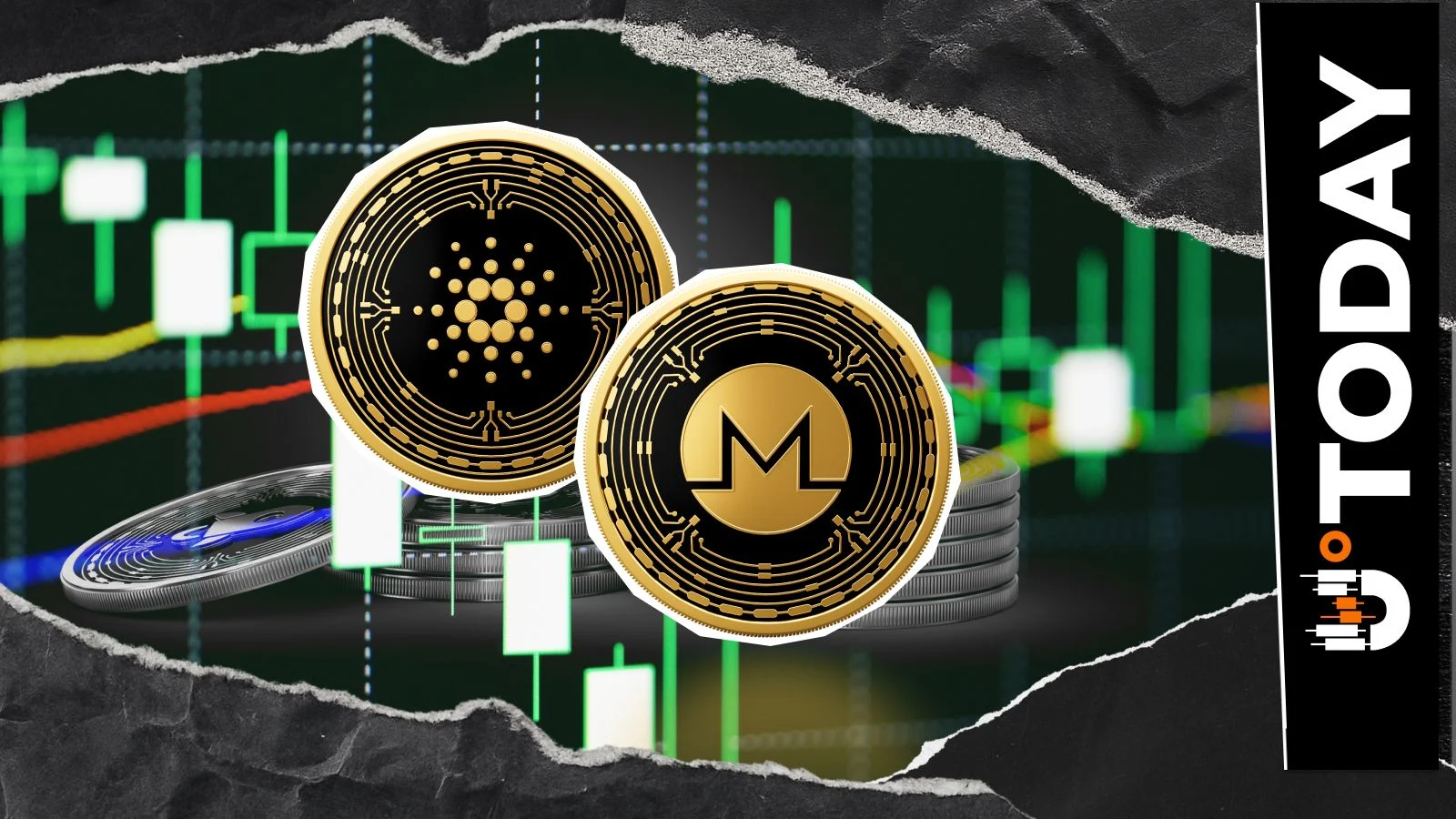
Monero (XMR) is making a move towards Cardano's market cap ranking, currently trailing by $2.5 billion, indicating a potential shift in relative market dominance if current trends persist.
Despite Monero's proximity, Cardano's market capitalization of $8.53 billion suggests a significant gap remains, making an immediate overtake unlikely without a substantial price surge for XMR or a significant drop for ADA.
Both Cardano and Monero experienced price declines in the last 24 hours, mirroring a broader crypto market downturn, which tempers immediate bullish sentiment for either asset individually.
Cardano's recent integration on the Dune network, alongside metrics like total value locked and transaction volume, provides fundamental data points that could influence its long-term valuation independent of its market cap ranking.
Deep Dive
Cardano (ADA) currently holds the 13th position in cryptocurrency market capitalization, with Monero (XMR) closely trailing at 14th. Cardano has recently fallen from the top 10 and is facing competition for its current spot.
Monero needs to gain approximately $2.5 billion in market capitalization to overtake Cardano. Cardano's current market cap stands at $8.53 billion, while Monero's is $6 billion. This suggests Monero's chances of surpassing Cardano are slim unless Cardano experiences a significant market cap increase beyond $9 billion.
In recent news, Cardano has been integrated into the Dune network. Data from Dune shows the Cardano network has $135 million in total value locked across 33 protocols, with nearly 22,000 daily transactions, 38% of which involve smart contracts. The network also boasts $47.7 million in stablecoin supply, with USDC at $17.4 million, 21.7 billion ADA staked (approximately 59% of circulating supply), a Nakamoto Coefficient of 168, and 1.35 million active delegators.
The overall cryptocurrency market is experiencing a downturn, with total liquidations reaching $386 million in the last 24 hours. Cryptocurrencies have seen a general decline as investors reduce exposure to risk assets amid volatility in stock and commodity markets. At the time of reporting, Cardano was down 4.46% to $0.236, and Monero was down 3.26% to $326 over the past 24 hours. Traders are anticipating key economic data releases, including initial jobless claims and the March jobs report.
Increased exchange inflows of 160 billion SHIB signal significant sell pressure, potentially disrupting any nascent bullish momentum. Structural weakness in SHIB's price action, characterized by lower highs and lack of volume confirmation, suggests a bearish trend remains dominant. With exchange reserves growing and momentum indicators weak, the market appears to be in a distribution phase, favoring further declines or consolidation near lows.
