
200+ crypto news providers in one place.

CoinFeather
200+ crypto news providers in one place.
Fast Read
Deep Dive
According to CoinShares' latest Digital Asset Fund Flows Weekly Report, inflows into XRP-linked exchange-traded funds (ETFs) experienced a significant decrease of 45% in the week spanning February 23 to March 1. These inflows amounted to $1.9 million for the week.
This decline occurred within a broader market context where total inflows into crypto ETFs and similar investment products reached over $1.061 billion during the same period. XRP's weekly inflow represented a mere 0.18% of the total market activity. This marks a notable shift from previous weeks when XRP ETFs were among the leading products attracting capital.
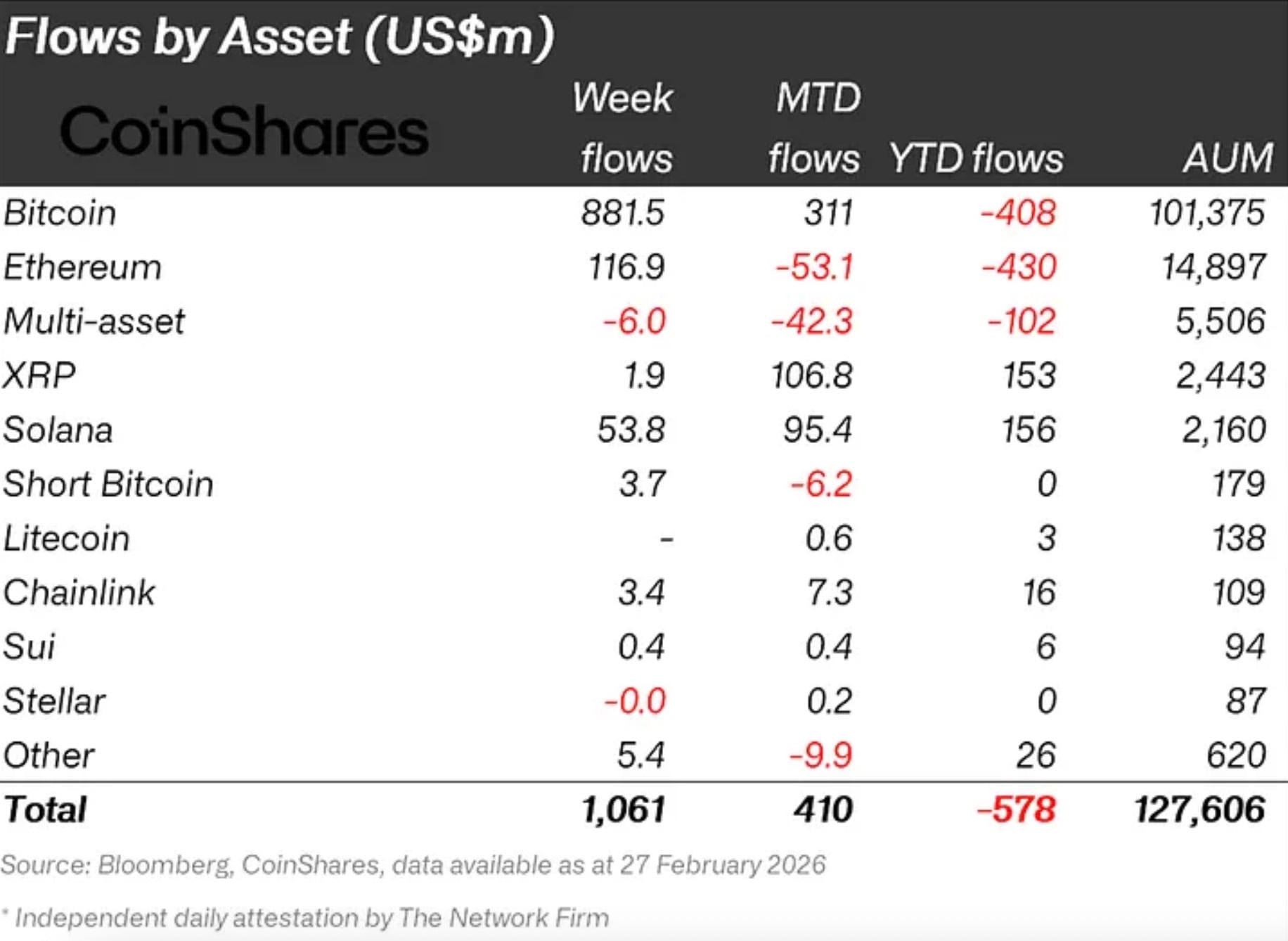
Despite the recent dip in weekly inflows, XRP ETFs have accumulated a substantial $153 million year-to-date. This positions XRP ETFs as the second-highest performers in terms of year-to-date inflows, trailing only Solana, which has attracted $156 million.
Furthermore, XRP's month-to-date inflows stand at $106.8 million, making it the highest among comparable products. The report suggests that the recent slowdown in weekly inflows may not indicate underlying structural issues for XRP but rather a natural progression where demand has been met for the time being.
The article posits that XRP's accelerated capital attraction in the preceding month may have led to the fulfillment of immediate market demand. As other cryptocurrencies began to gain traction and attract capital, the incremental investment available for XRP decreased, resulting in the lower inflow figures for the final week of February.
Crucially, XRP ETFs did not experience outflows, which is viewed as a more significant indicator of investor sentiment than a slowdown in new inflows. The performance of these investment products in March will be closely watched to see if demand for XRP ETFs will resume.
The price action of XRP is also a key factor. The asset has been trading sideways, consolidating near the $1.40 level without a decisive breakout. This range-bound movement suggests that XRP's direction will likely be influenced by broader market trends or specific narrative developments.
The CoinShares report also highlighted the significant role of the United States in the crypto ETF market. The US led weekly crypto ETF inflows with $958.2 million, a figure that dwarfs the $34.1 million recorded by Canada, the second-largest contributor. This disparity underscores the dominant position of the US market in current crypto ETF investment flows.
Source, catalyst, and sector overlap from the latest feed.
Bitcoin surged past $69,000, triggering over $80 million in short liquidations. MicroStrategy shares rallied alongside BTC after a significant new purchase. Analyst Tom Lee predicts a crypto market bottom and April rally.
Michael Saylor's firm Strategy purchased 3,015 BTC for $204.1 million, increasing its total holdings to 720,737 BTC. Peter Schiff sarcastically commented on the purchase, continuing the gold vs. Bitcoin debate.
Cardano's ADA has formed an hourly death cross, signaling potential bearish momentum amidst a broader market liquidation event. Development continues with preparations for the Protocol Version 11 hard fork, including node upgrades and Plutus cost model updates.
Veteran trader Bob Loukas views Bitcoin's weekly chart as "horrendous" despite oversold conditions, setting a price target of $49,000. He dismisses the influence of business cycles and the halving on current price action, attributing recent movements to ETF inflows and government factors within a broader bear cycle.
Approximately 470 million XRP ($472 million) have been deposited onto Binance, raising concerns of a potential sell-off and contributing to a recent 1.08% price drop. Daily trading volume has decreased by 25%, indicating reduced retail investor engagement. Despite short-term bearish signals, ongoing developer activity and planned use case expansions for XRP on the XRPL offer potential for future recovery.
Bitcoin surged over 6% to near $70k during U.S. market open, driven by U.S. hours liquidity and institutional flows via ETFs and CME futures, not liquidations. A sustained CME premium above 1% suggests ongoing institutional demand, while oil price volatility and ETF inflows remain key factors to watch.
Crypto funds attracted $1 billion last week, reversing a five-week outflow trend totaling $4 billion, led by Bitcoin products. Investors are now awaiting key US jobs data, with Deutsche Bank forecasting 4.3% unemployment.
XRP spot ETFs saw $58M in net inflows in February, marking four consecutive months of positive accumulation and a cumulative total of $1.24B. This sustained institutional demand highlights confidence in XRP as a strategic asset, even amidst market volatility.
Dogecoin ETFs have seen zero net inflows since February 3rd, with low trading volumes reflecting a lack of investor interest. This follows a period of price decline for DOGE, which has struggled to maintain momentum after an early year rally.
Macroeconomist Henrik Zeberg forecasts Bitcoin to reach $110,000-$120,000 by March 2026, driven by a risk-on macro environment, sustained ETF inflows, and institutional adoption. He assigns a 25% probability to an overshoot towards $140,000-$150,000. The outlook also includes bullish targets for ETH ($10k-$12k) and SOL ($350-$500).
Bitcoin initially acted as a risk asset during US-Iran tensions, but historical data and new ETF structures suggest potential for a rebound if oil prices stabilize. BlackRock analysis shows Bitcoin historically outperforms gold and equities 60 days post-shock, with outcomes dependent on oil price trajectory and inflation fears.
HyperLiquid's HYPE token has gained 23.9% YTD, outperforming BTC and ETH, as its derivatives exchange volume exceeds $200B/month. The platform's non-custodial model and 24/7 trading, including synthetic equities, attract retail traders in bear markets. Despite a past governance controversy, the vault TVL has recovered to $380M.
JPMorgan forecasts a U.S. crypto market recovery in H2 2026 if the Clarity Act is approved by mid-year. The bill aims to end 'regulation by enforcement' and clarify SEC-CFTC jurisdiction, potentially easing compliance and boosting institutional access.
Live Feed
Loading the broader stream in the same flow as the homepage feed.
Palantir (PLTR) stock surged over 6% driven by increased demand for its AI and defense analytics amid heightened geopolitical tensions. The company's dual role as a defense contractor and AI innovator positions it to benefit from potential increases in government spending and defense contracts.

Bitcoin governance is facing a critical juncture with the mining of a block supporting BIP-110, a proposal to restrict non-monetary data. Critics warn of potential blockchain splits and a violation of neutrality principles, while proponents aim to preserve Bitcoin's monetary infrastructure.
Bitcoin price has recovered above $70,000, supported by increased derivatives volume and open interest. Short-term holders show reduced selling pressure, and key weekly support at $65,000 is holding, suggesting potential for further upside towards $75,000-$80,000.
Shiba Inu (SHIB) is testing a critical support level around $0.00000565 amidst a bearish weekly chart structure. A breakdown below this zone could lead to a significant drop towards $0.00000138, indicating potential downside risk.
Transaction speed in crypto is a combination of platform processing and network confirmation, not just block time. Litecoin offers steadier transfers, Bitcoin is widely supported, and Ethereum confirms quickly but faces fee volatility. Users should consider predictability and platform support when choosing a network for payments.

UK politicians are increasingly calling for a ban on cryptocurrency political donations due to concerns over foreign interference and illicit finance. Advocacy groups and parliamentary committees support stricter regulations or outright bans, citing the opaque nature of crypto assets. Reform UK remains the primary party accepting crypto donations.

Bitcoin surged towards $70,000, driven by positive US manufacturing PMI data, outperforming US stocks despite geopolitical concerns. Technical indicators show mixed signals, with some analysts warning of potential downside while others eye resistance at $70k and $71.3k.

Banking lobbyists have stalled the U.S. Senate's Digital Asset Market Clarity Act by arguing stablecoin rewards threaten traditional lending. The OCC's interpretation of the GENIUS Act adds complexity, leaving the crypto industry at a crossroads regarding concessions on rewards versus the potential loss of the Clarity Act.

ProCap Financial acquired 450 BTC, increasing total holdings to 5,457 BTC. Concurrently, the company repurchased 782,000 shares below NAV to reduce its share price discount. ProCap's mNAV is currently 0.24.
Bitcoin heatmap shows a $62,000 liquidity pocket forming, potentially drawing price lower. Monthly chart analysis reveals a potential 'W' pattern within a long-term ascending channel, suggesting a possible upside continuation if support holds.
Dogecoin is consolidating in a tight range around $0.095, with resistance at $0.094-$0.095 and support near $0.090. Open interest has significantly declined from its peak, indicating reduced leverage and risk appetite in the derivatives market.

Nasdaq has filed a proposal with the SEC to list binary options on the Nasdaq-100 index, allowing for yes-or-no bets on market direction. This move mirrors the growing trend of prediction markets entering regulated financial spaces, with Cboe and crypto exchanges like Coinbase and Gemini also expanding in this area.
Lockheed Martin (LMT) stock surged 6-7% amid escalating US-Iran conflict, reaching a new 12-month high. The stock is seen as a direct "war trade" benefiting from increased defense spending, with year-to-date gains over 30%. Technical indicators suggest potential for pullbacks on de-escalation.
Crypto markets rallied sharply, with BTC and ETH leading gains, driven by positive U.S. economic data (ISM PMI beat expectations) and a significant short squeeze. Traditional safe-haven assets like gold and silver saw notable declines, indicating a capital rotation into risk assets. Institutional buying also contributed to the upward momentum.
Signal context only. Validate with price action, liquidity, and risk limits before taking a position.
