
Navigating Crypto News

CoinFeather
Navigating Crypto News
Quick market read from this story
XRP's MVRV ratio has fallen to its lowest point since late 2022, indicating that the majority of active wallets over the past year are experiencing an average loss of 41%.
The current on-chain data suggests XRP is in an accumulation range, similar to December 2022, which historically preceded a significant price recovery.
XRP faces the risk of its seventh consecutive monthly decline, a streak not seen since 2013-2014, highlighting persistent downward momentum despite broader market recoveries.
Despite recent market weakness, the deeply negative MVRV levels and sustained realized losses suggest that much of the selling pressure may have already occurred, potentially reducing downside risk.
Source, catalyst, and sector overlap from the latest feed.
Rakuten Wallet's expansion to include XRP, XLM, DOGE, SHIB, and TON signifies a broadening of regulated crypto access in Japan, potentially attracting retail and institutional interest. The inclusion of XRP, alongside other tokens, positions Rakuten Wallet to capitalize on potential institutional adoption within Ripple's ecosystem and the retail appeal of meme coins. Rakuten's promotional campaign for XRP trading aims to incentivize user engagement and adoption, suggesting a strategic effort to boost platform activity and liquidity for new listings.
Live Feed
Loading the broader stream in the same flow as the homepage feed.

South Korea's enhanced regulatory framework mandates 5-minute asset reconciliation for exchanges, significantly increasing operational costs and compliance burdens. The lifting of the 8-year ban on corporate crypto investment, with a 5% allocation cap on top 20 coins, signals a cautious but significant step towards institutional adoption in the region. The delay and potential abolition of the crypto gains tax, coupled with offshore capital flight, highlights ongoing uncertainty and the government's struggle to balance revenue generation with market growth. The expansion of the wholesale CBDC pilot to nine commercial banks and its use for government disbursements indicates a maturing digital currency infrastructure with potential implications for future payment systems.

DOGEBALL is launching a gaming-focused Layer 2 solution on Ethereum, aiming for low transaction costs and fast speeds to support its ecosystem and potential integrations with gaming companies. The project is currently in its presale phase, having raised over $180,000 with a defined timeline and community incentives, indicating early investor interest in the gaming and Layer 2 sector. With a total supply of 80 billion tokens and 15% allocated for liquidity, DOGEBALL's tokenomics and staking options during presale suggest a focus on ecosystem growth and participant engagement.

The departure of key Aave contributors (BGD Labs, ACI, Chaos Labs) creates a significant operational void, potentially impacting Aave's risk management and governance execution during the critical V3/V4 transition. Aave Labs is consolidating functions previously handled by external teams, aiming for faster execution and clearer responsibility, but faces the challenge of replicating the operational density of the previous federated model. Despite contributor exits, Aave's strong market position in DeFi lending, evidenced by its TVL and stablecoin dominance, provides a structural resilience, though a second operational incident could erode confidence. The recent wstETH liquidation event, though minor in financial terms, highlights the operational risks during the V3/V4 overlap and underscores the importance of Aave Labs successfully managing the new integrated structure.

The proposed Ethereum ERC-8211 standard would allow complex, multi-step blockchain actions to run in one transaction.
Polymarket is launching its own stablecoin, PolymarketUSD, backed 1:1 by USDC, to enhance internal operations and reduce bridge risks. The move aims to improve execution speed, lower gas fees, and provide greater flexibility for future platform upgrades, potentially attracting institutional traders. While PolymarketUSD will be used internally and is not a direct competitor to global stablecoins like USDT or RLUSD, it signifies a strategic step for the prediction market platform. The internal nature and limited scope of PolymarketUSD mean it is unlikely to significantly impact the broader stablecoin market dominated by global players.
XRP leads the week with a 656% ETF flow surge, while Binance users add 181 billion SHIB. Plus, Peter Schiff warns what happens with Saylor and Strategy if the $10,000 BTC scenario materializes by the end of the year.

JBStrategy's AI-powered quantitative trading platform aims to mitigate emotional decision-making in volatile crypto markets by leveraging machine learning and big data analytics. The platform's AI strategies focus on capturing market anomalies and generating alpha through high-frequency arbitrage and hedging, offering institutional-grade strategies to retail investors. JBStrategy emphasizes risk control with dynamic stop-loss orders and diversification, seeking to provide more stable returns across various profitable strategies. The continuous 24/7 operation of JBStrategy's automated system addresses the challenge of round-the-clock crypto markets, aiming for improved efficiency and reduced human bias.

Lido’s institutional lead argues that more crypto treasury companies will need to incorporate liquid staking to outperform the returns generated by staked Ether ETFs.

The CoinDesk 20 Index experienced a broad-based decline of 2.4%, with all 20 constituents trading lower, indicating a general bearish sentiment across major digital assets. Aave (AAVE) and Avalanche (AVAX) were the primary laggards, falling 8.5% and 7.6% respectively, suggesting specific project-level weakness or profit-taking impacting these assets more significantly. The uniform downturn across all components of the CoinDesk 20 index points to prevailing negative market conditions or a lack of fresh buying interest in the short term.

The DOGEBALL presale highlights a strategic shift towards Layer 2 utility projects, particularly those focused on gaming, signaling a potential new trend for altcoin investments. With a locked-in listing price of $0.015 from a current presale price of $0.0004, DOGEBALL presents a potential 37.5x ROI, attracting significant whale interest and offering a short-term, high-velocity trading opportunity. The project's custom L2 blockchain, DOGECHAIN, aims to address high gas fees for gamers with near-zero transaction costs, positioning it as a direct competitor in the growing blockchain gaming infrastructure sector. The article frames DOGEBALL as a potential successor to TRON's early success, emphasizing the importance of early entry into disruptive projects with strong utility and community backing.
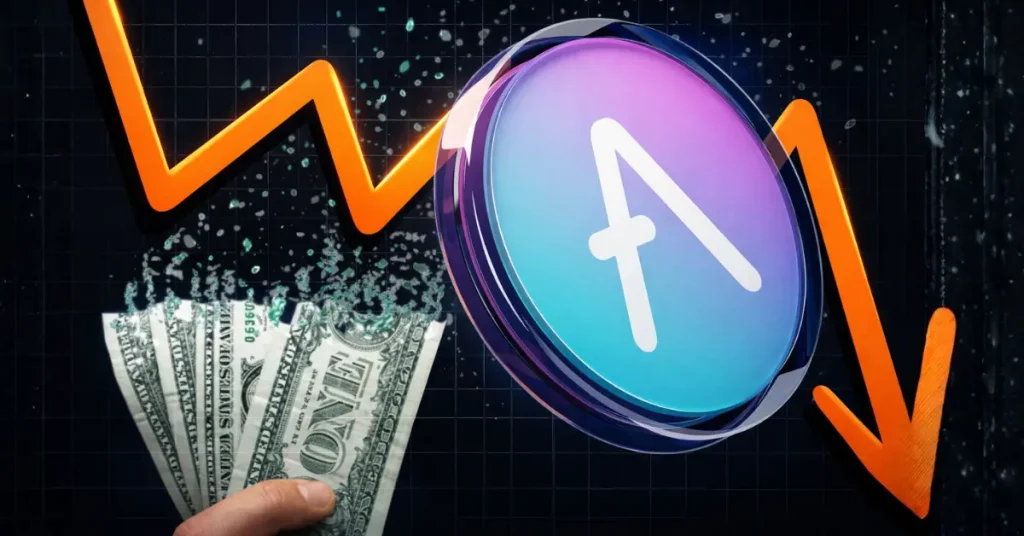
AAVE's price breakdown below $100, coupled with a 10% daily drop and rising exchange reserves, signals increasing sell-side pressure and a potential continuation of the bearish trend. The exit of Chaos Labs from the Aave ecosystem, following earlier contributor departures, raises concerns about governance continuity and long-term protocol direction, potentially impacting market confidence. With AAVE failing to reclaim the $95-$100 support zone, which has now become resistance, the price structure indicates a bearish continuation, with potential downside targets at $85, $55-$70.

Developers are finding novel ways to optimize AI model costs by manipulating output verbosity, directly impacting operational expenses for AI-driven applications. The 'caveman' prompt engineering technique demonstrates a significant, albeit unconventional, method for reducing token usage, potentially influencing how AI services are priced and utilized. While the cost savings are substantial for output tokens, input tokens remain a major cost driver, suggesting that further optimization strategies will be needed for comprehensive cost reduction. The viral adoption of this technique on platforms like GitHub highlights a community-driven approach to AI efficiency, potentially leading to broader adoption of similar cost-saving measures.
Signal context only. Validate with price action, liquidity, and risk limits before taking a position.
No explicit catalyst tagged.
The U.S. government's revised Medicare Advantage payment rates, increasing by 2.48% for 2027 and including risk adjustment changes, signal a significant revenue boost for health insurers like UnitedHealth, potentially driving near-term price appreciation. The market's strong reaction, with UnitedHealth stock jumping 8%, indicates investor relief from previous uncertainty and a renewed confidence in the health insurance sector's earnings outlook, shifting focus to upcoming Q1 2026 earnings reports. While the payment increase provides a more stable framework and eases policy concerns, ongoing challenges such as rising medical costs and healthcare utilization remain critical factors for sustained recovery, suggesting a cautious approach to long-term upside.
