
Navigating Crypto News

CoinFeather
Navigating Crypto News

Quick market read from this story
SpaceX's potential $75 billion IPO, aiming for a $2 trillion valuation, would position it as the most valuable public company holding Bitcoin, yet its BTC holdings represent a negligible fraction of its valuation, diminishing its role as a direct Bitcoin proxy.
The IPO's structure, potentially offering significant retail allocation without a lock-up, could drive demand, with the Bitcoin holdings serving as a secondary interest point for crypto-savvy investors rather than the primary investment thesis.
This development challenges the narrative of Bitcoin exposure through equity markets, as SpaceX's core business in space, communications, and defense will be the primary driver of its valuation, not its modest Bitcoin treasury.
Deep Dive
SpaceX has reportedly filed confidentially with the US Securities and Exchange Commission (SEC) for an initial public offering (IPO), a move that could lead to one of the largest stock market debuts in US history. The company is reportedly aiming to raise up to $75 billion at a valuation of approximately $2 trillion, with a potential listing as early as June. If successful, this valuation would place SpaceX among the top 10 global companies by market capitalization.
This potential IPO signifies a notable shift in how Bitcoin enters public markets. Unlike previous instances where exposure came primarily through companies focused on holding the asset, a SpaceX listing would introduce Bitcoin into a major industrial and infrastructure business. This changes the context in which investors encounter the cryptocurrency.
Founded in 2022, SpaceX operates at the intersection of commercial space, communications, defense, and infrastructure. It has become a dominant force in commercial launches and operates the Starlink satellite broadband network, which significantly contributes to its valuation. Reports indicate that SpaceX holds 8,285 Bitcoin, valued at approximately $569.5 million. This holding would make it the fourth-largest private corporate holder of BTC. However, this Bitcoin stash represents less than 0.03% of its projected $2 trillion valuation, meaning the stock would not function as a Bitcoin proxy.
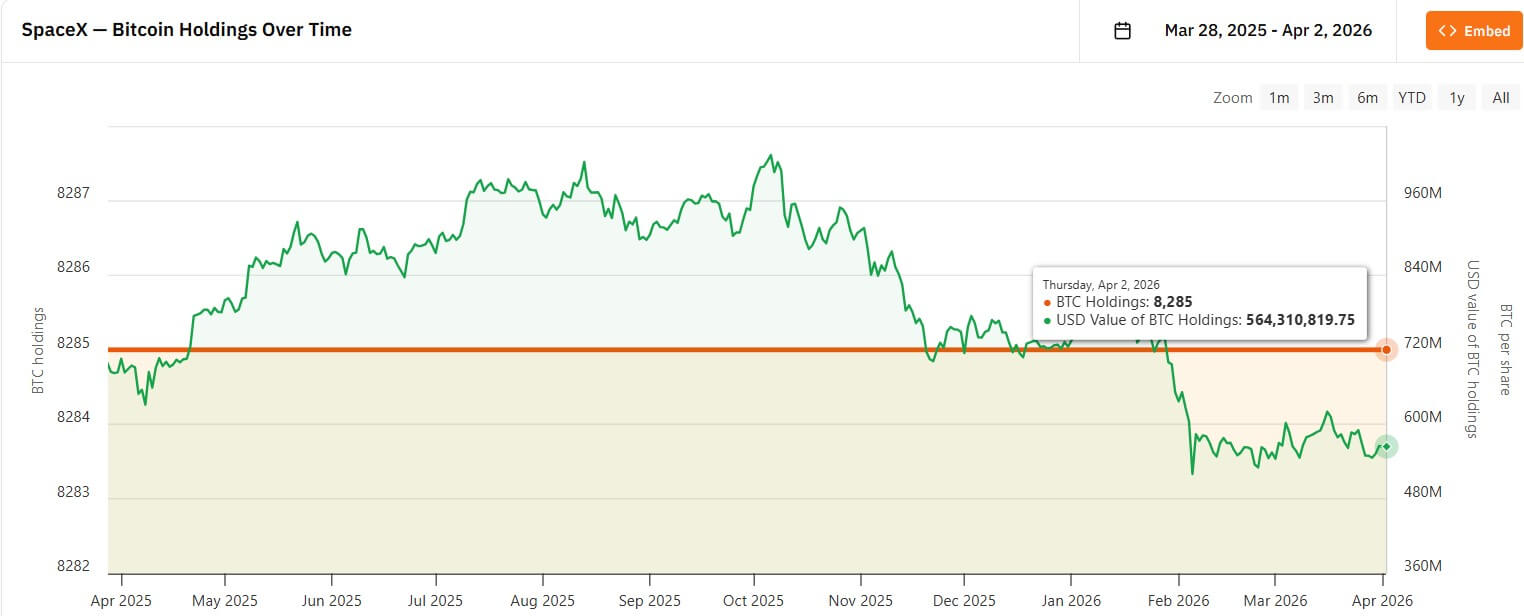
If these holdings are confirmed, SpaceX would surpass Tesla, another Elon Musk-led company, in terms of Bitcoin ownership on its balance sheet. Tesla currently holds over 11,000 Bitcoin and is the highest-valued public company known to own the token, with a current valuation of $1.37 trillion. Despite holding fewer coins, SpaceX's planned $2 trillion valuation would exceed Tesla's market value.
The trend of public firms adding Bitcoin to their balance sheets has grown, popularized by Michael Saylor's Strategy, the largest public corporate Bitcoin holder. However, SpaceX's equity model would differ significantly. Its stock would be driven by its core business operations in launch services, satellite technology, and defense, rather than Bitcoin accumulation.
The SpaceX IPO is expected to offer retail investors significant access, potentially with up to 30% of shares allocated and possibly without the standard six-month lock-up period. This structure could provide ordinary investors with favorable terms for accessing a highly sought-after private company. While the Bitcoin connection may add interest for crypto-savvy investors, the primary appeal of SpaceX's stock is anticipated to stem from its substantial scale, strategic importance in space and communications, and its scarcity value.
Source, catalyst, and sector overlap from the latest feed.
The Cardano Foundation's strategic shift to diversify its treasury away from ADA towards Bitcoin and cash signals a reduced direct financial linkage to ADA's price performance, potentially altering internal alignment and feedback loops. A significant decrease in ADA holdings from 76.7% to 51.6% of the Cardano Foundation's reserves, coupled with an increase in Bitcoin and cash, indicates a strategic de-risking and a move towards a more diversified treasury management approach. The Foundation's increased focus on technology, adoption, and governance spending, including initiatives in digital identity and RWA, suggests a strategic pivot to bolster Cardano's ecosystem infrastructure and attract institutional interest, independent of ADA's direct price action.
The US regulatory body OCC is actively selecting crypto firms for national trust charters, focusing on custody, settlement, and stablecoin infrastructure, signaling a deliberate integration of specific crypto functions into the traditional banking system. This federal chartering process creates a clear distinction between firms operating within the regulated banking perimeter and those outside, directly impacting which entities can scale nationally and capture institutional capital flows. The trend towards re-intermediation suggests that firms providing essential backend infrastructure like custody and reserve management are becoming the critical "picks-and-shovels" for the growth of tokenized finance, potentially commanding significant fees on trillions in assets. While the OCC's approach offers regulatory clarity and national reach, it imposes substantial compliance and supervisory costs, likely favoring well-capitalized incumbents and compressing the field of potential national players.
Bitcoin is functioning as a continuous price discovery mechanism for geopolitical risk over the Easter holiday weekend, while traditional markets are closed, highlighting its availability as a key market structure component. The current geopolitical tensions and oil price surge are transmitting macro stress through Bitcoin, linking it to inflation, yields, and liquidity conditions, which will be tested by traditional market reopenings and upcoming economic data. While Bitcoin's availability provides an immediate venue for price expression during market closures, its signal requires validation from traditional markets and cross-asset confirmation on Monday to determine durability.
Despite XRP's longest losing streak in a decade, Ripple's aggressive expansion into institutional finance and treasury management via GTreasury and HyperliquidX suggests a strategic build-out that could eventually drive demand. Ripple's integration of XRP and RLUSD into GTreasury's $13 trillion payment system aims to embed digital assets into corporate finance workflows, potentially shifting demand drivers from speculation to utility. The market's current disconnect between Ripple's enterprise progress and XRP's price weakness highlights a lack of immediate repricing catalysts, suggesting a 'wait-and-see' approach for traders. Ripple's expansion into institutional trading via HyperliquidX and partnerships in payments with Convera signal a broader strategy to position XRPL and its stablecoin infrastructure as a regulated layer for global financial operations.
A new framework for reserve assets is emerging, prioritizing accessibility and portability under geopolitical stress over traditional metrics like stability, potentially positioning Bitcoin as a 'sovereignty insurance' asset. The discussion around Bitcoin as a reserve asset is shifting from a pure hedge against monetary debasement to a strategic tool for maintaining access to funds during sanctions or conflict, a concept gaining traction with central banks diversifying away from USD. While Bitcoin's volatility and governance remain challenges, the 'access risk' argument, supported by real-world events like Russian fund freezes, suggests a potential for marginal adoption by politically exposed states, which could have outsized price impacts due to Bitcoin's market cap. The debate acknowledges Bitcoin's limitations, suggesting its most credible role may be as a small insurance sleeve alongside gold, rather than a primary reserve asset, as traditional assets like gold and diversified sovereign paper are still favored by many reserve managers.
The introduction of Bitcoin Everlight offers a new model for earning Bitcoin through transaction routing and network utility, aiming to bypass traditional mining barriers for retail investors with a low $100 entry point. The tiered 'shard' system, ranging from Jade to Radiant, provides varying levels of participation and potential rewards, with APY incentives during presale transitioning to real BTC fee distribution upon mainnet launch. With over $2.4 million secured in funding and progressing through its presale phases, Bitcoin Everlight is positioning itself as a scalable infrastructure solution for global Bitcoin payments, aiming for a mainnet launch that shifts focus from mining to transaction processing. The project's emphasis on a user-friendly interface and a fixed token supply of 21 billion BTCL aims to attract a broader audience and ensure a non-inflationary economic model, contrasting with the increasing costs and complexity of Bitcoin mining.
Binance's launch of the Digital Resilience Lab in Ukraine, backed by $500K in grants, signals a strategic investment in fostering Web3 development and digital infrastructure within a key geopolitical region. The program's focus on students, veterans, and entrepreneurs, combined with a public voting component for project selection, suggests an effort to democratize innovation and build practical Web3 tools with community support. This initiative represents a continuation of Binance's previous support efforts in Ukraine, indicating a sustained commitment to the region's technological advancement and potentially strengthening its ties with local tech communities and government bodies.
The SEC's classification of XRP as a digital commodity and significant ETF inflows totaling $1.39 billion, with Goldman Sachs as a major purchaser, removes legal ambiguity and signals institutional confidence, potentially supporting XRP's price trajectory. While XRP's price prediction targets suggest potential gains, the article highlights a presale project, Pepeto, aiming for 150x returns, positioning it as a potentially higher-reward, albeit higher-risk, alternative for traders seeking exponential growth. The comparison between XRP's projected long-term gains and Pepeto's presale potential suggests a market dynamic where established assets offer stability while new presales promise outsized returns, influencing trader allocation strategies.
Soluna's acquisition of a wind farm for its AI data center signals a strategic pivot to diversify revenue streams beyond Bitcoin mining, addressing industry-wide margin pressures. The move highlights a broader trend of crypto infrastructure companies leveraging renewable energy assets to support the burgeoning AI sector, potentially creating new demand for power-intensive computing. With Soluna's shares up 7.6% on the news, the market is reacting positively to this diversification strategy, suggesting investor confidence in its AI infrastructure expansion.
Ripple Prime's "BBB" investment-grade issuer rating from KBRA signifies enhanced credibility, potentially unlocking access to a broader institutional client base for traditional finance services. The rating validates Ripple's financial stability and technological reliability, which could translate into increased trust and capital flow into its prime brokerage operations. Despite the positive rating, Ripple Prime's reliance on a narrow service set and the parent company's revenue linkage to digital assets present ongoing diversification challenges and potential rating limitations.
Riot Platforms' significant sale of over $250 million in BTC during Q1 signals a strategic pivot towards AI infrastructure, potentially impacting its future operational focus and capital allocation away from pure mining. The company's continued BTC sales for consecutive quarters, coupled with a stated goal to utilize its power portfolio for data center development, suggests a fundamental shift in business strategy that could reduce its direct correlation with Bitcoin price movements. While Riot's stock has underperformed recently, the AI pivot narrative, supported by activist investor interest, presents a potential valuation catalyst that traders will monitor, especially in light of similar strategic shifts by other major Bitcoin miners.
Ripple's integration with SWIFT messaging and banking tools via the GTreasury acquisition signifies a strategic move to bridge traditional finance infrastructure with digital assets, potentially increasing XRP and RLUSD utility within corporate treasury operations. The launch of Digital Asset Accounts and Unified Treasury within Ripple Treasury allows finance teams to manage both fiat and digital assets in a single platform, indicating a push for broader institutional adoption of digital assets in treasury management. By leveraging SWIFT's established network and tools, Ripple is enhancing its treasury platform's credibility and accessibility for traditional financial institutions, which could lead to increased demand for its digital asset services.
Dmail Network's shutdown highlights the unsustainable economics of infrastructure-heavy Web3 projects, even those with high user engagement, due to escalating operational costs and monetization challenges. The failure of Dmail Network underscores the critical need for robust token utility and viable business models to ensure long-term sustainability in the Web3 communication sector. The closure of Dmail, a project previously ranked highly among AI DApps, suggests that user activity metrics alone are insufficient to guarantee the survival of Web3 platforms facing financial and operational headwinds.
The debate over centralizing crypto supervision under ESMA versus national regulators highlights a fundamental tension in MiCA's implementation, potentially impacting regulatory arbitrage and market access for CASPs across the EU. Malta's pushback against direct ESMA supervision, citing premature structural changes and the need to assess MiCA's impact, suggests potential delays or challenges in harmonizing EU crypto regulations, which could create short-term uncertainty for affected firms. The core of the dispute lies in balancing EU-level control with national regulatory expertise, raising questions about whether a centralized model will foster greater market integration or stifle innovation by removing jurisdictional advantages and specialized knowledge. While the article frames the issue as a clash over regulatory authority, the underlying concern is the potential fragmentation of oversight for complex crypto firms, which could compromise investor protection and operational resilience if not managed effectively.
Live Feed
Loading the broader stream in the same flow as the homepage feed.

The confirmed Binance listing for Pepeto, coupled with its origin from a Pepe co-founder and a SolidProof audited exchange, is presented as a rare setup with analysts projecting up to 150x returns from its presale price. Despite a prolonged period of extreme fear in the market, indicated by the Fear and Greed Index, significant capital is flowing into Pepeto's presale, suggesting a belief in its potential for substantial gains post-listing. The article draws a parallel between Pepeto and the original Pepe token, highlighting that Pepeto's integrated exchange tools and confirmed Binance listing offer a fundamental advantage that Pepe lacked, potentially justifying higher valuations. The current market environment of extreme fear, combined with Bitcoin ending a five-month losing streak, is framed as an opportune entry point for presale investments like Pepeto, mirroring historical patterns of early cycle believers.

Bitcoin faces potential downside to $60,000 or even $52,500 if key support levels break, indicating a bearish short-term outlook despite some analysts suggesting undervaluation. Major altcoins like ETH, BNB, XRP, SOL, DOGE, ADA, BCH, and LINK are also showing signs of weakness, with several at critical support levels that, if breached, could lead to significant further declines. The article presents a mixed outlook with some analysts predicting potential bottoms and others forecasting sharp drops, highlighting significant uncertainty and potential for volatility across the top cryptocurrencies. Despite bearish technical signals for many assets, the article also outlines potential upside scenarios if key resistance levels are overcome, suggesting a market awaiting clear directional catalysts.
The Ethereum Foundation's significant ETH staking activity, nearing its 70,000 ETH target, signals strong conviction in Ethereum's proof-of-stake security and long-term value appreciation. This substantial commitment to staking, representing a strategic treasury management decision, is likely to be interpreted by the market as a vote of confidence, potentially supporting ETH's price by reducing sell pressure and reinforcing network security. The projected annual staking rewards of $4-5 million highlight the economic sustainability of Ethereum's PoS model and the Foundation's strategy to generate yield from its holdings.
Despite a recent price uptick and growing wallet adoption for Shiba Inu, weak derivatives data showing a sharp drop in futures netflow signals cautious sentiment among traders, suggesting limited conviction for sustained upward momentum. The Shiba Inu price is trading within a narrow range, indicating a demand imbalance where existing holders are not being significantly outweighed by new buyers, which caps upside potential. While SHIB's adoption metrics like wallet count are positive, the decline in derivatives activity and long liquidations suggest a defensive positioning by market participants, making short-term price direction contingent on stronger demand signals. The meme coin sector is experiencing increased competition, with Shiba Inu's market cap ranking close to other emerging tokens, highlighting potential shifts in dominance if current trends persist.

Shiba Inu's netflow surge of 76.9% suggests potential whale accumulation, indicating increased holder conviction and reduced selling pressure. The formation of new support around $0.00000580-$0.00000590, coupled with a potential bounce above $0.000006, signals a stabilization of the SHIB price. While ecosystem upgrades and a recent surge in burn rate (2,332%) could support future price appreciation, the immediate focus remains on holding key support levels against potential resistance at $0.00000650.

The post Chainlink Price Stalls as Whale Accumulation Quietly Builds Momentum appeared first on Coinpedia Fintech News Chainlink price is consolidating on daily chart and isn’t doing anything flashy right now and that’s exactly the point. While most traders are busy chasing volatility elsewhere, the smart money seems to be quietly stacking. Over the past year, wallets holding at least 1 million LINK have grown from 100 to 125. Not explosive. Not …
Solana's price action is at a critical juncture, with analysts divided between bearish projections targeting $50 and bullish defense of the $80 support level. The prevailing market structure, characterized by lower highs and potential rising wedge formations, suggests continued downward pressure unless key resistance levels above $90 are decisively reclaimed. Despite bearish technicals, repeated defense of the $80 level indicates strong underlying demand, making the $75-$78 zone a crucial area to watch for potential trend continuation or breakdown.

Binance led derivatives trading in Q1 2026 with about $4.9 trillion in volume, while Hyperliquid entered the top 10 as perp DEXs continued to gain traction.

Ethereum L2s require responsive pricing models to achieve mass adoption by mitigating fee volatility, a key hurdle for traditional finance users. Arbitrum One's adoption of dynamic pricing represents a significant test for L2 scaling, balancing infrastructure protection with user-friendly transaction costs. While responsive pricing improves fee accuracy, the underlying gas model's reliance on transaction fees may need replacement for L2s aiming for billions of users. The debate over L2 fee models highlights a potential shift in Ethereum's scaling strategy, moving away from a purely L2-centric approach.

Elon Musk's X Money launch in April without Dogecoin integration signals a shift away from speculative hype towards confirmed utility and exchange listings for potential 'next Dogecoin' candidates. Pepeto's presale success, bolstered by an audited contract and a confirmed Binance listing, positions it as a speculative alternative to Dogecoin, capitalizing on investor fatigue with Musk-dependent narratives. The Solana ecosystem faces headwinds following a significant $285 million exploit on Drift, impacting SOL's price and highlighting the need for sustained institutional inflows for recovery. Investors seeking Dogecoin-like returns are rotating towards presale tokens like Pepeto, which offer a clear catalyst via exchange listings rather than relying on uncertain future integrations.

A CKPool-connected solo miner just landed a $210,000 Bitcoin block reward, one of only 20 solo‑mined blocks in the past year, as listed miners sell BTC to stay afloat.

US lawmakers are nearing a resolution on stablecoin yield regulations, potentially accelerating the CLARITY Act's progress and reducing uncertainty for crypto firms and banks. The resolution of the stablecoin yield debate could unlock legislative momentum for the CLARITY Act, with a committee markup and potential floor vote anticipated in the coming weeks. Market sentiment is cautiously optimistic, reflected in Polymarket odds suggesting a 64% probability of the CLARITY Act being enacted in 2026, indicating a potential positive catalyst for the stablecoin sector. The core dispute over whether digital asset platforms can offer yield on stablecoin holdings is being addressed, which is crucial for competitive parity and user adoption in the crypto space.

Shiba Inu's lead ambassador, Shytoshi Kusama, has broken a five-week silence with a cryptic announcement, explicitly stating it is unrelated to SHIB's price and instead refers to a 'global appointed time'. The announcement, framed with spiritual undertones and hints of a 'shift', suggests an upcoming update or communication that may focus on ecosystem positioning or new AI applications, rather than immediate price catalysts. While the SHIB price saw a modest 4.21% increase in the last 24 hours, the ambassador's statement downplays any direct correlation, indicating that market participants should not expect a price-driven event from this communication.

The CoinDesk 20 Index shows broad-based strength with 19 out of 20 assets trading higher, indicating positive market sentiment across a significant portion of the crypto market. NEAR Protocol and Avalanche are leading the gains within the CoinDesk 20, suggesting potential outperformance from these specific Layer 1 or Layer 2 solutions. Bitcoin's flat performance alongside altcoin gains suggests a potential shift in market focus away from the dominant cryptocurrency towards smaller cap assets, a common pattern during periods of altcoin strength.

ChangeNOW is a reputable crypto exchange platform that has spent nearly a decade championing user-controlled crypto assets. This reputed exchange has officially opened its new regional headquarters in the heart of Dubai’s business district. This expansion marks a new chapter in the company’s history. It is transitioning from a global service provider to a localized, […] The post Calculated Ambition: ChangeNOW Defies Market Uncertainty with New Dubai Headquarters appeared first on The Coin Republic.

Arkham Intelligence data reveals Vitalik Buterin is not the largest individual ETH holder, with Rain Lohmus holding more but being inaccessible. The ETH2 Beacon Deposit Contract holds the largest amount of ETH, highlighting significant locked supply essential for network security. Institutional holders like Bitmine and BlackRock are now major ETH holders, driven by ETF demand and staking strategies. While Buterin is the largest accessible individual ETH holder, the data shifts focus to institutional accumulation and locked supply dynamics.
Signal context only. Validate with price action, liquidity, and risk limits before taking a position.
