
Navigating Crypto News

CoinFeather
Navigating Crypto News

Source, catalyst, and sector overlap from the latest feed.
Veteran quant investor Cliff Asness challenges the crypto 'safe haven' narrative, asserting it currently correlates with risk-on equities. Asness's analysis suggests Bitcoin's price action mirrors that of tech stocks, implying it is not a reliable diversifier in the current market environment. The commentary from a prominent figure like Asness may influence investor perception regarding Bitcoin's role in portfolio diversification.
Michael Saylor's MicroStrategy has filed for new ATM programs totaling $44.1 billion, signaling a significant capital infusion capability to acquire more Bitcoin, despite short-term paper losses. Peter Schiff's public criticism of MicroStrategy's 4.5% weekly loss highlights ongoing debate around Bitcoin's volatility and Saylor's conviction in long-term accumulation strategies. The substantial $44.1 billion liquidity channel via SEC filings indicates MicroStrategy's aggressive stance on Bitcoin acquisition, potentially influencing market dynamics if fully deployed.
Live Feed
Loading the broader stream in the same flow as the homepage feed.
Bernstein identifies Circle and Coinbase as primary beneficiaries of stablecoin growth, driven by increasing USDC adoption and the emerging potential of agentic payments. Agentic payments, enabled by stablecoins' programmability and borderless nature, represent a new growth vector for stablecoins beyond traditional use cases, particularly for machine-to-machine microtransactions. Despite agentic payments being an optional upside, the core stablecoin thesis remains strong, supported by broad adoption in consumer and enterprise applications, positioning Circle and Coinbase as direct proxies for this expanding financial services category.

Prosecutors are questioning the authenticity of a court filing attributed to Sam Bankman-Fried, suggesting it may not have originated from prison and raising procedural concerns. The ongoing legal scrutiny of Bankman-Fried's communications and his family's public clemency campaign highlight the persistent reputational and legal risks associated with the FTX fallout. The FTX collapse continues to influence crypto policy debates, with recent events underscoring the long-term implications for regulatory approaches and investor confidence in the sector.
A significant 637% surge in SHIB token burns, removing over 8 million tokens, indicates strong community commitment to reducing supply and potentially creating upward price pressure through scarcity. The substantial token burn event coincided with a 5.68% price increase for SHIB, suggesting a short-term positive correlation between deflationary activity and asset performance. While the burn rate spike is notable, its long-term impact on SHIB's price will depend on sustained deflationary efforts and broader market conditions, as the token's quadrillion-scale supply remains a significant factor.
MicroStrategy's expanded $42 billion ATM program signals an aggressive, long-term strategy to accumulate Bitcoin, leveraging equity issuance to continuously increase its BTC holdings. The company's multi-channel capital raising approach, including common and preferred stock, provides significant flexibility to adapt to market conditions and investor appetite for Bitcoin exposure. This strategic capital deployment by a major corporate holder like MicroStrategy can be interpreted as a strong bullish signal for Bitcoin demand, potentially influencing market sentiment and price action.
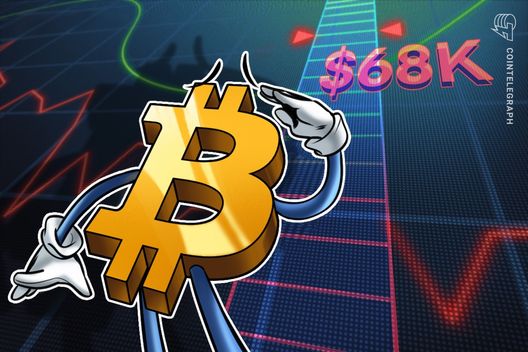
Bitcoin's failure to close above the 200-week EMA at $68,300 signals structural weakness, potentially initiating a downward leg towards the $46,000 to $47,000 support levels. Traders are bracing for further downside as the price action suggests a recent rally may have been a bull trap, with analysts pointing to untapped lows and a breakdown from a rising wedge pattern. The $47,000 level, representing the realized price for the 10-100 BTC holder cohort, is identified as a deep structural support, with a break below this threshold indicating a significant deterioration in market regime.

The arrest of the final suspect in the Ledger co-founder kidnapping case may signal a de-escalation of targeted physical attacks in the crypto space, potentially reducing perceived risk for high-profile individuals. While this specific event is resolved, the continued prevalence of 'wrench attacks' in France highlights an ongoing security concern for crypto holders and executives, suggesting a need for enhanced personal security measures. The resolution of this case, involving a significant crypto ransom demand, reinforces the narrative of crypto's role in illicit activities, which could indirectly influence regulatory sentiment and scrutiny.

Deloitte's collaboration with Stablecorp to build stablecoin infrastructure for Canadian institutions signals growing institutional interest in digital assets, particularly as regulatory frameworks develop. The initiative aims to leverage stablecoins for 24/7 payments and improved settlement efficiency, potentially paving the way for new financial products and increased adoption once regulatory clarity is achieved. This development aligns with global trends in stablecoin regulation and adoption, suggesting a move towards integrating digital assets into traditional financial systems in Canada.
PEPE is exhibiting a falling wedge pattern, a technical formation that historically precedes significant upward price movements, with analysts projecting a potential 708% breakout. Buyers are actively defending key support levels around $0.0000031, indicating accumulation interest that could fuel a relief bounce of up to 30% if sustained. Despite bullish technical signals, significant resistance remains between $0.00000414 and $0.00000500, suggesting that traders should await confirmation of a decisive breakout before expecting the projected large-scale rally.

Investors are rotating out of gold, which has entered a bear market, and into Bitcoin ETFs, signaling a shift in traditional safe-haven asset preference. The divergence highlights Bitcoin's increasing acceptance as a macro hedge, driven by ETF inflows despite higher interest rates and geopolitical uncertainty. Gold's decline is attributed to rising opportunity costs from sustained high interest rates and a stronger dollar, while Bitcoin's inflows suggest a continued appetite for digital asset exposure. The interplay of oil prices, inflation expectations, and Federal Reserve policy will be crucial in determining the near-term trajectory for both gold and Bitcoin.
H100 Group's proposed acquisition of two Norwegian Bitcoin treasury firms aims to significantly increase its BTC holdings, positioning it as a major European player and potentially signaling a trend of consolidation within the Bitcoin treasury sector. The all-stock transaction emphasizes a strategic move towards scaling operations and enhancing market relevance, suggesting that larger, more consolidated entities may gain an advantage in the evolving Bitcoin treasury landscape. This consolidation, if successful, could lead to increased institutional interest and liquidity for Bitcoin treasury services, especially given the current market environment where Bitcoin prices have stabilized after significant volatility.

Fidelity's formal request to the SEC for a framework enabling broker-dealers to offer, custody, and trade crypto on regulated systems signals a significant push for mainstream integration of digital assets into traditional market infrastructure. The development highlights the critical need for regulatory clarity in tokenized securities and DeFi reporting, which is a prerequisite for unlocking substantial institutional capital estimated at up to $5 trillion by end of 2026. While RWA tokenization is growing, with U.S. Treasury debt and commodities leading, the current market infrastructure and regulatory ambiguity remain key barriers, underscoring the importance of Fidelity's initiative. Recent regulatory actions, including the CFTC's reclassification of certain tokens as commodities and progress on stablecoin legislation, provide a supportive backdrop, but Fidelity emphasizes that the core market rails for institutional capital are yet to be built.

BlackRock CEO Larry Fink's endorsement of tokenization signals a significant potential shift in traditional finance infrastructure, suggesting a future where digital assets streamline issuance and trading. The comparison of tokenization to the internet in 1996 implies a long-term transformative potential, indicating that while immediate repricing may not occur, the underlying infrastructure development is a key structural trend. BlackRock's substantial involvement, with nearly $150 billion in assets connected to digital markets including BUIDL and stablecoin reserves, underscores the firm's strategic commitment and provides a strong signal of institutional adoption.

A sophisticated scam network on X is exploiting geopolitical tensions and war panic to lure users into fraudulent crypto schemes, highlighting a new tactic in social engineering for illicit gains. The identified scam network has generated six-figure profits through pump-and-dump schemes and fake giveaways, demonstrating the significant financial incentives and effectiveness of these coordinated online operations. The use of engagement farming via emotionally charged content, followed by the promotion of crypto scams, and the subsequent changing of usernames by scammers, presents a challenge for user protection and platform moderation.
Signal context only. Validate with price action, liquidity, and risk limits before taking a position.
Quick market read from this story
Shibarium is undergoing a significant infrastructure upgrade involving a full chain re-indexing and server migration, which is currently 45% complete.
The ongoing re-indexing is causing discrepancies in displayed data on the Shibarium explorer, but the underlying blockchain remains intact, reassuring users about asset safety.
Development focus is shifting towards Shibarium's Layer 3, with a new L3 explorer live for early testing, indicating future expansion and scalability efforts.
The infrastructure upgrade and L3 development signal a strategic move to enhance Shibarium's capabilities for future growth and increased transaction volume.
Deep Dive
The Shiba Inu-focused layer-2 network, Shibarium, is currently undergoing a significant infrastructure upgrade, including a major server migration and a full chain re-indexing. This process, which has been ongoing for the last 30 days, is aimed at enhancing the network's capabilities for future growth, rather than indicating a slowdown.
The Shibarium explorer is rebuilding from scratch, with synchronization currently at approximately 45% completion. This has led to discrepancies between the visible data on the explorer and the actual network statistics. For instance, the explorer shows around 2.4 million blocks and 168 million transactions, while the real figures are over 14 million blocks and 1.56 billion transactions. Similarly, the displayed wallet count is about 5 million addresses, contrasting with the actual figure of over 270 million addresses. Shibariumscan indicates that only 51% of blocks are indexed.
Shibizens, a prominent SHIB community account, has reassured users that visible data inconsistencies do not signify asset loss. The Shibarium blockchain itself remains intact, with the delays attributed to the ongoing indexing process. The network is described as
