
Navigating Crypto News

CoinFeather
Navigating Crypto News

Quick market read from this story
Shibarium experienced an 88.3% drop in transactions, falling from 10,940 to 1,230, indicating a significant decrease in network activity after a brief surge.
The transaction drop is attributed to infrastructure upgrades and ongoing reindexing of the Shibarium explorer, which is currently only 84% complete, suggesting that current on-chain metrics may be incomplete.
Despite the explorer indexing issues, the Shibarium network itself remains operational, with development shifting towards Layer-3 solutions like Shib Alpha and Shib Claw on the Puppynet testnet.
The market sentiment appears to have dipped due to the transaction volatility and broader crypto market losses, though SHIB and BONE showed minor gains at the time of reporting.
Deep Dive
The Shiba Inu Layer-2 blockchain, Shibarium, has experienced a significant 88.3% drop in transactions, falling from 10,940 to 1,230 within a 24-hour period. This sharp decline follows a brief surge on March 26, which saw transactions increase by as much as 300% after a period of remaining below 2,000 since February. However, this recovery was short-lived, with transaction numbers quickly reverting to their previous low levels.
Further investigation revealed that many of the recent transactions were labeled as "Value 0 BONE" and were contract calls rather than direct wallet transfers. This pattern was also observed during the previous day's transaction surge, raising questions about the nature of the activity. While the precise cause for the transaction drop remains unclear, the overall market sentiment has shifted, with many cryptocurrencies experiencing losses as traders adopt a more defensive stance.
A critical factor to consider is that the Shibarium blockchain and its explorer are currently undergoing significant infrastructure upgrades. A major server migration has taken place, and a full chain reindexing process is in progress, though not yet complete. Currently, 84% of blocks are indexed on the Shibarium explorer, which is rebuilding from scratch, meaning the displayed data is only partial. This indexing delay, however, does not impact the operational status of the blockchain itself, which continues to run steadily following its RPC migration. Metrics on Shibariumscan are therefore below the actual count due to incomplete indexing.
The development focus for Shibarium has shifted towards Layer-3, with ongoing progress on the Shib Alpha and ShibClaw projects. A new L3 explorer was launched on March 21 for early testing. At the time of reporting, the native token SHIB was trading at $0.000005813, showing a 0.85% increase in the last 24 hours. The Shibarium gas token, Bone ShibaSwap (BONE), saw a 1.22% increase in the same timeframe, trading at $0.06.
Source, catalyst, and sector overlap from the latest feed.
Ripple CTO emeritus David Schwartz clarified XRP escrow functionality, debunking misconceptions that funds were earmarked for specific individuals. The clarification highlights that XRP escrow operates on automated, condition-based releases, not pre-allocated contracts for specific parties, reinforcing the transparency of the XRP Ledger's mechanics. While not a direct price catalyst, the debunking of misinformation addresses potential FUD (Fear, Uncertainty, Doubt) surrounding XRP's supply dynamics, which could be viewed positively by long-term holders.
Shiba Inu's open interest has significantly retreated from recent highs, indicating a cooling of futures market activity and potentially reduced speculative interest. Despite muted derivatives activity, SHIB has shown a recent price uptick, suggesting a potential divergence between futures sentiment and spot market momentum. The current lack of clear directional signals in the futures market, coupled with minor spot price gains, positions SHIB as a watchlist asset pending further developments.
Shiba Inu's hourly death cross indicates short-term bearish momentum, coinciding with broader market liquidations and ETF outflows, suggesting potential for further downside pressure. Despite a technical bearish signal, SHIB is attempting a relief rally, with key resistance at the 50 MA and support at $0.00000571 to monitor for potential short-term price action. The increase in Shiba Inu's open interest and derivatives volume suggests heightened trader activity and positioning adjustments, which could precede a more significant price move.
XRP Ledger demonstrated robust scalability by sustaining over 120 TPS with low fees, indicating strong performance under load that could be crucial for upcoming bull market activity. The network's ability to handle high transaction volumes without congestion or fee spikes suggests underlying efficiency improvements or increased DEX activity, providing a positive signal for its capacity. While generally positive, a user report of fee increases at 200 TPS highlights potential scaling limits that warrant monitoring as transaction demand grows. Recent developments in XRPL security enhancements and stablecoin testing by Ripple Labs, coupled with this throughput surge, suggest proactive preparations for increased network utility and adoption.
Declining XRP exchange reserves to 2.75 billion indicate strong holder accumulation, suggesting potential for a price breakout driven by sustained demand despite recent price consolidation. The shift of XRP from exchanges to private wallets is a bullish signal for price appreciation, as it typically reflects a long-term holding sentiment and reduced selling pressure. Despite positive on-chain signals for XRP, the lack of institutional inflow into XRP ETFs, with potential for first monthly outflows, suggests a divergence between retail accumulation and institutional sentiment.
Developers are proposing gradual, shorter slot times for Ethereum's mainnet to enhance speed and efficiency, a strategy that aims to improve performance without introducing significant risks. The initiative, supported by the new QuickSlots platform, focuses on iterative improvements rather than a single, large-scale upgrade, potentially leading to a more stable and user-friendly network. Ethereum trading near its realized price suggests a market breakeven point, a rare condition historically preceding accumulation phases and potentially signaling a strategic entry opportunity. The ongoing development efforts, like the mainnet speed enhancement proposal, coupled with stable pricing, indicate continued network progress that could positively influence Ethereum's long-term outlook.
Despite a generally bearish market with Bitcoin down over 6% and Ethereum below $2,000, specific altcoins like Chainlink, Hedera, Kaspa, Sui, and Aptos are identified as having strong 10x potential setups. Chainlink's institutional partnerships and on-chain data streams position it as a critical infrastructure play, while Hedera's stablecoin launch and McLaren partnership signal institutional adoption. Kaspa's upcoming hard fork introducing programmability, Sui's multiple ETFs, and Aptos's robust transaction volume and stablecoin growth suggest these Layer-1s are building fundamental value independent of broader market sentiment. The article suggests that periods of market fear, characterized by price drops and negative sentiment, can present accumulation opportunities for fundamentally strong altcoins that may not require new all-time highs to deliver significant returns.
Google's 2029 deadline for quantum-resistant cryptography migration signals an accelerated timeline for quantum threats, pressuring Bitcoin developers to address cryptographic vulnerabilities sooner than anticipated. Ethereum's proactive eight-year preparation for post-quantum cryptography contrasts sharply with Bitcoin's current lack of a coordinated strategy, potentially leading to a divergence in their market perception and value (ETHBTC). The perceived urgency of the quantum threat, highlighted by Google's deadline and prominent advocate Nic Carter's warnings, suggests a potential shift in developer prioritization and could impact Bitcoin's long-term security narrative. While some analysts downplay the immediate threat to Bitcoin, citing the scattered nature of vulnerable addresses, the consensus among tech giants and key figures indicates a structural risk that requires proactive mitigation.
Hyperliquid's CEO argues that the token's current valuation is significantly undervalued when compared to established protocols like Ethereum and Solana, suggesting a substantial upside potential based on its performance metrics. The protocol's impressive $14 million in weekly fees and $208 billion in monthly trading volume highlight its dominance in the perpetual DEX market, processing a significant portion of non-crypto related derivatives like commodities and equities. Expansion into real-world assets (RWA) and the upcoming HIP-4 feature introducing prediction markets and options present a multi-trillion dollar total addressable market (TAM) that is currently underpriced by the market. While regulatory uncertainty and competition pose risks, Hyperliquid's strong fee generation and expanding market reach into traditional finance assets suggest a robust fundamental case for its valuation.
The increasing autonomy of AI agents necessitates a robust digital financial infrastructure, positioning crypto's stablecoins, wallets, and identity systems as potential core components for machine-to-machine transactions. While 'AI coins' may not be the primary beneficiaries, the underlying infrastructure of crypto, particularly stablecoins and programmable wallets, is poised to gain significant utility as AI agents begin to execute autonomous economic activities. Mainstream adoption by payment giants like Visa, Stripe, and Mastercard in agentic commerce validates the need for crypto's programmable money and digital asset solutions, signaling a shift from speculative narratives to practical infrastructure use cases. The development of 'Know Your Agent' identity solutions, leveraging cryptographic credentials, is crucial for enabling secure and verifiable transactions by AI agents, potentially becoming a key growth area for crypto infrastructure.
The tokenization of the Fundrise Innovation Fund via xStocks represents a significant step in bringing private market assets onto the blockchain, potentially increasing liquidity and accessibility for a broader investor base. Despite the initial surge in the Fundrise Innovation Fund's stock price, a short-seller report and subsequent price drop highlight the inherent volatility and regulatory scrutiny associated with tokenized real-world assets. The growth of tokenized equities, surpassing $1 billion in value, indicates a maturing RWA sector, though market concentration among a few platforms suggests ongoing consolidation and potential risks for smaller players. The partnership between xStocks and Fundrise, coupled with the broader RWA market growth, signals increasing institutional interest in bridging traditional finance with blockchain technology, creating potential opportunities for related infrastructure and platforms.
Major blockchain networks like Bitcoin, Ethereum, and Solana are actively developing strategies to counter the future threat of quantum computing, indicating a proactive shift from theoretical concern to practical implementation. The differing approaches to quantum resistance across Bitcoin (debate and gradual proposals), Ethereum (phased integration and architectural changes), and Solana (experimental tooling) highlight a lack of industry-wide consensus on the urgency and optimal solutions for this long-term risk. While the quantum threat is acknowledged as a significant long-term risk, the current market reaction is muted, suggesting that immediate repricing is unlikely as preparations are still in early stages and practical attacks are perceived as distant.
Google's significant investment in Anthropic's data center infrastructure signals a deepening partnership and a substantial commitment to AI development, potentially impacting demand for related compute and hardware resources. The judicial block on the Pentagon's directive against Anthropic suggests a more stable regulatory environment for AI firms, allowing for continued operations and potential government contracts. The dual developments of major infrastructure investment and regulatory reprieve for Anthropic indicate a strengthening position for the AI company, which could translate to increased demand for its services and underlying technologies.
Ondo Finance's strategic partnership with Franklin Templeton to tokenize ETFs signifies a major influx of traditional finance assets into the crypto space, potentially unlocking trillions in new capital flows. The collaboration positions Ondo Finance to further solidify its dominant 60% market share in tokenized stocks, indicating strong institutional adoption of its RWA infrastructure. Despite the significant fundamental development, ONDO's price action remains range-bound, suggesting a potential accumulation phase before a broader market recognition of the partnership's value. This development signals a growing trend of TradFi integration with crypto, where tokenized assets offer 24/7 access and DeFi composability, enhancing investor accessibility and market efficiency.
Live Feed
Loading the broader stream in the same flow as the homepage feed.

Significant Bitcoin ETF outflows totaling $225.5 million on March 27, led by BlackRock's IBIT, indicate institutional de-risking and have pressured BTC price below key support levels. The breach of the $66,000 support level, coupled with geopolitical stress and derivatives pressure from liquidations and options expiry, suggests a fragile market sentiment that amplifies selling pressure. Traders are closely watching the $65,000 support level, with a breakdown potentially leading to further downside, while a reclaim of the $68.4K-$69.2K resistance zone is needed to ease immediate selling pressure.
XRP Ledger's surge to over 120 TPS, driven by DEX offer cancellations rather than new payments, indicates robust network capacity for handling high instruction volumes, a positive sign for its underlying infrastructure. The minting of 9 million RLUSD on XRPL, alongside burns on Ethereum, highlights Ripple's ongoing strategy to rebalance and expand its stablecoin's utility, particularly for enterprise settlement and cross-border payments. Despite increased network activity and stablecoin developments, XRP's price remains below key resistance levels, suggesting that current on-chain metrics are not yet translating into significant upward price momentum for the asset.
Shiba Inu's hourly chart has formed a death cross, a bearish technical indicator, suggesting potential short-term downside pressure. The death cross occurred amidst a broader market sell-off and significant liquidations, exacerbated by a large Bitcoin and Ethereum options expiry event. SHIB is currently testing key resistance levels, with the 50-period moving average acting as an immediate barrier; failure to break above could lead to further declines. The market is closely watching if the $0.00000571 level can hold as support, as a breakdown could expose SHIB to renewed selling pressure.

The negative Coinbase Premium Index indicates US institutional investors are reducing Bitcoin exposure, signaling short-term caution driven by macro factors like inflation and geopolitical tensions. Morgan Stanley's record-low 14bps Bitcoin ETF fee filing intensifies competition, potentially attracting new traditional finance capital despite current institutional selling pressure. Traders are closely monitoring key liquidity zones around $65,200 and $69,000-$70,000, with potential for a test of lower support before any relief rally. While short-term selling from US institutions is evident, the ongoing ETF fee war suggests a continued long-term interest from major financial firms in Bitcoin exposure.

Washington state has filed a lawsuit against Kalshi, alleging violations of state gambling laws and the Consumer Protection Act, adding to the company's growing legal challenges across multiple jurisdictions. The lawsuit highlights the ongoing regulatory scrutiny of prediction markets, with state authorities increasingly classifying them as illegal gambling operations, potentially impacting similar platforms. Kalshi's defense, arguing for exclusive CFTC jurisdiction and seeking federal court relocation, indicates a broader legal battle over the classification and regulation of prediction markets in the US. The increasing number of state-level legal actions against Kalshi suggests a coordinated or escalating regulatory crackdown on prediction markets, warranting close monitoring by investors in related sectors.
Shiba Inu's futures open interest has seen a significant 26% drop from its recent peak, indicating a sharp decline in trader conviction and potentially signaling a cooling-off period for short-term price speculation. The substantial pullback in futures open interest, from 12 trillion to 8.87 trillion SHIB, suggests that recent bullish momentum may be waning, leading to a more cautious market sentiment for the meme coin. A decrease in open interest, coupled with a 2.18% price drop in 24 hours, implies that traders are reducing exposure, which could precede a period of consolidation or further downside pressure for SHIB.

Despite positive fundamental developments for several altcoins, the broader market downturn led by Bitcoin's drop below $87K resulted in significant weekly losses, highlighting the continued correlation between Bitcoin and altcoin price action. Tokens like ETHFI and KITE, despite recent positive news (exchange listings, hackathons) and technical indicators suggesting oversold conditions, experienced sharp price declines, indicating that macro uncertainty is currently overshadowing project-specific catalysts. Polkadot's implementation of a hard supply cap and reduced issuance, alongside the launch of a US-listed ETF, represents a structural upgrade, yet the token's price action remains weak, suggesting that the market is not yet pricing in these fundamental improvements. The analysis of the top five weekly losers reveals a pattern of sharp declines from recent highs, with many tokens now testing key support levels, making them potential watchlist candidates for a rebound if broader market sentiment improves.
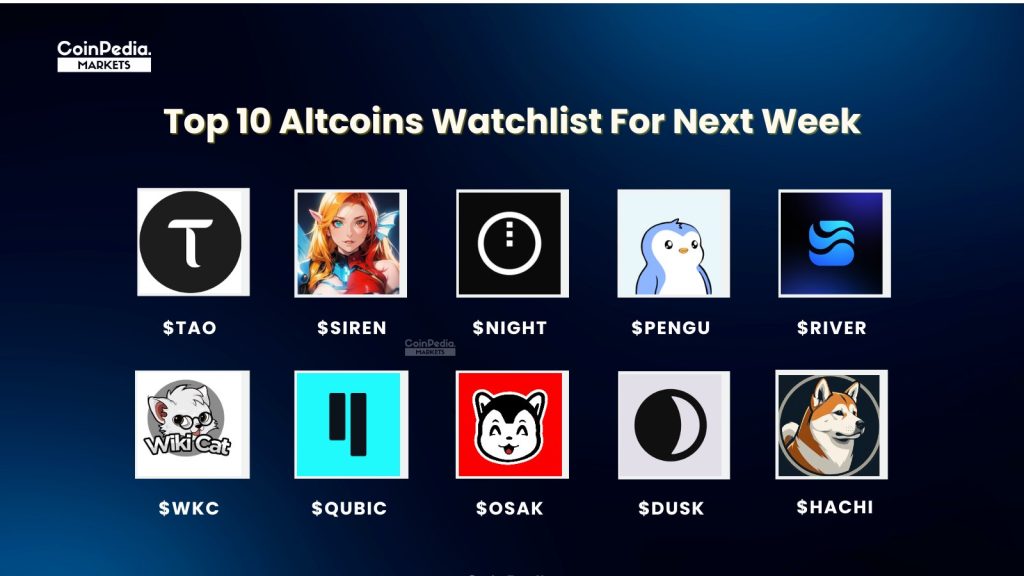
Despite a general market downturn, specific altcoins like Bittensor (TAO), Siren (SIREN), and Midnight (NIGHT) are highlighted with potential price targets, suggesting selective opportunities amidst broader weakness. The article presents a watchlist of altcoins with price targets for the upcoming week, indicating a focus on short-term trading opportunities rather than long-term structural plays. Factors such as institutional participation and geopolitical uncertainty are cited as influencing market sentiment, but the analysis focuses on technical indicators and specific coin performance for the watchlist.

The current crypto market downturn, characterized by a 50% drop from Bitcoin's all-time high, is interpreted as a necessary 'reset' rather than a terminal bear market, driven by macro liquidity tightening and deleveraging. Market cycles in crypto are heavily influenced by global liquidity; a contraction due to Fed balance sheet reduction and tax payments is pressuring prices, but historical patterns suggest this sets the stage for future expansion. While short-term volatility is expected to persist through 2026 with potential for further corrections, structural demand from institutional participation and improved infrastructure suggest the long-term bullish cycle for digital assets remains intact. Traders should adopt a defensive stance early in 2026, gradually increasing exposure as liquidity conditions stabilize and potentially shifting to overweight digital assets by year-end, focusing on active strategies during mid-cycle dislocations.

Washington state has filed a lawsuit against Kalshi, alleging it offers illegal gambling products, escalating regulatory pressure on prediction markets. The legal actions by Washington and Nevada against Kalshi, and Nevada's injunction against Coinbase's prediction market offerings, signal a growing state-level challenge to the classification of prediction markets. This trend of state-level regulatory scrutiny on prediction markets could lead to increased legal uncertainty and potential operational restrictions for platforms operating in multiple jurisdictions.

Ethereum's price recovery above $2,000 follows a significant drop amplified by an all-time high in futures leverage, indicating that while the immediate sell-off pressure has eased, the underlying market fragility due to extreme leverage has reduced but not disappeared. Despite the price volatility and leverage unwind, development activity within the Ethereum ecosystem, led by projects like MetaMask and ChainLink, remains robust, suggesting continued fundamental building independent of short-term market fluctuations. The recovery from the $1,971 low to $2,024 still leaves ETH significantly below its recent high of $2,200, and the macro conditions that initiated the sell-off persist, implying that further upside may be capped without a shift in broader market sentiment.

Kalshi's acquisition of a futures commission merchant license enables margin trading for professional clients, a significant development for institutional adoption in prediction markets. The introduction of margin trading by Kalshi differentiates it from crypto-native prediction platforms and could attract greater institutional capital by reducing upfront capital requirements. Despite regulatory scrutiny, the prediction market sector is experiencing growth, evidenced by Kalshi's substantial funding round and increased trading volumes, suggesting a maturing market.

Canada's proposed ban on crypto donations, mirroring UK actions, signals a growing global regulatory trend towards restricting digital asset use in political financing due to transparency concerns. Despite crypto donations being permitted since 2019, their minimal adoption in Canadian elections suggests this ban will have little immediate impact on the crypto market, but it highlights increasing governmental scrutiny. The legislation groups crypto with other less traceable funding methods, indicating a broader governmental effort to enhance electoral integrity by limiting anonymous or pseudonymous financial flows.

Bitcoin's valuation has compressed significantly, with the Mayer Multiple in lower percentiles, suggesting it may have already priced in tighter monetary conditions unlike equities which are just beginning to reprice. The shift in Fed rate cut expectations, driven by rising energy prices and inflation concerns, implies a less accommodative macro environment that could pressure risk assets, but Bitwise argues BTC's prior adjustment offers reduced downside. While traditional markets face renewed downside risk from macro shifts, Bitcoin's earlier repricing suggests it might be better positioned to weather the storm, though its correlation with altcoins remains high.
Signal context only. Validate with price action, liquidity, and risk limits before taking a position.
