
Navigating Crypto News

CoinFeather
Navigating Crypto News

Quick market read from this story
Ethereum's breakout above $2,780, confirmed by the SuperTrend indicator flipping to buy, signals the potential start of an altcoin season, suggesting broader market upside.
Increased institutional accumulation of ETH, evidenced by ETF inflows and exchange withdrawals, combined with a bullish technical setup, indicates strong underlying demand and potential for new all-time highs.
The technical indicators and analyst commentary suggest a shift in Ethereum's trend, potentially leading to significant price appreciation for ETH and other altcoins in the near term.
With Ethereum reclaiming key support levels and showing sustained buying pressure, traders should monitor for continued momentum as altcoins are expected to follow its lead.
Deep Dive
Macroeconomist Henrik Zeberg has declared the start of a new altcoin season following Ethereum's significant breakout above the $2,780 resistance level. Zeberg anticipates that this move by the largest altcoin will trigger a broader rally across the cryptocurrency market, potentially leading to new all-time highs for many altcoins in the current cycle.
Zeberg's analysis, based on an ETH/USD chart, shows rising trendlines and an RSI at 65, indicating ample room for further price appreciation. The chart also reflects sustained buying pressure, reinforcing the prediction of an extended altseason. This optimistic outlook is further bolstered by increasing institutional adoption within the crypto space.
Currently, Ethereum is trading at $2,274 per coin.
Crypto analyst Ali Martinez echoed Zeberg's sentiment, stating that Ethereum has signaled the end of its downtrend. He noted that the SuperTrend indicator has flipped from a sell to a buy signal for the first time since September. Historically, this indicator shift has preceded significant Ethereum rallies, including 52% and 174% surges in the past year.
Ethereum $ETH just signaled the end of the downtrend! For the first time since September, the SuperTrend indicator has flipped from Sell to Buy. In the last two instances, it led to moves of 52% and 174%.
Martinez highlighted key developments supporting this trend reversal. Ethereum has successfully reclaimed the $2,200 support level after a previous 39% decline. Furthermore, exchange-traded funds (ETFs) have accumulated approximately 83,000 ETH, valued at around $193 million, over the last three weeks. The next price levels to monitor are identified as $2,400 and $2,600.
Increased accumulation by both institutions and retail investors is evident, with notable figures like Erik Voorhees, founder of ShapeShift, reportedly buying Ethereum. The Ethereum Foundation also continues its staking activities. Over the past week, 336,000 Ethereum has been withdrawn from crypto exchanges, underscoring growing whale interest.
Source, catalyst, and sector overlap from the latest feed.
Despite significant XRP ETF outflows totaling $76.1 million, the asset's price has risen over 11% in two weeks, indicating strong retail or private investor demand potentially overriding institutional sentiment. The divergence between institutional outflows and price appreciation suggests a potential disconnect, with retail investors driving the current rally, possibly anticipating future adoption or regulatory clarity. While Bitcoin attracts the majority of new ETF inflows, XRP's resilience in the face of outflows highlights its unique market dynamics, though its perception as a riskier asset amid geopolitical shifts is a key factor.
Ethereum's open interest in futures has surged by over 18%, indicating increased leveraged positions and potential for heightened volatility. Despite a recent price rally and significant short liquidations, the continued premium on ETH put options suggests underlying trader caution and a potential 'bull trap' scenario. While bulls target $2,800, the divided market sentiment and put option pricing imply limited odds for a sustained 33% rally, with sideways trading between $1,750 and $2,200 a possibility if current support fails.
Cardano's trading volume surge of over 150% indicates renewed market interest and potential for recovery, driven by both spot and derivatives traders re-engaging with ADA. The significant increase in trading volume, particularly on major exchanges like Binance, suggests that ADA may be breaking out of an oversold technical structure, with short-term resistance near the 26-day EMA. Liquidation data showing higher short liquidations compared to long liquidations suggests bearish sentiment is being squeezed, potentially fueling further upward momentum for ADA in the short term.
Ripple CTO Emeritus David Schwartz downplayed the likelihood of a catastrophic 93% XRP price drop, citing historical volatility but deeming such a scenario improbable. Shiba Inu (SHIB) is showing potential for a 37-40% upside move, targeting key resistance levels at the weekly Bollinger Band and 200-day moving average. Bitcoin analysts have shifted to a 'Strong Buy' sentiment as BTC approaches $74,000, with upcoming Fed rate decisions and ETF inflows being key market drivers. The market is closely watching Jerome Powell's rhetoric on March 19th for signals on potential Fed rate policy, which could either fuel further Bitcoin rallies or trigger a correction.
Strategy's significant Bitcoin acquisition of 22,337 BTC for $1.57 billion, funded by selling its own stock, signals continued institutional conviction in Bitcoin as a treasury asset. The substantial capital deployment by Strategy, averaging $70,194 per BTC, suggests a belief in future price appreciation, potentially influencing market sentiment and demand. Strategy's increased holdings to 761,068 BTC at an average cost of $75,696 per coin highlights its long-term strategy and positions it as a major holder, impacting market dynamics.
Pi Network coin experienced a significant 30% price drop on Pi Day, erasing recent gains despite a network upgrade, indicating a potential 'sell-the-news' event. Increased trading volume suggests investors are liquidating holdings to lock in profits following the network's v20.2 upgrade and Pi Day hype. The price decline, despite a major upgrade and community event, highlights a disconnect between network development and immediate market sentiment, suggesting caution for short-term traders. While the monthly gains remain positive, the sharp weekly and daily losses point to profit-taking behavior and potential downward pressure on Pi Coin in the immediate trading horizon.
ARK Invest's report quantifies ~35% of Bitcoin supply as theoretically vulnerable to quantum attacks, shifting the discussion from abstract risk to concrete exposure. While the threat is long-term (mid-2030s earliest), the proposed BIP-360 upgrade highlights Bitcoin's slow governance process, suggesting a potential lag in addressing quantum risks compared to other blockchains. Developer Matt Corallo argues that capital rotation into AI, not quantum fear, is the primary driver of recent Bitcoin price weakness, suggesting market participants may be misattributing macro trends. The debate over quantum risk is splitting into three camps: those who believe it will ultimately strengthen Bitcoin, skeptics who see potential capital rotation to Ethereum, and those who view it as a broader civilizational threat.
The upcoming week features rate decisions from seven central banks, including the U.S. Federal Reserve, which could introduce volatility to risk assets like Bitcoin if hawkish inflation concerns emerge. Despite potential inflation-driven tightening of financial conditions, historical precedent suggests that geopolitical tensions, which are currently a dominant market factor, tend to fade, potentially creating buying opportunities for Bitcoin. Several token unlocks are scheduled, notably Arbitrum (ARB) and LayerZero (ZRO), which could increase circulating supply and potentially pressure prices if not absorbed by market demand. The week includes significant token generation events and listings, such as Backpack (BP) and Katana (KAT) on Binance, which could drive short-term trading interest and price action for these specific assets.
The debate around BIP-110 highlights a critical juncture for Bitcoin's governance, with prominent figures like Adam Back warning of potential 'downgrades' and risks to network neutrality and user funds. The proposal's temporary soft fork mechanism and a lower activation threshold (55%) raise concerns about potential network splits, which could fragment the Bitcoin ecosystem and impact its perceived stability. Rejection of BIP-110 would signal Bitcoin's continued commitment to censorship resistance, while acceptance could mark a shift towards more centralized governance, influencing future development and market perception.
Vitalik Buterin's proposal to merge Ethereum's Beacon Chain and execution layer backend programs aims to simplify node setup, potentially increasing decentralization by making it easier for individual users to run their own nodes. Reducing the technical complexity of running an Ethereum node addresses centralization concerns stemming from reliance on third-party service providers and high hardware/time requirements. This initiative, alongside previous proposals for stateless nodes, signals a continued focus on improving Ethereum's accessibility and scalability, which could have long-term positive implications for network participation and security.
Bitcoin's surge above $74,000, nearing a 25% bounce from its February low, indicates a potential shift in market sentiment driven by easing geopolitical tensions and a renewed appetite for risk assets. The outperformance of altcoins like ETH and SOL suggests a broadening of the crypto market rally beyond Bitcoin, signaling increased risk-on behavior from investors. The correlation between crypto gains, U.S. equities, and easing oil prices highlights the market's sensitivity to macroeconomic factors and geopolitical stability. The significant AI infrastructure deal between Nebius and Meta, alongside funding for Bitcoin miners like TeraWulf, demonstrates underlying strength in related tech and infrastructure sectors, potentially benefiting crypto-adjacent companies.
Ether's price has broken through key resistance levels, invalidating bearish patterns and suggesting a potential rally towards $2,800 based on symmetrical triangle analysis. On-chain data, specifically the unresolved supply overhang around $2,800 and the realized price at $2,350, indicates significant resistance that could cap further upside despite bullish technical signals. Market sentiment is shifting bullishly, with prediction markets showing increased odds for ETH to reach $2,800 in March, signaling growing trader conviction in an upward price movement.
Bitcoin's resilience near $70,000 despite geopolitical tensions and macro sell-offs highlights the sustained impact of consistent Bitcoin ETF inflows, which are absorbing market weakness. The correlation between Bitcoin and the S&P 500 ETF indicates that BTC is currently trading as a risk-on asset, making its price action highly sensitive to broader market sentiment and traditional financial market movements. While $69,659 serves as immediate support, the $73,000-$74,000 resistance zone remains a critical barrier that needs to be decisively broken for further upside momentum, with the upcoming Federal Reserve meeting potentially influencing the next directional move. Despite significant liquidations driven by leverage, the ongoing demand from Bitcoin ETFs and corporate accumulation, such as Strive's recent purchase, provides a foundational support level for BTC price.
XRP is showing signs of trend exhaustion after a prolonged downtrend, suggesting a potential shift in market momentum from selling to accumulation. The asset's ability to hold above the $1.48 support level indicates growing resilience and could signal the early stages of a recovery phase. A sustained push above current levels could see XRP target the psychological $2 mark, which would be a significant indicator of renewed market confidence and potentially reignite broader interest.
Live Feed
Loading the broader stream in the same flow as the homepage feed.

The $3.7 million flash loan attack on Venus Protocol highlights a persistent vulnerability in DeFi lending platforms, underscoring the ongoing arms race between attackers and security measures. While sophisticated defenses like AI circuit breakers and ZK-proof oracles are emerging, the incident suggests that smart contract bugs and oracle manipulation remain significant risks for DeFi protocols. The article also notes a parallel threat from North Korea-linked actors using social engineering and embedded backdoors, indicating that human vulnerabilities are as critical as code exploits in the current threat landscape.

Increased trading volume on prediction markets, particularly for Iran-related contracts, highlights a surge in speculative activity driven by geopolitical events. Regulatory scrutiny is intensifying with the CFTC classifying event contracts as financial assets and lawmakers proposing bans on war-related bets, signaling potential future restrictions on prediction market operations. The proposed "DEATH BETS Act" and recent insider trading allegations on Polymarket underscore the growing concerns around the ethical and regulatory implications of prediction markets, potentially impacting their future accessibility and scope. While current volume is high, the regulatory headwinds and potential for outright bans suggest a cautious outlook for prediction market platforms, especially those focused on sensitive geopolitical or conflict-related events.

Steven Spielberg's stance against AI replacing creative roles signals a potential friction point for AI adoption in content creation, which could impact demand for AI-related infrastructure if widely adopted by creators. The entertainment industry's ongoing debate and experimentation with AI, as highlighted by Netflix's acquisition and AMC's rejection of AI content, indicates a developing market for AI tools but also potential regulatory hurdles and user resistance. While Spielberg's comments are focused on creative industries, the broader discussion around AI's role in content creation and copyright could indirectly influence investor sentiment towards AI-focused blockchain projects and infrastructure.

USDC has surpassed USDT in transfer volume for the first time in seven years, signaling a shift in stablecoin utility from pure supply to transactional velocity. Solana's low transaction fees and high throughput are driving significant USDC transfer volume, indicating its growing importance as a settlement layer for high-frequency stablecoin activity. Regulatory actions, including the GENIUS Act in the US and MiCA in Europe, alongside institutional integrations like Visa's USDC settlement on Solana, are favoring compliant stablecoins like USDC over USDT. The divergence between USDT's large total supply and USDC's leading transfer volume highlights a market segmentation where utility and regulatory compliance are increasingly valued for active capital movement.

Bitcoin's resilience during geopolitical turmoil, driven by institutional accumulation via ETFs and corporate treasuries like Strategy, signals a maturing asset class increasingly viewed as a hedge. The significant accumulation by Strategy and growing ETF holdings, now representing 6.1% of supply, indicate a structural shift in ownership favoring long-term holding and potentially reducing near-term sell pressure. While retail investors have been net sellers, the dominance of long-term holders and Bitcoin's outperformance against traditional assets suggest a growing narrative of 'digital gold' and a potential for sustained demand. For equity investors, MicroStrategy (MSTR) offers a high-beta exposure to Bitcoin's price action, currently trading at a discount to its NAV, presenting a potential arbitrage opportunity.

Major financial institutions Hana Financial and Standard Chartered are deepening their alliance with a strategic focus on digital assets and tokenized services, signaling increased institutional integration into the crypto space. The expanded partnership builds on prior collaboration in stablecoin development, suggesting a growing commitment to exploring blockchain-based financial infrastructure and potentially influencing regulatory frameworks. Standard Chartered's parallel partnership with B2C2 to enhance institutional access to digital assets underscores a broader trend of traditional banks leveraging crypto-native firms to build regulated on-ramps for investors. This convergence of traditional finance and digital assets, particularly in key Asian hubs, indicates a strategic positioning by major banks to capture growth in tokenized finance and stablecoin markets.
Subway remains a privately held entity, with no stock symbol or price currently available, despite ongoing investor interest and speculation about a potential future IPO. The acquisition by Roark Capital in 2024 for approximately $9.6 billion solidifies Subway's private status, placing it within a large portfolio of restaurant brands and away from public market scrutiny. While a future IPO is not officially planned, it remains a possibility driven by private equity exit strategies or significant capital needs, which could unlock new investment opportunities if realized. Investors seeking exposure to the fast-food sector can consider publicly traded alternatives like McDonald's (MCD) or Restaurant Brands International (QSR) as direct Subway stock is unavailable.

The CoinDesk 20 Index experienced a broad-based rally, with ETH and DOT leading gains, indicating positive sentiment across major altcoins within the index. The overall market performance, as reflected by the CoinDesk 20 Index's 5.1% rise with all constituents trading higher, suggests a short-term bullish trend or a recovery phase in the broader crypto market. While ETH and DOT showed strong performance, the laggards UNI and BCH also posted gains, implying a general market uplift rather than sector-specific strength.
MicroStrategy's continued aggressive Bitcoin accumulation, funded by stock sales, signals strong conviction in BTC as a treasury asset, potentially influencing investor sentiment towards the company and Bitcoin itself. The substantial purchase of 22,337 BTC by MicroStrategy reinforces its position as a major corporate Bitcoin holder, with ongoing acquisitions potentially creating consistent demand pressure on Bitcoin. The 4.56% jump in MSTR shares following the announcement highlights the direct market correlation between MicroStrategy's Bitcoin strategy and its stock performance, offering a proxy play for BTC exposure.
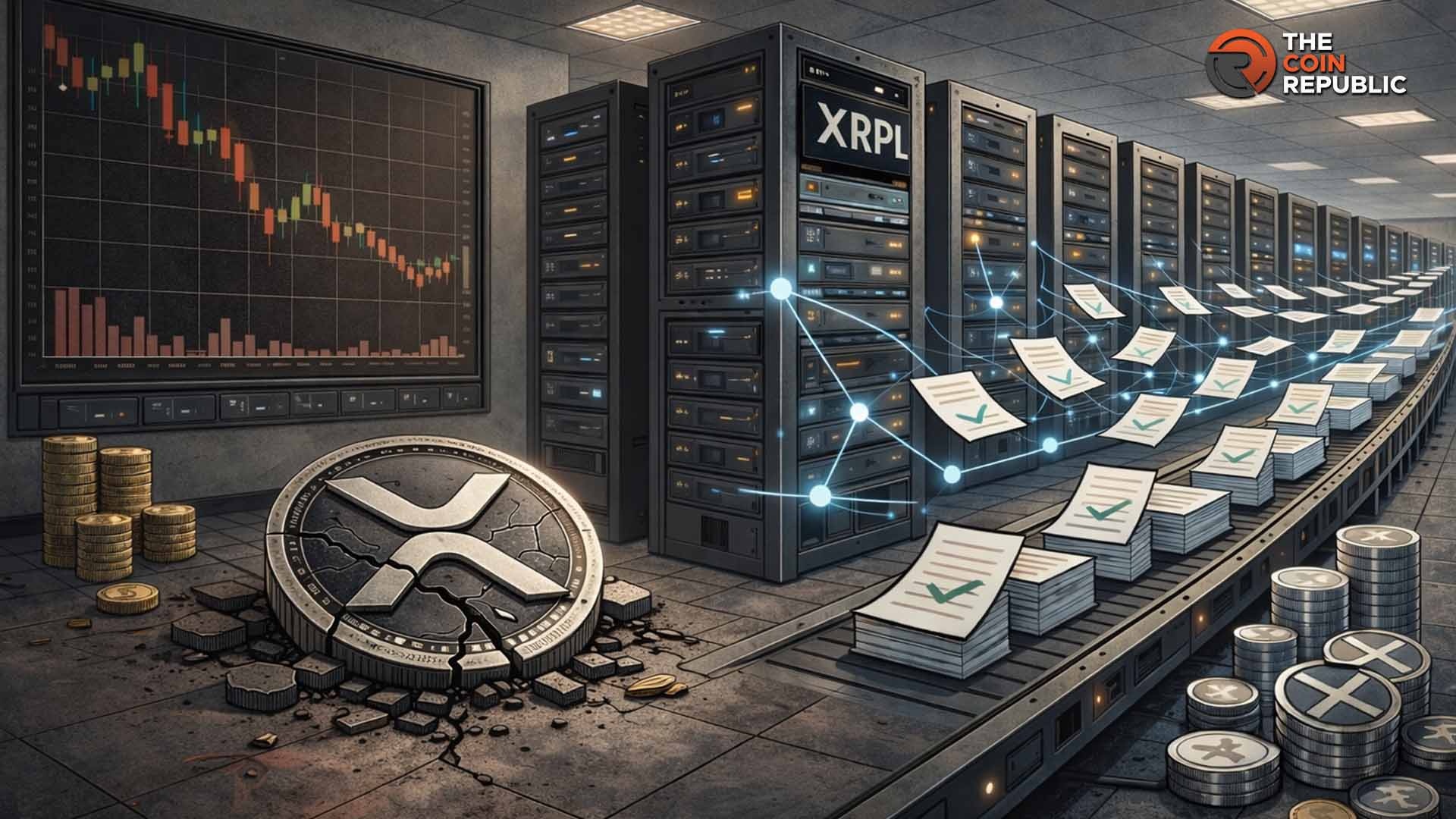
Despite a significant threefold increase in daily transactions on the XRP Ledger (XRPL) to 3 million, indicating strong adoption and utility for payments, liquidity, and tokenized assets, the XRP price is currently experiencing a downtrend, suggesting a decoupling of network activity from immediate price appreciation. The surge in XRPL activity highlights underlying network strength and adoption by both retail and institutional players, which market pundits view positively, yet this fundamental growth is not translating into price momentum amidst broader market downturns. While analysts remain bullish on XRP's long-term prospects with ambitious price targets, the current price action and declining trading volume indicate short-term investor caution or a lack of immediate catalyst to overcome prevailing market sentiment.

Abra's planned public listing via SPAC at a $750 million valuation signals a maturing crypto infrastructure sector seeking traditional market integration. The $300 million potential cash infusion will likely fuel Abra's expansion into institutional crypto lending, yield, and custody, potentially increasing competition in these areas. Abra's strategic shift towards institutional and high-net-worth clients after regulatory challenges highlights a trend of crypto firms adapting to compliance requirements to access broader markets. The planned Nasdaq listing under ticker ABRX provides a new avenue for traditional investors to gain exposure to crypto-related financial services, potentially driving demand for related assets.
Crypto majors are demonstrating significant strength, outperforming traditional markets despite escalating geopolitical tensions and a volatile macro environment. The sustained inflow streak into Bitcoin ETFs, coupled with positive ETH ETF performance, signals growing institutional demand and confidence in major digital assets. Tom Lee's substantial over-the-counter purchase of ETH from the Ethereum Foundation indicates strong conviction from a prominent figure, potentially influencing market sentiment. Stanley Druckenmiller's forward-looking view on stablecoins reshaping global payments highlights a potential long-term growth narrative for the stablecoin sector.

President Javier Milei is under federal investigation for alleged involvement in a cryptocurrency 'rug pull' involving the $LIBRA token, with evidence suggesting a $5 million payment scheme tied to his promotion. Forensic evidence and recovered documents directly contradict President Milei's defense, indicating the $LIBRA token promotion was a pre-arranged deal rather than a spontaneous endorsement. The investigation has escalated to include Milei's sister, Karina Milei, with her phone seized and bank records unsealed, and Interpol has been requested to issue a Red Notice for the $LIBRA creator. The scandal has significant political ramifications for President Milei, including potential impeachment proceedings, and has led to international class-action lawsuits and a criminal probe into alleged fraud and bribery.
Signal context only. Validate with price action, liquidity, and risk limits before taking a position.
