
Navigating Crypto News

CoinFeather
Navigating Crypto News
Quick market read from this story
Significant outflows from Bitcoin and Ethereum spot ETFs on April 7th indicate a potential shift in institutional sentiment, suggesting short-term selling pressure may impact prices.
While BTC and ETH ETFs experienced net outflows, the inflow into XRP ETFs highlights selective investor interest, implying a nuanced market sentiment rather than a broad downturn.
The observed outflows from major crypto ETFs could signal a period of consolidation or a precursor to further price adjustments, warranting close monitoring of subsequent trading days.
Source, catalyst, and sector overlap from the latest feed.
Bitmine's significant accumulation of 4.8 million ETH, valued at $10.2 billion, represents a substantial conviction from a major player, yet the market has not yet reflected this in ETH's price. The upcoming NYSE uplisting for Bitmine on April 9th, backed by prominent investors, could serve as a catalyst for increased institutional interest and potential ETH price appreciation. Pepeto's imminent Binance listing and successful presale, raising over $8.78M, positions it as a potential high-growth opportunity, drawing parallels to early ETH market dynamics. While ETH price predictions suggest significant long-term upside, the current sideways movement contrasts with Pepeto's potential for rapid gains post-listing, offering a distinct risk-reward profile.
Live Feed
Loading the broader stream in the same flow as the homepage feed.

JPMorgan CEO Jamie Dimon identifies blockchain technology, stablecoins, and tokenization as direct competitive threats to traditional banking, signaling a strategic imperative for banks to adopt these innovations. Dimon's acknowledgment of blockchain's efficiency, despite his continued skepticism towards public cryptocurrencies like Bitcoin, highlights a bifurcated view within traditional finance towards underlying technology versus speculative assets. The bank's investment in its proprietary blockchain platform, Kinexys, underscores a proactive approach to integrating distributed ledger technology to maintain market share against emerging fintech and blockchain-native competitors.

Ethereum's stablecoin supply reaching $180 billion signifies robust on-chain liquidity and growing institutional interest, potentially fueling a sustained bull cycle driven by RWA tokenization. The projected $850 billion in "new flows" to Ethereum by 2030, if realized, indicates a significant long-term growth trajectory for the network as a hub for stablecoins and tokenized assets. Despite strong growth, potential competition from rival chains, regulatory uncertainties, and macroeconomic volatility remain key factors that could impede further upside for Ethereum's stablecoin dominance.

Pi Network's successful distribution of KYC validator rewards, distributing over 26 million PI coins, signals a move towards a more decentralized workforce and utility beyond basic mining. The V21.2 protocol upgrade is positioned as a foundational enhancement for Pi Network, aiming to improve stability, scalability, and security, which could support future development and dApp integration. While Pi Network is trading near $0.17, its potential to reach $0.30 is contingent on broader market sentiment, particularly Bitcoin's performance above $69,000, and overcoming key resistance levels around $0.20.

Academic research suggests that the energy and computational requirements for a quantum computer to successfully mine Bitcoin are astronomically high, approaching stellar output, effectively rendering a 51% attack via quantum mining physically unattainable. The article debunks sensationalized claims of imminent quantum threats to Bitcoin by highlighting research that demonstrates past "quantum factoring breakthroughs" were based on flawed premises or simplified problems, easily replicated with older technology. While quantum attacks on Bitcoin mining are deemed impractical, the threat to older or reused wallet addresses remains a genuine long-term concern, prompting ongoing development of quantum-resistant solutions. Market participants appear to be pricing in the quantum threat as a distant concern, with higher probabilities assigned to wallet security upgrades rather than fundamental changes to Bitcoin's mining algorithm in the near term.

Bitcoin's reclaim of the $72K level, driven by a significant short squeeze, signals renewed bullish momentum and potential for further upside. The substantial $596 million in liquidations, predominantly short positions, indicates a strong shift in market sentiment and a potential catalyst for a sustained bull run. Analysts are closely watching the $80,000 mark as a critical psychological and technical level that could confirm a transition from a bear to a bull market, with some predicting this could occur this week. A large whale initiating a highly leveraged long position on both BTC and ETH suggests extreme conviction in an impending price surge, potentially influencing market dynamics.
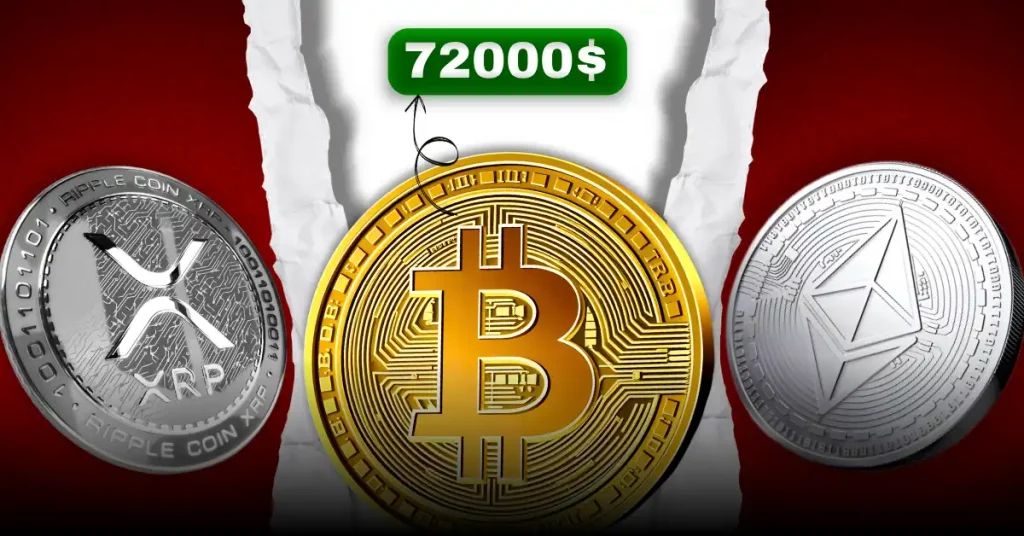
Easing geopolitical tensions in the Middle East, particularly regarding US-Iran relations, has triggered a positive risk-on sentiment in crypto markets, driving prices for Bitcoin, Ethereum, and XRP higher. Improved liquidity conditions due to cooling oil prices, a consequence of reduced war fears, are facilitating capital rotation back into crypto and equities, supporting the current market rally. Technical indicators for Bitcoin, Ethereum, and XRP show positive momentum with prices reclaiming key moving averages, suggesting potential for further upside if resistance levels are broken.

XRP's breakout above $1.37, supported by whale accumulation and strong volume, signals potential short-term upside, but traders must monitor for confirmation above $1.40-$1.42 to invalidate the broader downtrend. Despite the tactical breakout, XRP's trend reversal remains unconfirmed due to ongoing ETF outflows and mixed long-term conviction, suggesting a cautious approach is warranted. Ripple's strategic positioning within the growing stablecoin market and deepening ties in Asia, particularly Japan, could provide fundamental support for XRP's ecosystem development.

Anthropic's AI model has demonstrated a significant capability to discover thousands of critical software vulnerabilities, including decades-old bugs, signaling a potential paradigm shift in cybersecurity defense and offense. The limited release of Anthropic's Claude Mythos Preview and the formation of Project Glasswing with major tech players suggest a strategic move to leverage AI for proactive threat detection and patching, potentially enhancing overall software security. While AI-driven vulnerability discovery promises a more secure future, the "transitional period" is acknowledged as "fraught," implying potential near-term risks from the proliferation of these capabilities before robust defenses are universally implemented. The news highlights the growing intersection of AI and cybersecurity, with potential implications for blockchain protocols and infrastructure that rely on secure software, though no specific crypto assets are directly mentioned as affected.
Signal context only. Validate with price action, liquidity, and risk limits before taking a position.
Zcash price has surged nearly 23% in 24 hours, driven by short liquidations and increased open interest, indicating aggressive short-term positioning rather than a fundamental trend shift. The current rally faces a critical resistance zone around $320-$330, coinciding with the 200-day moving average, which will determine if ZEC can sustain its upward momentum or face rejection. A confirmed daily close above $330 could signal a trend reversal with upside targets at $375 and $420, while a failure to hold this level and a drop below $280 would invalidate the bullish setup.
