
Navigating Crypto News

CoinFeather
Navigating Crypto News
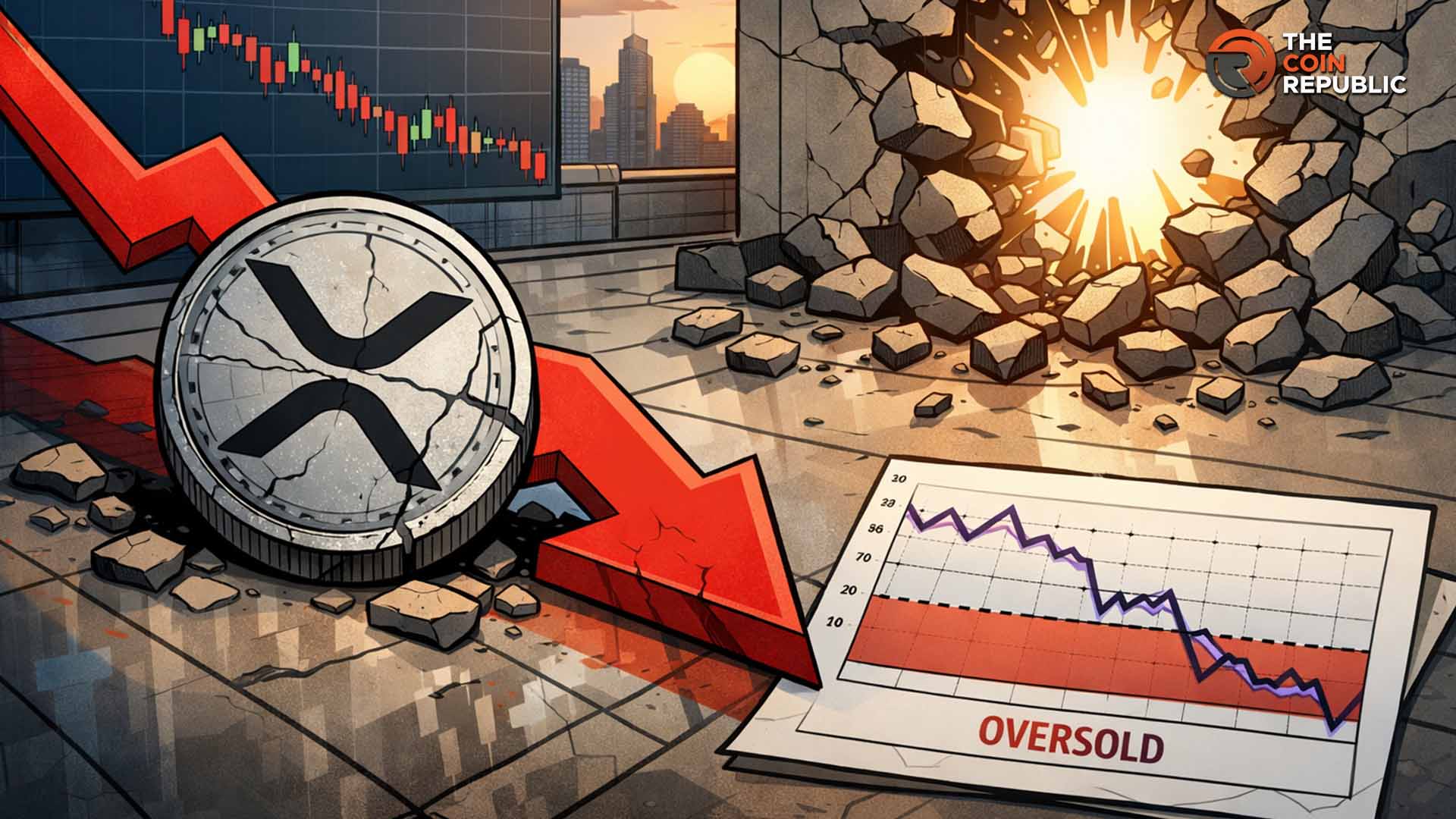
Quick market read from this story
XRP's RSI hitting 2022 bear market lows suggests extreme oversold conditions, historically a precursor to potential reversals, warranting trader attention for momentum shifts.
Despite zero daily XRP ETF inflows, the substantial cumulative $1.21 billion indicates sustained institutional interest, with current flat flows likely reflecting market observation rather than disinterest.
The surge in XRP Ledger transactions to nearly 3 million daily, coupled with Evernorth's $1 billion XRP treasury plan, signals increasing network utility and growing institutional adoption within the XRP ecosystem.
The confluence of technical oversold signals and fundamental on-chain activity growth, alongside institutional treasury plans, presents a potentially bullish setup for XRP if broader market sentiment turns positive.
Source, catalyst, and sector overlap from the latest feed.
Despite a recent price drop below $2,000, Ethereum's network activity has surged, with daily active addresses reaching 1.1 million in February, indicating accumulation by long-term holders and potential for future price appreciation. The significant increase in staked Ether (37.85 million) and decreasing exchange reserves suggest a tightening liquid supply, which could amplify price movements when demand returns. Ethereum is approaching a key resistance level, and its ability to break through or hold the current support zone will determine its short-term trajectory, with the 21-week EMA near $2,700 as a potential target if momentum builds.
Live Feed
Loading the broader stream in the same flow as the homepage feed.
Geopolitical tensions in the Middle East are driving a significant risk premium in Brent crude, pushing prices to $111/barrel and sparking speculation of $150-$200 levels. Despite the current spike, the futures market suggests traders anticipate a normalization of prices towards the low $100s by Q1 end and mid-$110s over 12 months, indicating a belief that extreme levels are low probability. The tight inventory, limited spare capacity, and prior strategic reserve draws create an upside risk for oil prices if diplomatic efforts fail and shipping lanes remain disrupted. The volatility in oil prices is directly impacting consumer costs and inflation expectations, potentially influencing central bank policy and driving short-term trading activity across related financial instruments.

Bitcoin's price discovery has structurally shifted from spot demand to a derivatives-driven market, influenced by futures, options, and ETF hedging mechanics. The increasing correlation with traditional risk assets like the Nasdaq highlights Bitcoin's integration into global macro portfolios, amplifying volatility during liquidity cycles. While scarcity remains a core attribute, Bitcoin's marginal price is now largely set by liquidity dynamics and the cost of capital within the derivatives ecosystem. The evolution of financial products, including ETFs and derivatives, is transforming Bitcoin into a portfolio building block, enabling more sophisticated investor strategies and risk management.

The ECB's proactive search for experts to integrate a digital euro into existing payment infrastructure signals a significant step towards potential adoption, indicating a shift from theoretical planning to practical implementation. While the ECB focuses on a digital euro, the parallel development of the Qivalis project by European banks highlights a growing interest in stablecoin solutions for blockchain payments, potentially creating a competitive landscape. The ECB's preparatory work and potential 2029 rollout timeline suggest a long-term strategic play in digital currency, which could influence traditional financial systems and digital asset integration over the next several years.
AI chips need DRAM and HBM, and Micron is a key supplier. Check 2026 price targets, earnings forecasts, and risks before betting on more upside in MU.
Dogecoin futures open interest hints at a likely price reset as DOGE falls below $0.10.

Significant open interest in deep out-of-the-money Bitcoin put options suggests traders are employing volatility strategies or selling premium rather than outright bearish bets. Despite geopolitical tensions, the overall options market sentiment remains slightly bullish with a put-call ratio below 1, indicating more call options are being traded. The concentration of open interest at $75,000 and $125,000 strikes alongside the $20,000 puts indicates a wide range of market expectations, from upside potential to tail-risk hedging. The $20,000 put option's popularity, while appearing bearish, is likely a premium-selling strategy due to the low probability of such a drastic price drop, suggesting a focus on income generation or volatility plays.

Michael Saylor reiterates Bitcoin as the 'ultimate hedge against chaos' despite recent price drops in BTC, gold, and silver, signaling conviction in its uncorrelated value proposition. Bitcoin's recent price decline to $69,190, a drop of over 8.5% in 24 hours, contrasts with its prior surge to $76,000, indicating market uncertainty and a flight to USD amid geopolitical and policy concerns. MicroStrategy's significant Bitcoin holdings are currently showing an unrealized loss of 8.44% based on an average purchase price of $75,696, yet Saylor views this as an entry opportunity rather than a signal to exit.

The CFTC's first information-sharing agreement with a professional sports league, MLB, signals a growing regulatory framework for prediction markets tied to real-world events. This collaboration with MLB and Polymarket as an exclusive partner aims to enhance the integrity of prediction markets by mitigating fraud and manipulation risks. The establishment of a federal regulatory approach for prediction markets, as opposed to state-by-state regulation, simplifies compliance and potentially encourages broader adoption.
Gold has experienced an 8% pullback from recent highs, driven by shifting interest rate expectations and hawkish Fed commentary, which has increased real yields and strengthened the dollar. Despite the short-term correction, major financial institutions maintain a bullish outlook for gold, forecasting a return to higher price levels by year-end, supported by anticipated Fed rate cuts and continued central bank demand. The primary risks to the bullish gold narrative include prolonged high interest rates, a stronger dollar, and a significant slowdown in inflation, which could lead to extended consolidation rather than an immediate resumption of the uptrend. The current pullback is interpreted as a classic bull-market correction within a larger uptrend, rather than a definitive cycle top, suggesting potential buying opportunities at support levels.

US regulators are signaling a bifurcated future for on-chain dollar equivalents, where bank-issued tokenized deposits will retain FDIC insurance while payment stablecoins will not, potentially shifting competitive advantages back to traditional finance infrastructure. This regulatory distinction could lead to market segmentation, with stablecoins potentially dominating open, permissionless networks for payments and transfers, while tokenized deposits become the preferred instrument for institutional settlement and regulated asset markets due to their insured status. The FDIC's proposed stance creates a clear competitive dynamic: banks can offer insured on-chain money, while non-bank stablecoins may lose a key differentiator, forcing them to rely on network effects and programmability to maintain market share.

A Coinbase subdomain linked to its Commerce tool reportedly directed users to a withdrawal page asking to enter their seed phrases, raising concerns among security observers.
Find out what analysts expect for PulseChain in 2026, with realistic price forecasts, token supply insights, and long-term market outlook.
Signal context only. Validate with price action, liquidity, and risk limits before taking a position.
Tether's new AI framework enables large language model training on consumer smartphones, potentially democratizing AI development and reducing reliance on centralized cloud providers. The framework's use of BitNet architecture and LoRA fine-tuning significantly lowers memory requirements, making AI model development more accessible and cost-effective. This development aligns with a broader trend of crypto firms investing in AI infrastructure, signaling a convergence of blockchain and artificial intelligence technologies. By supporting non-Nvidia hardware and mobile GPUs, Tether's initiative aims to decentralize AI compute power, challenging the dominance of traditional high-performance computing setups.
