
Navigating Crypto News

CoinFeather
Navigating Crypto News

Source, catalyst, and sector overlap from the latest feed.
Geopolitical uncertainty stemming from Middle East conflict is driving defensive capital flows into stablecoins and liquid staking tokens, indicating a market preference for yield and capital preservation over speculative assets. Bitcoin and Ethereum experienced declines mirroring traditional markets, suggesting a correlation with broader macroeconomic sentiment and risk-off behavior among investors. Conflicting statements regarding Iran's willingness to negotiate have created volatility, with crypto markets reacting to shifts in geopolitical risk perception. Traders are positioning for potential downside in Bitcoin, with prediction markets showing a higher probability of a price drop to $55,000 than a significant rally.
Live Feed
Loading the broader stream in the same flow as the homepage feed.

GameStop has transitioned its Bitcoin holdings into an options income strategy, pledging BTC to Coinbase for covered calls, indicating a shift from a simple buy-and-hold approach. The company no longer directly holds its Bitcoin, now accounting for it as a receivable due to Coinbase's ability to rehypothecate the assets, altering its balance sheet treatment. While GameStop maintains economic exposure, the pledged Bitcoin is now encumbered by counterparty risk and derivative contracts, changing its liquidity and risk profile.

Japan's Financial Services Agency has issued warning letters to KuCoin for unregistered OTC derivatives trading, signaling continued regulatory scrutiny on exchanges operating in the region. This regulatory action by the FSA, following previous warnings and app removal requests, suggests a tightening environment for crypto exchanges targeting Japanese residents. The development highlights the ongoing risk of regulatory enforcement for platforms not adhering to local financial instrument laws, potentially impacting KuCoin's operations and user base in Japan.

Corporate Bitcoin treasury buying has significantly contracted, with Strategy (MicroStrategy) now accounting for 98% of recent purchases, indicating a shift from a broader trend to a single dominant buyer. The financing model for corporate Bitcoin treasuries, reliant on rising prices and favorable equity premiums, is faltering as Bitcoin's price has declined, making it harder for companies to issue stock for further BTC acquisition. The weakening demand from corporate treasuries outside of Strategy suggests a potential reduction in incremental buying pressure for Bitcoin, impacting market dynamics for companies that previously leveraged stock issuance for BTC accumulation. Signs of stress are emerging within the corporate treasury sector, with some companies selling Bitcoin to support stock prices and others facing mounting unrealized losses, signaling a more selective and challenging environment ahead.

OKX's decision to delay its IPO, prioritizing long-term shareholder value over immediate market entry, signals a cautious approach to public listings within the crypto industry. The exchange's strategic investment from ICE, valuing the company at $25 billion, suggests a strong underlying business despite the IPO postponement, potentially indicating a robust foundation for future growth. OKX's emphasis on building a durable company over decades, rather than timing the market, reflects a strategic shift towards sustainable growth and away from the speculative frenzy seen in past crypto booms. Concerns about past poor performance of crypto IPOs, as highlighted by OKX's executive, suggest a potential for continued investor skepticism towards similar listings, impacting the broader exchange sector.

MicroStrategy's preferred equity (STRC) has recovered to par value faster than its historical average, enabling the company to raise capital for further Bitcoin accumulation. The faster recovery of STRC to $100 par value suggests improved market confidence or demand for the instrument, directly facilitating MicroStrategy's strategy of buying Bitcoin with newly issued equity. This development allows MicroStrategy to continue its Bitcoin buying strategy, potentially increasing its BTC holdings and reinforcing its position as a major corporate holder, which could indirectly support Bitcoin's market narrative.
XRP's market structure is shifting as speculative leverage on Binance has significantly decreased by approximately 78%, suggesting a move towards spot demand-driven price action rather than futures positioning. Growing crypto adoption in Africa, with over $205 billion in on-chain value, provides a narrative tailwind for XRP, aligning with Ripple's focus on payments and cross-border transactions in emerging markets. Despite reduced leverage and increased on-chain activity on the XRP Ledger, traders are closely watching key support levels around $1.37-$1.40, as a break below could trigger a ~16% correction due to a bearish head-and-shoulders pattern.

Ripple's significant RLUSD token burns, totaling over 35 million tokens across Ethereum and XRP Ledger, indicate active supply management by the stablecoin treasury. While token burns are routine for stablecoin peg maintenance, the scale and short timeframe of these recent burns have prompted community discussion about liquidity management and potential underlying market dynamics. The market cap fluctuation from $1.6 billion to $1.4 billion due to these burns highlights the direct impact of supply adjustments on stablecoin valuation and circulating supply.
Economist Peter Schiff warns of a potential US housing market crisis exceeding 2008 levels, driven by collapsing affordability due to rising mortgage rates, insurance, taxes, and utilities. The current housing market risks are primarily linked to affordability erosion rather than excessive leverage, creating a feedback loop of lower demand and price pressure. Geopolitical tensions and persistent inflation, exacerbated by potential conflict and Fed policy, add a new layer of risk, with higher oil prices being a key concern for increased costs. The article draws parallels to China's housing market downturn, highlighting the vulnerability of housing markets to extreme monetary conditions and converging economic pressures.

The upcoming $3.7 billion options expiry on Deribit introduces a significant event risk, potentially driving short-term price volatility for Bitcoin and Ethereum. Geopolitical tensions and macro events are increasing overall market volatility, pressuring Bitcoin and Ethereum prices ahead of key support levels. Analysts suggest that while short-term retracements are expected, the health of Bitcoin and Ethereum's price action will depend on their ability to hold critical support levels around $106,000 and $2,700 respectively. The put-call ratios and max pain points for both BTC and ETH options indicate a mixed to bearish sentiment among traders, suggesting caution is warranted.

Veteran trader Peter Brandt warns of a potential 75% Bitcoin crash, drawing parallels to the 2022 downturn, suggesting that current market conditions near $110K may signal overheating and increased volatility. On-chain data from Glassnode indicates potential market overheating in the derivatives space, with rising liquidations and speculative interest, despite cautious optimism reflected in funding rates. Technical indicators for Bitcoin show slowing bullish momentum with resistance at $110K and support at $108K-$108.5K, suggesting a critical juncture that could lead to a sharp pullback if sentiment shifts.
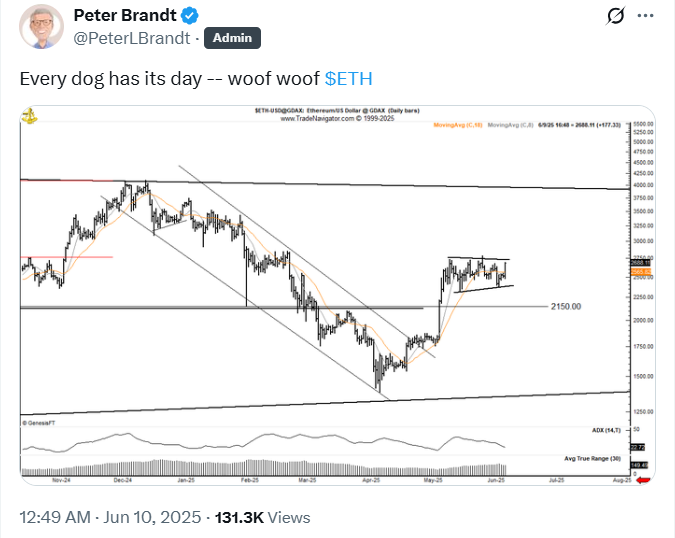
Ethereum has reclaimed its 200-day Moving Average, a key technical indicator, suggesting a potential bullish trend continuation and a retest of higher price levels. Significant inflows into Ethereum ETFs, coupled with strong DeFi ecosystem performance and increased whale accumulation, indicate growing institutional and retail interest, supporting price appreciation towards the $4,000 target. The rotation of capital from SOL to ETH, as observed in whale transactions, signals a potential shift in market sentiment favoring Ethereum's established utility and ecosystem over emerging competitors. Increased trading volume and reclaiming the 200-day MA suggest that ETH is building momentum for a breakout, with expert projections targeting $4,000, making it a key asset to watch for near-term upside.
Signal context only. Validate with price action, liquidity, and risk limits before taking a position.
Quick market read from this story
Ripple's deployment of AI for enhanced XRP Ledger security, including an AI-assisted red team, signals a proactive approach to mitigating risks and could bolster investor confidence in the platform's long-term stability.
The prioritization of bug fixes over new features in the upcoming XRP Ledger release, coupled with increased security audits, indicates a maturing development cycle focused on foundational integrity, which may appeal to institutional adoption.
Despite the security enhancements, XRP's price decline to a two-week low suggests that broader market sentiment and macroeconomic factors are currently overshadowing project-specific developments.
Deep Dive
Ripple has announced a significant security enhancement for the XRP Ledger, implementing an AI-powered strategy that includes automated testing and a dedicated red team. This initiative has already identified more than 10 bugs within the blockchain's codebase.
The new security approach integrates AI tools throughout the XRP Ledger development process. This involves adversarial code scanning for every pull request and comprehensive automated stress testing. The AI-assisted red team specifically analyzes how new features interact with existing code in real-world conditions, focusing on the boundaries between legacy and new functionalities.
In a move to prioritize security, Ripple plans to dedicate the upcoming XRP Ledger software release solely to bug fixes and improvements, foregoing the introduction of new features. The company also intends to mandate multiple independent security audits for any substantial protocol changes and is expanding its existing bug bounty program. A statement from Ripple emphasized their commitment to evolving the XRPL by systematically strengthening its foundation to meet the demands of global payments, tokenized assets, and institutional-grade financial infrastructure.
The announcement comes as XRP was trading around $1.34 on Thursday, marking a 5% decrease on the day. This decline occurred amidst a broader downturn in the cryptocurrency market and broader economic uncertainties. At this price, XRP reached its lowest point in over two weeks, a significant drop from its all-time high of $3.65 reached in July of the previous year.
Wikipedia's new policy prohibiting AI-generated text for articles signals a growing concern over content accuracy and verifiability, potentially impacting platforms reliant on user-generated content. The distinction between AI-assisted copyediting and AI-generated content is crucial, with Wikipedia allowing the former under strict human oversight, highlighting a nuanced approach to AI integration. This development underscores the challenges in maintaining content integrity in the age of LLMs, a concern that could extend to other decentralized platforms and knowledge bases. While not a direct crypto event, the policy reflects broader societal discussions on AI's role and potential risks, which can indirectly influence investor sentiment towards AI-integrated crypto projects.
