
Navigating Crypto News

CoinFeather
Navigating Crypto News

Quick market read from this story
Bitcoin's resilience around $70,000 is driven by significant options market activity, particularly a large upcoming expiry on March 27, which creates a "magnet" effect due to concentrated hedging flows.
The recent oil shock and associated supply chain concerns initially triggered Bitcoin liquidations, but the derivatives market's gravitational pull towards key strike prices like $70,000 and $75,000 facilitated a rapid rebound.
Traders should monitor the March 27 options expiry and ongoing macro volatility, especially related to oil and shipping, as these factors will likely continue to influence Bitcoin's price action within the established derivatives-driven corridor.
Deep Dive
Bitcoin experienced a notable rebound, returning to the $70,000 zone on March 4, despite escalating geopolitical tensions in the Middle East that impacted oil prices and shipping. While traditional risk assets were under pressure due to disruptions in the Strait of Hormuz, Bitcoin's recovery was driven by a combination of macro factors and the significant influence of the derivatives market, particularly options.
The Strait of Hormuz, a critical chokepoint for global oil and gas trade, saw increased threats following joint US and Israeli strikes on Iran and retaliatory attacks. This led to a surge in oil prices, shipping costs, and war risk insurance premiums, as traffic through the strait was disrupted. The impact on oil prices, which are fundamental to the global economy, raised concerns across various markets regarding logistics, inflation, and broader economic stability.
Bitcoin's initial reaction to the macro shock involved significant liquidations, with nearly $1 billion in Bitcoin positions liquidated between February 28 and March 1. However, the cryptocurrency quickly rebounded, a recovery attributed largely to the dynamics of the options market. The concentration of open interest and high gamma sensitivity around the $70,000 to $73,000 range, particularly near $71,000, created a magnetic effect. This means that as the price moved, hedging activities by large institutions amplified short-term price swings, contributing to the rapid recovery.
The options market, especially for Bitcoin, has grown substantially, exerting a significant gravitational pull on price action. Data from CoinGlass indicates dense open interest between $70,000 and $75,000, with substantial notional exposure at these levels. A major factor influencing future price action is the upcoming options expiry on March 27, which carries approximately $13.27 billion in notional exposure. This large expiry is expected to concentrate trading behavior and intensify hedging as the date approaches, potentially reinforcing the magnetic effect of the $70,000 to $75,000 corridor.
The overall open interest in BTC options rose from around $32 billion in late February to $36-37 billion in early March, underscoring the growing influence of options-related flows during periods of volatility.
The sequence of events highlights a clear interplay: the oil shock initially triggered broad market sell-offs, including Bitcoin, due to its liquidity and 24/7 trading. Subsequently, as selling pressure subsided, Bitcoin's rebound was channeled into the $70,000 to $75,000 options corridor. This zone, characterized by high hedging sensitivity and significant open interest, amplified price movements. Additionally, repeated negative funding spikes observed in late February and early March, followed by rallies, suggest short-covering adding buying pressure that pushed prices into these derivative-heavy zones.
Moving forward, three key areas will be crucial to watch: the concentration of strike prices in the options market, as shifts in open interest will indicate changes in the price corridor; the approaching March 27 expiry, which could reshape market positioning; and the ongoing volatility in oil and shipping markets, which will likely continue to influence Bitcoin's behavior as a fast, liquid asset that reacts to macro shocks by selling initially and then rebounding into derivative-concentrated levels.
Source, catalyst, and sector overlap from the latest feed.
AI is augmenting, not replacing, high-skill tech roles like software engineers and designers, shifting value towards direction, judgment, and oversight rather than pure execution. The crypto industry can leverage AI for faster coding, document review, and task automation, but will still require human expertise for security, product integrity, and operational risk management. While AI adoption is increasing productivity and changing the job mix, the primary risk appears to be a shrinking entry-level talent pipeline rather than immediate mass layoffs in skilled tech sectors. Companies may see short-term economic gains from AI-driven efficiency, but face a medium-term risk of a thinner talent pool if junior roles are absorbed by AI-assisted workflows.
US lawmakers are proposing legislation to ban prediction markets tied to military action and national security events, spurred by significant betting volumes on Iran-related outcomes, indicating a potential regulatory crackdown on specific market segments. The regulatory push highlights a divergence between regulated US exchanges like Kalshi and offshore crypto platforms like Polymarket, suggesting a possible future where controversial prediction markets are pushed offshore, mirroring trends seen in the broader crypto industry. While a blanket ban on prediction markets is unlikely due to CFTC rulemaking and industry arguments for their utility, the focus is shifting towards which types of contracts, particularly those involving war and sensitive government actions, will be tolerated, signaling a narrowing of acceptable market activities. Institutional interest, such as Intercontinental Exchange's investment in Polymarket, complicates the regulatory landscape, presenting prediction markets as a growing part of mainstream finance while simultaneously drawing scrutiny for their association with high-risk, ethically questionable events.
Bitcoin's recent rally above $73,000 is interpreted as a potential regime transition, moving from peak negative momentum to a more stable state if key levels are held. Easing spot demand contraction and a resurgence in US ETF inflows suggest a shift from selling pressure to potential accumulation, though broader bullish indicators remain low. The market is testing critical resistance at $79,000 and $90,000, with sustained holds indicating a structural shift, while rejections could signal a continuation of bear-market relief bounces. The next 4-12 weeks will likely see Bitcoin either fail to hold momentum above key thresholds, consolidate in a base-building range, or confirm a regime change with sustained positive demand and ETF flows.
A prolonged oil shock stemming from the US-Iran conflict could force the Federal Reserve to delay interest rate cuts, shifting Bitcoin's primary bullish catalyst from a liquidity tailwind to a liquidity stall. Sustained elevated oil prices, particularly if Brent crude reaches $100-$150, would likely lead to increased inflation impulses, forcing a 'higher-for-longer' interest rate environment that negatively impacts risk assets like Bitcoin. Beyond macro impacts, a sustained oil price surge also threatens miner economics by increasing electricity costs, potentially leading to sell pressure on Bitcoin or reduced network security. The duration of the oil conflict is critical, with week four marking an inflection point where risk premiums transform into inflation concerns and week seven potentially pushing oil prices into recessionary territory, leading to significant Bitcoin repricing.
Stress in the $3 trillion private credit market, exemplified by Blue Owl's redemption halt and Blackstone's capital injection, signals a potential liquidity crunch that could force asset sales. Bitcoin's 24/7 liquidity and instant settlement make it a prime candidate for forced liquidation during a dash for cash, potentially leading to significant price drops similar to March 2020. The severity of Bitcoin's reaction to private credit stress hinges on whether the situation remains contained or escalates to systemic levels, influencing Fed policy and risk asset sentiment. While Bitcoin may be the first asset sold due to its liquidity, it could also be the first to rebound if the credit stress prompts expectations of Fed rate cuts.
Geopolitical tensions between the U.S. and Iran are driving a broad crypto market sell-off, impacting major assets like Bitcoin and Ethereum as investors de-risk. The potential for escalating conflict and U.S. actions to cut Iran's oil revenues are creating significant uncertainty, pressuring Bitcoin towards a key support level around $55,000. The current market downturn, characterized by a 3-5% drop across major altcoins, suggests a heightened sensitivity to global macroeconomic and geopolitical events rather than project-specific news.
The 2020 MakerDAO 'Black Thursday' incident, where a bot exploited a 40-minute window to acquire $8.32M in ETH for free due to network congestion and failed auctions, highlights critical DeFi risk management failures. This historical event serves as a foundational case study for modern DeFi liquidation systems, emphasizing the importance of designing for extreme network conditions and continuous market participation. The incident resulted in a $4.5M bad debt for MakerDAO, forcing MKR holders to approve a token mint to cover the shortfall, demonstrating the direct financial impact on governance token holders during protocol failures. With current DeFi liquidations in focus, the lessons from this 40-minute exploit remain highly relevant for assessing the resilience of decentralized finance protocols under stress.
Geopolitical tensions and weak US jobs data are driving a risk-off sentiment, leading to significant liquidations and a market-wide sell-off in cryptocurrencies. The decline in crypto market capitalization to $2.33 trillion, with Bitcoin and Ethereum experiencing notable drops, underscores the sensitivity of digital assets to global instability and macroeconomic factors. Short-term Bitcoin holders are realizing profits, transferring substantial amounts to exchanges, indicating a potential shift in sentiment and contributing to the current selling pressure. The market is experiencing a correction driven by macro events and profit-taking, with potential for further downside if selling pressure persists, contingent on geopolitical developments and economic data.
Archax's integration of Cardano (ADA) on its FCA-regulated platform provides institutional-grade custody, removing a key barrier for traditional finance capital deployment into the network. The move strategically positions Cardano as a primary network for Real-World Asset (RWA) tokenization, leveraging its protocol-level token standards for simplified compliance and reduced attack surfaces. Despite recent market fear and ADA trading near $0.27, the integration and growing ecosystem traction (300% TVL growth) suggest potential upside if fundamental adoption continues. Cardano's shift towards an enterprise infrastructure narrative, coupled with its energy-efficient Proof-of-Stake model, aligns with institutional ESG mandates and could attract further commercial development.
A significant BTC transfer of $19 million to exchanges by a wallet linked to Jane Street raises concerns of a potential market sell-off, potentially pressuring Bitcoin towards the $65K support level. Despite the immediate sell-off fears driven by Jane Street's actions, analysts highlight that $70K remains a critical support level, with some on-chain data suggesting long-term bullish momentum may persist if this level holds. The market is closely watching Bitcoin's ability to reclaim the $75K resistance and the 50-day SMA to confirm a continuation of bullish momentum, with significant short liquidation leverage currently outweighing long liquidation.
Live Feed
Loading the broader stream in the same flow as the homepage feed.

The launch of the ShibClaw skill represents an integration of AI agents into the Shiba Inu ecosystem, potentially enhancing automation for developers building on Shibarium. While the ShibClaw skill aims to provide AI-driven functionality for Shibarium, a warning has been issued regarding contract address verification and security best practices, highlighting ongoing risks in ecosystem development. This development signals a broader trend of AI integration within blockchain infrastructure, suggesting that AI agents could become crucial tools for scaling and operational efficiency in crypto ecosystems.
The renewed momentum for the CLARITY Act in the US signals a potential shift towards regulatory clarity, which could attract institutional capital and foster a more favorable environment for digital assets. While industry figures are optimistic about a July 2026 passage, political challenges and potential favoritism towards traditional finance could still delay or alter the bill, creating a bearish scenario of prolonged uncertainty. Traders may anticipate a 'buy the rumor, sell the news' dynamic around the CLARITY Act's progression, suggesting potential short-term trading opportunities as market sentiment reacts to legislative developments.

The US national cybersecurity strategy's explicit mention of crypto and blockchain marks a significant shift, integrating digital assets into national security discussions and potentially signaling future regulatory frameworks. Industry executives interpret the strategy's language on dismantling criminal infrastructure as a potential justification for increased enforcement against privacy coins and mixers, suggesting a bearish outlook for these specific crypto segments. The strategy's inclusion of post-quantum cryptography risks highlights growing government awareness of future technological threats to blockchain security, particularly impacting Bitcoin's underlying encryption and prompting consideration of protocol upgrades. While the strategy focuses on AI and workforce development, its broader implications for crypto security and financial regulation suggest that federal cyber priorities will increasingly influence the digital asset ecosystem.

A prominent researcher warns that quantum computing poses a future threat to the privacy of Zcash and Monero by potentially cracking their elliptic curve cryptography. While the threat is considered long-term by some experts, the core privacy mechanisms of ZEC and XMR could be compromised if public keys are exposed. The development highlights the ongoing challenge of quantum-resistant cryptography for privacy-focused assets and may prompt users to seek alternative privacy solutions.

Robert Kiyosaki's assertion that war drives silver demand, citing its use in rockets, suggests a potential bullish sentiment for silver as geopolitical tensions escalate. Despite recent volatility, silver's significant year-on-year surge and Kiyosaki's $200 price target highlight its perceived role as a safe-haven asset amidst global instability. While Kiyosaki links gold, silver, and Bitcoin as hedges against inflation from government spending on war, the article does not provide direct crypto market catalysts or price action.

Stablecoin transfer volume reached an all-time high of $1.8 trillion in February, indicating significant on-chain activity and potential capital deployment into crypto markets. USDC's dominance, capturing 70% of total stablecoin volume and surpassing Tether (USDT) in transfer volume, suggests growing adoption and trust in Circle's stablecoin, potentially impacting market share dynamics. The surge in stablecoin supply on exchanges, coupled with a recovering Stablecoin Supply Ratio (SSR), signals increased 'buying power' returning to the market, which historically precedes upward price movements for assets like Bitcoin. The substantial increase in stablecoin liquidity on exchanges, reaching a three-week high, acts as a direct catalyst for potential price appreciation in major cryptocurrencies, as sidelined capital becomes readily available for investment.

A US federal court has dismissed the lawsuit accusing Binance and CZ of enabling terrorist financing, citing insufficient evidence from plaintiffs. The dismissal removes a significant legal overhang for Binance, potentially improving sentiment and reducing regulatory uncertainty for the exchange. While this specific lawsuit is dismissed, Binance still faces other regulatory scrutiny, suggesting continued caution is warranted for the exchange's operational outlook.
The DTCC, a critical financial infrastructure provider, has patented a cross-ledger settlement framework that identifies XRP and XLM as key digital liquidity tokens for global asset tokenization. This development signals institutional interest in leveraging blockchain for efficient settlement of tokenized assets, potentially positioning XRP and XLM as crucial bridges between traditional finance and distributed ledgers. While the patent does not guarantee immediate adoption, it highlights a strategic exploration by major financial players into interoperability solutions, suggesting a future where these assets could facilitate trillions in tokenized asset flows.
Weakening U.S. labor market data, indicated by a 92,000 job loss and a rise in unemployment to 4.4%, is increasing speculation of Federal Reserve rate cuts, which could boost crypto market liquidity and risk appetite. While some economists anticipate Fed rate cuts by mid-year or later to confirm sustained labor market weakness and controlled inflation, prediction markets show a slight uptick in expectations for a March cut. A dovish Fed policy shift towards lower interest rates typically weakens the U.S. dollar and can drive investors towards alternative assets like Bitcoin, potentially fueling a crypto rally. The market is closely monitoring incoming employment and inflation data, as well as Fed communications, to gauge the timing of potential rate cuts and their subsequent impact on Bitcoin and broader crypto markets.

Grok's recent viral, vulgar roasts of public figures, including Elon Musk, highlight the evolving nature of AI guardrails and its potential for unpredictable, attention-grabbing outputs. Elon Musk's positive reaction to Grok's controversial roasts suggests a potential strategy to leverage AI's uninhibited nature for engagement, which could influence how AI-powered platforms are perceived and utilized. The controversy surrounding Grok's roasts, following previous issues with sexualized deepfakes and conspiracy theories, indicates ongoing challenges in AI content moderation and safety, potentially leading to increased regulatory scrutiny for xAI and similar platforms. While the roasts generated significant buzz, the underlying development is primarily about AI behavior and content generation rather than a direct market event for specific cryptocurrencies, suggesting a neutral impact on crypto assets.

Significant Bitcoin exchange outflows, totaling approximately $3 billion, suggest a shift towards long-term holding rather than immediate selling, a pattern historically associated with bottom formations. The capitulation of short-term holders, evidenced by large profit-taking on exchanges, combined with aggressive accumulation by long-term holders, indicates a potential market bottom where weaker hands exit and stronger hands accumulate. The appearance of a golden cross on the Inter-Exchange Flow Pulse indicator, alongside Bitcoin holding the 2021 all-time high support level, signals a potential shift from speculative derivatives trading to spot accumulation and reinforces the structural integrity of the market. While short-term volatility may persist, the confluence of on-chain signals such as exchange outflows, LTH accumulation, and technical support suggests Bitcoin may be stabilizing near a potential price bottom, setting the stage for a future rally.

Anticipation of the Clarity Act's passage is driving institutional interest in specific altcoins, suggesting a potential pre-emptive capital inflow ahead of regulatory clarity. Banks are reportedly accumulating assets tied to stablecoin infrastructure and RWA tokenization, indicating a strategic focus on these emerging crypto sectors. The article highlights a diversified list of 8 altcoins, with Ethereum, Solana, XRP, Chainlink, HBAR, Canton Network, Uniswap, and Ondo Finance identified as key targets for institutional accumulation. The recommended accumulation strategy is Dollar-Cost Averaging (DCA) over the long term, implying that the identified opportunities are viewed as structural rather than short-term speculative plays.

A US federal court's approval of class action status in the Tether and Bitfinex lawsuit signifies a significant legal development that could lead to substantial market scrutiny. The lawsuit's core claim that Tether (USDT) issuance was used to manipulate Bitcoin and Ethereum prices during the 2017 bull run, if proven, could have profound implications for stablecoin market integrity and investor confidence. While the court's decision is procedural, it opens the door for evidence presentation, potentially impacting future regulations on stablecoin transparency and market practices.
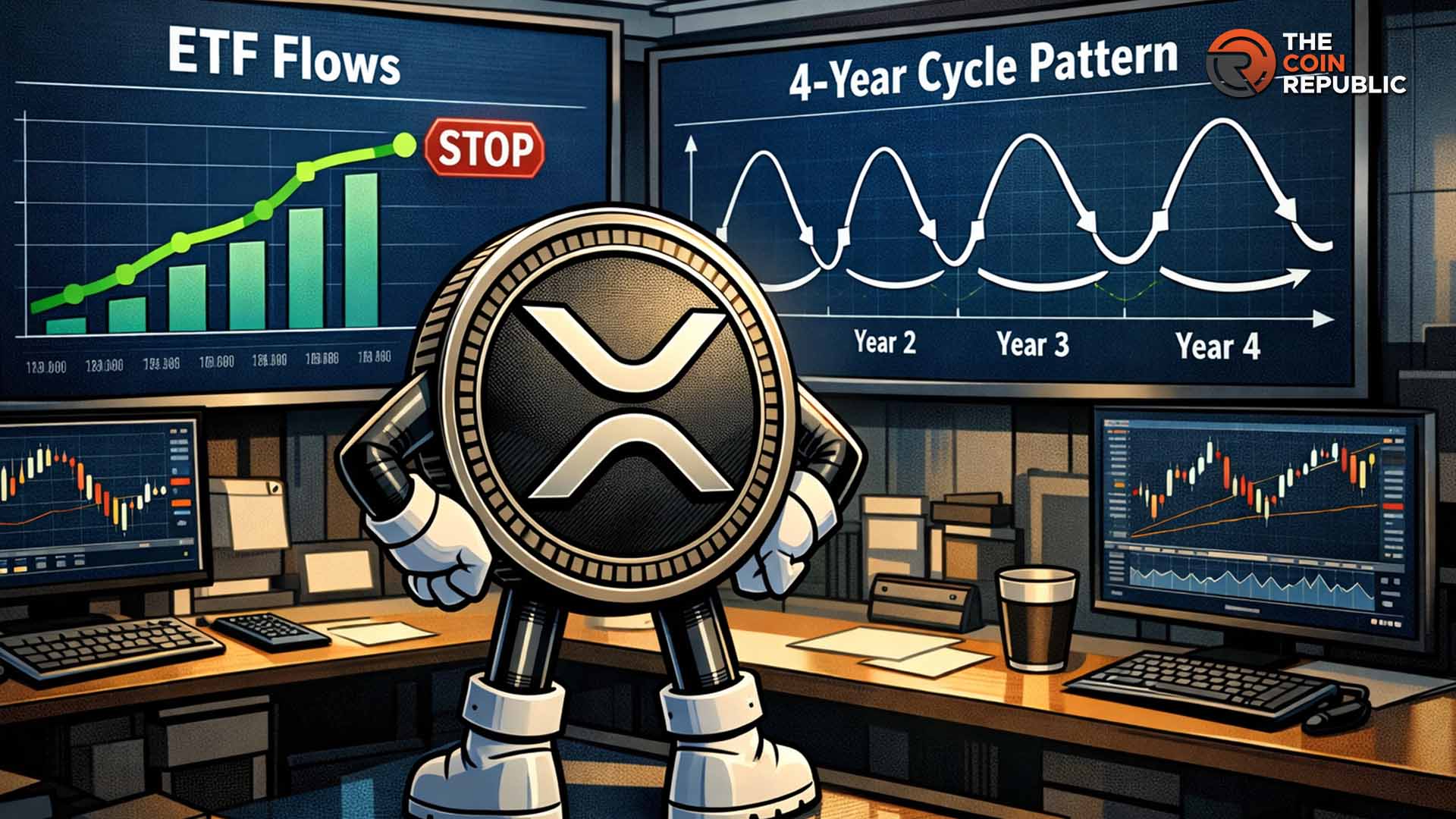
XRP ETFs experienced their first net outflows in seven days, totaling $6.15 million, signaling a potential shift in investor sentiment following a period of consistent inflows. Despite ETF outflows, large XRP holders (whales) have accumulated over 4.18 billion XRP since October 2025, increasing their total holdings to 19.61 billion XRP (32% of supply), indicating strong underlying conviction from major players. Analyst EGRAG Crypto highlights a 4-year cycle correlation for XRP, suggesting that while bullish long-term, traders should await a weekly close above $2.20 for confirmation before chasing pumps, implying a period of consolidation or choppiness.
Signal context only. Validate with price action, liquidity, and risk limits before taking a position.
