
Navigating Crypto News

CoinFeather
Navigating Crypto News

Quick market read from this story
Bitcoin's historical correlation with global M2 money supply is breaking down due to rapid dollar strengthening, indicating that liquidity expansion alone is no longer a sufficient driver of price action.
The dollar's immediate tightening effect on financial conditions, driven by factors like oil shocks and repriced Fed rate expectations, now outpaces the slower transmission of M2 liquidity growth, creating a divergence in market signals.
Traders must recalibrate their models as Bitcoin's sensitivity to dollar moves and risk aversion is currently overriding the supportive backdrop of increasing M2, suggesting a shift in short-term market dynamics.
The near-term outlook for Bitcoin hinges on whether the dollar's strength proves temporary; a stabilization or reversal could allow M2 to reassert its influence, while sustained dollar dominance would prolong the current divergence.
Deep Dive
Bitcoin is no longer consistently tracking the global liquidity playbook that traders have relied on, as a stronger U.S. dollar is tightening financial conditions faster than rising money supply can lift prices. Despite an expansionary backdrop in U.S. M2 money supply, Bitcoin is currently trading as if constrained by macro factors, particularly dollar strength and shifting interest rate expectations.
Historically, traders have closely watched global M2 liquidity, with a time lag, as an indicator for Bitcoin's price movements. The theory posits that increased global money supply eventually flows into risk assets like Bitcoin. However, this correlation has faltered recently. U.S. M2 data shows a steady increase, with figures reaching $22.667 trillion in February, up from $22.469 trillion in January. Despite this expansion, Bitcoin has struggled to maintain upward momentum.
The discrepancy arises from differing transmission speeds of macro factors. M2 is a slow-moving monthly stock measure that influences risk assets gradually over months by easing financial conditions. In contrast, dollar strength tightens financial conditions almost immediately. The Federal Reserve and BIS research confirm that a stronger dollar, coupled with higher yields and lower equity prices, rapidly tightens financial conditions.
March exemplified this dynamic. The dollar index saw a significant monthly gain of 2.35%, its best quarter since late 2024, driven by safe-haven demand, geopolitical events, and repricing of Federal Reserve rate-cut expectations. Over the same period, U.S. M2 increased by approximately 1.25%. This indicates that the tightening effect of the dollar moved roughly four times faster than the expansionary effect of M2.
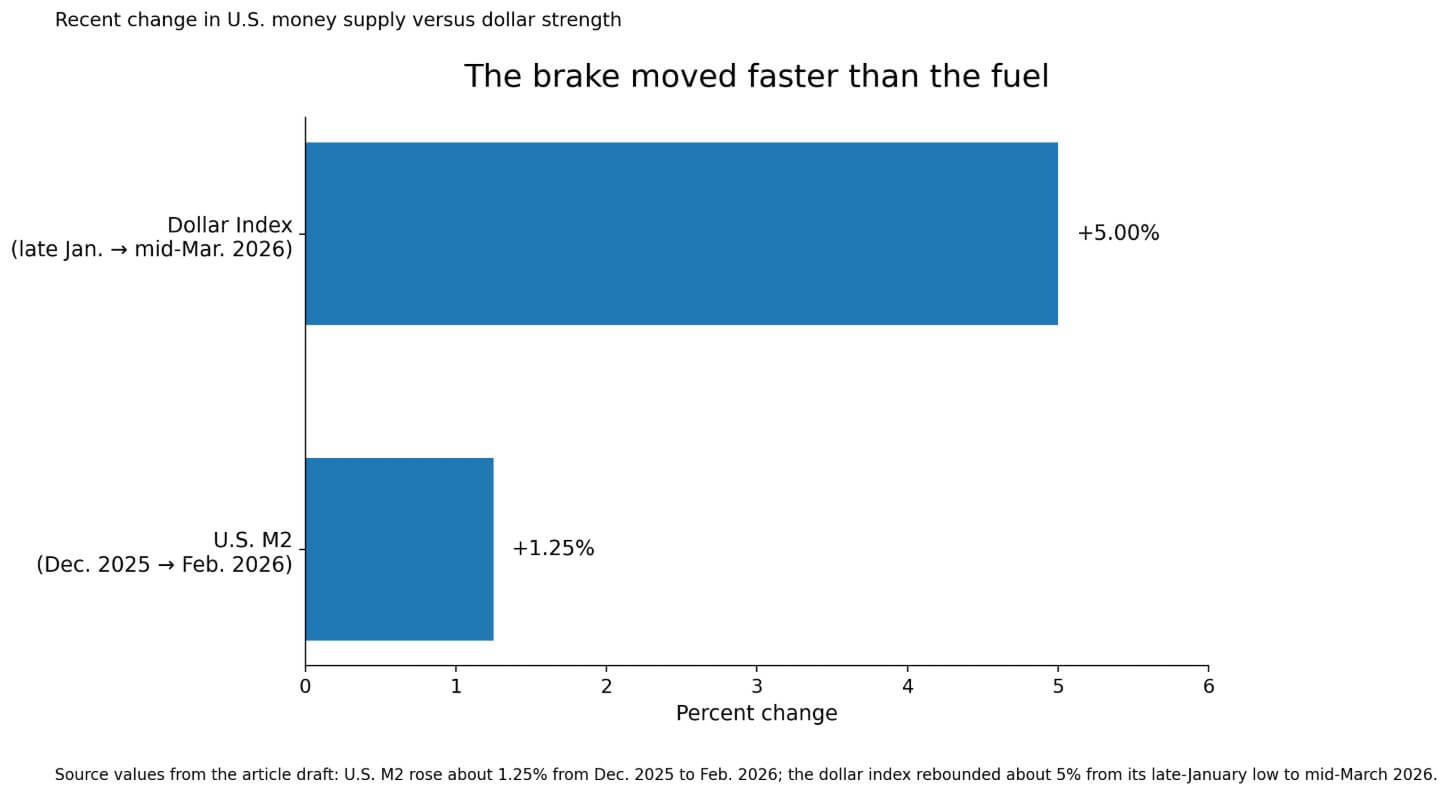
The key shift is not that liquidity has stopped expanding, but that it is being overshadowed by faster-acting tightening forces. Bitcoin's price action reflects this speed of change rather than just the direction of liquidity.
Bitcoin's continuous trading across global venues, its pricing against the dollar, and its global investor base make it particularly sensitive to dollar-denominated returns. This positions Bitcoin as one of the fastest markets to absorb dollar tightening effects before the slower accumulation of M2 can impact credit channels, capital flows, and overall risk appetite.
External shocks, such as the oil shock in March which saw Brent crude forecasts significantly revised upwards, further amplify this dynamic. Increased inflation expectations from such events force markets to price out potential Fed rate cuts, reinforcing dollar strength. This repricing occurs rapidly in dollar and rate markets, often before M2 data for the period is even released.
Furthermore, aggregated global M2 charts often convert foreign money stocks into dollars, meaning exchange rate movements directly impact the composite measure. This dual role of the dollar—as a competing variable and as a component within liquidity calculations—can simultaneously slow the apparent rise in liquidity and compromise the chart's predictive power for Bitcoin.
The M2 thesis remains relevant for background liquidity conditions over multi-month windows, especially when the dollar is stable or weakening. In such calmer macro regimes, the gradual increase in money supply acts as a tailwind for risk assets. However, in the current environment, dollar strength and risk aversion dominate the short-term outlook, potentially pinning Bitcoin below levels suggested by a rising M2 alone.
The outlook for Bitcoin hinges on the sustainability of the dollar's strength. In a bull case scenario, if geopolitical tensions ease, oil prices retreat, and markets reprice some Fed easing back into expectations, the dollar's tightening impulse would weaken. This would allow the M2 tailwind to reassert itself, potentially enabling Bitcoin to close the gap with the liquidity chart.
Conversely, the bear case suggests the dollar could maintain its advantage if oil prices, risk aversion, and cross-asset volatility remain elevated. In this scenario, Bitcoin might continue to diverge from the M2 script for an extended period, delaying the point at which background money growth translates into market performance. The immediate test for traders will be whether the dollar's momentum breaks before liquidity conditions can catch up, determining whether Bitcoin realigns with money supply expansion or continues its divergence.
Source, catalyst, and sector overlap from the latest feed.
Bitcoin's Q1 performance was significantly impacted by macro and geopolitical pressures, shifting its narrative from a potential inflation hedge to a leveraged macro trade. Weakening institutional demand, evidenced by net outflows from Bitcoin ETFs and reduced corporate treasury buying, failed to absorb selling pressure from miners and long-term holders. The derivatives market shows continued caution, with negative funding rates and high put-call ratios indicating traders are bracing for further downside rather than anticipating a strong recovery. The confluence of war-driven energy shocks, sticky inflation concerns, and rising Treasury yields created a challenging environment for risk assets like Bitcoin, overshadowing the initial optimism surrounding ETF approvals.
Tether's strategic pivot from aggressive expansion, including hiring top gold traders, to prioritizing a full financial audit signals a significant shift towards regulatory compliance and institutional credibility. The dismissal of gold traders and pause on fundraising ahead of a Big Four audit suggest Tether is actively restructuring its image and operations to meet stricter transparency demands, potentially de-risking its profile. By pursuing a full audit and enhancing disclosure, Tether aims to close its credibility gap with Circle's USDC, positioning USDT for broader institutional adoption and mitigating regulatory risks, especially with upcoming legislation like the GENIUS Act. The market should anticipate a period of heightened scrutiny for Tether; a clean audit could solidify its dominant position, while delays or complexities could expose its thin equity cushion and benefit rivals.
Google's updated quantum computing estimates suggest a 20-fold reduction in required qubits, significantly shortening the timeline for potential cryptographic threats to blockchains like Bitcoin and Ethereum. The research highlights that while traditional systems have recourse for fraud, blockchain transactions are often irreversible, making them a critical test case for post-quantum cryptography migration due to their public and final failure modes. Google's choice to focus this research disclosure on crypto, rather than banking or defense, positions the sector as a public laboratory for demonstrating the challenges and progress of quantum-resistant upgrades. The paper serves as a controlled warning, pushing the crypto industry towards visible and measurable PQC migration, potentially establishing post-quantum trust infrastructure and influencing broader digital security standards.
The launch of Midnight's network on Cardano aims to address the significant gap between Cardano's market cap and its on-chain activity by introducing privacy-first infrastructure for regulated finance. Midnight's success hinges on its ability to attract institutional use cases, such as Monument Bank's tokenized deposits, by demonstrating compliance and solvency without revealing sensitive data. While competitors like Aztec and Namada also focus on privacy, Midnight's integration with Cardano's existing staking infrastructure and builder base provides a unique competitive advantage. The federated operator model, including major players like Google Cloud and MoneyGram, lowers the trust barrier for institutions but raises decentralization concerns that need to be addressed later in 2026.
The introduction of the 'Mined in America Act' signals a significant shift in US industrial policy, framing Bitcoin mining hardware as a national security concern akin to semiconductors and critical minerals. This legislative push aims to reduce US reliance on Chinese-manufactured mining hardware, potentially creating opportunities for domestic manufacturers and impacting the supply chain dynamics for Bitcoin miners. While the bill proposes domestic manufacturing support and certification, its success hinges on market adoption and the ability of US-based suppliers to compete on cost and performance against established Chinese vendors. The codification of a Strategic Bitcoin Reserve alongside hardware policy suggests a more integrated federal approach to digital assets, moving beyond market speculation to infrastructure control.
New research suggests quantum computers may require fewer resources to break current encryption, potentially accelerating the timeline for "Q-Day" and increasing the urgency for quantum-resistant upgrades across the crypto ecosystem. While quantum computers do not pose an immediate threat to Bitcoin or Ethereum, the findings highlight a long-term engineering challenge that necessitates proactive development and migration strategies to ensure future network security. The potential threat of quantum computing is not uniform across all blockchains, with Bitcoin's UTXO model offering some near-term protection compared to Ethereum's account model, though both require eventual transition to quantum-safe cryptography. Institutional investors should prioritize understanding the sequencing of quantum threats, with traditional finance likely to be targeted before crypto, providing a window for the crypto industry to prepare and upgrade its cryptographic foundations.
Ripple's routine 1 billion XRP escrow unlock, while standard practice, introduces potential short-term liquidity shifts that traders monitor for price impact. The integration of XRP Ledger into Bitget Wallet signifies an expansion of payment infrastructure, aiming to drive real-world utility and potentially increase demand for XRP over time. Significant RLUSD burns, exceeding 180 million tokens, indicate a reduction in stablecoin supply due to institutional redemptions, reflecting a dynamic balance between minting and demand within Ripple's ecosystem.
Cardano's Protocol 11 hard fork in April 2026 and the launch of its Midnight privacy sidechain with major validators signal significant technical progress, yet the market has not reflected this with ADA trading 91% below its all-time high. The article contrasts Cardano's substantial development with its lagging price performance, suggesting that retail investors may seek alternative opportunities like the Pepeto presale, which offers exchange tools and a Binance listing catalyst. While Cardano's technical upgrades and regulatory clarity (SEC classifying ADA as a commodity) provide a positive outlook, sustained on-chain activity beyond governance is needed to bridge the gap between development and price appreciation. The Pepeto presale is positioned as a potential high-return opportunity due to its combination of meme coin appeal, zero-cost trading, risk scoring, free bridging, and a confirmed Binance listing, aiming to capitalize on market noise and investor search for clear value.
Google's research suggests quantum computers could break Bitcoin's cryptography with fewer qubits than previously estimated, potentially accelerating the timeline for quantum threats and highlighting the urgency for post-quantum cryptography adoption. The crypto industry is seeing diverging strategies for quantum-resistant development across major ecosystems like Bitcoin and Ethereum, indicating a potential fragmentation in security approaches and a need for clear communication on migration roadmaps. Base's 2026 roadmap, focusing on tokenized markets and stablecoins, signals a strategic shift towards institutional adoption and real-world asset integration within the Ethereum L2 ecosystem, potentially driving new use cases and demand. Australia's new comprehensive digital asset licensing framework targets exchanges and custodians, aiming to enhance investor protection and reduce risks, which could set a precedent for other jurisdictions and influence operational standards in the region.
Smart money on Hyperliquid, classified as 'Money Printers,' are showing a net long bias on XRP, contrasting with their overall short positions in Bitcoin and Ethereum. XRP exhibits minimal liquidation risk and a positive outlook among sophisticated traders, positioning it as a potential safe haven asset for April. Recent SEC/CFTC guidance classifying XRP as a digital commodity, coupled with anticipated price breakouts above $1.50, supports bullish sentiment for the asset. The unlocking of 1 billion XRP by Ripple, with 80% expected to be relocked, presents a supply-side event that traders are monitoring for potential price impact.
Live Feed
Loading the broader stream in the same flow as the homepage feed.

Meta's strategic pivot to integrating existing stablecoins rather than issuing its own reflects regulatory lessons learned from Libra, signaling a pragmatic approach to market entry. By leveraging its massive user base across Facebook, Instagram, and WhatsApp, Meta aims to create a dominant digital payment ecosystem by focusing on distribution and user experience, rather than currency control. The partnership-driven model, potentially with entities like Stripe, allows Meta to bypass complex regulatory hurdles and infrastructure development, focusing instead on seamless integration and AI-driven commerce applications. The planned 2026 rollout positions stablecoins as critical infrastructure for AI-powered commerce and everyday transactions, potentially driving significant adoption if user friction is minimized.
Ripple's introduction of an on-chain treasury system integrates fiat, XRP, and RLUSD into a single corporate dashboard, potentially increasing XRP utility beyond a bridge asset and driving institutional adoption. The launch of Ripple Treasury, a product of the Ripple-GTreasury partnership, signifies a move towards unifying traditional finance and digital assets for corporate treasury management, enhancing efficiency and compliance. By enabling corporations to manage digital assets directly within their existing dashboards, Ripple Treasury streamlines cross-border payments and yield strategies, potentially impacting traditional payment systems and treasury operations.
Ripple's RLUSD stablecoin is now accessible in South Korea via Coinone with KRW trading, expanding its international reach into a key Asian market with strong retail participation. The integration of XRP and RLUSD into Ripple Treasury's new on-chain capabilities for enterprise finance signals a move towards broader institutional adoption of digital assets for treasury management. The RLUSD stablecoin's market cap exceeding $1.2 billion and its listing on multiple major exchanges indicate growing adoption and utility beyond Ripple's direct ecosystem.
Franklin Templeton's launch of a dedicated crypto investment management platform, Franklin Crypto, signals increased institutional commitment to digital assets. The acquisition of 250 Digital and liquid strategies from CoinFund by Franklin Templeton indicates a strategic move to bolster its crypto investment capabilities and product offerings. This development suggests a growing trend of traditional asset managers establishing specialized units to cater to institutional demand for regulated and sophisticated crypto investment products.

The convergence of TradFi and crypto necessitates a fundamental shift in AML risk assessment, moving from static identity-based models to dynamic, on-chain activity monitoring. Hybrid blockchain governance models are emerging as the preferred solution for institutional adoption, balancing public verifiability with predictable control and regulatory integration. The increasing complexity of crypto financial crime, including chain-hopping and mixers, requires specialized blockchain intelligence and forensic capabilities beyond traditional AML frameworks. Effective governance and crisis anticipation are becoming critical differentiators for blockchain networks, potentially outweighing raw throughput or token count for long-term endurance.
Moody's assigning a Ba2 rating to Bitcoin-backed bonds marks a significant step in traditional finance's integration with digital assets, potentially increasing institutional confidence. The rating, while speculative (Ba2), validates Bitcoin as direct collateral for debt instruments, signaling a growing acceptance of crypto assets within structured finance. The use of Bitcoin as collateral with specific advance rates and liquidation triggers highlights the evolving financial engineering around volatile digital assets. This development could pave the way for more regulated financial products backed by crypto, influencing market perception and potentially attracting new capital flows.

Historical April price action for Dogecoin shows significant volatility, including a 500% surge in April 2021, setting a precedent for potential upward movement this month. Current price action indicates Dogecoin is testing the $0.09 support level, with a potential retest of $0.11-$0.12 if it breaks above moving averages, or a drop to $0.08 if support fails. The $0.10 level is identified as a key psychological and technical resistance, with a sustained breakout potentially targeting $0.15, contingent on overcoming current selling pressure.
The significant concentration of stablecoin reserves on Binance, holding 65% of total reserves, directly impacts trading costs by influencing slippage and spreads on other platforms. Traders, especially institutional participants, must align their position sizes with venue liquidity depth to optimize execution costs, as smaller exchanges with lower reserves will exhibit higher price impact. The widening liquidity gap between major exchanges like Binance and smaller competitors suggests a market trend towards capital consolidation on platforms offering superior execution quality for larger trades. Understanding stablecoin reserve distribution provides a quantitative framework for venue selection, cutting through marketing claims and focusing on the practical implications for trading efficiency.

Shiba Inu's hourly golden cross suggests potential short-term bullish momentum, but the derivatives market's mixed signals and subdued trading volume indicate caution is warranted. Despite a technical bullish signal, increased spot flows to exchanges and a lack of conviction in derivatives trading imply that holders may be looking to exit, potentially capping upside. While the golden cross offers a technical setup for a rebound, sustained price action above $0.000006 requires stronger demand, with key support at $0.000005 and resistance at $0.00000625.

Major financial institutions like JPMorgan and Goldman Sachs are exploring entry into the prediction markets, signaling a significant trend towards institutional adoption of decentralized finance and novel market structures. The increasing interest from traditional finance in prediction markets, alongside growth from crypto-native firms like Coinbase and Robinhood, indicates a maturing and expanding market segment with potential for increased liquidity and user access. Regulatory clarity from bodies like the CFTC is a key factor for the future growth of prediction markets, with major banks likely to proceed cautiously until a more defined legal framework is established. The competition between blockchain-based platforms like Polymarket and traditional exchanges like Kalshi highlights divergent technological approaches within the prediction market space, offering varied opportunities for different market participants.
March 2026 marked the first monthly inflow for Bitcoin ETFs in 2026, totaling $1.32 billion and reversing a four-month streak of outflows. This reversal suggests a potential return of institutional confidence and demand for Bitcoin, possibly indicating that investors perceive the asset to be near a market bottom. BlackRock's ETF continued to lead inflows, highlighting its significant market share and influence within the Bitcoin ETF landscape.

Cango is actively raising capital through a $10 million convertible note and a $65 million insider round to address its precarious financial situation and potential NYSE delisting. The company's pivot towards AI and computing infrastructure, alongside its ongoing efforts to regain NYSE compliance, signals a strategic shift to diversify revenue beyond bitcoin mining. Despite recent capital raises, Cango's share price remains significantly below the $1 threshold, indicating ongoing market pressure and a challenging path to compliance.
Franklin Templeton's acquisition of 250 Digital and launch of Franklin Crypto signals a strategic shift towards active crypto strategies to capture institutional capital. The use of BENJI tokens for part of the acquisition payment demonstrates Franklin Templeton's growing acceptance of tokenized instruments as legitimate financial tools. This move, coupled with partnerships with Binance and Ondo, positions Franklin Templeton as a comprehensive institutional crypto infrastructure provider, anticipating increased demand from pension and sovereign wealth funds. The acquisition is likely to be viewed positively by the market, reflecting a growing trend of traditional finance firms building out dedicated crypto divisions to cater to institutional needs.
Paris Hilton's continued investment and advocacy in crypto and Web3, including NFTs and the metaverse, signals a sustained interest from high-profile individuals in digital asset innovation. Her personal investment in Bitcoin and Ethereum since 2016, alongside her successful NFT sales and metaverse ventures, highlights the growing integration of digital assets into mainstream celebrity portfolios. Hilton's role as an investor and advisor for Origin Protocol and her development of 'Paris World' on Roblox demonstrate a strategic approach to leveraging digital platforms for brand expansion and community engagement.

The post MORPHO Price Jumps 15% on pyUSD Vault Launch, But Resistance Looms appeared first on Coinpedia Fintech News The MORPHO price today popped 15% intraday, and yeah it didn’t come out of nowhere. A fresh integration involving pyUSD vaults on a high-speed network lit the fuse, pulling traders back into a token that had already been quietly outperforming much of the altcoin pack this year. But before anyone starts calling it a breakout, …
Signal context only. Validate with price action, liquidity, and risk limits before taking a position.
