
Navigating Crypto News

CoinFeather
Navigating Crypto News
Quick market read from this story
TRON's integration with Zero Hash provides regulated access to TRX and TRC-20 USDT for enterprise and fintech platforms, removing significant compliance hurdles for institutional adoption.
The recent SEC settlement dismissing charges against Justin Sun and the TRON Foundation, coupled with Anchorage Digital offering TRX custody, significantly de-risks TRON for U.S. institutional investors.
TRX technical indicators show continued bullish momentum with RSI and MACD signaling strength, suggesting potential upside towards $0.32 resistance, though a break is needed for further gains.
Deep Dive
TRON DAO has announced a significant integration with Zero Hash, a regulated infrastructure provider, enabling enterprise and fintech platforms to access TRX and TRC-20 USDT. This move, occurring in March 2026, follows a series of major developments for TRON, including a landmark SEC settlement and the introduction of institutional custody for TRX by a federally chartered bank.
March 2026 proved to be a pivotal month for TRON. The U.S. Securities and Exchange Commission (SEC) officially dismissed its fraud and market manipulation case against Justin Sun, the TRON Foundation, and the BitTorrent Foundation with prejudice on March 5. While a Sun-linked company paid a $10 million civil penalty, the dismissal of claims against individuals and entities removes a significant legal overhang. Additionally, on March 26, Anchorage Digital, a federally chartered crypto bank, announced support for TRX custody, providing a compliant pathway for U.S. banks and hedge funds to hold the asset. This integration is being rolled out in phases, with TRC-20 asset support and native TRX staking planned for later stages.
The integration with Zero Hash allows fintechs, exchanges, and neobanks to leverage TRON's network for custody, trading, liquidity, and settlement without building their own compliance infrastructure. This includes facilitating fiat-to-crypto onboarding, a critical step for institutional adoption. TRON's network statistics highlight its substantial activity, with over $25 trillion in cumulative transfer volume since its 2018 mainnet launch, more than 373 million user accounts, and approximately 11 million daily transactions, including over $23 billion in daily transfer volume.
Technically, TRX/USDT is trading near the $0.32 resistance level. The Relative Strength Index (RSI) is at 63.31, indicating bullish momentum without being overbought, and has been trending upward since late January. The Moving Average Convergence Divergence (MACD) also confirms strengthening momentum, with the MACD line above its signal line and the histogram printing green. A decisive break above $0.32 could lead to further gains towards $0.33–$0.34, while a rejection might see it retest the $0.29–$0.30 support zone. Steady trading volume suggests holder participation rather than pure speculation.
Source, catalyst, and sector overlap from the latest feed.
Geopolitical de-escalation signals from Iran have triggered a 'risk-on' sentiment in crypto markets, leading to broad gains across major altcoins and Bitcoin. The market's positive reaction is primarily driven by a reduction in perceived geopolitical risk, causing a reversal of 'war premium' fear trades and a rotation into higher-beta assets. Despite the immediate price surge, the sustainability of the rally is uncertain, hinging on the US response to Iran's conditional peace proposal, with potential for gains to reverse if negotiations falter. The current market movement reflects a speculative reaction to the possibility of de-escalation rather than confirmed progress, highlighting the sensitivity of crypto assets to geopolitical events.
A significant $20 million leveraged short position on Ethereum has been opened by a new whale wallet, creating a direct conflict with rising spot demand signals and introducing uncertainty into ETH's near-term price direction. While on-chain taker buy pressure is exhibiting a pattern historically preceding rallies, a negative Sharpe ratio indicates that recent risk-adjusted returns for ETH have been poor, suggesting a market in transition with potential for either a sharp move or further consolidation. The divergence between the whale's bearish bet and the bullish taker demand, coupled with macro uncertainties, suggests that external factors will likely be the primary driver for ETH's price resolution in the short term.
The U.S. Department of Labor's reversal of its 2022 stance on crypto in 401(k) plans removes a significant legal barrier, potentially opening up substantial retirement assets to digital asset investment. Plan fiduciaries can now legally offer crypto exposure if they adhere to a new six-factor safe harbor framework, emphasizing documentation and due diligence, which could drive demand for compliant crypto products. The DOL's move, coupled with the introduction of the 'Mined in America Act,' signals a broader regulatory shift towards acknowledging and integrating digital assets into traditional financial and industrial frameworks. With the $10.1 trillion 401(k) market now more accessible, even a small allocation shift towards crypto could have significant implications for asset managers and the broader digital asset ecosystem.
Bitcoin's March close below the 50 SMA and significant derivatives data shifts, including a $1.4 billion CVD reversal on Binance, indicate increasing short exposure and potential downside pressure. The Long-Term Holder Spent Output Profit Ratio (LTH SOPR) at 0.8 marks the fourth historical instance of this capitulation level, suggesting that while current price action is weak, it aligns with historical bottoms preceding major recoveries. Analyst Michaël van de Poppe anticipates an early April 'low sweep' to clear liquidity before a sustainable recovery, a scenario supported by the current derivatives positioning and historical LTH SOPR data. The confluence of bearish derivatives signals and historically significant on-chain capitulation levels suggests that a final flush lower, potentially triggering a short squeeze, is a plausible near-term scenario before a potential recovery.
Despite a technical breakdown below channel support targeting $0.22, Cardano whales have accumulated 220 million ADA in the past week, suggesting a divergence between short-term price action and long-term holder conviction. The recent launch of the Midnight ZK privacy mainnet and the SEC/CFTC classification of ADA as a digital commodity in March address key institutional barriers and use cases, fundamentally altering Cardano's long-term value proposition. Upcoming Q2 2026 upgrades, including the Van Rossem hard fork and Ouroboros Leios scalability improvements, combined with the recent infrastructure additions like USDCx and Midnight, position Cardano for significant structural growth irrespective of current market sentiment.
The introduction of the 'Mined in America Act' signals a significant shift in US industrial policy, framing Bitcoin mining hardware as a national security concern akin to semiconductors and critical minerals. This legislative push aims to reduce US reliance on Chinese-manufactured mining hardware, potentially creating opportunities for domestic manufacturers and impacting the supply chain dynamics for Bitcoin miners. While the bill proposes domestic manufacturing support and certification, its success hinges on market adoption and the ability of US-based suppliers to compete on cost and performance against established Chinese vendors. The codification of a Strategic Bitcoin Reserve alongside hardware policy suggests a more integrated federal approach to digital assets, moving beyond market speculation to infrastructure control.
WisdomTree's head of digital assets views the Clarity Act as non-inhibitive to innovation, suggesting existing SEC tools are sufficient for developing tokenized security and fund markets. The firm's focus on tokenized real-world assets, exemplified by their continuously trading money market fund, highlights a practical application of blockchain for traditional finance products. WisdomTree's ongoing development in crypto and tokenization, irrespective of market volatility, signals sustained institutional interest and operational momentum. While acknowledging the Clarity Act's potential constructiveness, WisdomTree emphasizes that progress is being driven by firms leveraging existing regulatory pathways rather than waiting for new legislation.
The XRP Ledger's integration as a core payment engine for Bitget Wallet signifies a strategic shift towards real-world utility, moving beyond speculative trading. With payments now comprising 53% of XRP Ledger activity, driven by assets like RLUSD, the network is demonstrating tangible adoption for cross-border and everyday transactions. This partnership elevates the XRP Ledger's infrastructure role, positioning it as a foundational layer for secure, scalable digital payments, enhanced by quantum-resistant and AI security measures. The development suggests a potential for increased demand and usage of XRP and RLUSD as Bitget Wallet aims to facilitate peer-to-peer transfers and everyday purchases via its platform.
Tether's USAT stablecoin expansion to Celo, an Ethereum L2, signifies a strategic move to broaden regulated digital dollar accessibility beyond Ethereum's mainnet. The integration with Google Cloud for infrastructure support and a privacy-preserving faucet highlights a focus on compliant and user-friendly distribution channels for USAT. USAT's potential role as a gas currency on Celo, coupled with Celo's mobile reach via Opera MiniPay, could drive adoption and utility for the stablecoin within a significant user base.
The US Department of Labor's proposed rule to allow digital assets in 401(k) plans signals a shift towards regulatory neutrality, potentially increasing institutional interest in crypto as a retirement investment option. Senator Lummis's support for the proposal highlights a bipartisan effort to reduce regulatory friction for digital assets, suggesting a more favorable environment for crypto integration into traditional finance. Despite the regulatory shift, adoption within 401(k) plans may remain slow due to fiduciary concerns regarding legal risks and compliance standards, indicating a cautious approach from plan sponsors. The move, driven by a presidential directive, aims to reduce retirement plan sponsor burdens and litigation risks, which could indirectly benefit the broader digital asset market by fostering greater acceptance.
Cardano's Midnight Network launch introduces a privacy-focused sidechain, aiming to unlock enterprise adoption by enabling secure handling of sensitive data on-chain. The introduction of Midnight Network addresses a key barrier to blockchain adoption for real-world applications like private finance and real estate, potentially expanding Cardano's utility beyond current use cases. The NIGHT token has shown an immediate market reaction with a price increase, indicating early investor interest in the privacy-centric development and its potential for future network activity. Charles Hoskinson's vision for Midnight Network positions it as a crucial evolution beyond basic smart contracts and payments, specifically targeting the integration of private data into blockchain ecosystems.
Live Feed
Loading the broader stream in the same flow as the homepage feed.
Geopolitical de-escalation signals a potential shift to risk-on sentiment, benefiting Bitcoin and crypto equities as investors seek higher yields. While immediate price action shows gains for Bitcoin and related stocks, sustained rallies depend on broader institutional flows and regulatory clarity, not just geopolitical events. The market's positive reaction to potential de-escalation highlights crypto's sensitivity to global stability, suggesting a correlation with traditional risk assets.

Geopolitical de-escalation signals from Iran have triggered a broad market rally, lifting Bitcoin above $68,000 and adding $40 billion to the crypto market cap as investors rotate back into risk assets. The market's rapid repricing of geopolitical risk highlights Bitcoin's sensitivity to macro events, particularly its correlation with traditional risk assets like stocks and its inverse relationship with oil prices and the US Dollar Index. The potential for reduced Middle East tensions could alleviate inflationary pressures and improve the outlook for central bank policy easing, creating a more favorable macro environment for risk assets.
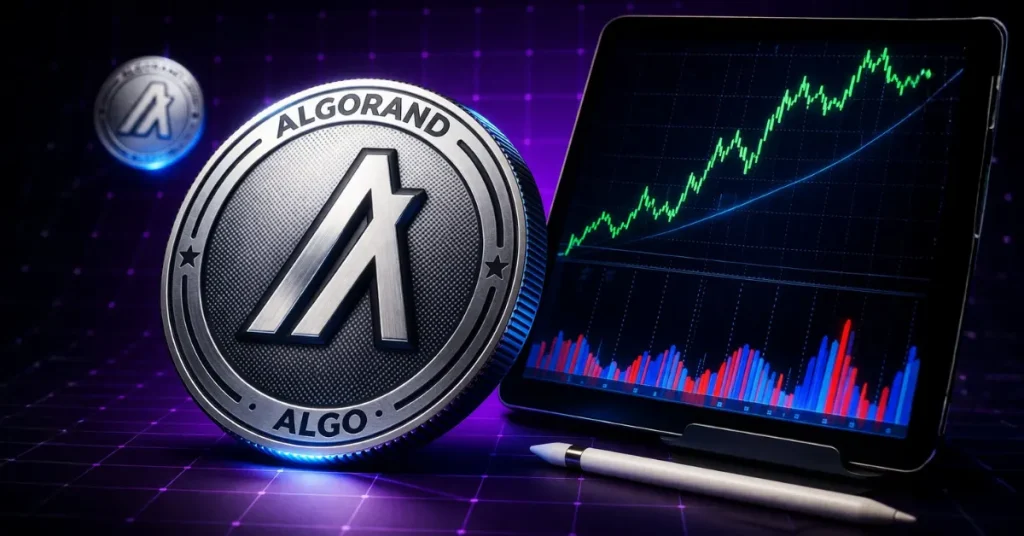
Algorand's price surge of over 10% appears to be driven by technical factors and broader market stabilization rather than new fundamental catalysts, suggesting a potentially fragile rally. The current price action tests a critical descending trendline resistance, making it a make-or-break level for ALGO's short-term direction, with a breakout needed to confirm a trend reversal. Traders should exercise caution and await a decisive breakout above $0.095-$0.105 or a clear rejection from the trendline before establishing significant positions, as premature entries risk falling into traps.

Google's quantum computing research indicates a significantly accelerated timeline for breaking Bitcoin's elliptic-curve cryptography, potentially enabling theft of live transactions within minutes of broadcast. The findings suggest that the industry's prior assumptions about quantum threats being a decade away are now untenable, necessitating an urgent, coordinated upgrade effort to post-quantum cryptography. The rapid progress across multiple quantum computing architectures (superconducting and neutral-atom) highlights a compounding feedback loop, making the threat less a single 'moonshot' and more an inevitable engineering reality. Migrating Bitcoin to post-quantum cryptography will require a hard fork and extensive community consensus, a process that could take months and is politically fraught, making proactive migration essential before Q-Day.

Anthropic's accidental leak of Claude Code's source code, including internal architecture and hidden features, represents a significant information disclosure that could accelerate AI development and competition. The inability to contain the leak due to decentralized repositories and clean-room rewrites highlights the challenges of intellectual property control in the current technological landscape. While Anthropic claims no sensitive customer data was exposed, the leak of internal system prompts and unreleased functionality provides valuable insights for developers and potential exploiters. The legal ambiguity surrounding AI-generated code and copyright, coupled with the permanence of decentralized storage, creates a complex situation for intellectual property enforcement.
Dogecoin network activity has surged 28% to 73,000 active addresses, indicating increased user engagement, though this metric alone does not guarantee a price rally. Despite rising on-chain activity, DOGE price has only seen a modest 0.46% recovery to $0.09210, suggesting that broader market sentiment and liquidity flows are currently outweighing network engagement signals. The divergence between network activity and price action highlights a potential for increased volatility, making DOGE a watchlist candidate as traders assess whether on-chain interest will translate into sustained price appreciation.
Geopolitical tensions in the Middle East are driving significant volatility in European markets, with the Stoxx 600 on track for its worst monthly performance since the 2020 COVID crash. Rising energy prices and renewed inflation concerns in the Eurozone, exacerbated by the Iran conflict, are increasing investor caution and pressuring risk assets. The market's sensitivity to headlines regarding the Strait of Hormuz and the duration of military operations highlights the fragile risk sentiment and potential for further price swings.
Standard Chartered's reaffirmation of a $2 trillion stablecoin market cap forecast for 2028, despite doubled velocity, suggests that increased transaction efficiency is being offset by new, additive use cases rather than cannibalizing existing demand. The divergence in stablecoin velocity between USDC (driven by TradFi displacement and AI payments on Base/Solana) and USDT (driven by emerging market savings) highlights distinct market segments and potential competitive dynamics within the stablecoin ecosystem. The surge in USDC velocity on Solana and Base, linked to early AI agent payments via Coinbase's x402 protocol, indicates emerging demand for stablecoins in decentralized AI applications, though the transient nature of this initial surge warrants close monitoring.
Geopolitical tensions involving Iran and U.S. firms are creating market uncertainty, impacting major tech stocks like Microsoft, Nvidia, and Tesla, which could spill over into broader market sentiment. While specific tech stocks saw gains, the underlying threat of targeted attacks on U.S. companies in the Middle East introduces a risk premium for companies with significant regional operations, potentially affecting investor confidence and continuity planning. The escalation of rhetoric from both U.S. and Iranian officials, coupled with threats to critical infrastructure and trade routes like the Strait of Hormuz, highlights systemic risks that could impact energy prices and global supply chains.

Despite some analysts forecasting short-term downside for Bitcoin toward $60,000, technical indicators and liquidation heatmap data suggest a potential rally to $82,000 if key resistance at $68,879 is overcome. The market structure for Bitcoin remains bearish according to some analysts, but recent price action and institutional interest present a conflicting narrative that traders should monitor closely. Key resistance levels for Bitcoin are identified at the 50-day moving average around $68.8K and short liquidity clusters between $68,500-$70,000 and $72,000-$74,000, which could fuel a liquidation rally if breached.

BitGo's new portfolio-based lending platform for institutions allows borrowing and lending against a diverse range of digital assets, including staked and locked tokens, enhancing capital efficiency for institutional clients. The platform's integration of borrowing, lending, and collateral management into a single workflow streamlines institutional operations and reduces reliance on multiple counterparties. By enabling institutions to leverage staked and locked assets as collateral without unwinding positions, BitGo unlocks new avenues for yield generation and liquidity management within custody accounts. This development signals a growing trend in institutional finance towards more integrated and flexible collateral management solutions for digital assets, potentially increasing demand for custody services.
Cardano's upcoming Midnight privacy sidechain launch, coupled with the Van Rossem hard fork, aims to introduce confidential smart contracts, potentially attracting new capital by addressing privacy concerns and compliance needs. The article highlights Pepeto's presale, projecting 100x returns driven by an upcoming exchange listing and a 191% APY staking reward, positioning it as a potential beneficiary of capital inflow from the Cardano ecosystem upgrades. While Cardano's ADA shows a historically strong buying signal with its MVRV ratio, the primary focus for speculative trading appears to be on the Pepeto presale, which is heavily promoted with aggressive return projections tied to its listing. SUI and PEPE are mentioned as holding support levels, but the narrative strongly favors Pepeto's presale as the primary near-term opportunity, leveraging the anticipation of the Cardano Midnight fork and a Binance listing.
Warren Buffett's commentary reinforces Apple's status as Berkshire Hathaway's largest holding, signaling long-term confidence despite recent trimming, which suggests a potential for sustained institutional interest. Despite strong fundamentals like record services revenue and a large active device base, Apple faces near-term headwinds from legal issues and AI strategy questions, creating a neutral outlook for immediate price action. Technical indicators show AAPL in a weak short-term range below key resistance levels, suggesting that while Buffett's endorsement provides a floor, significant upside may be capped until broader market sentiment or technicals improve.
Signal context only. Validate with price action, liquidity, and risk limits before taking a position.
