
Navigating Crypto News

CoinFeather
Navigating Crypto News

Quick market read from this story
Nium's launch of a stablecoin card issuance platform integrating with Visa and Mastercard signifies a significant step towards mainstream adoption of digital dollar spending at the point of sale.
The platform's ability to shorten stablecoin card program launch times from months to days, by consolidating conversion, settlement, and compliance, could accelerate the integration of stablecoins into traditional payment rails.
This development, alongside Visa's expanded stablecoin support and Mastercard's acquisition of BVNK, indicates a growing trend of major payment networks embracing stablecoin utility, potentially increasing demand for stablecoins like USDT and PYUSD.
While regulatory clarity remains a hurdle, the increasing infrastructure for stablecoin payments suggests a growing market for tokenized assets and their integration into everyday commerce.
Deep Dive
Global payments infrastructure provider Nium has introduced a new platform enabling businesses to issue stablecoin-funded cards through Visa and Mastercard. This development allows for the spending of digital dollar balances at merchants by leveraging existing card networks.
Nium's platform converts stablecoin balances into fiat currency at the point of sale. It manages settlement, compliance, and card network integration through a single, unified integration. The company anticipates this will significantly reduce the time required to launch stablecoin card programs, shortening the process from months to days.
The move occurs as stablecoins gain increasing attention. Consultancy Bain & Company noted that stablecoins are having a
Source, catalyst, and sector overlap from the latest feed.
Mitsubishi's adoption of JPMorgan's Kinexys blockchain for corporate payments signals growing institutional trust in blockchain-based financial infrastructure, potentially driving further adoption in traditional finance. The expansion of Kinexys beyond payments into tokenization of assets like private credit and real estate, coupled with other major institutions like BlackRock and Franklin Templeton exploring tokenization, indicates a significant shift towards RWA and tokenized assets. JPMorgan's continued investment in blockchain infrastructure, despite CEO Jamie Dimon's past skepticism, highlights a strategic pivot towards leveraging distributed ledger technology for core financial services and future market opportunities.
Live Feed
Loading the broader stream in the same flow as the homepage feed.

The Ethereum Foundation's increased ETH staking, now totaling $50 million, signals a strategic shift towards enhancing financial sustainability through DeFi yield generation. This proactive treasury management by the Ethereum Foundation, aiming to stake up to 70,000 ETH, could set a precedent for other large holders and potentially increase demand for staking services. The Foundation's involvement in staking aligns with broader ecosystem developments like the Ethereum Economic Zone, suggesting a coordinated effort to bolster Ethereum's infrastructure and financial health.

Bitcoin's continuous trading allows it to act as a real-time macro market, pricing geopolitical events and sentiment shifts outside traditional U.S. trading hours. The interplay between Iranian geopolitical developments and U.S. political messaging is directly influencing cross-asset pricing, with Bitcoin acting as an early indicator. The upcoming week's economic data, particularly concerning oil prices and inflation, will be interpreted through the lens of geopolitical risk, with Bitcoin's 24/7 price action providing immediate market feedback. Traders are closely monitoring Bitcoin's behavior during off-hours for clues on market sentiment regarding geopolitical events, potentially offering an asymmetric trading edge before traditional markets open.
SpaceX's potential IPO, targeting a $1.75T valuation, may significantly impact retail brokerages like Robinhood and SoFi by prioritizing underwriter-linked platforms such as E*Trade for retail share allocation. The exclusion of Robinhood and SoFi from a substantial retail allocation in the SpaceX IPO could negatively affect their trading volume and customer engagement, as evidenced by Robinhood's stock pressure following the news. A new Nasdaq rule allowing faster inclusion of large-cap companies into the Nasdaq 100 could further boost demand for the SpaceX IPO, potentially increasing its attractiveness and influencing brokerage participation.
Ethereum's price action is currently constrained by descending trendline resistance, suggesting a continuation of the bearish structure observed in recent chart patterns. Technical analysis indicates that a failure to break above key resistance levels could lead to further downside, with potential targets identified below the $2,000 mark. Traders should monitor the descending trendline as the primary technical barrier; a sustained break above it would be required to invalidate the current bearish outlook.
Federal Reserve Chair Jerome Powell's remarks indicate a patient approach to monetary policy, suggesting that rate cuts are unlikely in the near term due to persistent inflation and geopolitical oil price risks. The Fed's stance implies a continued period of higher interest rates, which could pressure risk assets like cryptocurrencies by increasing the cost of capital and reducing speculative investment appetite. Powell's emphasis on waiting for more data, despite some labor market softness, signals that the Fed prioritizes inflation control over immediate economic stimulus, potentially prolonging market uncertainty. The acknowledgement of internal FOMC disagreements highlights the complex economic outlook, suggesting that future policy decisions will be data-dependent and subject to ongoing debate, making forward guidance less reliable.
Bernstein maintains 'Outperform' ratings on Coinbase, Robinhood, and Figure despite lowered price targets, signaling a belief in their long-term growth potential in areas like tokenized assets and prediction markets. The analysis suggests a potential bottom for crypto stocks, with current prices ~60% off their peaks, presenting a 'buy the dip' opportunity for investors anticipating a crypto market recovery. Despite weak Q1 earnings and reduced EPS estimates for Coinbase, its stablecoin revenue and derivatives business expansion, alongside Robinhood's prediction market growth and Figure's tokenization efforts, are highlighted as key resilience factors. The report indicates a strategic shift in analyst focus towards diversified revenue streams beyond direct crypto trading, emphasizing the growth prospects in tokenized real-world assets and prediction markets for these companies.

Analyst Aralez predicts a potential Bitcoin price drop to $54,000, citing a downward channel and consistent lower highs/lows, suggesting a risk-off sentiment driven by ETF outflows and macroeconomic factors. Significant weekly outflows from spot Bitcoin ETFs, totaling $290 million with BlackRock's IBIT seeing substantial single-day redemptions, indicate waning institutional demand and contribute to bearish price pressure. Historical data suggests that a deeper Bitcoin drawdown correlates with a longer recovery period, implying that the current 48% drawdown could necessitate approximately 300 days for a full recovery to previous all-time highs. Geopolitical tensions and inflation concerns, exacerbated by oil price surges and statements from Donald Trump regarding Iran, are contributing to a broader risk-off environment that negatively impacts Bitcoin and other risk assets.
Bitcoin experienced significant volatility, with liquidations on both long and short positions, indicating a battle for control around key price levels. The $69,000 to $70,000 zone represents critical resistance; a failure to break through this area could signal a continuation of the downtrend, while a sustained hold above it may indicate a bullish reversal. Liquidation heatmaps suggest that while the $65,000 support held, the $63,500 to $66,500 range has higher liquidation clusters, making it a potential revisit area if downward pressure resumes.
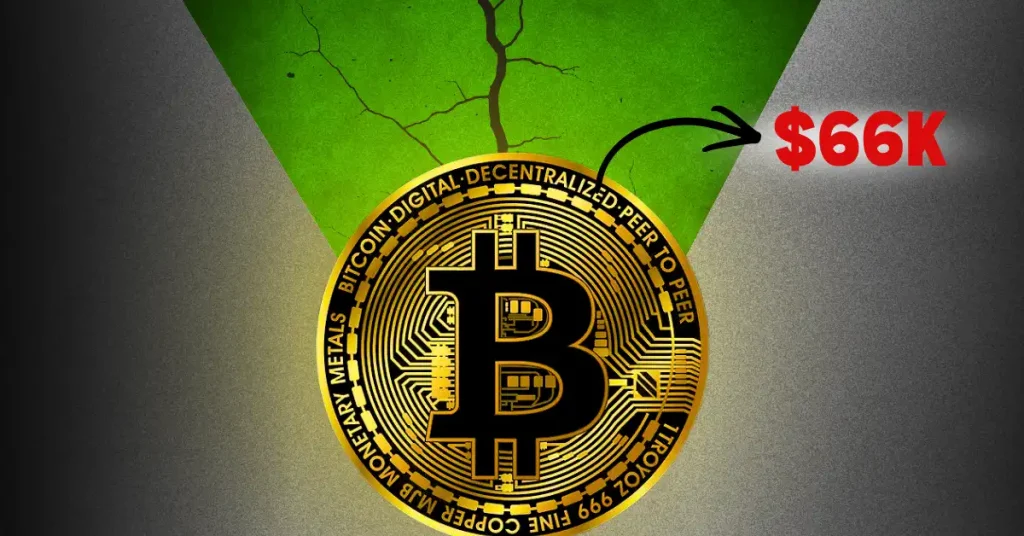
Potential government stimulus events, driven by geopolitical conflict, AI job displacement, or fiscal crises, could trigger significant inflation and repricing of hard assets like Bitcoin. An analyst predicts that one of nine potential catalysts could materialize within 3 to 24 months, leading to money printing that may significantly boost Bitcoin's value due to its fixed supply. The article highlights that historical government responses to crises involve substantial money printing, suggesting a recurring pattern that could benefit Bitcoin as a hedge against currency devaluation.
Dogecoin's price action is consolidating within a descending triangle pattern, indicating a potential 29% downside move to $0.075 if the bearish resolution occurs. The overwhelming liquidation of long positions (98%) and bearish technical indicators like EMAs, RSI, and MACD suggest strong sell-side pressure and a lack of buyer conviction. While a bullish scenario exists with a reclaim of $0.0932, the current technical setup and market sentiment heavily favor a bearish outcome, making short-term downside the primary risk.
Understanding user cognitive load and mobile interface design is crucial for crypto casino platforms aiming to optimize short-session gameplay. Fast-paced games like roulette, Keno, and Plinko are favored for short crypto casino sessions due to their simple rules and quick outcomes, reducing mental effort. The choice of game format in crypto casinos significantly impacts the user experience during brief sessions, with clarity and quick resolution being key factors for player satisfaction. While slots are often perceived as short-session games, modern variants with complex features can extend engagement, offering a different dynamic for players.
Signal context only. Validate with price action, liquidity, and risk limits before taking a position.
The formation of the Blockchain Leadership Fund by Chainlink Labs and Anchorage Digital signals a coordinated industry effort to influence US crypto policy ahead of critical midterm elections. This PAC's hybrid structure allows direct candidate contributions and independent expenditures, mirroring strategies used in 2024 and indicating a sustained push for favorable regulatory outcomes. While specific funding amounts are undisclosed, the involvement of established players like Chainlink and Anchorage suggests a significant commitment to shaping the future regulatory landscape for digital assets. The initiative highlights the increasing importance of political engagement for the crypto sector, particularly concerning legislation like the CLARITY Act, which could impact market structure and company operations.
