
Navigating Crypto News

CoinFeather
Navigating Crypto News
Source, catalyst, and sector overlap from the latest feed.
Solana's price action near $80 suggests potential accumulation after a liquidity sweep, indicating seller exhaustion and a possible shift in momentum towards reclaiming higher resistance levels. Analysts highlight the $84-$85 zone as a critical resistance for Solana; a successful reclaim could trigger a move towards $88-$92, signaling a stronger bullish reversal and potentially influencing broader altcoin market trends. Despite short-term mixed sentiment, a broader market structure analysis suggests a potential long-term reversal for Solana, with significant support identified between $70 and $80. Downside risks remain below $70, with a potential acceleration towards $50 if this level breaks, though such corrections could present long-term accumulation opportunities.
Live Feed
Loading the broader stream in the same flow as the homepage feed.

Federal Reserve Chair Powell's comments on inflation expectations being 'well anchored' eased bond market concerns, leading to a drop in Treasury yields and reduced Fed rate hike probabilities. Despite dovish Fed commentary, rising oil prices to over $100 per barrel continue to pressure risk assets, causing U.S. stocks and Bitcoin to give up early gains. The market is currently balancing dovish Fed signals against persistent inflationary pressures from commodities, creating a mixed sentiment for risk assets like Bitcoin.

Square's integration of Bitcoin Lightning Network for millions of US small businesses represents a significant step towards mainstream adoption, potentially increasing BTC transaction volume and utility. The default settlement to USD for merchants, coupled with waived processing fees until 2026, lowers the barrier to entry for businesses and signals a pragmatic approach to integrating crypto payments. This large-scale rollout leverages Layer 2 technology, highlighting the scalability and speed improvements of the Lightning Network over the base Bitcoin blockchain for everyday transactions. The development could be interpreted as a 'TCP/IP moment' for financial infrastructure, suggesting a foundational shift in how digital payments are processed and adopted globally.

Alibaba's Qwen 3.5 Omni release signifies a significant advancement in native omnimodal AI, integrating text, audio, and video processing for more seamless and interactive AI agents. The model's superior performance on audio benchmarks and real-time web search capabilities suggest a competitive edge against existing large language models, potentially driving adoption for advanced AI applications. Features like voice cloning and audio-visual vibe coding indicate a push towards more sophisticated AI functionalities, which could redefine user interaction and workflow automation in the near future. While the technology is impressive, its direct impact on the crypto market is currently limited as it is an AI development rather than a blockchain-specific event.

Mitsubishi's adoption of JPMorgan's Kinexys blockchain for corporate payments signals growing institutional trust in blockchain-based financial infrastructure, potentially driving further adoption in traditional finance. The expansion of Kinexys beyond payments into tokenization of assets like private credit and real estate, coupled with other major institutions like BlackRock and Franklin Templeton exploring tokenization, indicates a significant shift towards RWA and tokenized assets. JPMorgan's continued investment in blockchain infrastructure, despite CEO Jamie Dimon's past skepticism, highlights a strategic pivot towards leveraging distributed ledger technology for core financial services and future market opportunities.

The formation of the Blockchain Leadership Fund by Chainlink Labs and Anchorage Digital signals a coordinated industry effort to influence US crypto policy ahead of critical midterm elections. This PAC's hybrid structure allows direct candidate contributions and independent expenditures, mirroring strategies used in 2024 and indicating a sustained push for favorable regulatory outcomes. While specific funding amounts are undisclosed, the involvement of established players like Chainlink and Anchorage suggests a significant commitment to shaping the future regulatory landscape for digital assets. The initiative highlights the increasing importance of political engagement for the crypto sector, particularly concerning legislation like the CLARITY Act, which could impact market structure and company operations.

Square's strategic shift to automatically enable Bitcoin payments for millions of U.S. sellers, moving from opt-in to opt-out, significantly lowers the barrier to entry for mainstream BTC adoption at the point of sale. This development, driven by Jack Dorsey's maximalist stance, could lead to a substantial increase in Bitcoin transaction volume for everyday purchases, provided merchants do not actively disable the feature. The zero-fee structure for accepting Bitcoin and automatic USD conversion mitigates merchant risk and operational complexity, making it a more attractive, albeit default, payment option.
Bernstein maintains 'Outperform' ratings on Coinbase, Robinhood, and Figure despite lowered price targets, signaling a belief in their long-term growth potential in areas like tokenized assets and prediction markets. The analysis suggests a potential bottom for crypto stocks, with current prices ~60% off their peaks, presenting a 'buy the dip' opportunity for investors anticipating a crypto market recovery. Despite weak Q1 earnings and reduced EPS estimates for Coinbase, its stablecoin revenue and derivatives business expansion, alongside Robinhood's prediction market growth and Figure's tokenization efforts, are highlighted as key resilience factors. The report indicates a strategic shift in analyst focus towards diversified revenue streams beyond direct crypto trading, emphasizing the growth prospects in tokenized real-world assets and prediction markets for these companies.

Analyst Aralez predicts a potential Bitcoin price drop to $54,000, citing a downward channel and consistent lower highs/lows, suggesting a risk-off sentiment driven by ETF outflows and macroeconomic factors. Significant weekly outflows from spot Bitcoin ETFs, totaling $290 million with BlackRock's IBIT seeing substantial single-day redemptions, indicate waning institutional demand and contribute to bearish price pressure. Historical data suggests that a deeper Bitcoin drawdown correlates with a longer recovery period, implying that the current 48% drawdown could necessitate approximately 300 days for a full recovery to previous all-time highs. Geopolitical tensions and inflation concerns, exacerbated by oil price surges and statements from Donald Trump regarding Iran, are contributing to a broader risk-off environment that negatively impacts Bitcoin and other risk assets.

The CLARITY Act, if passed, is positioned not to directly benefit Ripple but to remove regulatory uncertainty for all financial institutions, potentially unlocking broader adoption of digital assets by global banks. Brad Garlinghouse's commentary suggests that the primary impact of the CLARITY Act is enabling traditional finance to engage with crypto, rather than altering Ripple's existing legal standing post-SEC lawsuit. Ripple's prime brokerage revenue tripling indicates growing institutional confidence and demand for digital asset services, independent of the CLARITY Act's passage, highlighting current business momentum. The article highlights XRP Ledger's expanding use cases beyond payments, including real-world asset tokenization, suggesting a diversification of utility that could support its long-term value proposition.
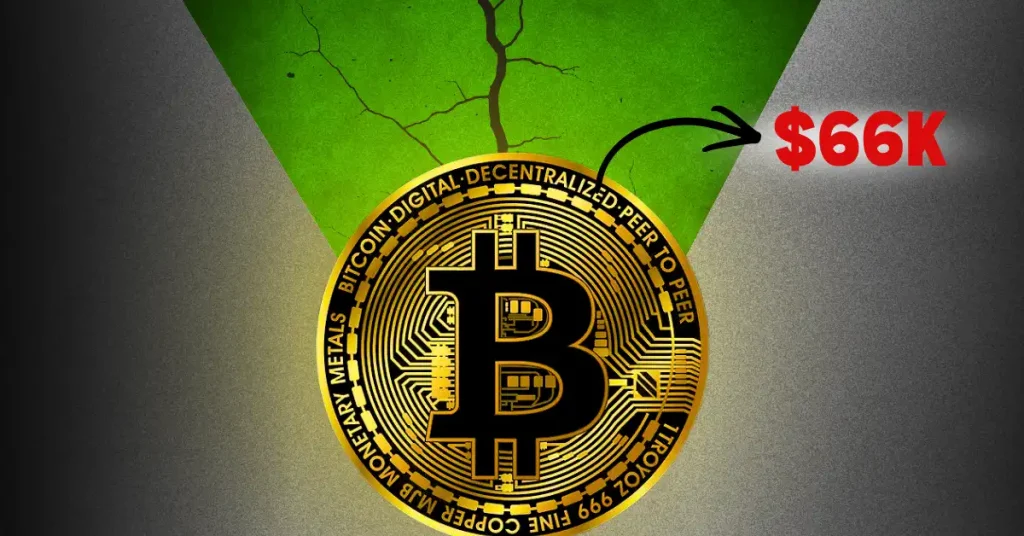
Potential government stimulus events, driven by geopolitical conflict, AI job displacement, or fiscal crises, could trigger significant inflation and repricing of hard assets like Bitcoin. An analyst predicts that one of nine potential catalysts could materialize within 3 to 24 months, leading to money printing that may significantly boost Bitcoin's value due to its fixed supply. The article highlights that historical government responses to crises involve substantial money printing, suggesting a recurring pattern that could benefit Bitcoin as a hedge against currency devaluation.
Signal context only. Validate with price action, liquidity, and risk limits before taking a position.
Quick market read from this story
Bitcoin experienced significant volatility, with liquidations on both long and short positions, indicating a battle for control around key price levels.
The $69,000 to $70,000 zone represents critical resistance; a failure to break through this area could signal a continuation of the downtrend, while a sustained hold above it may indicate a bullish reversal.
Liquidation heatmaps suggest that while the $65,000 support held, the $63,500 to $66,500 range has higher liquidation clusters, making it a potential revisit area if downward pressure resumes.
Deep Dive
Bitcoin (BTC) experienced significant price swings, dropping to $65,000 before rapidly rebounding above $67,000. This volatility led to substantial liquidations, with approximately $257 million in long positions wiped out during the initial selloff, followed by another $136 million in short positions liquidated during the subsequent rebound.
Analysis of liquidation heatmaps indicates thin liquidity between $68,500 and $69,500, suggesting that Bitcoin could move through this range if upward momentum continues. Conversely, the $63,500 to $66,500 zone holds significantly larger liquidation clusters, making it a more probable area for a price revisit from a liquidity standpoint.
The cryptocurrency tested a critical support turned resistance area around the $65,000 mark, successfully defending this level for the time being. However, the broader market structure remains under pressure as BTC lost the former support zone between $69,000 and $70,000.
Current charts suggest that Bitcoin's next significant move hinges on its ability to break through the $69,000 to $70,000 resistance zone. A rejection from this area could signal a continuation of the downtrend, with potential support levels at $60,421, $59,801, $55,123, and $52,507.
Alternatively, a successful reclaim and hold above the $69,000 to $70,000 range could pave the way for a push towards higher resistance blocks, potentially near the $75,500 to $76,500 area. The market is closely watching this critical test to determine the short-term direction for Bitcoin.
Dogecoin faces a critical juncture to break a five-month losing streak by month-end, with current price action, increased volume, and a neutral RSI suggesting potential for a short-term reversal. Whale accumulation of 4.5 million DOGE below $0.09 and institutional holders maintaining their positions despite recent price dips indicate underlying support and a potential 'hold' strategy ahead of a possible rebound. The correlation with Bitcoin's broader recovery provides a potential tailwind for DOGE, making its ability to break immediate resistance at $0.093-$0.095 a key indicator for trend continuation.
