
Navigating Crypto News

CoinFeather
Navigating Crypto News

Quick market read from this story
Internet Computer (ICP) is showing signs of stabilization after a prolonged downtrend, potentially forming a base near $2.20-$2.60, which could precede a recovery if key resistance levels are breached.
The article presents long-term price predictions for ICP, suggesting a potential move towards $27 by 2026 and $70 by 2030, contingent on increased Web3 infrastructure adoption and decentralized cloud service expansion.
Recent catalysts like exchange listings and the AI narrative are noted, but the core price action remains in a transitional phase, requiring a confirmed breakout from consolidation to signal a strong recovery.
Source, catalyst, and sector overlap from the latest feed.
Stellar (XLM) is consolidating above a key demand zone, indicating potential for a structural breakout if resistance levels at $0.30 and $0.50 are reclaimed. The price prediction models suggest significant upside potential for XLM by 2026 and 2030, contingent on increased payment adoption and tokenization growth. While current price action shows signs of stabilization, a confirmed trend reversal requires sustained momentum above critical resistance, making it a watchlist candidate.
Iran's reported plan to utilize Bitcoin for oil tanker fees through the Strait of Hormuz presents a novel geopolitical use case for crypto, potentially bypassing traditional financial sanctions and creating a new demand vector for BTC. The proposed Bitcoin payments, if implemented at scale, could represent a significant daily demand for BTC, potentially exceeding daily mining supply and impacting market dynamics if sustained. Despite the potential implications, significant uncertainties remain regarding adoption, insurance, and governmental responses, suggesting this development is currently a speculative catalyst rather than a confirmed market shift.
Live Feed
Loading the broader stream in the same flow as the homepage feed.

The U.S. Treasury's proposed rule under the GENIUS Act formalizes AML/sanctions program requirements for stablecoin issuers, aligning them with existing financial institutions. This regulatory clarity aims to protect the U.S. financial system from illicit finance while seeking to foster innovation in the stablecoin ecosystem. The proposal mandates that stablecoin issuers must offer tokens capable of being blocked or frozen, indicating a focus on control and compliance for transaction finality. With multiple agencies like FinCEN, OFAC, FDIC, and OCC issuing proposals, the stablecoin regulatory landscape is solidifying, potentially impacting issuer operations and token utility.
Dogecoin's potential to reach $9.32 by matching Bitcoin's market cap presents a significant hypothetical upside, driven by analyst projections of a major rally. Technical analysis suggests Dogecoin is consolidating, with indicators pointing to a potential breakout and a move above $1, which would represent a new all-time high. Easing geopolitical tensions, such as the US-Iran ceasefire, could act as a macro tailwind for risk-on assets like Dogecoin, potentially fueling its anticipated rally. Despite bullish technicals, the article highlights that Dogecoin's increased supply means matching historical market caps of Bitcoin or Ethereum would result in significantly different price targets, with XRP's market cap being a more conservative benchmark.

Anthropic's new Claude Mythos AI demonstrates unprecedented cybersecurity capabilities, finding thousands of zero-day vulnerabilities, but its power is being restricted to vetted defenders due to safety concerns. The development of Mythos highlights a critical crisis in AI safety evaluation, as Anthropic admits its current measurement tools are becoming insufficient to assess the capabilities of its most advanced models. Despite Mythos being Anthropic's best-aligned model, it also poses the greatest alignment-related risk, indicating a divergence between average-case performance and tail-risk consequences in AI development. The inability to reliably benchmark advanced AI like Mythos raises questions about the future evaluation of AI safety and the path towards broader deployment of highly capable systems.

Bernstein's analysis suggests Bitcoin has a 3-5 year window to implement quantum-resistant upgrades, framing quantum computing as a manageable upgrade cycle rather than an existential threat. The primary quantum risk is concentrated in older Bitcoin wallets and addresses with exposed public keys, implying that newer security practices and wallet formats significantly mitigate this threat. While Bitcoin's mining process (SHA-256) is deemed not meaningfully vulnerable, specific older address types like P2PK and P2MS present higher risks that the developer community must address. The market should view the quantum threat to Bitcoin as a long-term, addressable technical challenge requiring proactive protocol development, not an immediate systemic risk.
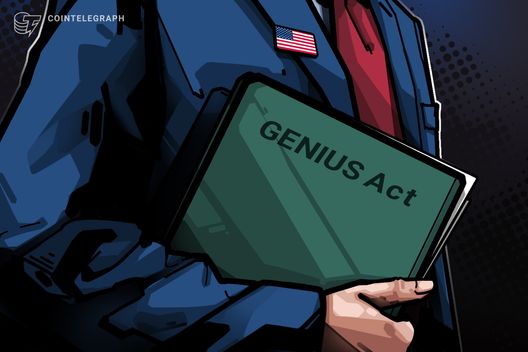
The US Treasury's proposed rule under the GENIUS Act mandates stablecoin issuers to implement AML/CFT and sanctions compliance programs, effectively treating them as financial institutions and increasing oversight on transactions. This regulatory push signifies a move towards stricter controls on stablecoins, potentially impacting their utility for illicit finance and increasing operational burdens for issuers, which could affect market participants' perception of stablecoin risk. While the GENIUS Act implementation is progressing, the broader CLARITY Act for digital asset markets remains stalled in the Senate, highlighting a fragmented approach to crypto regulation in the US.

Generational wealth transfer and point-of-sale adoption could drive stablecoin volumes to eclipse traditional payment rails, says Chainalysis.

Bitcoin's recent rebound is primarily driven by easing geopolitical tensions and falling oil prices, which reduce inflation fears and improve risk appetite, rather than political developments like impeachment odds. The market's transmission mechanism for Bitcoin remains tied to traditional macro factors such as energy prices, inflation expectations, and Federal Reserve policy, reinforcing its correlation with broader risk assets. While impeachment odds provide a political stress gauge, traders should prioritize monitoring oil price stability below $100 and the Fed's stance on interest rates for clearer directional signals for BTC. The current macro backdrop remains fragile, with potential for renewed volatility if oil prices surge above $110-$120 or if the current ceasefire fails, which could lead to a retest of Bitcoin's lower price ranges.

Bitcoin's technical indicators suggest a potential bottoming out, with key resistance at $72,000 to $76,000, a break above which could signal a move towards $84,000. Ether is showing early signs of a bullish trend, with potential upside targets at $2,400 and $2,800 if key resistance is overcome. Several major altcoins are exhibiting early buying signals, but require further confirmation to indicate a sustained trend reversal. Despite some bullish technicals, a final shakeout below $60,000 for Bitcoin is still considered a possibility by some analysts in the coming months.

Bernstein and Adam Back suggest the quantum threat to Bitcoin is manageable, framing it as a long-term upgrade cycle rather than an existential risk. While legacy Bitcoin wallets with exposed public keys are most vulnerable, newer protocols and Bitcoin mining are considered quantum-safe for the foreseeable future. The development highlights the ongoing need for quantum-resistant cryptography, with developers already preparing for future protocol transitions to mitigate long-term risks. Current quantum computing capabilities are far from posing a threat to Bitcoin's cryptography, requiring significant advancements in hardware and error correction.

OpenAI's release of a Child Safety Blueprint signals a proactive industry response to the growing threat of AI-enabled child exploitation, potentially influencing future regulatory frameworks and platform development. The blueprint's focus on legal reforms, enhanced reporting, and technical safeguards indicates a recognition of the need for multi-faceted solutions to combat AI misuse, suggesting a shift towards more responsible AI deployment. While not directly impacting crypto assets, this development highlights the broader societal and regulatory pressures on AI technologies, which could indirectly affect AI-focused crypto projects or infrastructure.
Ethereum breaks key resistance as ETH futures inflows, open interest, and net longs rise, though analysts still warn of lower lows.
Meta's launch of the Muse Spark AI model, featuring multimodal reasoning and agent orchestration, signals a strategic push to compete in the rapidly expanding AI market, potentially driving user engagement across its platforms. The introduction of Muse Spark, designed for efficiency and practical deployment, aims to close the gap with AI leaders like OpenAI and Google, with potential monetization through API access and integration into Meta's core applications. Meta's significant investment in AI infrastructure, coupled with the broad rollout of Muse Spark, indicates a strong commitment to AI development, which could influence its stock performance and competitive positioning in the tech sector.

Michael Saylor suggests Bitcoin's bottom is in, driven by seller exhaustion and increasing ETF demand, indicating a potential shift in market sentiment. The formation of banking and digital credit on Bitcoin is identified as the key catalyst for the next bull market, moving Bitcoin beyond a simple store of value. Saylor dismisses quantum computing risks to Bitcoin as overblown and decades away, suggesting it should not be a near-term concern for investors. Mizuho's 'outperform' rating on MicroStrategy with a significant price target implies strong conviction in the company's strategy and Bitcoin's future.
Signal context only. Validate with price action, liquidity, and risk limits before taking a position.
No explicit catalyst tagged.
