
Navigating Crypto News

CoinFeather
Navigating Crypto News
Quick market read from this story
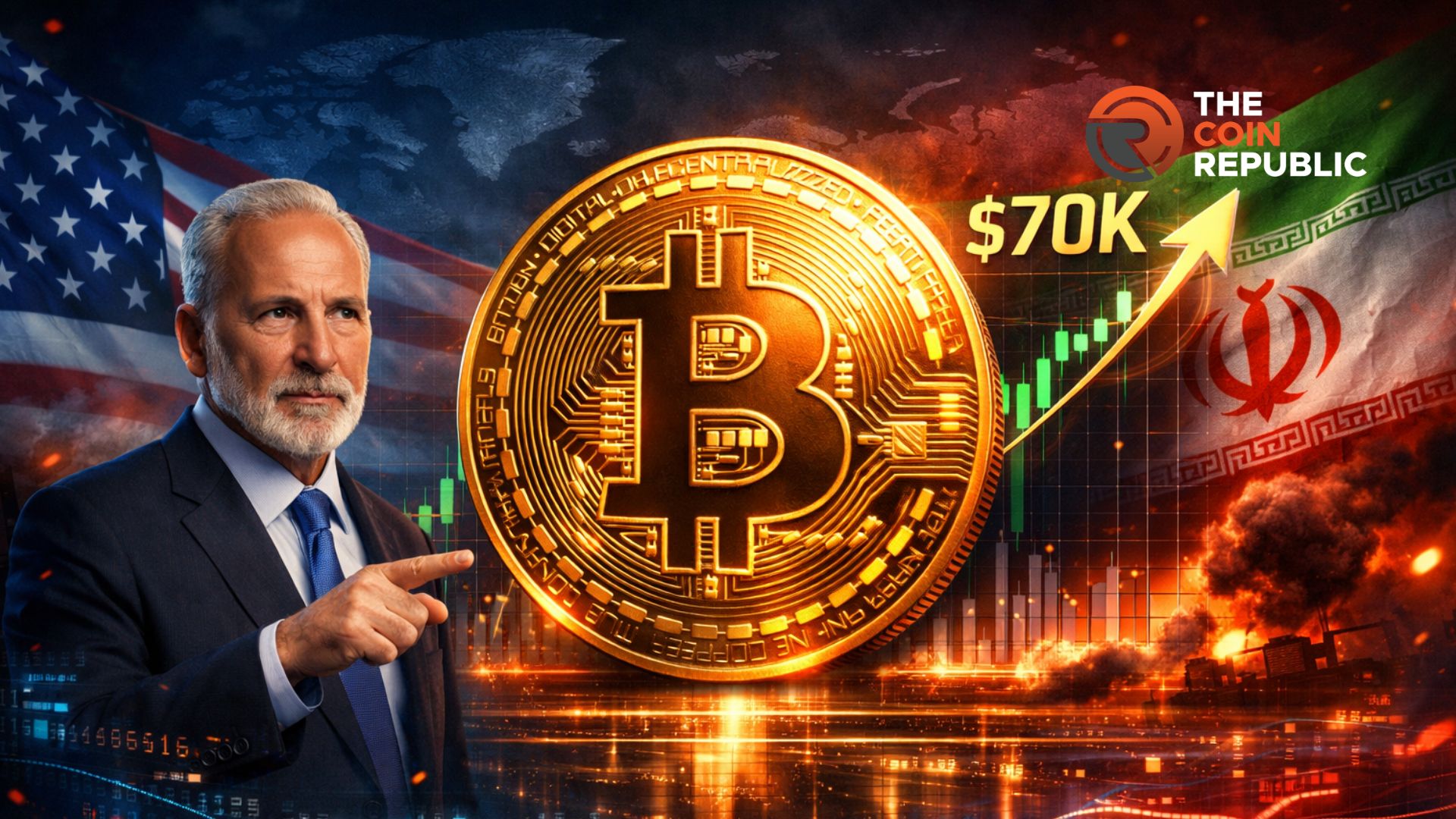
Bitcoin's surge above $70,000 amidst geopolitical tensions presents a divergence from traditional safe-haven assets like gold, suggesting a potential shift in investor behavior or short-term speculative trading driven by uncertainty.
Peter Schiff's warning about prolonged conflict pressuring stocks and crypto, while boosting oil and gold, highlights a bearish outlook for risk assets if geopolitical risks escalate, contrasting with Bitcoin's current upward momentum.
On-chain data indicating easing selling pressure and reduced unrealized losses for traders and long-term holders supports the narrative of a short-term relief rally, though broader market outlook remains bearish according to CryptoQuant's Bull Score.
Deep Dive
Bitcoin (BTC) experienced a significant price surge, breaking above the $70,000 mark amidst escalating geopolitical tensions between the United States and Iran. This rally occurred while traditional safe-haven assets like gold saw a decline, presenting an unusual divergence in market behavior.
Economist Peter Schiff voiced concerns, warning that a prolonged conflict could negatively impact stocks, bonds, and cryptocurrencies, while simultaneously boosting oil and gold prices. Schiff suggested that current market optimism might underestimate the risks associated with an extended war.
The energy market reacted swiftly to the conflict, with oil prices climbing due to concerns over potential disruptions to key energy routes. This contrasts with Bitcoin's upward movement and gold's retreat, challenging traditional safe-haven trends.
Market analysts offered varied perspectives on Bitcoin's recent performance. Billionaire Ray Dalio questioned direct comparisons between Bitcoin and gold, citing Bitcoin's lack of central bank backing and limited privacy advantages. He also noted potential future threats from quantum computing to Bitcoin's security.
Bloomberg ETF analyst Eric Balchunas suggested that short-term price actions might not redefine Bitcoin or gold as definitive safe-haven assets, attributing the moves to market-making activity and sentiment shifts rather than a fundamental change in investor behavior.
Despite these differing views, Bitcoin news highlighted the scale of its recent rally, with the cryptocurrency gaining over 10% since the strikes began, while gold fell nearly 2%.
On-chain data from CryptoQuant suggests that easing selling pressure contributed to Bitcoin's relief rally. Selling pressure across spot markets declined, with demand contraction narrowing significantly. Trader unrealized losses reached levels not seen since July 2022, historically a condition that reduces marginal selling and supports short-term price rebounds.
Furthermore, selling by long-term holders slowed considerably, reaching its lowest recorded level since June 2025. Despite these indicators supporting a short-term rally, CryptoQuant maintained a generally bearish outlook for the broader market, noting resistance levels in the $79,000-$90,000 range.
Sentiment in the broader crypto sector has shown signs of increased bullishness, though global markets remain sensitive to ongoing conflict developments.
Source, catalyst, and sector overlap from the latest feed.
The launch of the 21Shares Polkadot ETF (TDOT) on Nasdaq with $11 million in seed capital provides a regulated, accessible entry point for traditional investors into the Polkadot ecosystem, potentially increasing demand for DOT. While the ETF launch is a positive development for Polkadot's institutional adoption, the current muted market sentiment and DOT's recent price retracement suggest that immediate significant price appreciation may be tempered. Upcoming tokenomics changes for Polkadot, including a supply cap and reduced emissions, coupled with a shortened unbonding period, could enhance DOT's long-term value proposition and liquidity, making it more attractive post-ETF listing.
Bitcoin experienced a price dip below $70,000, influenced by a broader risk-off sentiment in global equity markets. Significant Bitcoin outflows from exchanges, totaling 32,000 BTC in a single day, suggest potential accumulation by large investors despite the price decline. The combination of weak equity futures and substantial BTC exchange withdrawals indicates a complex market dynamic where institutional accumulation may be occurring amidst short-term price pressure. On-chain data showing stablecoin inflows preceding large BTC withdrawals points to active spot buying pressure, suggesting underlying demand despite the price slip.
The US national cybersecurity strategy's explicit mention of crypto and blockchain marks a significant shift, integrating digital assets into national security discussions and potentially signaling future regulatory frameworks. Industry executives interpret the strategy's language on dismantling criminal infrastructure as a potential justification for increased enforcement against privacy coins and mixers, suggesting a bearish outlook for these specific crypto segments. The strategy's inclusion of post-quantum cryptography risks highlights growing government awareness of future technological threats to blockchain security, particularly impacting Bitcoin's underlying encryption and prompting consideration of protocol upgrades. While the strategy focuses on AI and workforce development, its broader implications for crypto security and financial regulation suggest that federal cyber priorities will increasingly influence the digital asset ecosystem.
A significant BTC transfer of $19 million to exchanges by a wallet linked to Jane Street raises concerns of a potential market sell-off, potentially pressuring Bitcoin towards the $65K support level. Despite the immediate sell-off fears driven by Jane Street's actions, analysts highlight that $70K remains a critical support level, with some on-chain data suggesting long-term bullish momentum may persist if this level holds. The market is closely watching Bitcoin's ability to reclaim the $75K resistance and the 50-day SMA to confirm a continuation of bullish momentum, with significant short liquidation leverage currently outweighing long liquidation.
A US federal court has dismissed the lawsuit accusing Binance and CZ of enabling terrorist financing, citing insufficient evidence from plaintiffs. The dismissal removes a significant legal overhang for Binance, potentially improving sentiment and reducing regulatory uncertainty for the exchange. While this specific lawsuit is dismissed, Binance still faces other regulatory scrutiny, suggesting continued caution is warranted for the exchange's operational outlook.
The SEC's proposed settlement to drop most claims against Justin Sun and Tron entities, focusing only on a wash trading charge against Rainberry Inc. for a $10 million penalty, significantly de-risks the Tron ecosystem from ongoing litigation. This resolution, pending court approval, removes substantial legal uncertainty for Justin Sun and associated foundations, potentially allowing for renewed focus on development and adoption without the overhang of a broad SEC enforcement action. The settlement aligns with a broader trend of the SEC re-evaluating and narrowing its enforcement actions, suggesting a potential shift in regulatory strategy that could impact other ongoing or future cases in the crypto space.
Ripple's expansion into tokenizing traditional fund structures with Aviva Investors on XRPL signals a significant move towards bridging traditional finance and blockchain for RWA adoption. The integration of Coinbase futures, including XRP, onto Ripple Prime's $3 trillion clearing platform enhances institutional access and liquidity for regulated derivatives trading. Ongoing XRPL development, including the upcoming Permissioned DEX and Lending Protocol, alongside AI agent payment capabilities, indicates a strategic push for broader utility and enterprise adoption. Ripple's expanded Ripple Payments service, supporting fiat and stablecoin transactions across over 60 markets, demonstrates a focus on global payment infrastructure and cross-border settlement.
XRP ETFs experienced their largest monthly withdrawals totaling $16.62 million on March 6, indicating institutional caution despite overall strong cumulative inflows since launch. Significant outflows from major XRP ETFs like 21Shares, Bitwise, and Grayscale suggest a potential shift in institutional sentiment or a rebalancing of portfolios away from XRP. The substantial ETF outflows coincide with XRP's price correction, highlighting a potential correlation between institutional trading activity and short-term price movements.
Solana's price action is currently dictated by key liquidity clusters around $95 resistance and $78-$85 support, suggesting potential for a short-term rebound after testing lower levels. The $83 level is identified as a critical mid-range defense for bulls; failure to hold this support could trigger a decline towards the $75 zone, indicating bearish pressure. Despite some market sentiment viewing Solana as 'cooked' due to a weakened memecoin ecosystem, the asset has shown resilience, rebounding from recent lows and indicating potential for continued short-term trading opportunities. Traders should monitor the $83 support and $90-$92 resistance levels for directional cues, as a decisive break in either direction will likely dictate SOL's immediate price trajectory.
Live Feed
Loading the broader stream in the same flow as the homepage feed.

A federal judge has certified a class action lawsuit against Tether and Bitfinex, allowing retail investors to pursue claims of market manipulation from nearly a decade ago. The lawsuit alleges that Tether issued unbacked USDT to artificially inflate Bitcoin and Ethereum prices during the 2017 bull run, a claim previously addressed in settlements with the NYAG and CFTC. With class certification granted, the case now proceeds to the discovery phase, where evidence will be presented, potentially impacting the credibility and future operations of Tether and Bitfinex. This development highlights ongoing legal scrutiny of stablecoin issuers and their market impact, carrying implications for the broader crypto industry's regulatory landscape.

The growing trend of 'digisexuality' and emotional bonds with AI chatbots highlights a new frontier in human-computer interaction, potentially influencing future digital service design and user engagement models. The AI companion market, projected to reach $210 billion by 2030, signifies a substantial economic opportunity, yet raises ethical concerns regarding user well-being and the potential for emotional dependency. User backlash to AI model updates, such as OpenAI's GPT-4o to GPT-5 transition, demonstrates the depth of emotional investment users form with AI, impacting platform loyalty and product development strategies. Tragic incidents involving AI chatbots and user suicides underscore the critical need for responsible AI development and robust safety protocols to mitigate potential psychological risks.
XRP is currently positioned at a critical technical juncture, indicated by its price hovering around the middle Bollinger Band, suggesting potential for significant directional movement based on market sentiment and user engagement. Despite a recent 6.29% price appreciation over seven days, XRP's current trading volume and a 2.7% decline in the last 24 hours, influenced by broader market pressures like Middle East tensions and US economic data, indicate a lack of strong conviction from market participants to drive a sustained rally. The potential for XRP to either break towards $1.42 or fall below the $1.30 support level hinges on increased buying activity and whale intervention, with a breach of support potentially leading to a decline towards $1.20. While the article highlights a liquidity crunch on Binance as a potential trigger for an upward shift, the overall market conditions and current trading volume suggest a neutral to cautious outlook, with significant price swings to $2 or below $1 remaining possibilities.

The significant growth in tokenized RWAs to $20.4B and the expansion of Ethereum's L2 ecosystem to 146 networks indicate a strengthening fundamental infrastructure that could support future price appreciation. With stablecoins comprising over 60% of liquidity ($179B) across Ethereum's mainnet and L2s, the network remains the central hub for DeFi activity, suggesting continued demand for ETH as the base settlement layer. Declining ETH exchange reserves signal potential accumulation by investors, a historically bullish indicator that contrasts with the current sluggish price action and suggests underlying confidence in the network's long-term prospects. The confluence of institutional interest in blockchain infrastructure, significant on-chain liquidity, and expanding L2 capabilities suggests that Ethereum's current price may be underestimating the network's fundamental growth and potential for future repricing.

Ethereum is testing a critical ascending trendline that has historically supported major lows since 2019, making its current hold pivotal for its long-term bull case. Underperformance relative to Bitcoin suggests ETH lacks momentum at this key support level, increasing the risk of a breakdown if the trendline fails. A successful hold could trigger a rotation into altcoins, signaling the start of an altcoin season, while a break could lead to capital flowing back into Bitcoin and further downside for ETH. The confluence of geopolitical tensions and weak economic data creates a challenging macro environment, amplifying the importance of ETH's weekly close at this make-or-break support level.

Significant weekly capital inflows of $680 million into Hyperliquid, surpassing major blockchains, indicate growing investor confidence and liquidity, supporting potential price appreciation. The HYPE token's breakout from a falling wedge pattern, coupled with strong protocol revenue and increasing derivatives trading activity, suggests a bullish technical setup with a potential target of $55-$58. Hyperliquid's leading fee generation, exceeding $1.7 million in 24 hours, highlights robust network demand and user engagement, positioning it as a key player in decentralized derivatives trading. With strong on-chain metrics and a bullish technical outlook, traders may interpret the current momentum as a signal for a potential rally, provided resistance levels are overcome.

Kalshi and Polymarket are reportedly exploring fundraising rounds at a $20 billion valuation, doubling their previous valuations and signaling strong investor confidence in the prediction market sector. Despite potential for significant growth, both platforms face increasing regulatory scrutiny and insider trading allegations, which could impact future operations and valuations. The news suggests a potential surge in capital inflow into prediction market infrastructure, though regulatory headwinds remain a key risk factor for traders.
Geopolitical tensions between the U.S. and Iran are driving a broad crypto market sell-off, impacting major assets like Bitcoin and Ethereum as investors de-risk. The potential for escalating conflict and U.S. actions to cut Iran's oil revenues are creating significant uncertainty, pressuring Bitcoin towards a key support level around $55,000. The current market downturn, characterized by a 3-5% drop across major altcoins, suggests a heightened sensitivity to global macroeconomic and geopolitical events rather than project-specific news.

The 2020 MakerDAO 'Black Thursday' incident, where a bot exploited a 40-minute window to acquire $8.32M in ETH for free due to network congestion and failed auctions, highlights critical DeFi risk management failures. This historical event serves as a foundational case study for modern DeFi liquidation systems, emphasizing the importance of designing for extreme network conditions and continuous market participation. The incident resulted in a $4.5M bad debt for MakerDAO, forcing MKR holders to approve a token mint to cover the shortfall, demonstrating the direct financial impact on governance token holders during protocol failures. With current DeFi liquidations in focus, the lessons from this 40-minute exploit remain highly relevant for assessing the resilience of decentralized finance protocols under stress.

The launch of the ShibClaw skill represents an integration of AI agents into the Shiba Inu ecosystem, potentially enhancing automation for developers building on Shibarium. While the ShibClaw skill aims to provide AI-driven functionality for Shibarium, a warning has been issued regarding contract address verification and security best practices, highlighting ongoing risks in ecosystem development. This development signals a broader trend of AI integration within blockchain infrastructure, suggesting that AI agents could become crucial tools for scaling and operational efficiency in crypto ecosystems.

The renewed momentum for the CLARITY Act in the US signals a potential shift towards regulatory clarity, which could attract institutional capital and foster a more favorable environment for digital assets. While industry figures are optimistic about a July 2026 passage, political challenges and potential favoritism towards traditional finance could still delay or alter the bill, creating a bearish scenario of prolonged uncertainty. Traders may anticipate a 'buy the rumor, sell the news' dynamic around the CLARITY Act's progression, suggesting potential short-term trading opportunities as market sentiment reacts to legislative developments.
Geopolitical tensions and weak US jobs data are driving a risk-off sentiment, leading to significant liquidations and a market-wide sell-off in cryptocurrencies. The decline in crypto market capitalization to $2.33 trillion, with Bitcoin and Ethereum experiencing notable drops, underscores the sensitivity of digital assets to global instability and macroeconomic factors. Short-term Bitcoin holders are realizing profits, transferring substantial amounts to exchanges, indicating a potential shift in sentiment and contributing to the current selling pressure. The market is experiencing a correction driven by macro events and profit-taking, with potential for further downside if selling pressure persists, contingent on geopolitical developments and economic data.
Signal context only. Validate with price action, liquidity, and risk limits before taking a position.
