
Navigating Crypto News

CoinFeather
Navigating Crypto News

Quick market read from this story
The market's sharp sell-off in Circle's CRCL stock, triggered by leaked regulatory drafts banning passive stablecoin yield, appears to be an overreaction as analysts argue the core business model of earning interest on reserves remains intact.
While proposed regulations may impact exchanges like Coinbase that offer stablecoin yields, Circle's revenue primarily derives from interest on its USDC reserves, suggesting its business model is less directly threatened than initially perceived.
Despite the regulatory uncertainty and a temporary freeze of USDC balances, Circle's underlying operating metrics for USDC show continued growth in circulation and transaction volume, indicating sustained demand beyond passive yield.
The concurrent audit announcement by Tether and Circle's involvement in freezing assets due to a civil case have introduced competitive and operational pressures, respectively, making the stablecoin landscape more dynamic.
Deep Dive
Circle, the issuer of the USD Coin (USDC) stablecoin, experienced a significant 20% drop in its stock value this week, wiping out $5 billion in market capitalization. This sharp decline, the steepest intraday drop since its public debut, occurred on the same day that rival Tether announced it had engaged a 'Big Four' accounting firm for a full audit of its USDT stablecoin.
The immediate trigger for the sell-off was the emergence of new draft language for the anticipated CLARITY Act. This proposed legislation reportedly aims to ban passive stablecoin yield, preventing users from earning rewards simply for holding dollar-pegged tokens. Furthermore, it would prohibit exchanges and affiliated firms from offering yield on stablecoin balances, directly or indirectly, or through economically equivalent structures.
While activity-linked incentives might still be permitted, the draft grants US financial regulators, including the SEC and Treasury, time to define specific regulations. This news arrived after a substantial rally in Circle's shares, which had climbed 170% from February lows, driven by positive earnings, accelerating USDC growth, and optimism surrounding regulated stablecoins in tokenization, AI payments, and cross-border transfers.
Market analysts, including Mario Stefanidis of Artemis, noted that the market repriced the stablecoin trade rapidly, exposing a potential business-model vulnerability for issuers, especially as interest rates and reserve yields had already begun to decline.
Despite the sharp stock decline, many market analysts and institutional investors argue the market's reaction was an overreaction. They contend that Circle's core business fundamentals remain strong. Circle generates revenue by issuing USDC, investing reserves in short-duration US Treasurys and overnight repurchase agreements, and earning the spread on these holdings. In Q4 2025, Circle's reserve income increased 60% year-over-year to $711 million, with total revenue reaching $2.7 billion, up 64%.
Bernstein analysts emphasized that investors should differentiate between stablecoin issuers like Circle and distributors. They argue the proposed rules target platforms that pass yield to users, not issuers earning on reserve assets. Some investors, like Simon Dedic of Moonrock Capital, believe the draft could even strengthen Circle's position by preserving its ability to earn reserve yield while limiting competition from aggressive yield offers by others.
Exchanges such as Coinbase, which do pass on yield to users, may face more immediate adjustments if the bill becomes law, potentially impacting their reward programs and loyalty systems.
The sell-off occurred while USDC's operational metrics showed continued strength. In late March, USDC circulation reached approximately $81 billion, up from $76 billion at the end of 2025. Adjusted on-chain transaction volume for USDC in Q4 2025 exceeded $6.8 trillion, more than double the previous year's level.
Circle has also expanded its commercial reach through partnerships in Africa and integration with Intuit. These developments suggest that USDC demand is increasingly driven by activities beyond passive yield, including cross-border settlement and trading collateral. This outlook prompted Ark Invest to purchase 161,513 Circle shares during the market dip.
The stock's decline was also influenced by two other events. Firstly, Tether's progress towards a full audit by a Big Four firm has raised speculation about its potential to improve its market standing, challenging Circle's perceived advantage as a more regulated issuer. Secondly, Circle's freeze of USDC balances in 16 business hot wallets late Monday, reportedly linked to an undisclosed US civil case, disrupted operations for several platforms. Blockchain investigator ZachXBT criticized the freeze, calling it potentially "incompetent" due to the nature of the targeted addresses.
While the market is currently pricing in the harshest interpretation of the CLARITY Act draft, analysts suggest this may be overly severe. The policy direction towards limiting passive yield is not entirely new, with previous proposals like the GENIUS Act indicating a similar regulatory path. Analysts at Berinstein maintain an Outperform rating with a $190 price target, and Clear Street reiterated a buy rating with a $152 price target.
Bitwise CIO Matt Hougan believes Circle's strong market position provides an advantage over potential future entrants like big banks, projecting the stablecoin firm could be worth $75 billion by 2030.
Source, catalyst, and sector overlap from the latest feed.
G Coin's rapid holder growth post-launch is now facing a critical test of its utility and ecosystem integration, moving beyond initial listing hype to sustained demand. The focus shifts from holder milestones to observable metrics like exchange liquidity, staking participation, and in-ecosystem usage to validate G Coin's claims as an operational economic layer. Sustained demand for G Coin will depend on its ability to demonstrate real-world utility within its gaming and sports event ecosystem, rather than relying solely on speculative interest.
A supply chain attack targeting the popular LiteLLM Python package has been detected, injecting wallet-stealing malware that specifically searches for Bitcoin, Ethereum, and Solana private keys and validator credentials. The incident highlights a significant risk to developers and crypto infrastructure, as the malware was distributed via PyPI to tens of millions of users, potentially compromising sensitive information stored on developer machines and within Kubernetes environments. While detection was relatively swift, the sophisticated nature of the attack, which included persistence mechanisms and targeted harvesting of cloud credentials and SSH keys, suggests a high potential for undetected compromises and subsequent exploitation of drained assets or compromised infrastructure. This event underscores the critical need for enhanced supply chain security practices, including dependency pinning, secure credential management, and robust auditing, to mitigate risks associated with widely used developer tools.
The Ethereum Foundation's updated post-quantum roadmap, coupled with Google's accelerated 'Q-Day' projection to 2029, signals an urgent need for protocol and user-level cryptographic upgrades, potentially impacting network security and asset accessibility sooner than anticipated. Ethereum's reliance on account abstraction (EIP-4337) presents a viable migration path for users, but the coordination challenge for high-value operational keys at bridges and custodians, along with the political complexity of dormant coin migration, introduces significant execution risks. The accelerated quantum threat timeline intensifies the focus on operational security for bridges and exchanges, as market participants may begin to price in security risks associated with delayed migrations, potentially leading to capital outflows for lagging operators. While Ethereum's lower percentage of dormant coins compared to Bitcoin simplifies potential governance decisions regarding asset recovery, the broader industry faces a complex coordination problem to ensure a secure transition to post-quantum cryptography across all critical infrastructure.
Morgan Stanley's imminent launch of its own Bitcoin ETF (MSBT) signifies a major TradFi institution moving from distributing third-party products to issuing its own, potentially redirecting significant fund flows within its $8 trillion wealth management division. The scale of Morgan Stanley's wealth management platform, overseeing $6 trillion in adviser-led assets, suggests that even a small allocation to MSBT could represent substantial demand, potentially dwarfing existing Bitcoin ETFs. By integrating MSBT into its model portfolios and offering it through its own adviser network, Morgan Stanley is positioning Bitcoin as a standard asset class within traditional wealth management, indicating a maturing adoption phase for crypto. The competitive landscape for Bitcoin ETFs is intensifying, with Morgan Stanley likely needing to price MSBT competitively, potentially around 0.20%-0.25%, to attract assets against established players like BlackRock's IBIT.
Bitcoin miners are increasingly selling BTC to fund operations and pivot to AI infrastructure, signaling a shift from holding treasuries to acting as commodity producers under pressure. The AI pivot is creating a bifurcation in miner stocks, with AI/HPC-linked companies potentially earning valuation premiums over pure-play miners due to diversified revenue streams. Miners with significant debt loads face dual headwinds from potential BTC price weakness and execution risk on AI contracts, increasing their refinancing stress. The changing dynamics suggest a market where efficient, well-capitalized operators will survive, while older fleets and those heavily reliant on legacy mining may face forced shutdowns or asset sales.
Solana's on-chain indicators suggest a cooling market phase, which analysts interpret as a potential precursor to a significant price breakout, driven by anticipation of a SOL ETF approval. The SEC's request for amendments to Solana ETF filings, with a decision potentially by mid-July or early August, represents a key regulatory catalyst that could unlock institutional capital and drive demand for SOL. The burgeoning Solana memecoin ecosystem, exemplified by Pump.Fun's rapid growth and high token launch volume, is contributing to positive sentiment and potential price appreciation for the SOL network.
Ripple and the SEC have jointly filed a request to modify the final judgment, seeking to reduce the penalty to $50 million and lift an injunction, but legal experts express skepticism about Judge Torres' approval. XRP price experienced a 7% decline, influenced by broader market downturns due to geopolitical tensions and tariffs, alongside specific concerns regarding the SEC-Ripple settlement's approval. The legal arguments presented for the settlement modification are considered weak by some lawyers, increasing uncertainty for XRP's future price action and potential for continued litigation.
Circle CEO's 'iPhone moment' prediction for stablecoins, coupled with new partnerships and regulatory developments like the GENIUS Act, signals a potential inflection point for mass adoption in global payments. The increasing involvement of major corporations like Walmart and Amazon, alongside traditional banks exploring stablecoins, indicates a growing institutional interest and a competitive landscape heating up for market dominance. Circle's strategic partnership with Matera in Brazil and its IPO filing suggest a proactive approach to expanding USDC's reach within traditional banking infrastructure, aiming to embed digital dollars into daily transactions. While Circle's USDC is a significant player, the continued strength of Tether and the emergence of new entrants like Ripple's RLUSD highlight a dynamic and competitive stablecoin market, with regulatory clarity poised to accelerate growth.
US CPI inflation at 2.4% was slightly below the 2.5% forecast, indicating a potential easing of price pressures that could support risk assets like Bitcoin and Ethereum. Despite the slightly lower-than-expected CPI, the market's focus remains on potential Federal Reserve rate cuts, with CME FedWatch showing high probabilities for September and December, which could be a tailwind for crypto. While Bitcoin and Ethereum saw minor price movements, the underlying sentiment suggests resilience, with analysts like 10x Research noting that even weaker data might reignite stimulus discussions, potentially benefiting crypto. Whale accumulation of Bitcoin and increased futures trading volume for Ethereum suggest underlying strength and potential for upside, despite current price range-bound action.
Renewed institutional interest in XRP, evidenced by $11.8 million in inflows, signals growing confidence driven by optimism surrounding the conclusion of the Ripple vs. SEC lawsuit. The potential resolution of the SEC lawsuit is a primary catalyst, with a key June 16 deadline for status updates potentially influencing near-term price action and investor sentiment. Despite broader market inflows, XRP's specific recovery is closely tied to legal developments, suggesting a speculative rather than purely fundamental driver for current price action. Increased trading volume and open interest in XRP derivatives indicate heightened trader activity and potential for significant price swings as the lawsuit's outcome approaches.
OKX's decision to delay its IPO, prioritizing long-term shareholder value over immediate market entry, signals a cautious approach to public listings within the crypto industry. The exchange's strategic investment from ICE, valuing the company at $25 billion, suggests a strong underlying business despite the IPO postponement, potentially indicating a robust foundation for future growth. OKX's emphasis on building a durable company over decades, rather than timing the market, reflects a strategic shift towards sustainable growth and away from the speculative frenzy seen in past crypto booms. Concerns about past poor performance of crypto IPOs, as highlighted by OKX's executive, suggest a potential for continued investor skepticism towards similar listings, impacting the broader exchange sector.
Ripple's significant RLUSD token burns, totaling over 35 million tokens across Ethereum and XRP Ledger, indicate active supply management by the stablecoin treasury. While token burns are routine for stablecoin peg maintenance, the scale and short timeframe of these recent burns have prompted community discussion about liquidity management and potential underlying market dynamics. The market cap fluctuation from $1.6 billion to $1.4 billion due to these burns highlights the direct impact of supply adjustments on stablecoin valuation and circulating supply.
XRP Ledger's integration of AI for proactive security threat detection signifies a maturation of its infrastructure, aiming to enhance reliability for scaling global payments and tokenized assets. The shift from reactive to proactive security measures, driven by AI, positions XRPL to better support increasing transaction volumes and the growth of stablecoins like RLUSD, potentially boosting institutional confidence. XRPL's concurrent launch of AI-powered Agent Commerce alongside security enhancements suggests a strategic push towards optimizing on-chain payments and autonomous agent functionality, leveraging AI for both efficiency and safety.
Cardano's listing on Bitstamp via Robinhood significantly enhances its accessibility for U.S. investors, potentially increasing liquidity and demand. The Bitstamp listing, following previous SEC concerns, signals a more favorable regulatory environment for ADA in the U.S., supporting bullish sentiment. Analyst projections suggest a potential 585% surge for ADA to $5.36 in the next bull cycle, driven by increased market access and technical support at $0.24. While technical indicators show consolidation and some resistance, the overall market sentiment and listing catalyst provide a foundation for potential upward price movement.
The fading hype surrounding the US-China trade deal truce has triggered a sell-off in crypto-related stocks, with MSTR and COIN experiencing significant declines, indicating a market reaction to shifting geopolitical sentiment. MicroStrategy's (MSTR) stock drop is exacerbated by ongoing concerns regarding its aggressive Bitcoin accumulation strategy, highlighting potential risks associated with large-scale corporate treasury diversification. Coinbase's (COIN) stock resilience, attributed to its revenue-sharing agreement with Circle for USDC, suggests that strategic partnerships and stablecoin ecosystem growth can partially insulate exchange-related equities from broader market volatility.
Live Feed
Loading the broader stream in the same flow as the homepage feed.

A new benchmark, ARC-AGI-3, reveals a significant gap between current AI models and true Artificial General Intelligence (AGI), with leading models scoring below 1% compared to human performance. The benchmark's focus on generalization and learning from scratch in novel environments, rather than pattern recall, highlights a fundamental limitation in current AI capabilities, challenging recent AGI claims from industry leaders. The stark performance difference suggests that despite advancements, AI systems lack the reasoning and adaptability of humans, indicating that the market may be overestimating the current state of AGI development. The ARC Prize Foundation's $2 million competition with open-source requirements aims to drive progress in true AGI, but current results indicate a long road ahead, potentially tempering near-term speculative enthusiasm around AI-driven crypto narratives.

Ripple's deployment of AI for enhanced XRP Ledger security, including an AI-assisted red team, signals a proactive approach to mitigating risks and could bolster investor confidence in the platform's long-term stability. The prioritization of bug fixes over new features in the upcoming XRP Ledger release, coupled with increased security audits, indicates a maturing development cycle focused on foundational integrity, which may appeal to institutional adoption. Despite the security enhancements, XRP's price decline to a two-week low suggests that broader market sentiment and macroeconomic factors are currently overshadowing project-specific developments.

MicroStrategy's preferred equity (STRC) has recovered to par value faster than its historical average, enabling the company to raise capital for further Bitcoin accumulation. The faster recovery of STRC to $100 par value suggests improved market confidence or demand for the instrument, directly facilitating MicroStrategy's strategy of buying Bitcoin with newly issued equity. This development allows MicroStrategy to continue its Bitcoin buying strategy, potentially increasing its BTC holdings and reinforcing its position as a major corporate holder, which could indirectly support Bitcoin's market narrative.
XRP's market structure is shifting as speculative leverage on Binance has significantly decreased by approximately 78%, suggesting a move towards spot demand-driven price action rather than futures positioning. Growing crypto adoption in Africa, with over $205 billion in on-chain value, provides a narrative tailwind for XRP, aligning with Ripple's focus on payments and cross-border transactions in emerging markets. Despite reduced leverage and increased on-chain activity on the XRP Ledger, traders are closely watching key support levels around $1.37-$1.40, as a break below could trigger a ~16% correction due to a bearish head-and-shoulders pattern.
Economist Peter Schiff warns of a potential US housing market crisis exceeding 2008 levels, driven by collapsing affordability due to rising mortgage rates, insurance, taxes, and utilities. The current housing market risks are primarily linked to affordability erosion rather than excessive leverage, creating a feedback loop of lower demand and price pressure. Geopolitical tensions and persistent inflation, exacerbated by potential conflict and Fed policy, add a new layer of risk, with higher oil prices being a key concern for increased costs. The article draws parallels to China's housing market downturn, highlighting the vulnerability of housing markets to extreme monetary conditions and converging economic pressures.

The upcoming $3.7 billion options expiry on Deribit introduces a significant event risk, potentially driving short-term price volatility for Bitcoin and Ethereum. Geopolitical tensions and macro events are increasing overall market volatility, pressuring Bitcoin and Ethereum prices ahead of key support levels. Analysts suggest that while short-term retracements are expected, the health of Bitcoin and Ethereum's price action will depend on their ability to hold critical support levels around $106,000 and $2,700 respectively. The put-call ratios and max pain points for both BTC and ETH options indicate a mixed to bearish sentiment among traders, suggesting caution is warranted.

Veteran trader Peter Brandt warns of a potential 75% Bitcoin crash, drawing parallels to the 2022 downturn, suggesting that current market conditions near $110K may signal overheating and increased volatility. On-chain data from Glassnode indicates potential market overheating in the derivatives space, with rising liquidations and speculative interest, despite cautious optimism reflected in funding rates. Technical indicators for Bitcoin show slowing bullish momentum with resistance at $110K and support at $108K-$108.5K, suggesting a critical juncture that could lead to a sharp pullback if sentiment shifts.

Retail investors are shifting preference from Strategy's common stock (MSTR) to its preferred share (STRC), indicating a demand for lower volatility and higher yield digital credit products. The increasing retail adoption of STRC, which offers a 11.5% annual dividend and Bitcoin overcollateralization, suggests a growing segment of the market seeks income-generating assets with defined risk parameters. STRC's growing popularity expands Strategy's addressable investor base, potentially strengthening its ability to accumulate more Bitcoin by diversifying its capital-raising avenues beyond traditional equity. While MSTR remains a leveraged Bitcoin proxy for sophisticated investors, STRC's distinct appeal to retail investors suggests it is carving out a separate market niche rather than directly competing with the common stock.
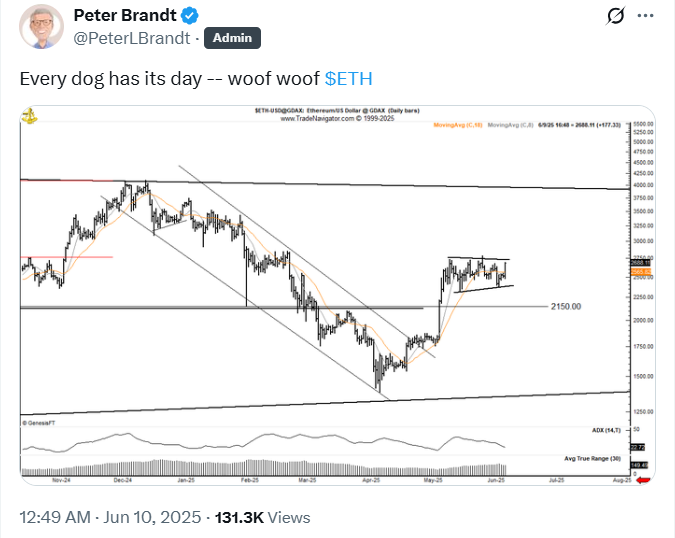
Ethereum has reclaimed its 200-day Moving Average, a key technical indicator, suggesting a potential bullish trend continuation and a retest of higher price levels. Significant inflows into Ethereum ETFs, coupled with strong DeFi ecosystem performance and increased whale accumulation, indicate growing institutional and retail interest, supporting price appreciation towards the $4,000 target. The rotation of capital from SOL to ETH, as observed in whale transactions, signals a potential shift in market sentiment favoring Ethereum's established utility and ecosystem over emerging competitors. Increased trading volume and reclaiming the 200-day MA suggest that ETH is building momentum for a breakout, with expert projections targeting $4,000, making it a key asset to watch for near-term upside.

CFTC Chair Michael Selig suggests blockchain's timestamping and on-chain identifiers can verify AI-generated content, potentially increasing demand for blockchain infrastructure solutions. The regulator's call for a light-touch approach to AI agents, focusing on actors rather than developers, implies a potentially favorable environment for blockchain-based AI verification tools. The integration of blockchain for AI content verification, as discussed by the CFTC chair and exemplified by Worldcoin's proof-of-personhood, signals a growing intersection between AI and blockchain technology.
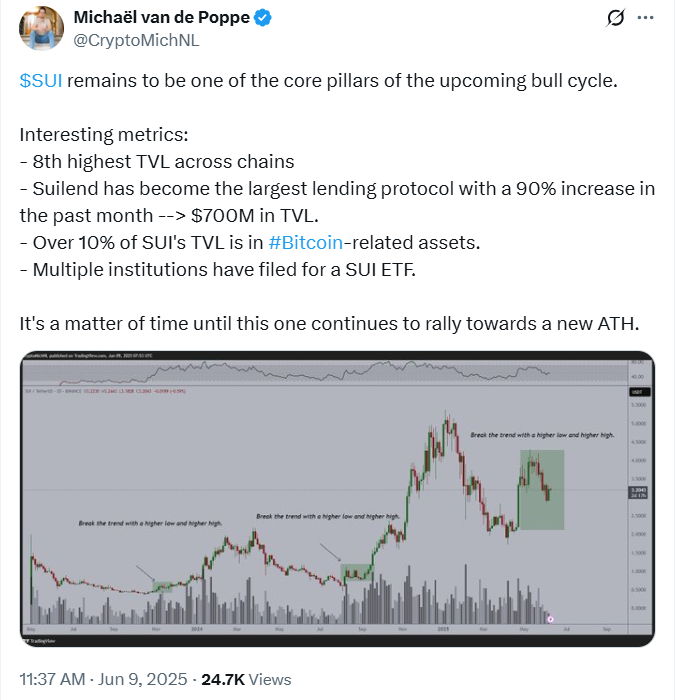
Sui's significant increase in Total Value Locked (TVL) to $1.873 billion, reaching 8th position, signals strong DeFi growth and increasing investor confidence in the network's capabilities. The integration of Bitcoin-related assets into Sui's TVL, accounting for 10%, suggests enhanced cross-chain potential and could drive demand for SUI as users engage with Bitcoin on the Sui network. The filing of a spot SUI ETF by Canary Capital Group and interest from other asset managers like 21Shares indicates growing institutional interest, potentially paving the way for increased capital inflows and a new all-time high for SUI. Analyst Michaël van de Poppe's positive outlook, citing Sui's DeFi performance and ETF prospects, positions SUI as a potential leader in the next crypto market rally, supported by on-chain activity and potential price appreciation.

Bittensor's TAO has experienced a significant 160% rally, but the formation of a golden cross pattern on its daily chart historically precedes substantial price corrections, suggesting a potential downside risk. Despite the sharp price increase, retail euphoria remains muted, indicating that while the rally has attracted attention, it may not yet be driven by widespread speculative excess, potentially allowing for further short-term upside before a reversal. The technical indicators, including an overbought RSI and the historical precedent of golden crosses leading to ~40% drawdowns, combined with broader macroeconomic concerns like inflation risks, point towards a bearish outlook for TAO in the near term.

Increased optimism surrounding potential Solana ETF approvals, with Polymarket odds surging to 92%, suggests significant institutional interest and a potential catalyst for SOL price appreciation. The SEC's request for amendments from 7 ETF applicants indicates an expedited review process, potentially leading to approvals within weeks and driving demand for SOL similar to BTC's ETF impact. Despite positive ETF sentiment, SOL price has recently pulled back to a two-month support level, presenting a potential entry point for traders anticipating a positive regulatory outcome. The inclusion of staking language in ETF applications could unlock new demand drivers for SOL, enhancing its appeal to institutional investors and potentially boosting network activity.
Signal context only. Validate with price action, liquidity, and risk limits before taking a position.
