
Navigating Crypto News

CoinFeather
Navigating Crypto News

Source, catalyst, and sector overlap from the latest feed.
Ripple's planned acquisition of an Australian Financial Services License via BC Payments Australia signifies a strategic expansion into a key APAC market, aiming to offer its full payments suite. The move is supported by a near doubling of Ripple's APAC payments volume in 2025, indicating strong regional demand and potential for further growth in cross-border transactions. While the acquisition is pending, it positions Ripple to enhance its regulated footprint globally, with over 75 licenses worldwide, and participate in Australia's digital asset infrastructure initiatives like Project Acacia. The mention of XRP trading at $1.38, up 0.3%, suggests a minor market reaction to the news, but the primary focus remains on Ripple's operational and regulatory expansion rather than direct XRP price catalysts.
Live Feed
Loading the broader stream in the same flow as the homepage feed.

Aave founder Stani Kulechov argues DAOs require a hybrid governance model, blending decentralized decision-making with clear leadership for operational efficiency and accountability. The debate highlights a critical challenge in DAO evolution: balancing true decentralization with the practical need for agile execution and leadership, potentially impacting future DAO structures. Recent governance disputes within Aave, including a failed proposal on brand asset transfer and a delegate's exit, underscore the immediate need for these governance reforms.

Senator Alsobrooks is pushing for a compromise on crypto market structure legislation, indicating that both the crypto industry and banks will need to make concessions for the bill to advance. The core sticking point appears to be stablecoin yield payments, with banking groups advocating for a ban due to concerns about deposit flight and systemic risk. The ongoing debate over stablecoin yields is directly stalling progress on broader crypto market regulation, highlighting the significant influence of traditional finance on legislative outcomes. The sentiment from Senator Alsobrooks suggests a push towards regulating crypto assets as 'bank-like products' requiring 'bank-like protections,' which could impose stricter compliance measures on the industry.

WLFI is consolidating near $0.10, with price predictions suggesting a potential breakout to $0.80 by the end of 2026 if market conditions remain bullish. The article presents long-term price targets for WLFI, projecting growth to $5.00 by 2030, indicating a speculative outlook based on sustained adoption and favorable market trends. Current price action shows WLFI consolidating within a descending channel, with key support at $0.098-$0.100, suggesting a potential short-term recovery towards $0.12-$0.15 if this level holds.
XRP's price is currently consolidating around a key demand zone of $1.30-$1.40, with potential for recovery if broader market momentum builds. Long-term forecasts suggest significant upside for XRP, with predictions ranging from $5-$6 by 2026 and up to $18 by 2030, driven by expected institutional adoption and Ripple's payment network expansion. Traders should monitor the $1.80 resistance level; a break above could signal a move towards $2.20-$2.50, while a drop below $1.30 could lead to a retest of $1.10.

Ripple's acquisition of an Australian Financial Services License (AFSL) via BC Payments Australia significantly expands its regulatory moat, enabling comprehensive cross-border transaction management within Australia. This strategic move positions Ripple to streamline payments for entrepreneurs by bypassing traditional correspondent banks, potentially increasing its APAC payment volume further. With over 75 global licenses and approvals, Ripple's consistent pursuit of regulatory compliance across key jurisdictions like the UK, EU, and UAE, alongside its US OCC conditional approval, signals a robust strategy for institutional adoption.

X Money's upcoming April 2026 launch, featuring a 6% APY savings account and P2P payments, signals a significant move into traditional finance by a major social media platform, potentially drawing users away from existing fintech services. While the initial launch will be fiat-only, the stated roadmap for later 2026 includes crypto and stock trading, indicating a phased integration that could eventually impact digital asset markets and trading platforms. The announcement caused a short-term price reaction in DOGE, highlighting the market's sensitivity to Elon Musk's involvement in financial services, despite the absence of direct crypto integration at launch. X's acquisition of money transmitter licenses in over 40 states positions it as a serious contender in the payments space, though regulatory hurdles in key markets like New York remain a potential challenge.

A temporary oracle misconfiguration on Aave's CAPO system triggered a $27 million liquidation cascade, highlighting the critical reliance on accurate price feeds in DeFi lending. Despite the significant liquidation volume, Aave protocol incurred no bad debt and confirmed full reimbursement for affected users, suggesting resilience in its risk management framework. The market reaction to the Aave liquidation event was muted, with AAVE's price showing minimal volatility, indicating that traders perceive the incident as a technical glitch rather than a fundamental flaw.
Institutional adoption and expanding use cases in DeFi, stablecoins, and RWA present a bullish outlook for crypto in 2026, suggesting potential for continued growth beyond speculative interest. Despite potential upside, extreme volatility and regulatory uncertainty remain significant risks for crypto investors in 2026, necessitating a cautious approach and diversification. The comparison of Bitcoin to 'digital gold' highlights its potential as a store of value, but its higher volatility compared to gold requires investors to assess their risk tolerance carefully.
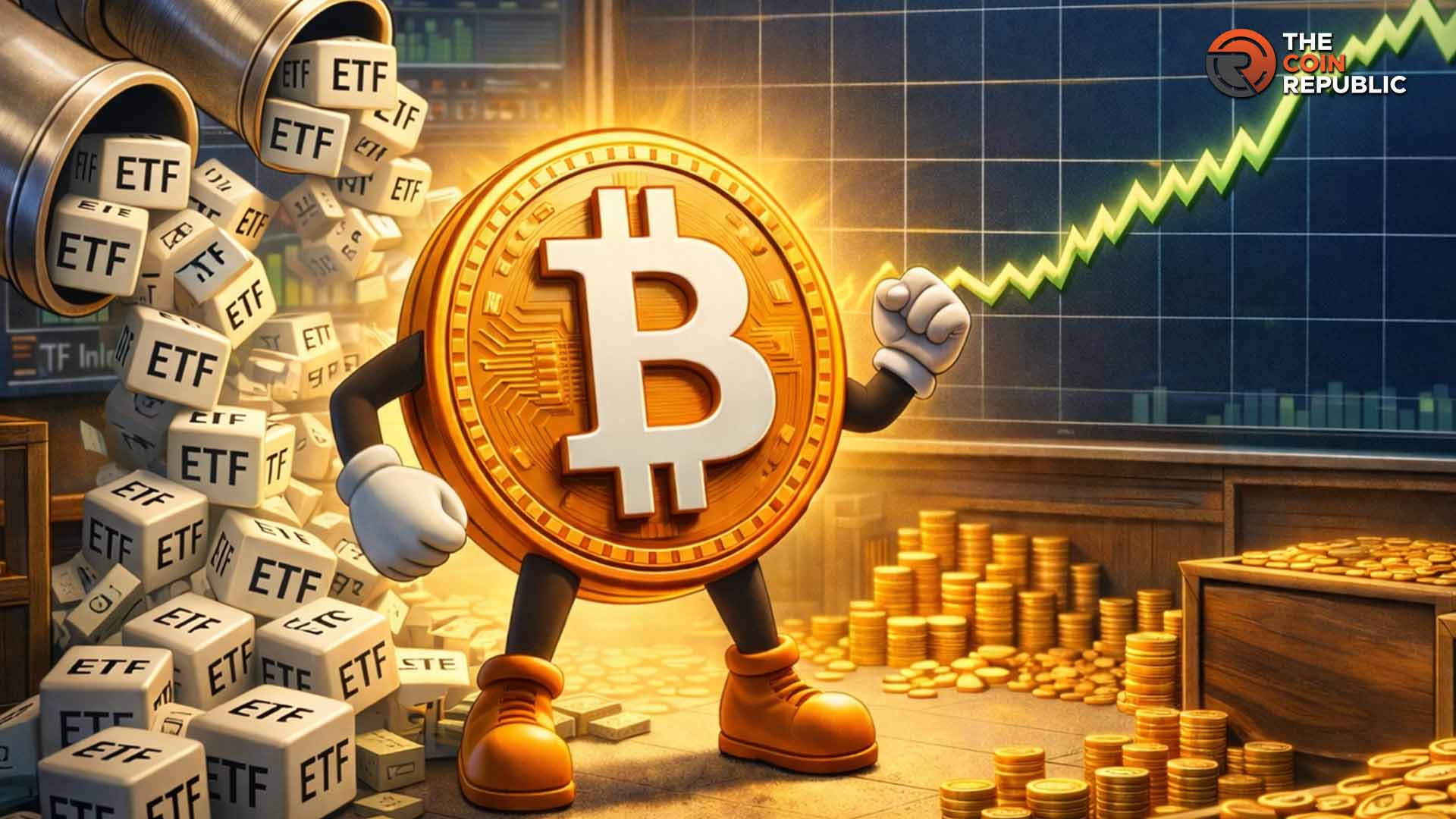
Strong positive inflows into US Bitcoin ETFs, totaling $167 million, signal renewed institutional demand and a potential shift in market sentiment. The resurgence in ETF inflows, particularly led by BlackRock's IBIT, suggests that institutional investors are re-engaging with Bitcoin, potentially supporting a sustained price above $70,000. The recovery in Bitcoin's price to over $71,000, coinciding with improved global risk sentiment, indicates that macroeconomic factors and geopolitical events can significantly influence short-term price action.
US lawmakers are proposing legislation to explicitly ban prediction market contracts on war, death, and assassination, removing regulatory discretion. The proposed "DEATH BETS Act" aims to codify a ban on such contracts, irrespective of CFTC leadership, addressing concerns over national security and insider profit. This regulatory push, coupled with the CFTC's announced plans to expand oversight, signals increased scrutiny on prediction markets and their potential for misuse. The development could impact platforms offering event contracts, potentially leading to delistings or stricter compliance requirements for specific contract types.
Signal context only. Validate with price action, liquidity, and risk limits before taking a position.
Quick market read from this story
Despite a significant increase in XRP Ledger transactions to 2.7 million daily, XRP's price remains rangebound between $1.34 and $1.44, indicating that on-chain activity is not currently translating into upward price momentum.
The growing value of tokenized real-world assets on the XRP Ledger, approaching $461 million, suggests underlying ecosystem development, but traders are prioritizing technical levels due to thin liquidity and lack of clear directional catalysts.
XRP's consolidation pattern between $1.34 and $1.44, with declining volume, suggests a potential breakout is building, but traders are awaiting confirmation of a break above resistance or support to signal the next significant price move.
The current market environment for XRP is characterized by low trading volume and a lack of specific token catalysts, leading to a neutral sentiment as participants await a decisive break of key technical levels.
Deep Dive
XRP has experienced a significant increase in activity on the XRP Ledger, with daily transactions reaching approximately 2.7 million. This surge in network usage is partly driven by tokenized real-world assets, which now total around $461 million on the network. Despite this underlying growth, the price of XRP has remained range-bound, trading quietly around $1.38 and consolidating between support near $1.34 and resistance at $1.44.
The XRP token has been trading within a tight range, characterized by declining trading volume and repeated rejections near the $1.44 mark. This consolidation suggests that traders are awaiting a clearer directional signal, with liquidity in broader crypto markets remaining thin. The session high near $1.44 was met with a sharp rejection, reinforcing this level as near-term resistance. Following this, XRP formed lower highs on decreasing volume, indicating fading momentum. The $1.38 level is currently acting as short-term support, with several tests confirming its significance.
Market participants are closely monitoring the support level around $1.34–$1.35. A hold above this threshold could allow XRP to continue its consolidation before attempting a breakout towards $1.44 and potentially $1.50 if momentum picks up. Conversely, a breakdown below $1.34 would signal a weakening of the current consolidation structure, potentially leading to a decline towards the $1.30–$1.32 zone. The current compression between resistance and support is often seen as a precursor to a larger directional move once liquidity returns to the market.
Bitcoin's resilience above $70,000 is being tested, with buyers needing to consolidate gains to avoid a return to previous consolidation patterns. Easing energy price fears due to the IEA's proposed oil reserve release could marginally strengthen the case for Fed rate cuts, positively influencing risk assets like Bitcoin. While Bitcoin shows signs of buyer confidence, holding above $70,000 and breaking the $73,000 resistance level are crucial for sustained upward momentum. The correlation between Bitcoin and the S&P 500 remains high, indicating that crypto markets will likely follow any signals from the upcoming Fed meeting.
