
Navigating Crypto News

CoinFeather
Navigating Crypto News

Quick market read from this story
Shiba Inu (SHIB) exhibits a bullish divergence on the RSI and has broken above a key resistance level, suggesting potential for a near-term upward move.
The technical setup points to a potential 37% price increase for SHIB, targeting the 200-day moving average around $0.00000842, contingent on holding support at $0.00000504.
While technical indicators are positive, SHIB's price action remains heavily influenced by broader market sentiment, making the $0.0000068 level a critical short-term breakout point.
Deep Dive
Shiba Inu (SHIB) is exhibiting signs of emerging from a period of dormancy, with technical indicators suggesting a potential local reversal. The cryptocurrency has established a firm position above its 50-day and 23-day moving averages, indicating a shift in momentum after weeks of trading within a dull sideways range.
The Relative Strength Index (RSI) indicator has shown a double bullish divergence over the past month, signaling a decrease in selling pressure and the gradual accumulation of SHIB by buyers. This pattern suggests that the asset is building energy for its next significant move.
SHIB has successfully broken out of a narrow range above the $0.00000504 level. If this support holds on higher time frames, the immediate target is the resistance zone around $0.00000662. The primary objective for bulls is the 200-day moving average, currently situated at approximately $0.00000842, which represents a potential 37% increase from current price levels.
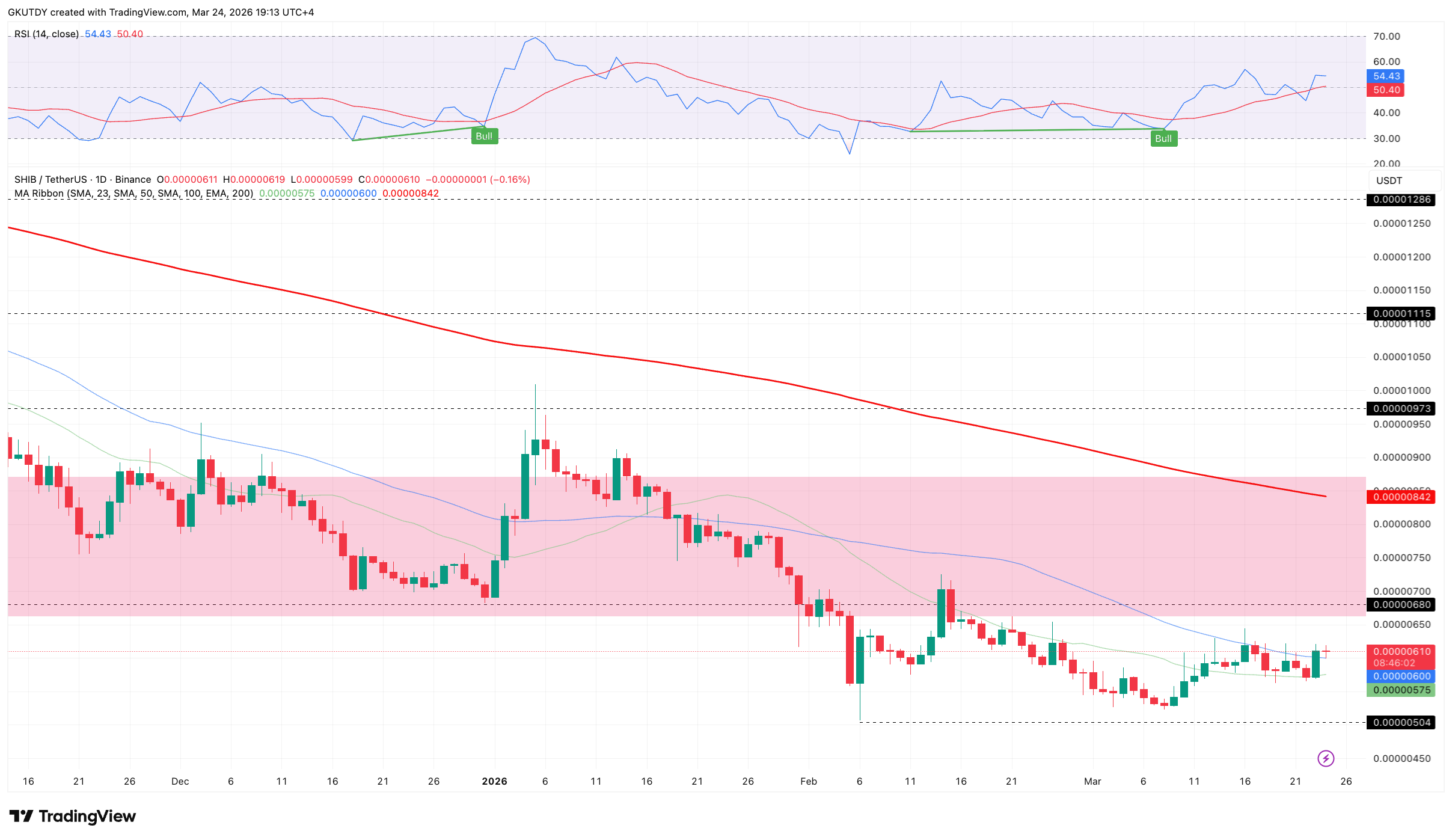
While the cryptocurrency market's overall sentiment heavily influences SHIB's performance, the current chart structure, featuring higher lows throughout March, appears promising. A decisive break above the $0.0000068 level by the end of the first quarter could catalyze a buying wave, potentially driving the price rapidly toward the $0.00000842 target. The critical support level for Shiba Inu remains at $0.00000504; sustained trading above this point keeps the growth scenario as the priority.
Source, catalyst, and sector overlap from the latest feed.
XRP's Q2 performance historically shows significant volatility, with an average April return of +24.8% and a notable +1,109% in Q2 2017, suggesting potential for a strong rebound after its -23% start to 2026. Despite historical bullish tendencies in Q2, the possibility of a 'bull trap' or further decline exists, as evidenced by a -59.4% Q2 in 2022 and a potential repeat of 2024's April weakness. The current oversold market condition for XRP, following a weak Q1 2026 and a bearish Q4 2025, sets the stage for a critical Q2 'moment of truth' with divergent outcomes.
The SEC chair's confirmed appearance at the Digital Asset Summit, following the release of new crypto guidance, signals a potentially more collaborative regulatory environment. Recent SEC guidance clarifying the classification of digital assets as securities or non-securities, including stablecoins and digital commodities, provides much-needed clarity for market participants. The SEC's stated intention to issue a proposed rule for a startup safe harbor program indicates a proactive approach to fostering innovation within a defined regulatory framework. The shift in enforcement focus towards 'quality over quantity' suggests a potential reduction in broad-based enforcement actions, which could be interpreted positively by the market.
The recent burning of 40 million RLUSD on Ethereum, following previous burns, raises questions about potential declining demand despite the stablecoin's overall growth trajectory. While token burns are a normal mechanism for fully-backed stablecoins to maintain parity with reserves, the frequency and scale of recent RLUSD burns may signal a shift in institutional redemption patterns. Despite concerns over burn activity, RLUSD's circulating supply remains robust, approaching $1.5 billion, indicating continued underlying adoption and potential for further growth towards the $2 billion milestone. The net reduction in RLUSD supply over the past week (45 million burned vs. 10 million minted) suggests a temporary slowdown in net issuance, which could impact its growth rate in the short term.
Michael Saylor's MicroStrategy is initiating a significant $44.1 billion capital raise, signaling an aggressive accumulation phase for Bitcoin and potentially increasing demand for BTC. The planned capital raise, split between equity and debt, aims to boost MicroStrategy's Bitcoin holdings towards one million BTC, positioning it as the largest public holder and potentially influencing market sentiment and BTC price action. Despite recent equity issuances and a drawdown on its current portfolio, MicroStrategy's Bitcoin efficiency per share has increased, suggesting a continued strategic focus on BTC accumulation despite market volatility.
Cardano's Lace wallet has issued a scam alert regarding fake wallet updates and phishing emails, warning users to stay vigilant against malware and data theft attempts. The alert highlights a common phishing tactic where scammers impersonate legitimate sources to trick users into revealing sensitive information like recovery phrases. While the primary focus is on security, the article also mentions the upcoming mainnet launch of Cardano's privacy network, Midnight, which aims to integrate Zcash-like privacy features with smart contracts.
Multiple analysts project significant upside for Dogecoin, with targets ranging from $0.44 in the near-term to $2 by 2029, suggesting a potential 350% to 2,500% rally based on historical patterns and technical divergences. Despite bullish technical signals, bearish risks persist below the $0.10 level, with one analyst warning of a potential 35% drop to $0.06 if consolidation continues, highlighting the critical importance of this price threshold for sentiment. Geopolitical tensions, specifically the U.S.-Iran conflict, are identified as a persistent headwind for speculative assets like Dogecoin, potentially diverting capital to safe havens and overriding purely technical bullish outlooks.
Rising exchange reserves of 181 billion SHIB signal increased selling pressure, potentially leading to a price decline if demand does not absorb the supply. SHIB's inability to break above the 50 EMA indicates weak bullish momentum, suggesting that any short-term price increases may be corrective rather than indicative of a trend reversal. The confluence of high exchange balances and failure to reclaim key resistance levels increases the probability of a further downward price movement for SHIB.
Shiba Inu experienced a significant price surge and an 18% increase in open interest, indicating renewed trader interest and potential short-covering activity. The price action suggests a potential shift in momentum for SHIB, with bulls attempting to reclaim key technical levels like the daily MA 50. A sustained break above the $0.000009 resistance level could signal a broader bullish trend, potentially targeting the $0.00001 psychological level.
Dogecoin experienced a 6% price surge despite a short-term death cross on its 3-hour chart, indicating potential short covering or a bear trap scenario. The price action suggests that market participants are overlooking bearish technical signals in favor of broader market recovery and short liquidation dynamics, with shorts being liquidated at a significantly higher rate than longs. Near-term price action for DOGE will likely be dictated by its ability to break above the daily MA 50 at $0.096, with potential upside targets at $0.12 and $0.16 if bullish momentum sustains.
Shiba Inu is consolidating below the 50 EMA, indicating a potential shift from capitulation to a watching phase, but a confirmed trend reversal requires sustained acceptance above this key resistance level. Analysts caution that a single close above the 50 EMA is insufficient for a trend reversal, especially for meme coins prone to false breakouts, emphasizing the need for multi-session acceptance. The current consolidation phase, marked by reduced volatility and slowed downward momentum, presents a neutral outlook, suggesting traders should remain on the sidelines until a clear breakout is confirmed. While SHIB is showing early signs of a potential trend shift, the technical fragility and reliance on sustained price action above the 50 EMA mean that current price action should be treated with skepticism rather than as a buy signal.
Live Feed
Loading the broader stream in the same flow as the homepage feed.
XRP Ledger's increasing dominance of payment transactions, now at 53.2%, signals a maturation towards real-world utility beyond speculative trading. The rapid growth of RLUSD, exceeding $1 billion market cap and doubling supply since December, highlights increasing demand for stable, efficient value transfer on XRPL. Convergence of payment dominance, growing DEX activity (34.2%), and institutional interest, including potential ECB collateral acceptance, positions XRPL as a multifunctional financial ecosystem.
The NYSE's partnership with Securitize to build a tokenized securities platform signals a significant institutional embrace of blockchain for traditional finance infrastructure. Europe's focus on developing its own onchain settlement infrastructure, independent of US dollar stablecoins, indicates a strategic move towards monetary sovereignty in the digital asset space. Invesco's expansion into tokenized Treasury funds, alongside other major asset managers, highlights a growing trend of institutional adoption and demand for blockchain-based yield products. The progression of tokenization from pilot projects to core financial infrastructure globally suggests a fundamental shift in how assets will be issued, traded, and settled in the future.

Prediction markets like Kalshi and Polymarket are implementing stricter anti-insider trading policies, directly impacting user behavior and platform integrity. The new rules, targeting politicians and athletes, aim to prevent the use of non-public information, signaling a proactive response to regulatory scrutiny. Escalating regulatory pressure, including proposed legislation and state-level actions like Utah's, suggests a challenging environment for prediction market platforms. Legal challenges, such as the lawsuit against Kalshi in Arizona, highlight the ongoing conflict between these platforms and existing gambling regulations.

BMO's integration with CME Group's tokenized cash platform on Google Cloud signifies a major step towards 24/7 institutional settlement, potentially reducing friction and increasing capital efficiency in traditional finance. This development highlights the growing institutional adoption of tokenization for core financial operations, moving beyond speculative assets to utility-based applications like collateral and treasury management. The partnership between a major bank, a derivatives exchange, and a cloud provider indicates a maturing ecosystem for tokenized assets, setting a precedent for future financial infrastructure.
XRP's inclusion in the top five crypto exposures reported by banks under Basel III signifies a formal integration into institutional risk management frameworks, moving beyond speculative trading. The data from the Bank for International Settlements, covering 150 banks including G-SIBs, indicates a broad, system-wide acceptance and monitoring of XRP within the core of global finance. XRP's alignment with modernizing payment systems like SWIFT and its potential to unlock significant value in cross-border transactions suggest a growing practical relevance for the asset in financial infrastructure.

Bernstein's call on Bitcoin's bottom, supported by the absence of structural damage and increasing institutional demand via ETFs, suggests a potential shift from a bear market to a bull phase, with a reiterated year-end target of $150,000 for 2026. CoinDesk's volatility analysis indicates that extreme implied volatility readings, similar to past capitulation events, may signal a bottom near $60,000, framing the recent sell-off as fear-driven rather than structurally bearish. Historical analysis of Bitcoin's weekly RSI shows that oversold conditions, as observed now, have preceded significant rallies (2,700%, 1,800%, 350%), presenting a bullish technical outlook if key support levels hold. A recurring bear market signal has triggered again, historically preceding substantial declines; however, reclaiming $70,000 could invalidate this signal, creating a critical inflection point for near-term price action.

BitGo and Susquehanna Crypto are launching institutional OTC access to prediction markets, enabling large investors to trade event-based contracts using crypto collateral, which addresses key infrastructure gaps for institutional participation. This development comes amid increasing regulatory scrutiny of prediction markets in the US, with several states taking action against platforms, highlighting a complex regulatory landscape that could impact future growth. The offering allows for bilateral trades using crypto collateral like Bitcoin or stablecoins, potentially increasing demand for these assets as collateral in new financial products. By facilitating institutional access to prediction markets, this partnership could signal a growing trend of integrating crypto-native financial products into traditional institutional workflows.

The filing of multiple competing ETFs for Hyperliquid's HYPE token by major asset managers indicates institutional interest, but suggests that the early retail entry window for significant gains has likely closed. The article promotes Pepeto as a superior investment opportunity compared to assets being packaged for institutional ETFs, highlighting its presale pricing, working exchange, and experienced co-founder as key differentiators for retail investors. While Digitap and Mutuum Finance are presented as alternative investments, their projected return profiles are deemed less explosive than Pepeto's, positioning Pepeto as the primary 'best crypto to invest in' before its listing.

Bernstein analysts suggest Bitcoin's price has likely bottomed, projecting a rise to $150,000 by year-end, indicating a potential shift in market sentiment and a bullish outlook for the asset. Strategy's resilience in accumulating Bitcoin during market downturns, supported by its preferred share offering, highlights its strategic financial management and reinforces its position as a major corporate holder. The maturation of Bitcoin's market structure, evidenced by the debut of ETFs and Strategy's role as a 'Bitcoin bank of last resort,' suggests a growing and more resilient capital base, potentially altering traditional cycle-based market expectations.
Microsoft stock is experiencing a near-term pullback driven by broader market weakness and geopolitical tensions, despite positive underlying economic data and continued AI growth narrative. The stock's long-term technical support at the 200-week moving average remains intact, suggesting resilience despite current volatility, which could be a factor for traders to watch for potential reversals. While AI competition is intensifying, Microsoft's integration of AI into Azure and products like Copilot continues to be a key driver for enterprise technology and long-term revenue growth.

BlackRock's CEO envisions digital wallets as the next frontier for asset management, aiming to integrate traditional investment products like stocks and ETFs, signaling a significant TradFi adoption trend. The firm's substantial existing AUM in stablecoin reserves ($65B) and digital asset ETPs ($80B) provides a strong foundation for this strategy, indicating tangible progress beyond mere rhetoric. This move could accelerate mainstream adoption of wallet-native investing by leveraging BlackRock's infrastructure to bridge traditional finance with crypto-native rails, potentially impacting market access and distribution models. While the long-term vision includes fractional private market access, current progress is focused on tokenized cash and Treasury products, suggesting a phased rollout prioritizing regulated and established assets.

The NYSE's partnership with Securitize to launch a tokenized securities platform signifies a major institutional embrace of blockchain technology, potentially accelerating the adoption of RWA tokenization. Securitize's designation as NYSE's first digital transfer agent establishes a precedent for on-chain settlement of traditional securities, indicating a significant shift in financial infrastructure. This move by the NYSE, alongside other major players like BlackRock and Franklin Templeton, suggests a growing trend towards tokenization, which could redefine market liquidity and accessibility for traditional assets.

Morgan Stanley's strategy shift indicates a maturing institutional approach to digital assets, moving beyond hype towards foundational infrastructure development. The bank's planned support for tokenized equities trading signals a significant step towards integrating traditional securities with blockchain technology, potentially impacting RWA and broader market structure. Despite current market conditions, the sustained investment in crypto infrastructure by major financial institutions suggests a long-term commitment to digital asset integration.

Proposed changes to the Clarity Act could significantly curtail stablecoin yield generation, impacting the value proposition for holding stablecoins like USDC and potentially reducing adoption. Circle's stock experienced an 18% decline due to the legislative threat, indicating market sensitivity to regulatory actions that affect core revenue streams and product utility. The concurrent news of Tether undergoing a full reserve audit introduces competitive pressure, potentially shifting market share away from USDC if USDT's transparency improves significantly. Despite a sharp sell-off, some analysts suggest the market may be overreacting, implying potential for a rebound if the final legislation is less restrictive than the draft suggests.

The maturation of DeFi tools, as highlighted by Aave and Ethena founders, suggests a shift towards more predictable yield generation, potentially attracting traditional finance capital seeking stable returns. The increasing sophistication of DeFi products, moving beyond simple token trading and borrowing to offer fixed-to-floating rate swaps, indicates a growing capacity for risk management within the crypto space. Aave's role as a liquidity provider is crucial for bootstrapping new DeFi products, signaling a strengthening of the underlying infrastructure that supports innovation and product development in the sector. While leverage still dominates DeFi yield generation, the potential integration of real-world assets (RWAs) through tokenization points to a future where yields are increasingly derived from traditional financial instruments, bridging the gap between crypto and TradFi.

The introduction of insurance-backed staking products, benchmarked by CESR, is transforming staked ETH from a speculative asset into a legitimate institutional yield product. This development allows cautious TradFi firms to integrate ETH staking into existing risk frameworks, potentially unlocking significant new institutional capital flows. By mitigating risks like slashing and downtime through insurance and standardized benchmarks, staked ETH becomes more palatable for regulated entities seeking predictable yield.
Circle's CRCL stock has experienced a significant pullback of approximately 18% from recent highs, despite strong on-chain performance and increased usage of its USDC stablecoin. The stock's correction suggests that market sentiment is shifting from pure stablecoin optimism to a more cautious outlook, factoring in potential future interest rate cuts and regulatory uncertainties that could impact Circle's revenue streams. Traders are closely monitoring USDC's net inflow trends and the sustainability of stablecoin activity growth, as these metrics will determine if the recent dip in CRCL stock presents a buying opportunity or signals further downside.
Signal context only. Validate with price action, liquidity, and risk limits before taking a position.
