
Navigating Crypto News

CoinFeather
Navigating Crypto News

Source, catalyst, and sector overlap from the latest feed.
Bloomberg strategist Mike McGlone reiterates a bearish $10,000 Bitcoin call, citing macroeconomic headwinds and a lack of uncorrelated hedging properties. Industry analysts largely dismiss McGlone's $10,000 target, suggesting such a drastic drop would require an extreme global liquidity crisis or geopolitical event, not just a market correction. While acknowledging potential for further downside, analysts like Mati Greenspan and Jonatan Randin suggest Bitcoin may have already seen its bear market bottom or could find accumulation zones between $30,000-$40,000. The debate highlights differing interpretations of Bitcoin's role in a risk-off environment, with McGlone seeing it as a speculative asset tied to traditional markets, while others maintain its potential for uncorrelated performance.
Live Feed
Loading the broader stream in the same flow as the homepage feed.

Bitcoin's repeated failure to break $72,000 resistance, coupled with rising supply in loss and declining apparent demand, signals a psychologically challenging phase characterized by elevated uncertainty and potential for further downside. On-chain data suggests Bitcoin is in a bear market consolidation phase, with long-term holders realizing losses and supply in loss approaching levels seen in previous deep corrective phases, indicating increased market stress. The inability to sustain demand above $72,000 suggests cautious market participants are unwilling to accumulate aggressively, potentially leading to a retest of lower support levels around $66,000 if resistance holds.
Nvidia's $2 billion investment in Nebius signals a strategic expansion into AI cloud infrastructure, reinforcing its dominance in the AI hardware and services ecosystem. The partnership aims to accelerate the development of specialized cloud platforms for AI workloads, addressing the growing demand for high-performance computing in the AI era. Nvidia's aggressive investment strategy across AI infrastructure companies, including Nebius, OpenAI, and Anthropic, positions it to influence multiple layers of the AI stack. Nvidia's stock is currently testing key technical levels within an ascending triangle pattern, with potential for a breakout driven by ongoing AI sector developments and strategic investments.
Shiba Inu price steadies as Shytoshi Kusama’s X silence and “UI bug fixes” bio update spark speculation amid crypto liquidations and market shifts.
Goldman Sachs' significant $154 million XRP ETF holdings indicate institutional interest, yet XRP's price has stalled below $1.50, suggesting current market dynamics are not solely driven by this institutional inflow. While institutional investors hold a notable portion of XRP ETFs, the majority of assets are controlled by non-reporting entities, implying retail demand and sentiment may be more influential on short-term price action. Despite substantial institutional accumulation via ETFs, XRP's inability to break key resistance levels highlights broader market headwinds, such as geopolitical tensions, which are currently overshadowing project-specific developments.
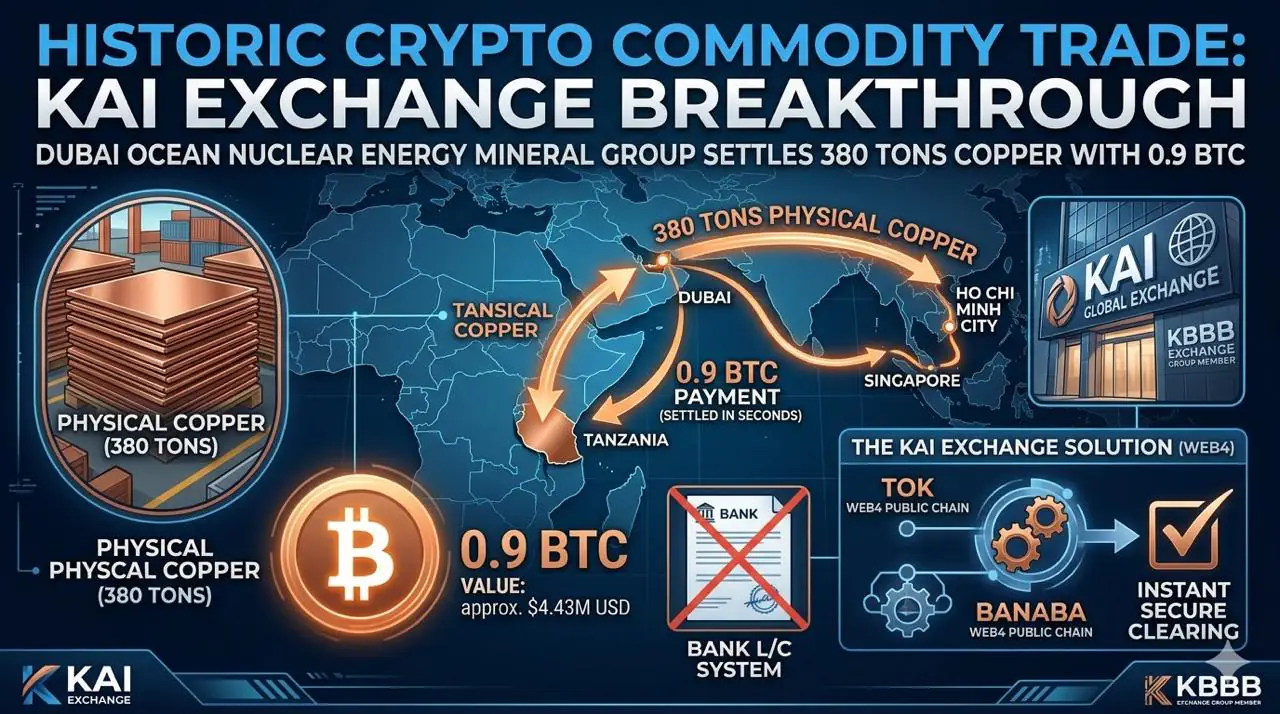
The settlement of 380 tons of copper using 0.9 BTC signifies a potential paradigm shift, demonstrating crypto's capability to replace traditional bank L/Cs in large-scale industrial trade and challenging legacy financial systems. KAI Exchange's integration of Web4 technology and its ambition to clear 3 million tons of copper annually suggest a strategic move to capture a significant portion of the global commodity market, potentially migrating pricing power from fiat to digital assets. This development highlights the increasing utility of Bitcoin beyond speculation, positioning it as a viable settlement asset for physical commodities and signaling a new 'Web4 Digital Credit Era' for global trade clearing.
Ripple's RLUSD stablecoin is gaining mainstream traction, highlighted by Fox Business, positioning it as a key bridge between traditional finance and digital assets. The integration of RLUSD on the XRP Ledger, including its recent listing on Binance, signifies growing utility and compliance-driven adoption, potentially boosting XRP Ledger's overall activity and market presence. RLUSD's rise into the Top 50 stablecoins and its $1.5B market cap suggest a successful strategy in merging fiat stability with blockchain efficiency, attracting institutional interest for faster, cheaper settlements. The broader adoption of RLUSD could transform the XRP Ledger into a significant player in global payments, potentially increasing XRP trading volumes and network utility as traditional finance increasingly engages with digital assets.
Foundry Digital's expansion into Zcash mining signifies a strategic diversification beyond Bitcoin, targeting institutional adoption by offering a compliant and U.S.-based mining pool. The move suggests a growing recognition of Zcash as an 'institutional-grade asset' and its potential role in advancing financial privacy, potentially attracting more capital and hashrate to the network. While Zcash price has seen significant gains, Foundry's decision is not solely profit-driven, indicating a focus on market gaps and long-term strategic positioning rather than immediate trading opportunities.

Bitcoin faces resistance near $70,000, but ETF inflows suggest underlying demand, potentially driving a rally to $74,508 if key resistance is broken. Several major altcoins are showing signs of strength, indicating potential for upward price movement if they can overcome their immediate overhead resistance levels. Analyst sentiment is divided, with some predicting a potential sell-off due to geopolitical risks and others focusing on technical indicators suggesting a bullish continuation if key levels are breached. The article provides technical analysis for multiple top cryptocurrencies, highlighting key support and resistance levels that traders should monitor for potential short-term trading opportunities.

MicroStrategy's STRC preferred stock issuance is generating significant capital, enabling rapid Bitcoin accumulation that could soon surpass BlackRock's ETF holdings. The increasing demand for STRC, driven by its attractive yield and use of proceeds for BTC acquisition, suggests a potential shift in institutional capital allocation towards Bitcoin-correlated assets. While STRC offers a novel way to gain Bitcoin exposure, investors must weigh the potential for significant capital appreciation against the inherent risks of preferred stock and dividend variability. STRC's growing influence highlights a potential new avenue for capital to enter the Bitcoin market, drawing parallels to the traditional fixed-income market and suggesting substantial future buying power.

XRP has formed a technical 'golden cross' on its hourly chart, a pattern historically associated with bullish price momentum, coinciding with a stable US inflation report. Despite the bullish technical signal, the sticky CPI data suggests the Federal Reserve may delay interest rate cuts, potentially tempering broader market enthusiasm and impacting XRP's short-term upside. Ripple's ongoing acquisition of regulatory licenses, including a recent Australian Financial Services License, strengthens its global compliance standing and supports its long-term infrastructure development narrative.
Signal context only. Validate with price action, liquidity, and risk limits before taking a position.
Quick market read from this story
Wells Fargo's trademark filing for WFUSD signals a strategic move into tokenized deposits or stablecoins, mirroring JPMorgan's prior actions and indicating a broader trend of traditional banks exploring digital asset services.
The development suggests a potential increase in institutional adoption of blockchain technology for financial services, which could lead to greater liquidity and integration of digital assets within the traditional financial system.
This filing, alongside other major banks exploring stablecoins, points towards a maturing crypto landscape where established financial players are actively seeking to leverage blockchain for payment processing and asset tokenization.
Deep Dive
Wells Fargo, one of the largest U.S. banks overseeing $1.7 trillion in assets, has filed a trademark application for a new digital asset-focused platform branded as WFUSD. This move signals the bank's increasing involvement in the cryptocurrency and blockchain space.
The trademark filing with the United States Patent and Trademark Office (USPTO) indicates that WFUSD would offer services such as "cryptocurrency payments processing," "execute trades of digital assets," and "services featuring software for tokenization of assets." This suggests a potential offering of a tokenized deposit or stablecoin, mirroring trends seen in the industry.
Wells Fargo's filing follows a similar trademark application by JPMorgan last year for "JPMD," which foreshadowed the launch of its own tokenized USD deposit on Ethereum's layer-2 network, Base. The move by Wells Fargo aligns with a broader trend of traditional financial institutions and global banks exploring digital assets, tokenized assets, and stablecoins.
Previously, in May, reports indicated that several major U.S. banks, including Wells Fargo, JPMorgan Chase, Bank of America, and Citigroup, were in early discussions to jointly launch a stablecoin. Wells Fargo also piloted an internal settlement service called Wells Fargo Digital Cash in 2019, utilizing its own distributed ledger technology (DLT) platform.
Revolut's acquisition of a full UK banking license signifies a significant regulatory milestone, enhancing its credibility and operational capacity within traditional finance. While the banking license is a positive development for Revolut's overall business, its core crypto and stock trading services will continue to operate under separate entities, limiting direct impact on those specific digital asset operations. The move positions Revolut for broader financial service integration in the UK, potentially attracting more traditional users while maintaining its crypto-friendly stance through distinct business units.
