
Navigating Crypto News

CoinFeather
Navigating Crypto News

Quick market read from this story
UK sanctions on crypto marketplace Xinbi and associated entities signal an intensified global effort to disrupt illicit finance networks, potentially impacting the operational capacity of scam centers reliant on crypto services.
The targeting of Xinbi by regulatory bodies highlights the increasing scrutiny on crypto infrastructure used for fraudulent activities, suggesting a heightened risk environment for platforms facilitating such operations.
This regulatory action, following previous large-scale asset freezes against the Prince Group, indicates a coordinated and sustained approach by international authorities to dismantle crypto-enabled scam operations, which could lead to further crackdowns.
Deep Dive
The United Kingdom has imposed sanctions on Xinbi, a cryptocurrency marketplace identified as one of Southeast Asia's largest illicit platforms, for providing services to scam centers. These centers exploit trafficked workers and defraud victims globally. The sanctions aim to sever Xinbi's connection to the legitimate crypto ecosystem by disrupting its transaction capabilities.
Xinbi is accused of offering services such as selling stolen personal data for targeting scam victims and providing satellite internet equipment for victim contact. Minister of State for Europe, North America and Overseas Territories, Stephen Doughty, stated that these sanctions send a clear message against tolerating scam centers that target British victims and against the severe human rights abuses occurring within them.
The sanctions also extend to Legend Innovation Co., the operator of #8 Park, a significant scam compound in Cambodia with the capacity to house 20,000 trafficked workers. The director of Legend Innovation, Eang Soklim, and key individuals like Thet Li, who managed the Prince Group's financial network, have also been sanctioned.
This latest action follows joint sanctions by the U.S. and UK against the Prince Group and its Chairman Chen Zhi. Those previous sanctions led to investigations, arrests, and the freezing or seizure of assets exceeding £1 billion.
Southeast Asia has become a focal point for transnational criminal networks operating scam compounds, which Interpol has classified as a global threat. These operations frequently involve human trafficking and forced labor. Earlier reports highlighted a humanitarian crisis resulting from mass escapes from these compounds in Cambodia.
International efforts to combat crypto-enabled scam operations are ongoing. Taiwan has indicted 62 individuals for laundering $339 million from Cambodian scam compounds. The U.S. launched a "Scam Center Strike Force" that has seized or frozen approximately $580 million in crypto. Additionally, 'Operation Atlantic,' a joint effort by the U.S. Secret Service, the UK, and Canada, targets crypto fraud.
Source, catalyst, and sector overlap from the latest feed.
Retail investors are shifting preference from Strategy's common stock (MSTR) to its preferred share (STRC), indicating a demand for lower volatility and higher yield digital credit products. The increasing retail adoption of STRC, which offers a 11.5% annual dividend and Bitcoin overcollateralization, suggests a growing segment of the market seeks income-generating assets with defined risk parameters. STRC's growing popularity expands Strategy's addressable investor base, potentially strengthening its ability to accumulate more Bitcoin by diversifying its capital-raising avenues beyond traditional equity. While MSTR remains a leveraged Bitcoin proxy for sophisticated investors, STRC's distinct appeal to retail investors suggests it is carving out a separate market niche rather than directly competing with the common stock.
Bluesky's successful $100 million Series B funding round, led by Bain Capital Crypto, signals strong investor confidence in its decentralized social media protocol (AT Protocol) and its potential to disrupt the traditional social media landscape. The AT Protocol's emphasis on user data ownership, portability, and customizable algorithms offers a fundamental shift from centralized platforms, potentially attracting users seeking greater control and transparency, which could drive adoption and network effects. While Bluesky's user base is growing, its current scale remains significantly smaller than established giants like X and Threads, indicating that while the technology is promising, widespread adoption and market impact will depend on continued development and user migration.
Brazil's new law allows seizure and sale of digital assets, including Bitcoin, to fund public security, signaling a new regulatory approach to crypto in combating crime. The legislation empowers judges to order the sale of seized crypto, potentially impacting liquidity and creating a new source of funding for government initiatives. This development highlights the increasing recognition of digital assets by governments as both a target for seizure and a potential funding mechanism.
Tether's expansion of its leading gold-backed token (XAUT) to BNB Chain increases accessibility for hundreds of millions of users, potentially driving adoption of tokenized gold within a major blockchain ecosystem. The integration of XAUT on BNB Chain, alongside major trading pairs on Binance, enhances liquidity and utility for tokenized gold, positioning it as a more accessible store of value within digital markets. Despite recent gold price volatility, the expansion of XAUT onto a new chain, coupled with Tether's ongoing USDT audit developments, signals continued strategic growth and integration efforts by a major stablecoin issuer.
MARA Holdings' significant $1.1 billion Bitcoin sale to repurchase convertible debt signals a strategic deleveraging, aiming to improve financial flexibility and reduce shareholder dilution amidst compressed mining margins. The move by MARA, alongside other miners pivoting to AI infrastructure, highlights a sector-wide trend driven by declining Bitcoin mining profitability and the pursuit of more stable, higher returns from AI services. While the sale reduces MARA's BTC holdings by 28%, the stock's positive reaction suggests investors favor the deleveraging and AI pivot over direct Bitcoin exposure, indicating a potential shift in the company's valuation drivers. The strategic capital allocation by MARA, including repurchasing debt at a discount, demonstrates proactive financial management in a challenging mining environment, potentially setting a precedent for other publicly traded miners facing similar pressures.
Solana's on-chain indicators suggest a cooling market phase, which analysts interpret as a potential precursor to a significant price breakout, driven by anticipation of a SOL ETF approval. The SEC's request for amendments to Solana ETF filings, with a decision potentially by mid-July or early August, represents a key regulatory catalyst that could unlock institutional capital and drive demand for SOL. The burgeoning Solana memecoin ecosystem, exemplified by Pump.Fun's rapid growth and high token launch volume, is contributing to positive sentiment and potential price appreciation for the SOL network.
Ripple and the SEC have jointly filed a request to modify the final judgment, seeking to reduce the penalty to $50 million and lift an injunction, but legal experts express skepticism about Judge Torres' approval. XRP price experienced a 7% decline, influenced by broader market downturns due to geopolitical tensions and tariffs, alongside specific concerns regarding the SEC-Ripple settlement's approval. The legal arguments presented for the settlement modification are considered weak by some lawyers, increasing uncertainty for XRP's future price action and potential for continued litigation.
Circle CEO's 'iPhone moment' prediction for stablecoins, coupled with new partnerships and regulatory developments like the GENIUS Act, signals a potential inflection point for mass adoption in global payments. The increasing involvement of major corporations like Walmart and Amazon, alongside traditional banks exploring stablecoins, indicates a growing institutional interest and a competitive landscape heating up for market dominance. Circle's strategic partnership with Matera in Brazil and its IPO filing suggest a proactive approach to expanding USDC's reach within traditional banking infrastructure, aiming to embed digital dollars into daily transactions. While Circle's USDC is a significant player, the continued strength of Tether and the emergence of new entrants like Ripple's RLUSD highlight a dynamic and competitive stablecoin market, with regulatory clarity poised to accelerate growth.
US CPI inflation at 2.4% was slightly below the 2.5% forecast, indicating a potential easing of price pressures that could support risk assets like Bitcoin and Ethereum. Despite the slightly lower-than-expected CPI, the market's focus remains on potential Federal Reserve rate cuts, with CME FedWatch showing high probabilities for September and December, which could be a tailwind for crypto. While Bitcoin and Ethereum saw minor price movements, the underlying sentiment suggests resilience, with analysts like 10x Research noting that even weaker data might reignite stimulus discussions, potentially benefiting crypto. Whale accumulation of Bitcoin and increased futures trading volume for Ethereum suggest underlying strength and potential for upside, despite current price range-bound action.
Renewed institutional interest in XRP, evidenced by $11.8 million in inflows, signals growing confidence driven by optimism surrounding the conclusion of the Ripple vs. SEC lawsuit. The potential resolution of the SEC lawsuit is a primary catalyst, with a key June 16 deadline for status updates potentially influencing near-term price action and investor sentiment. Despite broader market inflows, XRP's specific recovery is closely tied to legal developments, suggesting a speculative rather than purely fundamental driver for current price action. Increased trading volume and open interest in XRP derivatives indicate heightened trader activity and potential for significant price swings as the lawsuit's outcome approaches.
Cardano's listing on Bitstamp via Robinhood significantly enhances its accessibility for U.S. investors, potentially increasing liquidity and demand. The Bitstamp listing, following previous SEC concerns, signals a more favorable regulatory environment for ADA in the U.S., supporting bullish sentiment. Analyst projections suggest a potential 585% surge for ADA to $5.36 in the next bull cycle, driven by increased market access and technical support at $0.24. While technical indicators show consolidation and some resistance, the overall market sentiment and listing catalyst provide a foundation for potential upward price movement.
The fading hype surrounding the US-China trade deal truce has triggered a sell-off in crypto-related stocks, with MSTR and COIN experiencing significant declines, indicating a market reaction to shifting geopolitical sentiment. MicroStrategy's (MSTR) stock drop is exacerbated by ongoing concerns regarding its aggressive Bitcoin accumulation strategy, highlighting potential risks associated with large-scale corporate treasury diversification. Coinbase's (COIN) stock resilience, attributed to its revenue-sharing agreement with Circle for USDC, suggests that strategic partnerships and stablecoin ecosystem growth can partially insulate exchange-related equities from broader market volatility.
The market's sharp sell-off in Circle's CRCL stock, triggered by leaked regulatory drafts banning passive stablecoin yield, appears to be an overreaction as analysts argue the core business model of earning interest on reserves remains intact. While proposed regulations may impact exchanges like Coinbase that offer stablecoin yields, Circle's revenue primarily derives from interest on its USDC reserves, suggesting its business model is less directly threatened than initially perceived. Despite the regulatory uncertainty and a temporary freeze of USDC balances, Circle's underlying operating metrics for USDC show continued growth in circulation and transaction volume, indicating sustained demand beyond passive yield. The concurrent audit announcement by Tether and Circle's involvement in freezing assets due to a civil case have introduced competitive and operational pressures, respectively, making the stablecoin landscape more dynamic.
Brazil's new law allows law enforcement to utilize confiscated cryptocurrency for public security funding, potentially increasing demand for crypto assets used in criminal activities. This development establishes a precedent for how governments can leverage seized digital assets, impacting the perceived risk and utility of crypto in illicit finance. While the law focuses on using seized crypto for public security, it contrasts with proposals for a national Bitcoin reserve, indicating a bifurcated approach to state-level crypto asset management in Brazil.
Live Feed
Loading the broader stream in the same flow as the homepage feed.
The upcoming $3.7 billion options expiry on Deribit introduces a significant event risk, potentially driving short-term price volatility for Bitcoin and Ethereum. Geopolitical tensions and macro events are increasing overall market volatility, pressuring Bitcoin and Ethereum prices ahead of key support levels. Analysts suggest that while short-term retracements are expected, the health of Bitcoin and Ethereum's price action will depend on their ability to hold critical support levels around $106,000 and $2,700 respectively. The put-call ratios and max pain points for both BTC and ETH options indicate a mixed to bearish sentiment among traders, suggesting caution is warranted.

Veteran trader Peter Brandt warns of a potential 75% Bitcoin crash, drawing parallels to the 2022 downturn, suggesting that current market conditions near $110K may signal overheating and increased volatility. On-chain data from Glassnode indicates potential market overheating in the derivatives space, with rising liquidations and speculative interest, despite cautious optimism reflected in funding rates. Technical indicators for Bitcoin show slowing bullish momentum with resistance at $110K and support at $108K-$108.5K, suggesting a critical juncture that could lead to a sharp pullback if sentiment shifts.
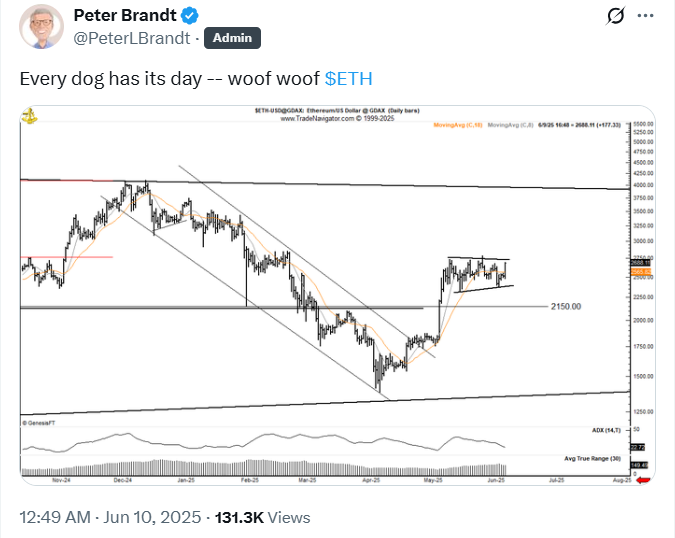
Ethereum has reclaimed its 200-day Moving Average, a key technical indicator, suggesting a potential bullish trend continuation and a retest of higher price levels. Significant inflows into Ethereum ETFs, coupled with strong DeFi ecosystem performance and increased whale accumulation, indicate growing institutional and retail interest, supporting price appreciation towards the $4,000 target. The rotation of capital from SOL to ETH, as observed in whale transactions, signals a potential shift in market sentiment favoring Ethereum's established utility and ecosystem over emerging competitors. Increased trading volume and reclaiming the 200-day MA suggest that ETH is building momentum for a breakout, with expert projections targeting $4,000, making it a key asset to watch for near-term upside.
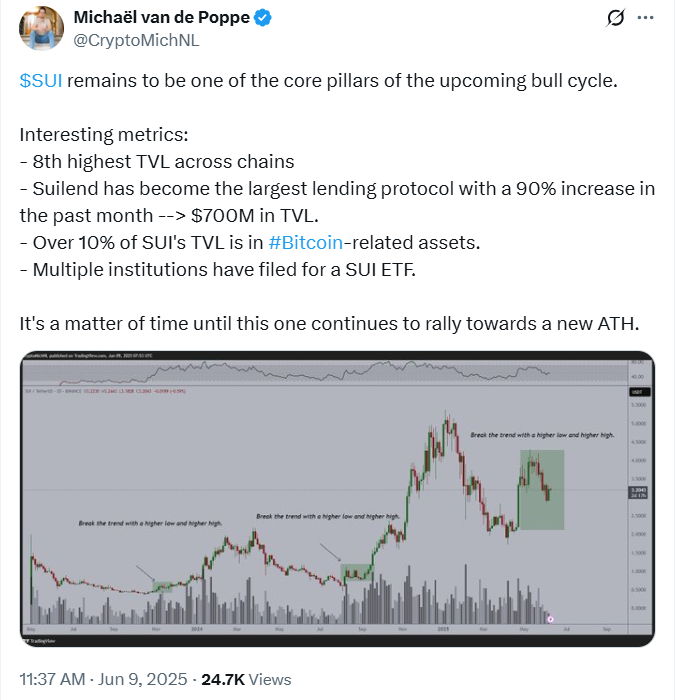
Sui's significant increase in Total Value Locked (TVL) to $1.873 billion, reaching 8th position, signals strong DeFi growth and increasing investor confidence in the network's capabilities. The integration of Bitcoin-related assets into Sui's TVL, accounting for 10%, suggests enhanced cross-chain potential and could drive demand for SUI as users engage with Bitcoin on the Sui network. The filing of a spot SUI ETF by Canary Capital Group and interest from other asset managers like 21Shares indicates growing institutional interest, potentially paving the way for increased capital inflows and a new all-time high for SUI. Analyst Michaël van de Poppe's positive outlook, citing Sui's DeFi performance and ETF prospects, positions SUI as a potential leader in the next crypto market rally, supported by on-chain activity and potential price appreciation.

Increased optimism surrounding potential Solana ETF approvals, with Polymarket odds surging to 92%, suggests significant institutional interest and a potential catalyst for SOL price appreciation. The SEC's request for amendments from 7 ETF applicants indicates an expedited review process, potentially leading to approvals within weeks and driving demand for SOL similar to BTC's ETF impact. Despite positive ETF sentiment, SOL price has recently pulled back to a two-month support level, presenting a potential entry point for traders anticipating a positive regulatory outcome. The inclusion of staking language in ETF applications could unlock new demand drivers for SOL, enhancing its appeal to institutional investors and potentially boosting network activity.
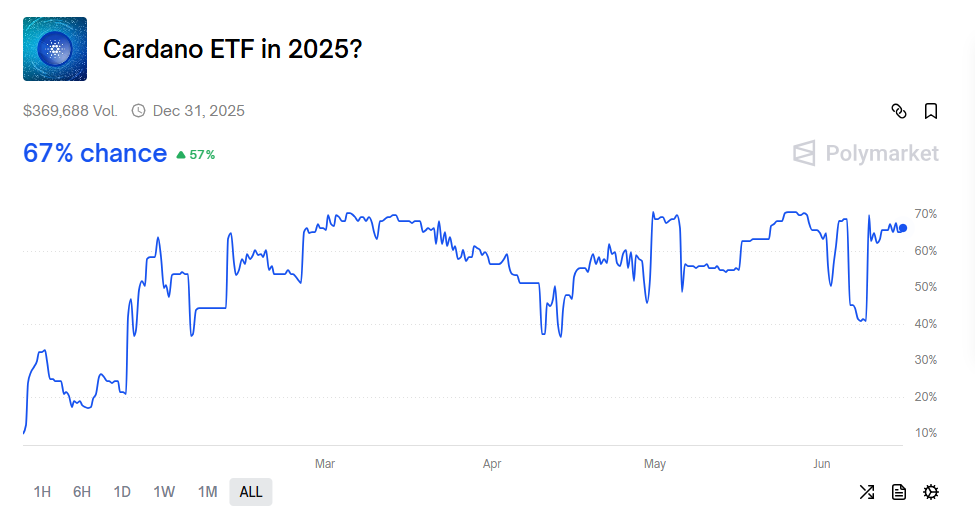
Cardano's treasury may allocate 5-10% of its ADA holdings to Bitcoin and stablecoins, aiming to generate yield and potentially fund ADA buy-backs. The proposed integration of XRP and RLUSD into Cardano's DeFi ecosystem signals an effort to boost network activity and interoperability. While Cardano's ETF prospects remain uncertain with a slight decrease in probability, the proposed treasury diversification and integrations could be viewed as strategic moves to enhance its market appeal. Charles Hoskinson's proposals, while criticized by some as last-ditch efforts, represent a significant shift in Cardano's treasury management and ecosystem expansion strategy.
Negative spot flow and significant liquidations across the crypto market suggest cautious sentiment and potential downside pressure, impacting Dogecoin's ability to break key resistance levels. Despite a 1,120% drop in spot flow, Dogecoin's price holding a range since early February indicates market uncertainty rather than a clear trend reversal, warranting a watchful approach. The failure to surpass the 50-day moving average around $0.095, a level acting as resistance since January, reinforces a bearish short-term outlook for DOGE.
Despite XRP's recent price dip below $1.40, rising net long positions and open interest suggest traders are increasing exposure, anticipating a potential rebound rather than further downside. The divergence between falling price and increasing bullish derivatives activity indicates a potential market reset where over-leveraged long positions could be liquidated, clearing risk for a more sustainable upward move. XRP is showing relative strength compared to the broader altcoin market, where only 5% of Binance-listed tokens trade above their 200-day moving average, highlighting its potential to outperform in a Bitcoin-dominated landscape.

G Coin's rapid holder growth post-launch is now facing a critical test of its utility and ecosystem integration, moving beyond initial listing hype to sustained demand. The focus shifts from holder milestones to observable metrics like exchange liquidity, staking participation, and in-ecosystem usage to validate G Coin's claims as an operational economic layer. Sustained demand for G Coin will depend on its ability to demonstrate real-world utility within its gaming and sports event ecosystem, rather than relying solely on speculative interest.
Signal context only. Validate with price action, liquidity, and risk limits before taking a position.
