
Navigating Crypto News

CoinFeather
Navigating Crypto News
Quick market read from this story
The Official Trump (TRUMP) Solana meme coin has experienced a significant price decline, falling over 96% from its all-time high, correlating with a dip in President Trump's approval ratings.
Despite a broader market rebound in Bitcoin and Ethereum, the TRUMP token's underperformance suggests that its price is heavily influenced by political sentiment and news rather than general crypto market trends.
The performance of the TRUMP token, alongside the related World Liberty Financial (WLFI) token, highlights the speculative nature of politically-themed crypto assets and their sensitivity to public perception and geopolitical events.
Deep Dive
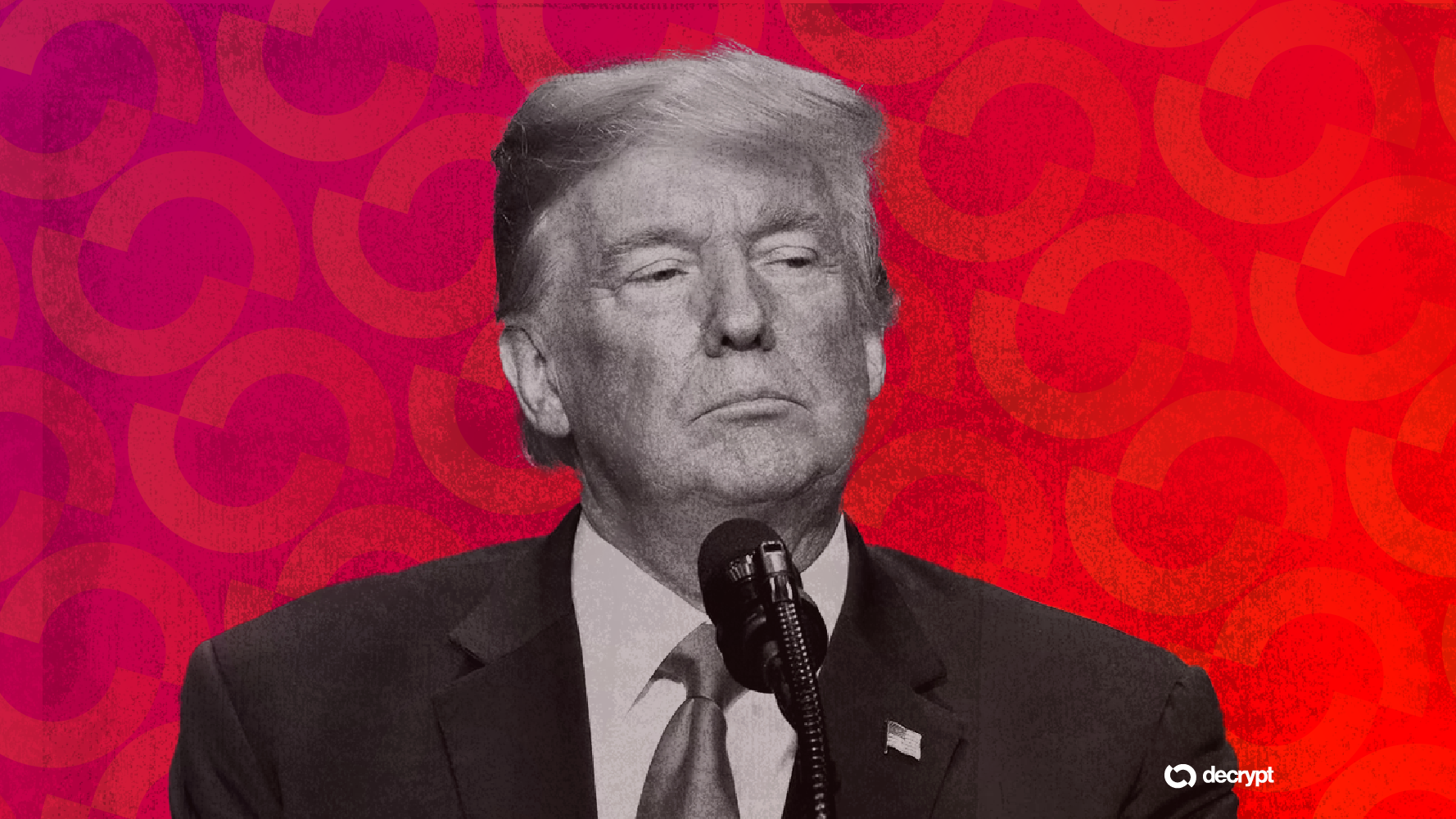
President Trump’s official Solana-based meme coin, Official Trump (TRUMP), reached its lowest price early Tuesday since shortly after its launch. This decline coincides with a dip in the president's approval ratings and ongoing uncertainty surrounding the U.S. conflict with Iran.
The TRUMP token was trading around $2.90 on Tuesday, marking a 1% decrease for the day and a more than 15% drop over the past week. This is in contrast to the broader crypto market, where leading cryptocurrencies like Bitcoin and Ethereum have seen rebounds, trading at approximately $70,137 and $2,041, respectively.
The TRUMP token fell to an overnight low of $2.87, its lowest point since trading began in January 2025, according to CoinGecko data. Another tracker, CoinMarketCap, indicates an all-time low of $1.21 during the same period. The current price represents a significant drop of over 96% from its all-time high of $73.43 in January 2025.
Political sentiment surrounding President Trump appears to be shifting. Predictors on Myriad, a prediction market operated by Dastan, have moved from even odds to favoring disapproval at 58%. This aligns with traditional polling data, which has shown less favorable views of the president's performance since mid-last year, with aggregated averages indicating around 54.8% disapproval.
President Trump's statements regarding the conflict in Iran have also influenced market dynamics. While he initially suggested the conflict was nearing completion, he later issued fresh threats concerning oil flow. Despite these geopolitical tensions and comments, Bitcoin has seen a modest rise, but the TRUMP meme coin has continued to decline.
Another Trump-connected token, World Liberty Financial (WLFI), has shown mixed performance. While it rose 1.4% in the last 24 hours to trade around $0.10, it recently hit a new trading low of $0.094 over the weekend. This token is currently 69% below its all-time high.
World Liberty Financial has previously faced scrutiny over a $500 million investment from the UAE into the Trump-aligned crypto venture, which held a conference at President Trump's Mar-a-Lago estate.
Source, catalyst, and sector overlap from the latest feed.
Bitwise CIO Matt Hougan projects Bitcoin could reach $1 million per coin by capturing a significant share of the growing global store of value market, assuming continued growth and adoption. The analysis suggests that Bitcoin's potential price target is contingent on the expansion of the overall store of value market, with a projected market cap of $121 trillion in 10 years, requiring Bitcoin to secure 17% of this market. Factors such as ETF inflows, institutional acceptance, and declining volatility are cited as key drivers that could support Bitcoin's ascent to a $1 million valuation, despite current market conditions.
Meta's acquisition of Moltbook signals a strategic move into the burgeoning field of AI agent interaction and social networking. The acquisition highlights the growing interest in understanding emergent AI behaviors and their potential applications beyond human-centric platforms. While the deal terms are undisclosed, the integration of Moltbook's founders into Meta's Superintelligence Labs suggests a focus on advancing AI research and development within the company.
The development of the BullshitBench highlights a critical flaw in current AI models: their inability to discern nonsensical prompts, which poses significant risks for real-world applications where misinformation can have severe consequences. Anthropic's Claude models demonstrate superior performance in identifying and rejecting nonsensical queries, suggesting a potential lead in AI reliability and trustworthiness compared to competitors like Google and OpenAI. The benchmark's findings indicate that advancements in AI reasoning capabilities do not automatically translate to improved bullshit detection, emphasizing the need for specialized training and evaluation methods to address this specific failure mode. For market participants, the performance disparity in AI models on this benchmark could influence investment decisions, favoring companies demonstrating greater reliability and robustness in their AI development.
X Money's upcoming public beta launch in April introduces a new payments platform with P2P transfers and yield generation, potentially impacting traditional finance apps. Despite Elon Musk's historical support for Dogecoin, the X Money app's launch appears to exclude any cryptocurrency integration, contrary to market speculation. The absence of crypto, particularly Dogecoin, in the X Money app's initial rollout suggests a cautious approach to digital asset integration by the platform.
Polymarket's partnership with Palantir to develop surveillance systems for sports prediction markets signals a proactive approach to regulatory compliance and market integrity. The initiative, leveraging Palantir's AI capabilities, aims to identify insider trading and manipulation, potentially mitigating risks that have drawn lawmaker scrutiny. This development could set a precedent for other prediction markets to enhance their self-policing mechanisms, especially as regulatory pressure increases.
Bernstein's 'Outperform' rating and $190 price target for Circle (CRCL) stock signal strong conviction in its growth potential, driven by accelerating stablecoin adoption and regulatory clarity from the 2025 GENIUS Act. Circle's stock performance, up 49% year-to-date and having doubled since February, demonstrates a decoupling from the broader crypto market, suggesting investor confidence in its business model beyond speculative crypto assets. The increasing adoption of stablecoins, supported by the regulatory framework established by the GENIUS Act, positions Circle's USDC as a key beneficiary, potentially driving further market share gains and stock appreciation. Circle's established relationships with traditional finance giants like BlackRock and BNY Mellon, coupled with its significant market share in stablecoins, provide a solid foundation for continued growth and institutional trust.
Stablecoins are projected to gradually pull 3-5% of core deposits from traditional banks over the next five years, potentially impacting bank profitability by approximately 3%. While not an immediate threat, the expanding use of stablecoins in payments and DeFi could lead to higher funding costs for banks as they compete for capital. Banks with high concentrations of retail and interest-bearing deposits are identified as most exposed to potential stablecoin-driven deposit runoff. Despite regulatory hurdles like the GENIUS Act limiting direct yield, the long-term risk of stablecoins attracting deposits through activity-based rewards and DeFi integration remains a concern for the banking sector.
The upcoming launch of X Money, Elon Musk's integrated wallet and payments system, signals a significant potential on-ramp for digital assets, particularly Dogecoin, given Musk's historical support. While initial X Money rollout focuses on fiat, the stated long-term plan for crypto integration, including BTC, ETH, and DOGE, could reshape competition with existing fintech platforms and exchanges if executed at scale. Speculation around Dogecoin integration with X Money, coupled with recent price action and increased trading volume, suggests a bullish sentiment among traders anticipating potential demand shifts.
Bernstein analysts project a 60% upside for Circle (CRCL) stock, driven by stablecoin adoption decoupling from crypto market cycles and increasing use in digital payments. The increasing integration of stablecoins with traditional payment networks like Visa, alongside Circle's own payment network expansion, signals a growing utility beyond crypto trading. Emerging use cases in AI-driven agentic finance and Circle's development of the Arc blockchain suggest future growth potential for stablecoin infrastructure and adoption.
X Money's April launch confirms a significant move into traditional finance infrastructure, potentially impacting established payment apps. While Dogecoin integration remains unconfirmed, speculation has already driven a price increase, highlighting market sensitivity to Elon Musk's pronouncements. The platform's focus on direct deposits, yield, and Visa partnership suggests a strategy to integrate with existing financial systems rather than disrupt them with unproven crypto solutions.
Live Feed
Loading the broader stream in the same flow as the homepage feed.

Ether's funding rates have turned negative, indicating a shift towards bearish sentiment in the derivatives market despite recent price attempts above $2,100. Weak demand for ETH spot ETFs, evidenced by significant outflows, coupled with staking yields underperforming stablecoin yields, suggests institutional caution and a lack of conviction in near-term price appreciation. While Ethereum developers are advancing upgrades like account abstraction and the Hegota fork, these technical improvements have not yet translated into increased on-chain activity or demand for ETH, highlighting a disconnect between development and market sentiment. The current market conditions for ETH show low conviction for a bullish breakout, but also a lack of worsening bearish signals, suggesting a neutral to cautious outlook for the immediate trading horizon.
Despite record-breaking network activity on Ethereum, on-chain data indicates this surge is driven by mass capitulation and selling pressure, not organic demand. The high volume of transactions, including DeFi unwinding and exchange transfers, coupled with negative realized capitalization, signals evaporating liquidity and potential further downside for ETH. The ETH/BTC ratio's decline during periods of high exchange inflows confirms that a significant portion of the network activity is investors exiting their positions, contrary to superficial interpretations of network health.
Bitcoin is approaching a critical resistance zone between $68,795 and $72,205, which technical analysts are closely watching as a potential turning point. On-chain data suggests a possible accumulation phase is underway, with short-term holders' realized price above long-term holders', indicating potential for a market bottom formation if current resistance is overcome. The interplay between the approaching resistance band and the underlying accumulation signals suggests a period of consolidation or potential volatility, requiring traders to monitor price action closely for directional cues. While a historical bottoming signal based on holder cost basis has not fully triggered, the current price action below the short-term holder cost basis implies recent buyers are under pressure, a common late-stage bearish condition.
Ethereum is approaching a critical $2,100 resistance level, with a significant cluster of short liquidations concentrated just above at $2,130. A breakout above $2,100 could trigger a cascade of short liquidations, potentially accelerating price discovery towards the next resistance at $2,350. Conversely, failure to break $2,100 could lead to a retest of support levels between $1,930 and $1,970, indicating continued range-bound trading.

BitGo's partnership with StableX to custody a $100M stablecoin-focused treasury signals growing institutional demand for infrastructure beyond Bitcoin, specifically within the stablecoin ecosystem. The development highlights a trend of publicly traded companies establishing digital asset treasuries, indicating a maturing market for institutional-grade custody and trading services for a wider range of crypto assets. StableX's investment in tokens like FLUID and LINK, alongside BitGo's expanding role, suggests a potential near-term catalyst for related stablecoin infrastructure and oracle projects.
The acquisition of SolanaFloor by the Jito Foundation signals a strategic move to restore independent coverage of the Solana ecosystem, addressing a critical information gap following past security incidents. With the Solana ecosystem experiencing growth and institutional interest, the revival of SolanaFloor under Jito Foundation ownership provides a vital, independent source for market participants to track on-chain developments. The return of SolanaFloor, despite its previous operational halt due to a hack, highlights the ongoing challenges in crypto security while underscoring the importance of reliable news and analysis for ecosystem health.

The Dutch government's decision to proceed with taxing unrealized investment gains, including cryptocurrencies, introduces significant cash-flow risks for investors who may be forced to sell assets to meet tax obligations. This regulatory development could pressure Dutch crypto holders to re-evaluate their asset allocation and potentially move holdings to jurisdictions with more favorable tax treatment. The proposed tax reform, driven by a Supreme Court ruling, signals a global trend towards aligning taxation with actual economic outcomes, albeit with potential implementation challenges for volatile assets.

SEC Chair Gary Gensler signals a move away from 'duplicative enforcement actions' between the SEC and CFTC, aiming for coordinated oversight. This regulatory coordination could streamline compliance for digital asset firms operating across both commodity and security definitions, potentially reducing legal friction. The announcement suggests a more unified approach to crypto regulation in the US, which could impact market participants by clarifying jurisdictional boundaries and enforcement strategies.

Bitcoin's recovery above $71,000 suggests a potential bottom, but altcoin market cap (TOTAL2) is testing critical 200-week moving average support around $900 billion, indicating continued divergence. With 36.8% of altcoins trading near all-time lows and average altcoin performance 44.4% below its 200-day SMA, the market is showing extreme stress, historically seen near bear-phase bottoms. The ETH/BTC pair remains in a descending channel, suggesting that a true altcoin season is contingent on Ether reclaiming key resistance levels, which would signal a significant shift in capital rotation. While some analysts debate the nature of future altcoin cycles, current data points to a Bitcoin-dominated market, with potential for altcoin outperformance only if ETH/BTC breaks its downtrend.

Strategy's increased reliance on STRC preferred stock for Bitcoin accumulation, offering an 11.50% yield, signals a shift in its funding strategy as MSTR's premium to NAV compresses. The substantial volume and yield of STRC, outperforming traditional financial instruments like JPMorgan's preferred stock, indicate strong demand from income-focused investors for leveraged Bitcoin exposure. While STRC provides continuous funding, the significant annual dividend cost of approximately $442 million presents a potential financial strain if Bitcoin prices decline or financing conditions tighten. MSTR's relative outperformance against Bitcoin year-to-date suggests that traders are currently absorbing the increased financing costs and risks associated with Strategy's aggressive accumulation model.

Multicoin Capital's 'Internet Labor Markets' thesis suggests a shift from speculative token acquisition to earning crypto through work, potentially driving future user adoption. The ILM model leverages blockchain for verifiable and instant settlement of labor, enabling a global marketplace for tasks ranging from data labeling to bandwidth contribution, with AI integration as a key growth area. This evolution from passive resource contribution (like DePIN) to active work and judgment-based tasks could redefine user engagement and value creation within crypto ecosystems, particularly on platforms like Solana.
XRP is consolidating above a critical $1.30-$1.35 support zone, indicating potential accumulation and setting the stage for a possible upward trend reversal. Increased long positions and buying pressure suggest growing investor confidence, which could fuel a breakout towards the $1.50 resistance level if current support holds. The stabilization above the $1.40 psychological level, coupled with higher highs and lows, signals a transition from a corrective phase to potential price recovery, making the upcoming sessions pivotal.

February saw a significant decrease in crypto hack losses to $49 million, down from $385 million in January, indicating a potential shift in attacker strategies. Attackers are increasingly focusing on social engineering and phishing scams, exploiting wallet permissions rather than direct smart contract vulnerabilities, suggesting a move towards targeting user behavior. While overall losses decreased, a single breach at Step Finance accounted for a substantial portion, highlighting the continued risk of large-scale exploits impacting specific platforms. The decline in reported losses, corroborated by multiple security firms, suggests improving industry-wide security practices and risk controls, though the threat of sophisticated attacks remains.
Signal context only. Validate with price action, liquidity, and risk limits before taking a position.
