
Navigating Crypto News

CoinFeather
Navigating Crypto News
Quick market read from this story
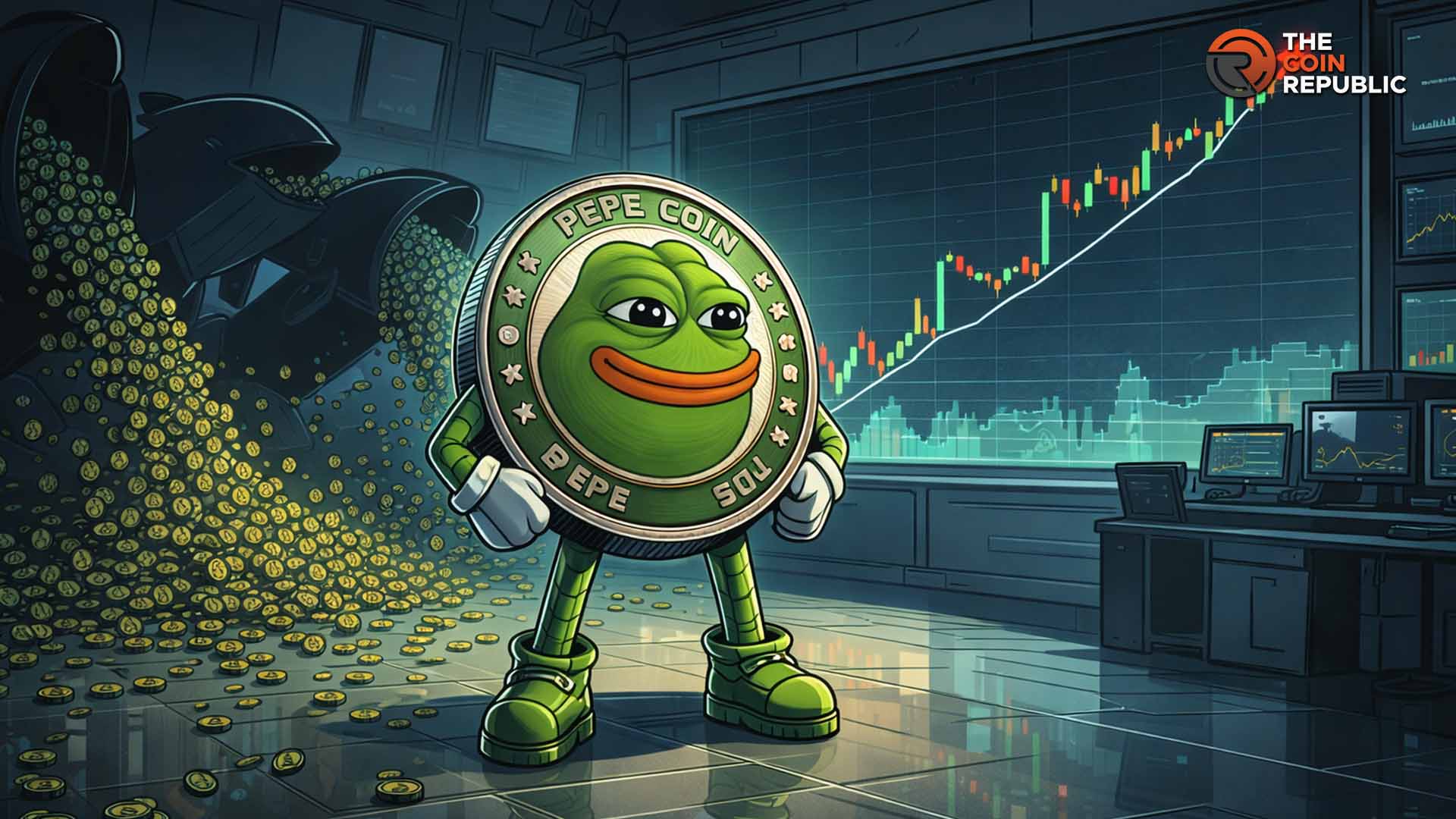
Pepe price is approaching a critical falling channel resistance, with a breakout potentially signaling a bullish reversal, but technical indicators suggest caution.
Hidden bearish divergence on RSI and declining Chaikin Money Flow indicate that recent price gains may be driven by retail sentiment rather than strong institutional accumulation.
Whale holders have reduced their Pepe holdings by approximately 3.43 trillion tokens since March 13, suggesting smart money is exiting positions ahead of potential downside.
A failure to break the falling channel resistance could lead to a significant price drop, with support breaking at $0.0000033 potentially triggering a 26% decline.
Source, catalyst, and sector overlap from the latest feed.
Crypto.com's partnership with KG Inicis in South Korea aims to integrate crypto payments for tourists, signaling a move towards real-world utility beyond trading. This collaboration could serve as a blueprint for broader crypto adoption in other markets if successful, potentially increasing transaction volumes for participating exchanges. The expansion into South Korea, a key crypto market, highlights Crypto.com's strategy to compete in the growing crypto payments sector against major players like Binance and Coinbase. By enabling crypto payments for goods and services, the partnership underscores the increasing practical applications of digital assets, moving them closer to mainstream payment methods.
Live Feed
Loading the broader stream in the same flow as the homepage feed.

The CFTC's no-action letter for Phantom Technologies signals a more accommodating regulatory stance towards non-custodial interfaces connecting users to regulated markets, potentially reducing friction for similar platforms. This development provides clarity for crypto wallet providers seeking to offer access to regulated derivatives and event contracts without requiring full broker registration, which could encourage further innovation in bridging traditional and digital finance. The CFTC's proactive engagement with Phantom, alongside previous no-action letters for platforms like Polymarket, indicates a strategic effort to foster innovation while maintaining oversight, potentially influencing future regulatory approaches to digital asset services.

The partnership between Allium and Walrus to integrate 65TB of historical blockchain data signifies a move towards more accessible and verifiable institutional-grade data, potentially enhancing on-chain finance and AI agent capabilities. By making data programmable and verifiable through Walrus's platform, this development could unlock new use cases for quantitative funds and AI agents, treating blockchain data as a tradable asset. The expansion of data availability from major blockchains like Bitcoin, Ethereum, and Sui on Walrus, coupled with Allium's existing client base (Visa, Stripe), suggests a growing demand for robust on-chain data infrastructure.

The era of Bitcoin treasury companies relying on 'accretive dilution' via equity issuance to fund Bitcoin accumulation is over, as roughly 40% now trade at a discount to NAV. Companies must pivot from passive 'Promoter' strategies to active 'Asset Manager' approaches, utilizing tools like basis trades and options to generate real yield and operational growth. Investor scrutiny is intensifying, shifting focus from narrative hype to demonstrable risk management, structured exposure, and productive deployment of Bitcoin holdings. The market is signaling a clear preference for disciplined asset management over passive accumulation, forcing treasury firms to adapt or risk irrelevance.

Theo's $100M facility for its gold-linked yield stablecoin, thUSD, signals institutional interest in non-Treasury yield alternatives. The thUSD yield generation strategy, combining tokenized gold with shorted futures, aims for 5-12% APY while hedging gold price volatility. The launch navigates the US GENIUS Act by generating yield from underlying assets rather than issuer-paid interest, differentiating it from restricted payment stablecoins. This development highlights a growing trend in tokenized commodities and alternative yield generation within the stablecoin market, despite ongoing regulatory debate.

PayPal's aggressive global expansion of PYUSD to 70 markets signals a strategic pivot towards leveraging stablecoins for global commerce, aiming to capture significant market share from traditional payment rails. The integration of PYUSD across Ethereum, Solana, and Arbitrum, coupled with PayPal's ongoing infrastructure development in logistics, AI, and retail, positions the company to challenge established players like Tether and potentially Visa/Mastercard. Despite regulatory advantages from the GENIUS Act, PYUSD faces stiff competition and potential market fragmentation, making its success contingent on effectively converting its 400 million user base into active stablecoin participants.

Ethereum's estimated leverage ratio on Binance has recovered to 0.69, signaling renewed trader optimism and a potential shift towards a new liquidity cycle. The recovery in leverage follows a significant liquidation event, suggesting that the market may be absorbing previous sell-offs and positioning for further upside. Technical analysis indicates ETH has broken key resistance at $2,152, with targets at $2,337 and $2,538, reinforcing the bullish sentiment driven by on-chain metrics.

Bitcoin's breach of the $70,000 resistance zone, coupled with significant ETF inflows, suggests a shift from fragile bounces to potential stabilization, but the $75,000 options cluster presents a critical inflection point. The $75,000 strike acts as a 'gamma magnet' with approximately $2 billion in negative gamma expiring March 27th, meaning a decisive break above could trigger accelerated upward price action via dealer hedging, while a rejection could amplify a subsequent pullback. The current setup, influenced by macro factors like inflation and potential Fed rate cut delays, amplifies volatility around the $75,000 level, turning it into a potential regime-break indicator for Bitcoin. Traders should monitor Bitcoin's price action around $75,000 closely, as dealer hedging dynamics and macro events will likely dictate whether the asset breaks out towards $80,000 or experiences a sharper decline.

XRP's market cap surge past BNB, reaching a monthly high, is directly linked to Ripple's strategic expansion and VASP license application in Brazil, signaling increased institutional interest and potential for broader adoption in Latin America. The significant rise in XRP's open interest, up 33% in two weeks, suggests growing conviction among derivatives traders, potentially indicating anticipation of further price appreciation or increased market activity. Ripple's proactive approach in Brazil, including expanding custody services and seeking a VASP license, positions the company to leverage the region's advanced financial ecosystem and could drive demand for XRP-related services.

World's AgentKit integrates World ID with Coinbase's x402 protocol, enabling AI agents to prove human verification for online service access and micropayments. This development signals a growing trend of crypto infrastructure supporting AI agent interactions, potentially expanding utility for decentralized identity solutions. While World ID's biometric approach faces privacy concerns, its integration with payment protocols like x402 could drive adoption for specific use cases requiring verified human-AI collaboration.

Mastercard's $1.8 billion acquisition of BVNK signals a significant strategic push into stablecoin infrastructure, aiming to enhance cross-border payment capabilities and compete directly with established players like Ripple and PayPal. The integration of BVNK's fiat and digital asset processing infrastructure will enable Mastercard to offer direct stablecoin settlements and crypto payments within its gateway, potentially increasing adoption and utility for digital currencies. This move positions Mastercard to leverage crypto-native settlement infrastructure and stablecoin routing, directly impacting the payments sector by aiming for faster, cheaper international transfers. The acquisition, expected to close by end of 2026, suggests a long-term commitment from a traditional finance giant to the digital asset space, potentially driving further institutional interest and innovation.

Strategy's shift to preferred stock for Bitcoin accumulation signals a move to reduce common stock dilution while managing significant dividend obligations. The company's substantial USD reserves provide a buffer against rising capital costs, suggesting a strategic approach to funding its growing Bitcoin holdings. Potential dividend increases on preferred stock to support its price below par indicate a focus on maintaining capital structure stability amidst market pressures. This funding model evolution implies a more conservative approach to common equity issuance, prioritizing preferred capital for future Bitcoin acquisitions.

Adam Back's strong opposition to BIP-110, labeling it a potential 'rug-pull' and threat to Bitcoin's store of value, highlights significant community division over protocol upgrades and spam mitigation. The proposal's low node support and Back's assertion that it is 'dead on arrival' suggest limited immediate impact, but the underlying debate on network neutrality and user risk warrants monitoring for future protocol developments. Concerns over potential fund freezing and chain splits due to BIP-110's activation mechanism, requiring only 50% hash rate support, introduce a speculative risk factor for Bitcoin users and miners involved in the debate.
Strategy has halted its Bitcoin accumulation via STRC preferred stock as the stock price fell below its $100 par value, indicating a potential reduction in buying pressure. Historical data suggests that STRC trading below $100 has preceded significant Bitcoin price declines of 25%–40%, implying a heightened risk of a near-term BTC pullback. The pause in STRC-backed BTC buys, following two weeks of aggressive accumulation, removes a key demand driver for Bitcoin, potentially exacerbating any downward price movement.
Signal context only. Validate with price action, liquidity, and risk limits before taking a position.
No explicit catalyst tagged.
Aave has implemented a new safeguard, AAVE SHIELD, to prevent extreme slippage events following a recent $50 million loss, indicating a proactive response to user protection concerns. The introduction of AAVE SHIELD, which blocks trades exceeding 25% slippage, suggests a move towards enhanced protocol stability and user confidence, potentially mitigating future large-scale losses. Despite a significant slippage incident, AAVE's price has shown resilience, reclaiming $120 and exhibiting bullish momentum, implying that the market may be pricing in the protocol's quick response and ongoing development. The $50 million slippage incident, while substantial, did not impact the Aave protocol's overall health, and the platform is working to restore the affected user's funds, signaling operational integrity.
