
Navigating Crypto News

CoinFeather
Navigating Crypto News

Quick market read from this story
Despite a significant surge in Dogecoin derivatives volume on BitMEX, the spot price remains under pressure, indicating a disconnect between speculative trading and underlying asset demand.
The rejection at the $0.10 level suggests a key resistance zone for DOGE, with the daily RSI below 50 hinting at potential consolidation or a bearish continuation.
While derivatives traders are active, the broader market sentiment, reflected in the Fear and Greed index moving into 'fear' territory, suggests caution among investors.
Deep Dive
Dogecoin (DOGE) has experienced a dramatic surge in derivatives volume, with futures volume on BitMEX alone skyrocketing by 26,548% in the last 24 hours, reaching $90.64 million. This significant increase in derivatives market activity, contributing to a broader 44% rise across the market, signals growing interest. However, despite this bullish indicator, the actual price of Dogecoin has seen a slight decline, trading down 2.57% to $0.0933 in subdued market conditions.
The broader market sentiment is influenced by recent economic data. The February consumer price index (CPI) report showed a 0.3% increase for the month, with the 12-month inflation rate at 2.4%. Both figures met forecasts and remain above the Federal Reserve's target of 2%. Upcoming economic indicators include housing starts, weekly jobless claims, and the personal consumption expenditures (PCE) index, the Fed's preferred inflation gauge. The Federal Reserve is widely anticipated to maintain current interest rates at its upcoming meeting.
Dogecoin's price faced rejection after a recent attempt to break above $0.10. The cryptocurrency has encountered resistance slightly above this level, having previously tested price points at $0.104 on February 25 and $0.106 on March 4, without a sustained breakout. Technical indicators, such as the daily Relative Strength Index (RSI) being just below 50, suggest potential sideways trading with a slight edge to bears. A similar sideways trend is observed on the four-hour chart, which could precede a significant price move. A decline below $0.09 could increase the risk of Dogecoin falling to $0.08. The overall crypto market sentiment is gradually improving, with the Fear and Greed index at 24/100, moving out of the 'extreme fear' zone into 'fear' territory after an extended period.
Source, catalyst, and sector overlap from the latest feed.
XRP has formed a technical 'golden cross' on its hourly chart, a pattern historically associated with bullish price momentum, coinciding with a stable US inflation report. Despite the bullish technical signal, the sticky CPI data suggests the Federal Reserve may delay interest rate cuts, potentially tempering broader market enthusiasm and impacting XRP's short-term upside. Ripple's ongoing acquisition of regulatory licenses, including a recent Australian Financial Services License, strengthens its global compliance standing and supports its long-term infrastructure development narrative.
Nassim Taleb's endorsement of X Money, contrasting it with Bitcoin, signals a potential shift in perception towards private, fiat-linked digital currencies over decentralized alternatives for everyday transactions. The upcoming launch of X Money, backed by Elon Musk's extensive user base and regulatory approvals, presents a significant challenge to Bitcoin's narrative as a primary medium of exchange, focusing instead on utility and stability. Taleb's critique of Bitcoin's volatility and perceived fragility, juxtaposed with X Money's potential integration with banking infrastructure and fiat, suggests a growing divide in the digital currency space between speculative assets and functional payment systems.
Shibarium's 148% transaction surge indicates increased network activity, potentially signaling growing adoption and a precursor to SHIB price appreciation. Despite a recent price consolidation, the technical indicators for SHIB, including a low RSI and Bollinger Band formation, suggest a potential bottoming out and readiness for a breakout. The correlation with Bitcoin's price action and increased on-chain user activity, coupled with strong open interest, provides a supportive backdrop for a potential SHIB rally.
Despite a significant Bitcoin price drawdown, US spot Bitcoin ETFs are showing resilience with substantial inflows, indicating sustained institutional interest that could support price recovery. The collective holdings of US Bitcoin ETFs now exceed 1.28 million BTC, solidifying their position as the largest single holder and highlighting their growing influence on market dynamics. While past outflows occurred, recent strong daily net inflows, particularly into BlackRock's IBIT, suggest a potential shift in market sentiment and a growing demand for regulated Bitcoin exposure.
The listing of Midnight (NIGHT) on Binance, the world's largest exchange, provides significant market access and liquidity, potentially driving near-term price discovery. Midnight's focus on privacy using zero-knowledge proofs, coupled with its Cardano ecosystem partnership, positions it within a growing niche that could attract specific investor interest. The initial price surge followed by a sell-off suggests immediate speculative trading activity, characteristic of new Binance listings, with longer-term price action dependent on adoption and utility.
Bitcoin has demonstrated resilience and outperformance against traditional assets like gold and stocks since the onset of the Iran conflict, driven partly by significant institutional buying and MicroStrategy's STRC product. Polymarket's partnership with Palantir and TWG AI to enhance its prediction market integrity signals a proactive approach to regulatory concerns and potential growth in the regulated prediction market sector. Hyperliquid's introduction of portfolio margin and prediction markets on testnet signifies a move towards a comprehensive on-chain trading stack, potentially increasing capital efficiency and attracting more sophisticated traders. The upcoming launch of X Money by Elon Musk, despite the absence of confirmed Dogecoin integration, represents a significant development in the mainstream adoption of financial services via social platforms, though its immediate crypto impact is uncertain.
Increased derivatives volume and open interest for BNB, coupled with positive funding rates, suggest growing trader optimism and a potential upward price movement. The surge in Binance's futures-to-spot volume ratio to a 1.5-year high indicates a structural shift towards leveraged trading, which could lead to more volatile and sharper price action for BNB. The dismissal of the case against Binance provides a short-term positive catalyst, potentially supporting the current bullish momentum observed in BNB's derivatives market.
Significant liquidation events, particularly impacting long positions, suggest a potential shift in short-term sentiment for SHIB following a brief rally. The price action indicates that SHIB is currently facing overhead resistance at its 50-day and 100-day EMAs, suggesting a bearish technical outlook until these levels are decisively reclaimed. Broader market liquidations exceeding $248 million highlight a prevailing risk-off sentiment, which could continue to pressure altcoins like SHIB in the near term.
Increased futures market activity for Cardano, evidenced by a 6% rise in open interest, suggests growing trader confidence and a potential near-term price target of $0.3 resistance. Cardano's UTXO model, enhanced for smart contracts, combined with the upcoming Ouroboros Leios upgrade for parallel processing, positions the network for efficient, large-scale payment distributions. A governance proposal to withdraw 800,000 ADA from the treasury to establish legal and technical infrastructure marks a significant step towards a broader Cardano DeFi liquidity program. The combination of rising derivatives interest and foundational network improvements indicates a potential shift in Cardano's market perception, warranting a watchlist approach for traders.
Live Feed
Loading the broader stream in the same flow as the homepage feed.

Strive's $50 million allocation to Strategy's STRC preferred stock signals increasing institutional adoption of yield-generating Bitcoin-linked treasury instruments. The move by Strive, a significant Bitcoin holder, highlights a growing trend of companies seeking higher yields than traditional money market funds while maintaining liquidity for treasury reserves. The increasing coverage and buy ratings from traditional finance analysts on Strategy (STRC) suggest a potential validation of Bitcoin treasury strategies as a viable investment class.

Bloomberg strategist Mike McGlone reiterates a bearish $10,000 Bitcoin call, citing macroeconomic headwinds and a lack of uncorrelated hedging properties. Industry analysts largely dismiss McGlone's $10,000 target, suggesting such a drastic drop would require an extreme global liquidity crisis or geopolitical event, not just a market correction. While acknowledging potential for further downside, analysts like Mati Greenspan and Jonatan Randin suggest Bitcoin may have already seen its bear market bottom or could find accumulation zones between $30,000-$40,000. The debate highlights differing interpretations of Bitcoin's role in a risk-off environment, with McGlone seeing it as a speculative asset tied to traditional markets, while others maintain its potential for uncorrelated performance.

Bitcoin's repeated failure to break $72,000 resistance, coupled with rising supply in loss and declining apparent demand, signals a psychologically challenging phase characterized by elevated uncertainty and potential for further downside. On-chain data suggests Bitcoin is in a bear market consolidation phase, with long-term holders realizing losses and supply in loss approaching levels seen in previous deep corrective phases, indicating increased market stress. The inability to sustain demand above $72,000 suggests cautious market participants are unwilling to accumulate aggressively, potentially leading to a retest of lower support levels around $66,000 if resistance holds.
Ripple Labs executed a significant burn of 25 million RLUSD stablecoins, a move intended to reduce circulating supply and potentially curb inflationary pressures, which could be interpreted as a bullish signal for XRP's price. The substantial RLUSD burn, coupled with Ripple's ongoing global licensing strategy and expansion into markets like Australia, suggests a concerted effort to strengthen its ecosystem and drive demand for its products and services. Market analysts are linking the RLUSD burn and positive technical indicators to a potential XRP price rally, with some predicting a significant upward trend if current corrective phases conclude and a bullish wave begins.

Revolut's acquisition of a full UK banking license signifies a significant regulatory milestone, enhancing its credibility and operational capacity within traditional finance. While the banking license is a positive development for Revolut's overall business, its core crypto and stock trading services will continue to operate under separate entities, limiting direct impact on those specific digital asset operations. The move positions Revolut for broader financial service integration in the UK, potentially attracting more traditional users while maintaining its crypto-friendly stance through distinct business units.
Nvidia's $2 billion investment in Nebius signals a strategic expansion into AI cloud infrastructure, reinforcing its dominance in the AI hardware and services ecosystem. The partnership aims to accelerate the development of specialized cloud platforms for AI workloads, addressing the growing demand for high-performance computing in the AI era. Nvidia's aggressive investment strategy across AI infrastructure companies, including Nebius, OpenAI, and Anthropic, positions it to influence multiple layers of the AI stack. Nvidia's stock is currently testing key technical levels within an ascending triangle pattern, with potential for a breakout driven by ongoing AI sector developments and strategic investments.

The integration of VanEck's crypto ETFs into US 401(k) plans via Basic Capital signifies a growing acceptance of digital assets within traditional retirement vehicles, potentially increasing demand from a new investor demographic. This development is underpinned by a recent US Department of Labor policy shift that no longer discourages crypto investments in 401(k)s, creating a more favorable regulatory environment for crypto adoption in retirement savings. The availability of Bitcoin and Ether ETFs, alongside broader digital asset-focused funds like VanEck's 'Onchain Economy' ETF, suggests a maturing crypto investment landscape catering to institutional and retail retirement savers.

Ripple's acquisition of BC Payments Australia strengthens its regulatory standing by securing a financial services license, enhancing its cross-border payment infrastructure in the APAC region. The move positions Ripple to operate more directly within Australia's regulated financial system, signaling a strategic shift towards becoming a licensed infrastructure provider rather than solely a cryptocurrency firm. With over 75 regulatory licenses globally, this acquisition underscores Ripple's commitment to navigating and expanding within regulated markets, a trend increasingly vital for blockchain and payment companies.
Shiba Inu price steadies as Shytoshi Kusama’s X silence and “UI bug fixes” bio update spark speculation amid crypto liquidations and market shifts.
Goldman Sachs' significant $154 million XRP ETF holdings indicate institutional interest, yet XRP's price has stalled below $1.50, suggesting current market dynamics are not solely driven by this institutional inflow. While institutional investors hold a notable portion of XRP ETFs, the majority of assets are controlled by non-reporting entities, implying retail demand and sentiment may be more influential on short-term price action. Despite substantial institutional accumulation via ETFs, XRP's inability to break key resistance levels highlights broader market headwinds, such as geopolitical tensions, which are currently overshadowing project-specific developments.

Thailand's implementation of the 'Speed Bump' system introduces a 24-hour delay on transactions over 50,000 THB, aiming to curb crypto-related money laundering by providing more time for suspicious activity detection. The crackdown involves freezing over 10,000 mule accounts and integrating databases with regulatory bodies, increasing compliance costs for digital asset firms but enhancing overall financial crime prevention. This regulatory action signals a proactive stance by Thai authorities against illicit financial flows within the crypto ecosystem, potentially impacting transaction speeds and user verification processes for Thai crypto users.

The FDIC's clarification that stablecoins will not receive deposit insurance under the GENIUS Act, even through pass-through mechanisms, removes a potential layer of perceived safety for stablecoin users. This regulatory stance by the FDIC aims to differentiate stablecoins from traditional bank deposits, potentially impacting investor perception and demand for stablecoins seeking parity with insured assets. The FDIC's consideration of tokenized deposits as eligible for insurance suggests a path for integrating traditional banking with blockchain technology while maintaining regulatory oversight. The explicit exclusion of stablecoins from FDIC insurance, despite mandates for full reserves, highlights a structural difference that could influence their adoption and competitive positioning against bank deposits.
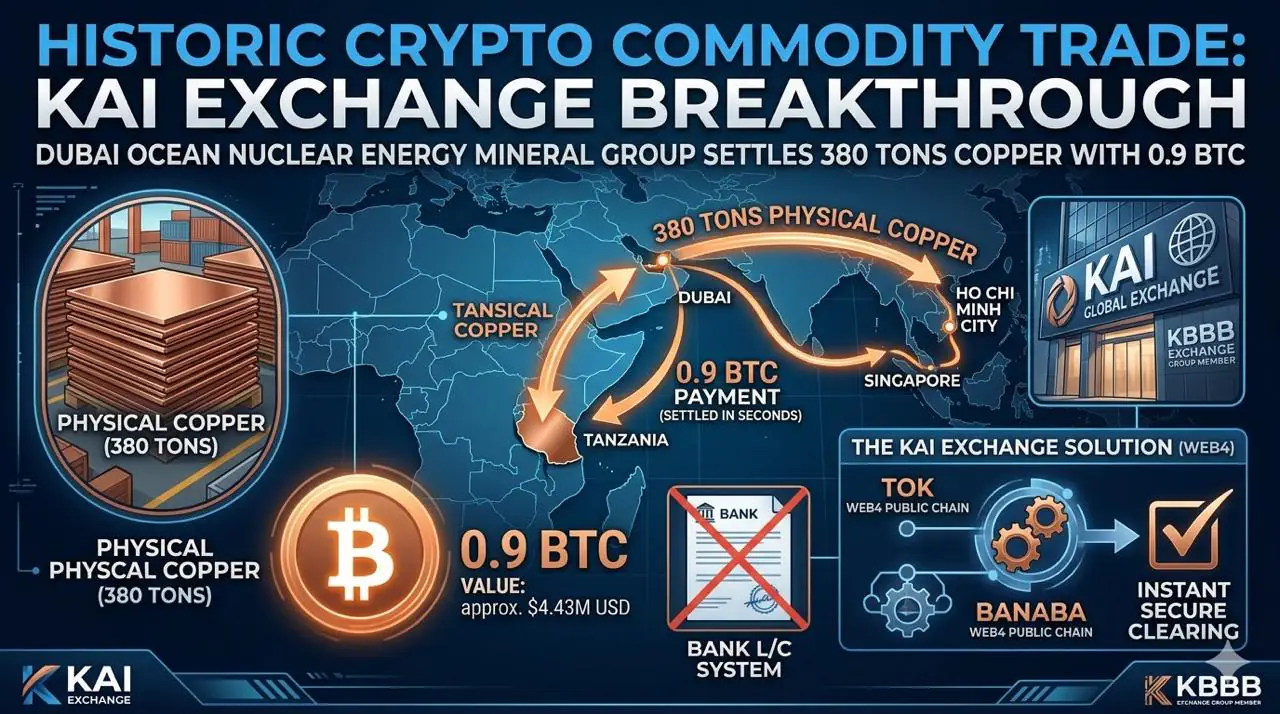
The settlement of 380 tons of copper using 0.9 BTC signifies a potential paradigm shift, demonstrating crypto's capability to replace traditional bank L/Cs in large-scale industrial trade and challenging legacy financial systems. KAI Exchange's integration of Web4 technology and its ambition to clear 3 million tons of copper annually suggest a strategic move to capture a significant portion of the global commodity market, potentially migrating pricing power from fiat to digital assets. This development highlights the increasing utility of Bitcoin beyond speculation, positioning it as a viable settlement asset for physical commodities and signaling a new 'Web4 Digital Credit Era' for global trade clearing.
Ripple's RLUSD stablecoin is gaining mainstream traction, highlighted by Fox Business, positioning it as a key bridge between traditional finance and digital assets. The integration of RLUSD on the XRP Ledger, including its recent listing on Binance, signifies growing utility and compliance-driven adoption, potentially boosting XRP Ledger's overall activity and market presence. RLUSD's rise into the Top 50 stablecoins and its $1.5B market cap suggest a successful strategy in merging fiat stability with blockchain efficiency, attracting institutional interest for faster, cheaper settlements. The broader adoption of RLUSD could transform the XRP Ledger into a significant player in global payments, potentially increasing XRP trading volumes and network utility as traditional finance increasingly engages with digital assets.

The article posits that AI agents, optimizing for reliability and predictable monetary rules, may become the primary drivers for the adoption of denationalized money, potentially bypassing human biases and political entanglements. Stablecoins are framed as a "trojan horse" that digitizes national currencies rather than denationalizing money, potentially leading to tighter control rather than true financial sovereignty. The core argument suggests that the future adoption of "good money" as defined by Hayek might be an engineering outcome driven by machine necessity rather than a philosophical or political movement. The analysis highlights that AI agents will prioritize machine-readable metadata, instant finality, composability, low overhead, and censorship resistance, characteristics that align with decentralized monetary systems like Bitcoin.
Foundry Digital's expansion into Zcash mining signifies a strategic diversification beyond Bitcoin, targeting institutional adoption by offering a compliant and U.S.-based mining pool. The move suggests a growing recognition of Zcash as an 'institutional-grade asset' and its potential role in advancing financial privacy, potentially attracting more capital and hashrate to the network. While Zcash price has seen significant gains, Foundry's decision is not solely profit-driven, indicating a focus on market gaps and long-term strategic positioning rather than immediate trading opportunities.

Bitcoin faces resistance near $70,000, but ETF inflows suggest underlying demand, potentially driving a rally to $74,508 if key resistance is broken. Several major altcoins are showing signs of strength, indicating potential for upward price movement if they can overcome their immediate overhead resistance levels. Analyst sentiment is divided, with some predicting a potential sell-off due to geopolitical risks and others focusing on technical indicators suggesting a bullish continuation if key levels are breached. The article provides technical analysis for multiple top cryptocurrencies, highlighting key support and resistance levels that traders should monitor for potential short-term trading opportunities.

MicroStrategy's STRC preferred stock issuance is generating significant capital, enabling rapid Bitcoin accumulation that could soon surpass BlackRock's ETF holdings. The increasing demand for STRC, driven by its attractive yield and use of proceeds for BTC acquisition, suggests a potential shift in institutional capital allocation towards Bitcoin-correlated assets. While STRC offers a novel way to gain Bitcoin exposure, investors must weigh the potential for significant capital appreciation against the inherent risks of preferred stock and dividend variability. STRC's growing influence highlights a potential new avenue for capital to enter the Bitcoin market, drawing parallels to the traditional fixed-income market and suggesting substantial future buying power.

Revolut's acquisition of a full UK banking license signifies a major regulatory milestone, enabling it to offer FSCS-protected deposits and expand into traditional banking services like lending. This regulatory approval positions Revolut to compete more directly with established banks and other challenger banks, potentially attracting a broader customer base seeking deposit security. The transition to a fully licensed bank enhances Revolut's credibility and operational framework, which could influence its future product development and integration strategies within the broader fintech ecosystem.
Signal context only. Validate with price action, liquidity, and risk limits before taking a position.
