
Navigating Crypto News

CoinFeather
Navigating Crypto News
Quick market read from this story
Traditional financial institutions are actively lobbying to block crypto yield features, particularly on stablecoins like USDC, citing competitive concerns over deposit rates and profitability.
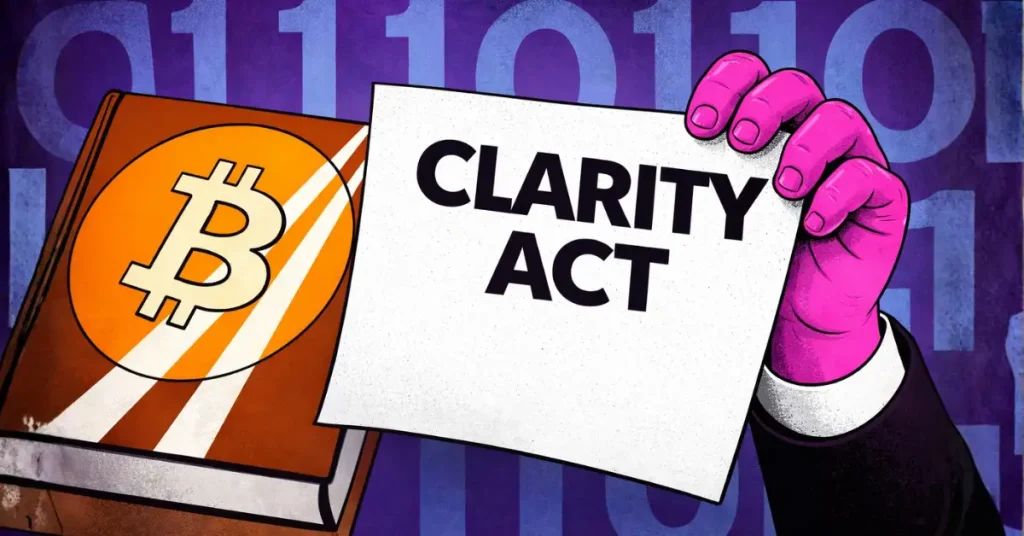
The CLARITY Act's progress is being influenced by a lobbying battle, with critics arguing it may favor incumbent banks by restricting non-bank yield offerings and maintaining traditional finance control over stablecoin liquidity.
Senator Cynthia Lummis is pushing for the CLARITY Act to advance, indicating renewed momentum for regulatory clarity in the digital asset space as it heads to the Senate Banking Committee.
The potential inclusion of the CLARITY Act within a broader national security agenda could accelerate its passage, signaling a strategic move to integrate digital assets under clear regulatory frameworks.
Source, catalyst, and sector overlap from the latest feed.
XRP's significant ETF inflows highlight strong institutional interest from specific regions, contrasting with Ethereum's outflows despite Grayscale's staking activity. Pepeto's presale is positioned as a high-return opportunity due to its current low valuation, working exchange, and confirmed Binance listing, contrasting with the larger market caps of XRP and ETH. The article suggests that early entry into the Pepeto presale offers a potential 100x return, a magnitude unlikely for established assets like XRP and ETH in the short term, driven by supply-demand dynamics post-listing. Despite XRP's $120 million ETF inflows, its price remains flat, indicating that substantial capital is required for significant price appreciation compared to the potential rapid gains from a low-cap presale like Pepeto.
Live Feed
Loading the broader stream in the same flow as the homepage feed.

The Hyperbridge exploit on Ethereum, which minted 1 billion DOT, highlights the critical security risks associated with cross-chain bridges and their potential to undermine native tokenomics, even with recent supply cap governance. The exploit's impact on bridged DOT, causing a collapse in value despite the native Polkadot chain remaining unaffected, underscores the market's sensitivity to the perceived integrity of wrapped assets. The significant disparity between the minted value ($1.1B) and realized profit ($237K) reveals the shallow liquidity of the bridged DOT market on Ethereum, indicating that its perceived value was not backed by substantial underlying depth. The Polkadot treasury's inability to fully reimburse the exploited amount due to its limited holdings and the governance challenges in addressing such a large-scale event suggest that full compensation is unlikely, potentially leading to partial restitution or no reimbursement.

A significant vulnerability in Hyperbridge's cross-chain gateway allowed an attacker to mint and dump 1 billion DOT tokens on Ethereum, highlighting ongoing risks in bridge security. Despite minting $1.19 billion worth of DOT, the attacker only realized approximately $237,000 due to limited liquidity on the Ethereum pool, demonstrating how market depth can cap exploit profits. The exploit targeted the bridge contract, not Polkadot's native network, meaning DOT itself was unaffected, but it underscores the systemic risk bridges pose to bridged asset integrity. The incident serves as a stark reminder of the inherent security challenges in cross-chain infrastructure, potentially leading to increased scrutiny and demand for more robust validation mechanisms.

Alameda Research has unstaked $16 million in SOL, continuing a pattern of moving assets to creditor distribution addresses, suggesting ongoing restructuring efforts. The consistent movement of SOL by Alameda to a known creditor address reinforces the narrative of asset liquidation for repayment, potentially influencing market sentiment around SOL supply. While SOL's price has been largely stable in the short term, Alameda's remaining holdings of approximately $294 million in SOL represent a significant potential future supply overhang.

Significant accumulation of TRUMP memecoin by whales suggests anticipation of event-driven price action, despite recent price declines. The concentration of supply among top wallets indicates potential for price manipulation and limited upside due to insider selling pressure. Regulatory scrutiny and proposed bills to limit memecoin profits pose a bearish overhang for the TRUMP token, despite potential event-driven catalysts. Historical price action around similar events shows a pattern of pre-event rallies followed by post-event declines, suggesting caution for short-term traders.
Researchers have identified a critical security flaw in third-party AI routers that can expose sensitive data, including private keys, potentially leading to cryptocurrency theft. The vulnerability allows malicious routers to intercept plaintext data by terminating TLS connections, creating a significant risk for developers working with smart contracts and crypto wallets. The findings highlight a new attack vector within the AI supply chain, necessitating enhanced security measures for users transmitting sensitive information through AI services.

A musician lost $420,000 in Bitcoin due to a fake Ledger app on Apple's App Store, highlighting ongoing security risks for self-custody users. The incident underscores the persistent threat of phishing and social engineering scams in the crypto space, with losses for Americans exceeding $11 billion in 2025. Funds were quickly funneled to KuCoin deposit addresses, indicating a common pattern in the laundering of stolen crypto assets.

The escalating legal dispute between WLFI and Justin Sun, stemming from accusations of exploitative DeFi dealings and counter-accusations of misconduct, signals increased counterparty risk for projects involved in complex DeFi lending and collateralization. The public confrontation and threat of legal action between WLFI and Justin Sun, a prominent figure in crypto, could lead to increased scrutiny of DeFi lending platforms and the collateralization practices of associated projects. Past collaboration between WLFI and Justin Sun, now soured into a legal battle, highlights the volatile nature of partnerships in the crypto space and the potential for rapid shifts in sentiment and operational relationships.
Signal context only. Validate with price action, liquidity, and risk limits before taking a position.
A critical security failure in the Hyperbridge protocol allowed an attacker to mint 1 billion DOT tokens, leading to a significant price drop and exchange suspensions. The exploit highlights systemic risks in cross-chain bridge security, potentially impacting investor confidence in bridged assets and interoperability solutions. Exchanges suspending DOT deposits and withdrawals indicate immediate market caution, suggesting potential for further price volatility until the vulnerability is fully addressed.
