
Navigating Crypto News

CoinFeather
Navigating Crypto News
Quick market read from this story
Chainlink's 18% volume spike suggests potential early accumulation following a period of low participation, though the broader downtrend remains intact.
Despite increased trading volume, LINK's price is consolidating and remains below key moving averages and the $10-$11 resistance range, indicating a bearish macro bias until a decisive breakout occurs.
The rising volume-to-market cap ratio above 5% signals renewed trader activity, which could precede increased volatility, but confirmation of accumulation requires breaking significant resistance levels.
Deep Dive
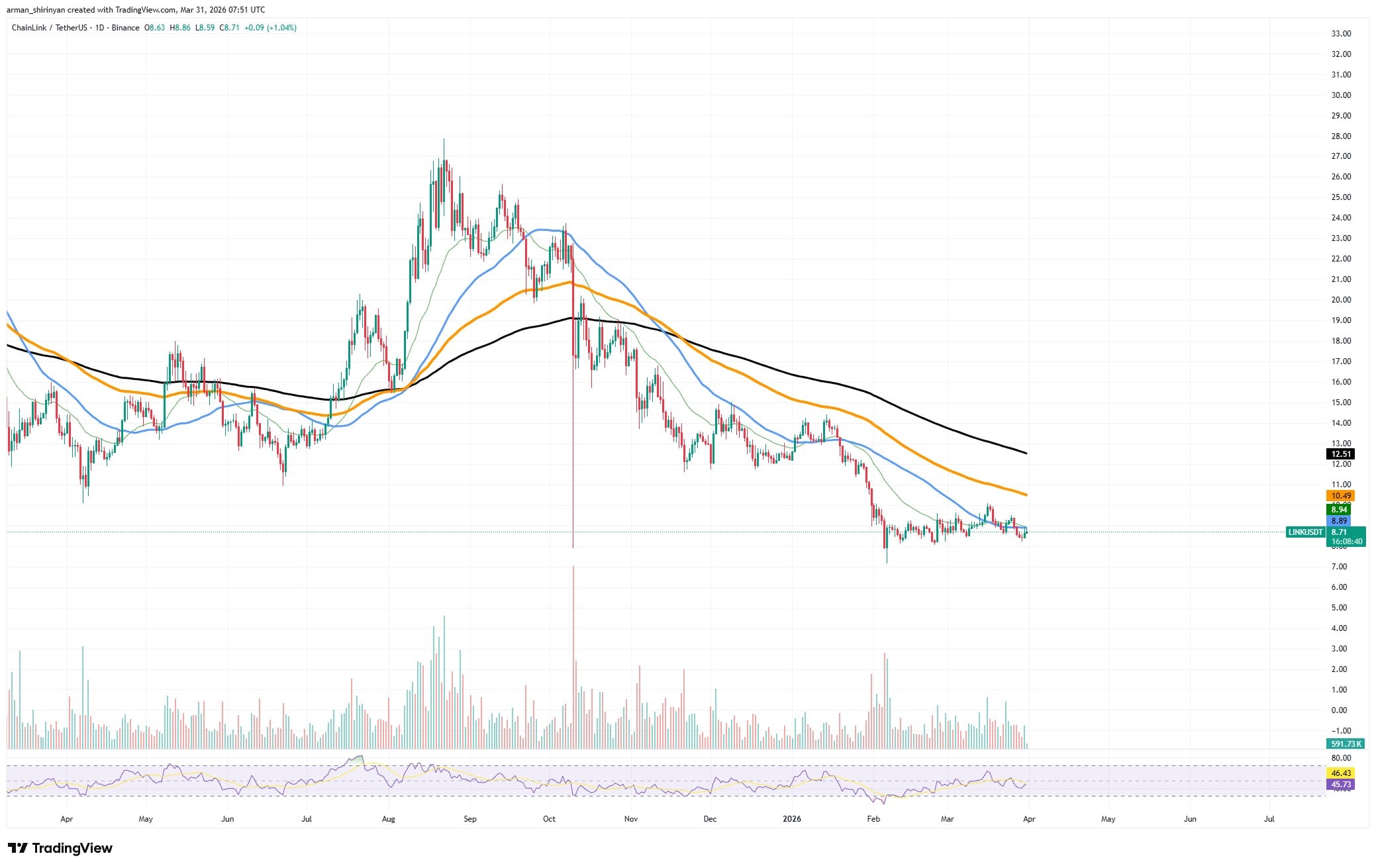
Chainlink (LINK) has experienced an 18% increase in its 24-hour trading volume, signaling a potential shift in market activity. This surge occurs despite LINK currently consolidating within a price range of $8.60-$8.80, following a decline from higher levels. The overall market trend for LINK remains a downtrend, with no structural break yet observed.
The recent volume spike is significant given the low participation levels in recent weeks. While a downtrend is characterized by lower highs, pressure from declining moving averages, and rejections near resistance, the increase in volume suggests a change from distribution to accumulation. The flattening price action indicates that the recent volume increase is more likely a sign of early accumulation rather than renewed selling pressure.
Chainlink maintains a stable market cap of approximately $6.15 billion, with the daily volume reaching $321 million. The 17% increase in daily volume suggests capital is rotating back into the asset rather than exiting the market. A volume-to-market cap ratio exceeding 5% typically indicates renewed trader activity, often preceding increased volatility.
Despite the positive volume indicators, the price of LINK has not yet broken significant resistance levels. The asset remains in a range-bound and bearish market until it decisively surpasses the $10-$11 range. A rejection at resistance levels or moving averages on high volume would indicate distribution rather than accumulation. LINK's decreasing volatility, increasing participation, and rising pressure suggest that the next market movement is likely to be more pronounced.
Source, catalyst, and sector overlap from the latest feed.
Cardano founder Charles Hoskinson's struggle to prove his identity on social media highlights a critical gap in online verification, potentially impacting user trust and security across platforms. The incident underscores the need for robust identity solutions, with Hoskinson pointing to Zero-Knowledge (ZK) systems as a potential fix, aligning with the principles of Cardano's recently launched Midnight network. This situation draws attention to the prevalence of impersonation in the crypto space and the ongoing challenge of distinguishing legitimate actors from scammers, a problem ZK technology aims to address.
Binance's delisting of the XRP/TUSD pair due to low volume signals a market consolidation trend, potentially impacting liquidity for less popular stablecoin pairings. Charles Edwards' prediction of an 85% quantum breach risk for Bitcoin within six years, coupled with Google's reported nine-minute ECDSA computation capability, introduces a significant 'quantum discount' factor that could pressure BTC's fair value. Ripple's continued investment in Keyrock, alongside Standard Chartered, in a $1.1 billion funding round highlights institutional confidence in digital asset infrastructure and its role in facilitating institutional liquidity for XRP Ledger. The confluence of quantum computing threats, potential FTX distributions, and upcoming US employment data creates a complex market outlook for Bitcoin, suggesting a period of heightened volatility and macroeconomic influence.
Bitmine's significant additional staking of $340 million in ETH signals strong institutional conviction in Ethereum's long-term yield potential, potentially bolstering investor confidence. Despite Bitmine's substantial ETH staking, the article notes minimal short-term price impact, suggesting that such large-scale staking events may already be priced into the market or that other market forces are currently dominant. The continued accumulation and staking by a major entity like Bitmine reinforces the narrative of Ethereum as a yield-generating asset, which could attract further capital into the ecosystem over time.
Ripple researchers have introduced Confidential Multi-Purpose Tokens (CMPTs) to the XRP Ledger, enabling hidden transaction amounts and balances through EC-ElGamal encryption and zero-knowledge proofs. This privacy enhancement is specifically targeted at institutional use cases, aiming to secure corporate treasury transfers and tokenized securities by allowing private financial activities while maintaining public verifiability of total supply. The integration of advanced privacy features addresses a key trade-off faced by many blockchains, positioning XRP Ledger to better meet institutional finance demands and potentially drive significant adoption.
Flare Network's planned Bitcoin integration aims to transform it into a universal computation layer for non-smart contract assets, potentially unlocking new DeFi opportunities for BTC holders. The integration of Bitcoin into the Flare ecosystem, alongside privacy tools, signals a strategic move to attract institutional capital and position Flare as a key bridge between legacy cryptocurrencies and modern DeFi. By first capturing liquidity in XRP via XRPFi and then extending this model to Bitcoin, Flare is positioning itself as a central hub for asset utilization beyond simple store-of-value functions.
The U.S. Department of Labor's reversal of its 2022 stance on crypto in 401(k) plans removes a significant legal barrier, potentially opening up substantial retirement assets to digital asset investment. Plan fiduciaries can now legally offer crypto exposure if they adhere to a new six-factor safe harbor framework, emphasizing documentation and due diligence, which could drive demand for compliant crypto products. The DOL's move, coupled with the introduction of the 'Mined in America Act,' signals a broader regulatory shift towards acknowledging and integrating digital assets into traditional financial and industrial frameworks. With the $10.1 trillion 401(k) market now more accessible, even a small allocation shift towards crypto could have significant implications for asset managers and the broader digital asset ecosystem.
OpenFX's $94M Series A funding round signals significant investor confidence in stablecoin-based cross-border payment solutions, potentially driving adoption and infrastructure development in this niche. The expansion into Southeast Asia and Latin America by OpenFX, leveraging stablecoins for faster settlement, could create new market opportunities and pressure traditional FX services. While OpenFX highlights rapid settlement times, regulatory divergence across major markets presents a key hurdle that could temper the broader adoption of stablecoin-based payment infrastructure. The "ChatGPT moment" analogy for stablecoins suggests a potential inflection point for corporate crypto adoption, with significant implications for payment infrastructure providers like OpenFX.
While quantum computing poses a theoretical long-term threat to Bitcoin's cryptography, the market is currently pricing in minimal near-term risk due to ongoing developer efforts and the distant timeline for practical quantum attacks. Changpeng Zhao's assertion that crypto can survive quantum computing, despite warnings from Google research, suggests a narrative of resilience and adaptability within the blockchain ecosystem, potentially easing investor concerns about existential threats. The discussion around quantum-resistant cryptography highlights a potential future catalyst for protocol upgrades across various blockchains, indicating a need for proactive development and investment in security infrastructure.
RIVER's integration with Base, a prominent L2 ecosystem, provides a fundamental catalyst for potential price appreciation by increasing accessibility and on-chain activity. The price action shows RIVER testing key resistance at $25, with rising open interest suggesting new capital is entering the market, potentially signaling a breakout scenario. On-chain data indicates significant liquidity above current price levels, suggesting that a sustained move above $25 could trigger rapid upside momentum due to short liquidations. While RIVER is consolidating, the combination of Base integration and bullish on-chain signals suggests a constructive setup for a potential rally towards $35-$40 if resistance breaks.
Live Feed
Loading the broader stream in the same flow as the homepage feed.

KuCoin operator Peken Global has been permanently barred from serving U.S. users unless registered, following a $500,000 CFTC settlement and a prior guilty plea to operating an unlicensed money transmitting business. The regulatory action against KuCoin, including a two-year exit from the U.S. market, signals increased enforcement and compliance scrutiny for centralized exchanges operating without proper registration. This development, coupled with the CFTC's recent coordination pact with the SEC and formation of an innovation task force, suggests a more aggressive regulatory stance towards crypto platforms in the U.S.
Solana's price action is consolidating within a defined range, with key resistance at $85 and support around $74-$80, indicating indecision and a potential for further downside if support breaks. The current market structure shows lower highs and lower lows, reinforcing a bearish bias for short-term price movements, suggesting traders await clearer signals for entry. Despite recent consolidation, elevated trading volume suggests active participation, but the lack of strong upward momentum from the $74-$78 bounce points to continued pressure.

Bitcoin's March close below the 50 SMA and significant derivatives data shifts, including a $1.4 billion CVD reversal on Binance, indicate increasing short exposure and potential downside pressure. The Long-Term Holder Spent Output Profit Ratio (LTH SOPR) at 0.8 marks the fourth historical instance of this capitulation level, suggesting that while current price action is weak, it aligns with historical bottoms preceding major recoveries. Analyst Michaël van de Poppe anticipates an early April 'low sweep' to clear liquidity before a sustainable recovery, a scenario supported by the current derivatives positioning and historical LTH SOPR data. The confluence of bearish derivatives signals and historically significant on-chain capitulation levels suggests that a final flush lower, potentially triggering a short squeeze, is a plausible near-term scenario before a potential recovery.

The CoinDesk 20 Index showed a slight gain of 0.1%, indicating a broadly flat market with mixed performance among its constituents. Bitcoin Cash (BCH) and NEAR Protocol (NEAR) were the top performers within the CoinDesk 20, each showing positive price action. The performance of specific assets like BCH and NEAR suggests localized strength, but the overall index flatness implies no strong directional trend for the broader market.
Dogecoin price is consolidating at $0.09 with weak volume, indicating a lack of conviction and potential for a breakdown if support fails. Speculation surrounding X Money integration and Elon Musk's involvement provides a speculative bullish narrative, but lacks concrete confirmation. Technical indicators like Bollinger Bands and parabolic SAR suggest a tightening range with resistance at $0.099-$0.10, limiting immediate upside potential. The current market environment for DOGE presents a neutral outlook, with bearish technicals offset by speculative bullish hype, suggesting a watchlist approach.

Nakamoto's sale of 284 BTC at a significant loss, below its $118k average purchase price, signals potential funding stress for Bitcoin treasury companies. The market is repricing Bitcoin treasury wrappers based on durability and financing discipline rather than ambition, as realized losses crystallize the gap between acquisition cost and exit value. Upcoming macro data releases and geopolitical events will further test the financing discipline and survivability of Bitcoin treasury companies, potentially leading to a divergence between those that can hold and those that must manage through selling assets. The equity performance of NAKA, trading near $0.21 after a peak of $34.77, highlights the market's skepticism towards treasury strategies facing realized losses and increased operational costs.

The proposed Ethereum Economic Zone (EEZ) framework aims to address L2 fragmentation by unifying rollups under Ethereum's security and settlement, potentially improving ETH's value accrual and user experience. While the EEZ seeks to create a more cohesive ecosystem, historical attempts like Cosmos' Atom Economic Zone faced challenges, raising questions about the EEZ's long-term adoption and success despite structural differences. The initiative highlights a strategic shift in Ethereum's scaling narrative, moving from pure L2 expansion to a more integrated model that could re-center economic activity on the mainnet and mitigate risks associated with bridge exploits. The EEZ's success hinges on overcoming the inherent 'walled garden' nature of individual rollups and demonstrating tangible benefits for protocols and users, with technical details still forthcoming.

Uniblock's $5.2M funding round highlights continued investor confidence in blockchain infrastructure solutions that simplify multi-chain operations. The platform's focus on unifying infrastructure across over 300 blockchains addresses a critical pain point for developers, potentially improving efficiency and reducing costs for dApps. The integration of AI-native developer tools suggests a forward-looking approach to developer experience, which could drive adoption and innovation in the ecosystem.

Base's 2026 roadmap signals a strategic pivot towards integrating AI agents, positioning the Ethereum L2 as a foundational layer for a future AI-driven economy. The network's focus on smart accounts, tokenization of diverse assets, and scaling payments indicates a proactive approach to capturing value from the emerging agentic AI sector. By aligning with initiatives from Ethereum, Tron, Visa, and Stripe, Base is signaling a broader industry trend towards blockchain infrastructure supporting AI agent interactions and transactions.

The rapid adoption of AI agents like OpenClaw presents a significant new attack vector for crypto wallets, as malicious skills can bypass traditional security measures through natural language manipulation. Security firm CertiK warns that OpenClaw's integration capabilities with messaging platforms and local systems create vulnerabilities for credential theft, impacting a wide range of browser extension wallets. While the OpenClaw founder claims security improvements, the platform's history of numerous vulnerabilities and its recommendation against use by non-experts suggest ongoing risks for users interacting with crypto assets.
Riot Platforms (RIOT) stock offers leveraged exposure to Bitcoin, with its price movements closely mirroring BTC's volatility due to mining economics and operational costs. While analysts maintain a generally bullish outlook with median price targets around $21, significant risks including Bitcoin volatility, high operating costs, and profitability challenges persist. The company's potential diversification into AI and data centers presents a growth avenue, but its core revenue remains tied to Bitcoin mining profitability, making it a speculative play on BTC's trajectory. Investors should consider RIOT as a high-risk, high-reward asset suitable for those bullish on Bitcoin and comfortable with significant price swings, rather than a conservative investment.

Base is strategically shifting its focus towards tokenized markets and stablecoin payments, signaling a move to capture institutional interest in on-chain finance. The network's pivot away from Optimism's tech stack towards in-house infrastructure indicates a drive for greater independence and scalability, potentially impacting its integration with the broader Superchain ecosystem. By prioritizing developer growth and AI integration, Base aims to foster innovation and increase user activity, which could lead to higher transaction volumes and network adoption. The emphasis on stablecoins and tokenized assets positions Base to capitalize on the growing trend of on-chain financial services, potentially attracting significant capital inflows.

Chainalysis's integration of AI agents aims to democratize blockchain intelligence, lowering the barrier to entry for non-technical users and traditional finance professionals. The move signifies a competitive response to TRM Labs' similar AI agent announcement, indicating a potential new AI-driven era in blockchain analytics and investigation. By enabling custom AI agents, Chainalysis empowers enterprises and law enforcement to build bespoke investigation workflows, enhancing their ability to track illicit asset movements.

The successful mainnet launch of NIGHT has triggered a significant price surge, amplified by a 100% increase in derivatives volume, indicating strong speculative interest and leveraged positioning. Aggressive market positioning is evident with a substantial liquidation of short positions, suggesting current buyer control, though the high leverage introduces risk of rapid unwinding. Technical indicators like MACD and RSI show bullish momentum following a descending triangle breakout, pointing towards potential further upside with an immediate target around $0.06500. While fundamental catalysts and technicals are supportive, the sustainability of NIGHT's rally hinges on continued buying pressure and liquidity, with potential for rapid reversals if momentum fades.

Bitcoin is on the verge of a rare six-month losing streak, underscoring persistent downside risk driven by macro pressures and technical weakness. Despite nearing a historical losing streak, Bitcoin remains above key long-term support levels like the 200-week moving average and realized price, suggesting potential for a rebound if these levels hold. Ongoing geopolitical tensions and concerns over quantum computing add layers of uncertainty, potentially prolonging the bearish sentiment and impacting investor confidence in the short to medium term. While a six-month losing streak is a significant bearish signal, the historical precedent of a subsequent recovery offers a glimmer of hope for bulls, though current macro conditions differ significantly from the 2018-2019 period.
Signal context only. Validate with price action, liquidity, and risk limits before taking a position.
