
Navigating Crypto News

CoinFeather
Navigating Crypto News
Quick market read from this story
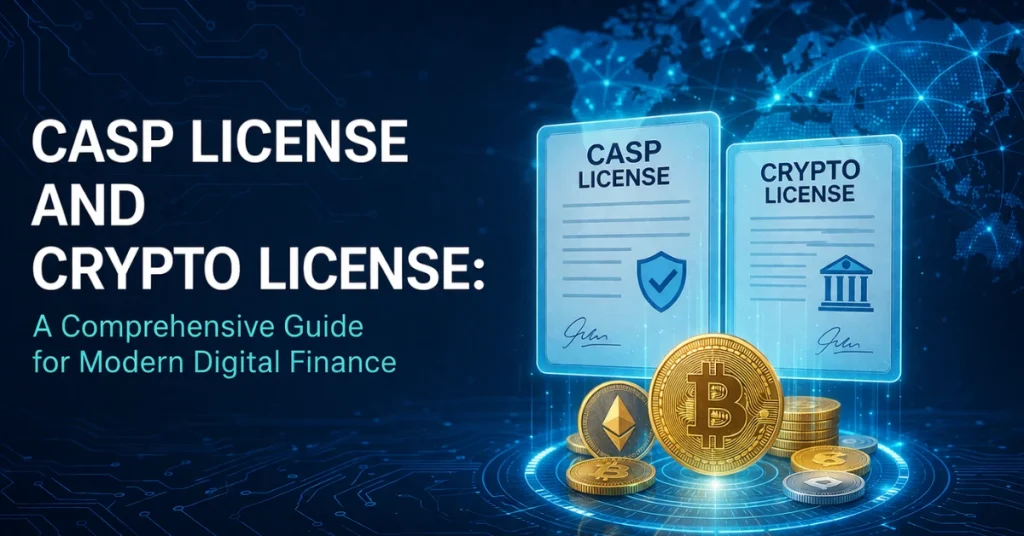
The article provides a comprehensive overview of crypto and CASP licenses, highlighting their importance for regulatory compliance and market credibility.
Obtaining these licenses is presented as a strategic advantage for crypto businesses, enabling access to banking services and facilitating market expansion.
The increasing adoption of CASP frameworks, particularly in Europe with MiCA, signals a trend towards more standardized and stringent crypto regulation globally.
Deep Dive
The rapid expansion of digital assets necessitates robust regulatory frameworks, with Crypto Licenses and CASP Licenses (Crypto-Asset Service Provider Licenses) emerging as crucial tools for ensuring transparency, security, and compliance in the evolving crypto ecosystem. These licenses authorize companies to conduct various digital asset activities, aiming to prevent illicit practices like money laundering and fraud while fostering a secure environment for users and investors.
A general crypto license grants legal authorization for businesses to operate with digital assets, including exchange services, wallet management, and token issuance. Obtaining such a license typically requires adherence to strict compliance standards, such as implementing robust Anti-Money Laundering (AML) and Know Your Customer (KYC) procedures, maintaining transparent financial reporting, and ensuring strong cybersecurity measures. These requirements are vital for protecting consumers and enhancing a company's credibility.
The CASP license, or Crypto-Asset Service Provider license, represents a more specific and often stricter regulatory framework, particularly prominent in European jurisdictions and associated with initiatives like the Markets in Crypto-Assets (MiCA) framework. It is mandatory for businesses offering services such as operating crypto exchanges, providing custody and wallet services, executing orders, offering investment advice, or managing crypto portfolios. CASP licenses usually entail more comprehensive oversight and detailed operational requirements compared to general crypto licenses.
While both license types aim for regulatory oversight, key differences lie in their scope and depth. Crypto licenses are broad and global, whereas CASP licenses are more standardized, especially within Europe. CASP frameworks often involve more rigorous regulations concerning risk management, governance, and consumer protection. Obtaining either license is vital for businesses to avoid severe legal penalties, build trust and credibility with customers and partners, gain access to essential banking services, and facilitate international market expansion.
Popular jurisdictions for obtaining crypto licenses include Canada (known for its well-regulated financial environment and MSB registration), the European Union (offering a unified framework via MiCA), Estonia (an early pioneer with evolving regulations), Lithuania (offering an efficient process), and Singapore (a global fintech hub with strong government support). The licensing process generally involves company registration, extensive documentation preparation (including business plans and AML/KYC policies), compliance setup, application submission to regulatory authorities, a review and approval phase, and ongoing compliance maintenance.
The process of obtaining a crypto or CASP license can be challenging, involving significant costs, time investment, and the need to adapt to frequently changing regulations. However, the long-term benefits, including legal compliance, enhanced credibility, and market access, are substantial. As digital assets gain wider adoption, regulatory frameworks like the CASP license are expected to become more prevalent globally, fostering greater international cooperation and standardization. These licenses are fundamental to building a stable, trustworthy, and secure crypto ecosystem, positioning licensed businesses for sustained success.
Source, catalyst, and sector overlap from the latest feed.
ZEC price has broken out of a descending triangle pattern, indicating a potential shift in market control towards bulls and targeting the $290-$300 range if momentum sustains. The price surge is supported by on-chain data showing increased shielded transaction volume and a preference for newer privacy features, suggesting renewed utility and demand for Zcash's core offering. A recent network upgrade (Zebra 4.3.0) with security fixes and performance improvements, coupled with renewed capital inflow and development focus, signals a potential revitalization of the Zcash ecosystem. The increasing use of shielded transactions, now representing 86.5% of total activity and 31.1% of circulating supply, reinforces the privacy narrative and could attract further investor interest.
Bitcoin's Long-Term Holder SOPR dropping below 1.0 signals a 'surrender phase,' historically preceding major rallies and indicating potential capitulation zones. Despite recent monthly losses, on-chain data mirroring past major bottoms suggests that current price action may represent a significant accumulation opportunity. Analysts suggest a potential liquidity sweep in early April, with a recovery zone between $53,000 and $60,000 before a potential reversal, aligning with historically strong April performance for Bitcoin. The upcoming monthly close is a critical short-term indicator, but the confluence of on-chain signals suggests a potential macro turning point for Bitcoin.
Bitcoin long-term holders are selling at a loss, indicated by LTH-SOPR below 1.0, signaling a potential capitulation phase that could precede a market bottom. Significant unrealized losses for short-term holders, amounting to $113.9 billion, suggest widespread pressure and a potential increase in selling volume if sentiment deteriorates further. The combined selling pressure from both long-term and short-term holders amidst prolonged downside volatility indicates a stressed market environment, impacting overall Bitcoin sentiment.
Bitcoin SV (BSV) is currently trading below its 200-day EMA, indicating a bearish trend, with analysts projecting a gradual price increase towards $175 by 2030, contingent on market conditions and demand. On-chain data shows aggressive selling pressure, but large average order sizes suggest potential whale accumulation, hinting at a possible liquidity bottom despite the current downtrend. Price predictions for BSV range significantly across different analysts, with some forecasting a modest rise to $35-$70 by 2030, while others suggest a more optimistic outlook up to $199-$360, highlighting considerable uncertainty.
KuCoin has settled with the CFTC for $500,000, resolving charges related to providing unregistered trading access to U.S. users. The settlement bars KuCoin from serving U.S. customers unless it completes proper registration, highlighting ongoing regulatory scrutiny for crypto exchanges operating internationally. While the settlement amount is relatively small for a major exchange, the restriction on serving U.S. customers until registration is complete could impact future growth and user acquisition in a key market.
Increased legislative scrutiny and state-level lawsuits against prediction markets like Kalshi and Polymarket suggest a heightened regulatory risk that could impact their operational scope and market activity. The potential for a Democratic majority in Congress in 2027 could accelerate the passage of stricter regulations, particularly concerning bets on government actions and elections, posing a significant challenge to the sector's growth. Despite regulatory headwinds, the prediction market sector has seen exponential growth, indicating strong user demand and potential for continued expansion if regulatory challenges are navigated successfully. The ongoing jurisdictional debate between federal (CFTC) and state regulators, potentially heading to the Supreme Court, creates uncertainty and a 'minefield' for operators, impacting near-term investment and operational decisions.
The OCC's revised rule effective April 1, 2026, provides a clearer regulatory framework for national trust banks engaging in digital asset custody, potentially benefiting Ripple's pending national trust bank charter. Despite the regulatory clarity, Ripple's national trust bank charter remains conditional, requiring satisfaction of supervisory and licensing conditions before full operations can commence, indicating a path forward but not immediate authorization. XRP price action remains weak and technically bearish, with resistance at the mid-$1.50 range and declining open interest suggesting short-term trader caution despite the ongoing regulatory developments.
Despite a technical breakdown below channel support targeting $0.22, Cardano whales have accumulated 220 million ADA in the past week, suggesting a divergence between short-term price action and long-term holder conviction. The recent launch of the Midnight ZK privacy mainnet and the SEC/CFTC classification of ADA as a digital commodity in March address key institutional barriers and use cases, fundamentally altering Cardano's long-term value proposition. Upcoming Q2 2026 upgrades, including the Van Rossem hard fork and Ouroboros Leios scalability improvements, combined with the recent infrastructure additions like USDCx and Midnight, position Cardano for significant structural growth irrespective of current market sentiment.
The new IRS Form 1099-DA introduces reporting for crypto sales, but its initial lack of basis information creates a compliance challenge for investors who must still calculate their own gains and losses. A significant portion of US crypto users remain unaware of new 2025 IRS reporting rules, indicating potential widespread confusion and non-compliance issues as the tax season approaches. The IRS's focus on gross proceeds via Form 1099-DA, without immediate basis reporting, necessitates investors maintaining meticulous personal records to accurately report taxable events and avoid discrepancies. Increased IRS scrutiny and reporting requirements are likely to influence investor behavior, potentially driving a shift towards more diligent tax planning and preference for regulated exchanges.
Google's research indicates that quantum computers may break current elliptic curve cryptography sooner than anticipated, potentially impacting Bitcoin and other blockchain security by 2032. While the threat of 'Q-Day' is a long-term engineering challenge, the findings necessitate 'appropriate urgency' for transitioning to post-quantum cryptography (PQC) to safeguard digital assets and infrastructure. The increased confidence in quantum computing timelines, even with a 10% probability by 2032, suggests a need for proactive preparation and upgrades across the entire internet infrastructure, not just blockchains.
Bitmine's significant additional staking of $340 million in ETH signals strong institutional conviction in Ethereum's long-term yield potential, potentially bolstering investor confidence. Despite Bitmine's substantial ETH staking, the article notes minimal short-term price impact, suggesting that such large-scale staking events may already be priced into the market or that other market forces are currently dominant. The continued accumulation and staking by a major entity like Bitmine reinforces the narrative of Ethereum as a yield-generating asset, which could attract further capital into the ecosystem over time.
Google's whitepaper highlights five quantum attack vectors on Ethereum, potentially exposing over $100 billion in assets and systemic risks to DeFi and L2s. While Ethereum has a roadmap for quantum resistance by 2029, the immediate threat lies in the thousands of existing smart contracts and L2s that require independent upgrades, creating a significant near-term vulnerability. The identified vulnerabilities in Ethereum's wallets, smart contract admin keys, staking system, and data availability sampling pose a material risk, suggesting a need for proactive security measures and potential repricing of affected assets. The potential for quantum computers to compromise admin keys for stablecoins like USDT and USDC could trigger a cascading failure across DeFi protocols, underscoring the interconnectedness of the ecosystem's security.
Chainlink's 18% volume spike suggests potential early accumulation following a period of low participation, though the broader downtrend remains intact. Despite increased trading volume, LINK's price is consolidating and remains below key moving averages and the $10-$11 resistance range, indicating a bearish macro bias until a decisive breakout occurs. The rising volume-to-market cap ratio above 5% signals renewed trader activity, which could precede increased volatility, but confirmation of accumulation requires breaking significant resistance levels.
Live Feed
Loading the broader stream in the same flow as the homepage feed.
Ripple researchers have introduced Confidential Multi-Purpose Tokens (CMPTs) to the XRP Ledger, enabling hidden transaction amounts and balances through EC-ElGamal encryption and zero-knowledge proofs. This privacy enhancement is specifically targeted at institutional use cases, aiming to secure corporate treasury transfers and tokenized securities by allowing private financial activities while maintaining public verifiability of total supply. The integration of advanced privacy features addresses a key trade-off faced by many blockchains, positioning XRP Ledger to better meet institutional finance demands and potentially drive significant adoption.
A potential de-escalation in the Middle East conflict, driven by a shift in U.S. policy towards prioritizing an Iran war exit, could trigger a significant risk-on rally in crypto markets, potentially pushing Bitcoin above $90,000. Despite geopolitical easing, Bitcoin's price action remains constrained around $66,000, highlighting the market's continued demand for sustained institutional flows and regulatory clarity before a major bull run can be sustained. While oil prices have surged due to the conflict, the Federal Reserve is widely expected to hold interest rates steady, creating a potentially favorable macro environment for risk assets if geopolitical tensions further subside.
The upcoming Qubic mainnet mining launch for Dogecoin introduces a novel dual-purpose computing model, potentially boosting network security and providing a fresh narrative catalyst for traders. Despite the Qubic integration, Dogecoin's price remains technically bearish, trading below key EMAs and facing resistance at the $0.095 descending trendline, suggesting caution is warranted. A successful Qubic mining launch could drive short-term sentiment, but sustained price appreciation hinges on breaking the established bearish technical structure and overcoming resistance levels.

A supply chain attack on the Axios npm library, compromising versions 1.14.1 and 0.30.4, poses a significant risk to developers and platforms relying on this popular JavaScript HTTP client. The attack, which involved injecting a malicious dependency (plain-crypto-js@4.2.1), could grant attackers remote access and lead to the theft of sensitive data including API keys and crypto wallet information. This incident underscores the persistent and evolving threat of supply chain attacks within the software development ecosystem, highlighting the need for rigorous security audits and prompt credential rotation for affected users. Past incidents involving Trust Wallet and other projects demonstrate the potential for such compromises to escalate, leading to direct financial losses for end-users and impacting trust in the broader crypto infrastructure.

OpenFX's $94 million funding round signifies strong investor confidence in stablecoin-powered cross-border payments, potentially driving increased adoption and integration within traditional finance. The company's expansion into Southeast Asia and Latin America, regions with growing stablecoin usage, positions it to capitalize on emerging market opportunities for efficient FX conversions. With $45 billion in annualized payment volume, OpenFX's growth trajectory suggests a tangible demand for its services, bridging the gap between legacy banking and digital asset solutions.
Rising US gas prices above $4 and European gas up 70% signal significant supply chain stress and geopolitical risk impacting consumer costs and potentially inflation. The divergence between crude oil and refined product prices highlights refinery and distribution constraints, suggesting a more direct and immediate impact on consumers and transportation costs. Escalating geopolitical tensions in the Middle East, particularly concerning the Strait of Hormuz and LNG facility disruptions, are driving sharp energy price increases globally, posing inflation risks for policymakers.

CoinDCX's launch of a 100 crore INR anti-fraud network signals a proactive response to increasing cyber threats and brand impersonation within the Indian crypto market. The initiative, backed by a significant financial commitment, aims to address a broader industry issue of phishing and fraud, potentially enhancing user trust and security across Indian crypto platforms. Following the clearance of its founders in an impersonation case, CoinDCX's move to establish a sector-wide security push could be interpreted as an effort to rebuild confidence and demonstrate commitment to user protection.

Dunamu's reaffirmed IPO plans are contingent on the completion of its share swap with Naver Financial, indicating a strategic focus on corporate restructuring before public market entry. The company's strong operating margin of 55.8% and significant revenue highlight its financial health, providing a solid foundation for its IPO ambitions. The delayed merger timeline, now extended to September 2026, suggests that Dunamu's IPO will likely not occur until late 2026, pending regulatory approvals and deal finalization. Dunamu's diversification strategy into AI-powered solutions and global market expansion signals a forward-looking approach beyond its core exchange operations.
Flare Network's planned Bitcoin integration aims to transform it into a universal computation layer for non-smart contract assets, potentially unlocking new DeFi opportunities for BTC holders. The integration of Bitcoin into the Flare ecosystem, alongside privacy tools, signals a strategic move to attract institutional capital and position Flare as a key bridge between legacy cryptocurrencies and modern DeFi. By first capturing liquidity in XRP via XRPFi and then extending this model to Bitcoin, Flare is positioning itself as a central hub for asset utilization beyond simple store-of-value functions.
Signal context only. Validate with price action, liquidity, and risk limits before taking a position.
