
Navigating Crypto News

CoinFeather
Navigating Crypto News
Quick market read from this story
Bitcoin's current price consolidation near $70K reflects a market at an intersection of macro headwinds (inflation, geopolitical risk, Fed policy) and strong institutional demand via ETFs, creating a tug-of-war that suggests potential for a breakout once one force dominates.
The narrative around Bitcoin is shifting from a pure risk asset to a hybrid hedge, evidenced by its relative strength compared to traditional markets during periods of macro uncertainty and geopolitical tension.
Despite recent ETF outflows, 30-day net inflows remain positive, indicating underlying accumulation and a constructive long-term outlook, though near-term price action is capped by macro pressures.
Deep Dive
Bitcoin is currently trading around $70,433, experiencing a slight weekly decline of 2.64% but maintaining a monthly gain of over 3%. While price action appears stable, the underlying macroeconomic environment presents significant challenges, including the Federal Reserve's 'higher-for-longer' interest rate policy and persistent inflation, particularly driven by rising energy prices due to geopolitical tensions in the Middle East. These factors are pressuring risk assets like Bitcoin and tempering expectations for liquidity-driven rallies, creating a ceiling on upward momentum.
Global instability, notably the conflict in the Middle East, has become a key driver of Bitcoin's price. While such events historically trigger short-term risk-off sentiment and have led to oil price surges, they are also increasing long-term interest in alternative assets like Bitcoin. Recent price action shows Bitcoin dipping during macro shocks but quickly stabilizing and rebounding as investors reallocate. This suggests a maturing market where Bitcoin is beginning to absorb, rather than just react to, fear, indicating a shift from a purely speculative asset to one that also acts as a hedge.
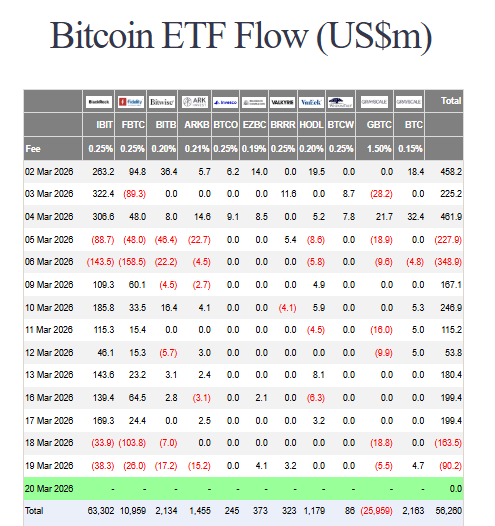
Institutional demand, a critical factor in the current cycle, is no longer moving in a single direction. Bitcoin ETFs have seen substantial inflows, accumulating billions of dollars, which confirms ongoing strong institutional participation. However, recent sessions have also recorded significant outflows, breaking a streak of inflows and signaling potential hesitation among larger investors. Despite this short-term volatility in ETF flows, the 30-day trend remains positive, suggesting overall accumulation rather than distribution.
In contrast to traditional markets experiencing sharp reactions to macro uncertainty, such as record highs in gold and volatile oil prices, Bitcoin has demonstrated relative strength by holding its range. This consolidation at current levels is a notable departure from previous cycles where Bitcoin would have experienced significant sell-offs under similar conditions. This resilience suggests Bitcoin is evolving, behaving less like a high-beta risk asset and more like a hybrid asset combining risk and hedge characteristics.
Projections for Bitcoin's future price, such as reaching $102,000 - $125,000 by 2026 and potentially $250,000 - $320,000 by 2030, are supported by factors including growing institutional adoption, limited supply, and recurring macro shocks. While volatility is expected to persist, the long-term bias remains upward. The current market is characterized by a tension between macroeconomic pressures (higher interest rates, inflation, geopolitical risks) limiting upside and strong institutional accumulation building a foundational support. This dynamic explains Bitcoin's current consolidation near $70,000, with the expectation that prolonged consolidation at highs often precedes significant expansion.
Source, catalyst, and sector overlap from the latest feed.
A significant majority of finance leaders (74%) now view stablecoins as a tool to improve cash flow and unlock working capital, indicating a strategic shift from pure payment utility to treasury management applications. Increasing regulatory clarity, exemplified by the OCC's move towards recognizing stablecoins and proposed federal oversight, is reducing institutional uncertainty and accelerating adoption. The growing institutional embrace of stablecoins for treasury and liquidity management, coupled with regulatory progress and ecosystem development, suggests a maturing market where stablecoins are becoming core financial infrastructure.
Solana is consolidating at a critical resistance level around $92, with a tightening price range indicating an imminent breakout or rejection that could dictate its short-term trajectory. The ascending trendline support remains intact, suggesting bulls are attempting to maintain upward momentum, but repeated rejections at resistance highlight significant selling pressure that could lead to a downside move if broken. Traders should monitor the $92 resistance and the ascending trendline closely, as a decisive move above resistance or a break below support will signal the next significant price action for SOL.
The World Gold Council's "Gold as a Service" platform aims to standardize tokenized gold, potentially increasing fungibility and liquidity across digital gold products by creating industry-wide infrastructure. This initiative could significantly boost the RWA sector by addressing fragmentation and interoperability issues, making tokenized gold more accessible to institutional participants and modern financial systems. While the tokenized gold market is currently valued at $5.5 billion, with XAUT and PAXG leading, a standardized platform backed by a major industry association may drive further growth and adoption.
Institutional demand for Ethereum is accelerating with the launch of BlackRock's staked ETF and consistent inflows, positioning ETH as an income-generating asset and signaling a potential structural shift beyond retail speculation. Significant accumulation by entities like Bitmine is tightening ETH's liquid supply, mirroring Bitcoin's corporate accumulation phase and amplifying the impact of future demand increases. Despite strong on-chain activity and institutional interest, regulatory uncertainty, particularly regarding the CLARITY Act and potential commodity classification, remains a key catalyst that could unlock further price appreciation. The combination of increasing institutional adoption, supply reduction through staking and accumulation, and the potential for regulatory clarity suggests a fundamental strengthening of Ethereum's market position, despite current price action lagging behind underlying developments.
XRP whales are accumulating over 200 million tokens, signaling strong conviction and a potential shift in market structure towards bullish sentiment. The $1.40 support level, reinforced by derivatives market positioning, is critical for maintaining XRP's current structure and preventing a bearish breakdown. Rising exchange volume without a sharp price increase suggests steady, institutional-style accumulation, potentially setting the stage for a breakout above $1.60. XRP reclaiming the fourth market cap position from BNB indicates growing conviction and a strengthening fundamental position, independent of speculative hype.
Institutional adoption of digital assets is no longer a speculative trend but a competitive necessity, with a significant majority of finance leaders viewing it as crucial for market positioning. Stablecoins are evolving beyond payment rails to become key treasury tools for cash management and T+0 settlement, indicating a maturing use case with substantial market cap growth. The surge in interest for asset tokenization, coupled with increasing regulatory clarity from frameworks like MiCA and the US GENIUS Act, signals a shift from discussion to implementation for real-world asset integration. The data suggests a narrowing window for financial institutions to establish competitive advantages in digital assets, as adoption accelerates and regulatory environments become more defined.
Morgan Stanley's amended S-1 filing for its Bitcoin ETF (MSBT) confirms operational details like the ticker, listing exchange (NYSE Arca), and initial seed funding, signaling a significant step towards institutional adoption. The involvement of established custodians like Coinbase Custody and BNY Mellon, coupled with Morgan Stanley's vast wealth management network, positions the MSBT ETF to attract substantial institutional capital, potentially influencing Bitcoin's price stability. Despite the lack of disclosed management fees or expense ratios, the filing's focus on institutional-grade security and potential fee-waiver strategies suggests a competitive approach to capturing market share in the growing spot Bitcoin ETF landscape. The amended filing brings the MSBT ETF closer to SEC approval, with market participants anticipating a decision within the next fiscal quarter, which could further legitimize Bitcoin as a core portfolio asset.
Ethereum faces a critical juncture with a bearish technical pattern mirroring a past 40% decline, placing the $2,000 support level under intense scrutiny for short-term traders. The upcoming Glamsterdam upgrade in H1 2026 promises a significant scalability boost with 10,000 TPS and reduced gas fees, potentially altering Ethereum's fundamental value proposition if delivered on schedule. Institutional adoption is accelerating with BlackRock's ETHB ETF attracting substantial AUM and BitMine aggressively accumulating ETH, signaling a growing demand for yield-bearing ETH assets despite short-term price risks.
Morgan Stanley's amended S-1 filing for its MSBT spot Bitcoin ETF, detailing seed capital and listing plans, signals a significant step towards the product's launch and direct capture of management fees. The involvement of major authorized participants like Jane Street and Virtu Americas suggests robust market-making infrastructure for the MSBT ETF, aiming to keep its price closely aligned with Bitcoin's spot price. This move by Morgan Stanley, alongside similar actions from Bank of America and Vanguard, indicates a broader institutional trend of increasing accessibility to crypto products, potentially driving further adoption and capital inflows.
Rising inflation fears and geopolitical tensions are driving a global bond market selloff, with traders now pricing in a potential Fed rate hike in April, which could pressure risk assets like Bitcoin. Bitcoin is exhibiting 'canary in the macro coal mine' behavior, potentially pricing in a recession while traditional assets have not, suggesting it may be ahead of the curve in anticipating broader economic downturns. Despite macroeconomic headwinds, Bitcoin remains a strong performer relative to traditional markets and gold since the recent geopolitical escalation, indicating resilience or a flight to perceived digital scarcity.
The SEC and CFTC's acknowledgment of XRP as a non-security digital commodity, following a shift in regulatory stance, provides a significant positive catalyst for the asset. Analyst Ali Martinez identifies XRP's current price action near a multi-year trendline as a potential strong buying opportunity, suggesting a bullish outlook based on technical support. Despite a recent price surge and subsequent pullback, the regulatory clarity for XRP could encourage renewed investor interest and potentially drive further price appreciation in the short to medium term.
Despite Bitcoin outperforming traditional assets amid geopolitical tensions, traders are actively hedging downside risk around $50,000, indicating a divergence between spot market resilience and derivatives market caution. The persistent hedging suggests traders are anticipating a potential inflation shock from oil price surges, which could delay Fed rate cuts and pressure risk assets like Bitcoin. While current derivatives positioning leans defensive with negative funding rates, this could set the stage for a short squeeze if spot demand continues to absorb liquidity and geopolitical risks subside. Market participants are closely monitoring oil price divergence and inflation data, as these factors will likely dictate whether Bitcoin revisits lower support levels or experiences further squeeze-driven upside.
Live Feed
Loading the broader stream in the same flow as the homepage feed.

Despite a bearish hourly death cross, Shiba Inu experienced a 5% price jump, suggesting a potential bear trap that could force short sellers to cover, driving further upward momentum. The price action indicates that short-term rallies are being sold into, hindering sustained breakouts, even with positive regulatory news regarding token classification potentially sparing SHIB from security status. Shiba Inu's attempt to reclaim the daily MA 50 at $0.00000607 is a key indicator for momentum, with its success or failure in the coming sessions likely to dictate near-term price direction.

CoinDesk PitchFest at Consensus events provides early-stage Web3 founders with crucial structured access to influential investors and decision-makers, acting as a significant accelerator for promising projects. The event has a track record of showcasing companies that later achieve substantial milestones, such as securing funding rounds or pivoting successfully, indicating its value as an early validation and networking platform. The introduction of a 'side mission' at Consensus Miami focusing on agentic commerce and one-person startups highlights a potential shift towards more autonomous and rapidly deployable Web3 applications, signaling a new frontier for innovation. While PitchFest itself does not guarantee funding, its role in facilitating direct engagement with key industry players offers founders a tangible pathway to gain credibility and accelerate their growth trajectory in a crowded market.

Financial leaders are increasingly viewing stablecoins not just as payment tools, but as critical instruments for treasury management and cash flow efficiency, signaling a maturation of their perceived utility. Fintech firms are leading the charge in stablecoin adoption for both payments and treasury functions, indicating a potential competitive advantage for early adopters in this evolving financial landscape. The strong emphasis on custody and integrated infrastructure by 89% of institutions highlights a key bottleneck and opportunity for service providers in the digital asset space. The survey data suggests a growing demand for comprehensive, one-stop-shop solutions for stablecoin integration, with corporates showing the highest preference for such offerings.

BitFuFu's strategic pivot to cloud mining, evidenced by a 60% revenue drop in self-mining and a significant increase in cloud mining's share, signals a move towards more predictable revenue streams and capital efficiency. The company's focus on scaling cloud mining and expanding its Bitcoin treasury in 2026, despite a substantial decrease in self-mined BTC output, indicates a commitment to long-term asset accumulation through diversified revenue. BitFuFu's reported 2.7% overall revenue growth in 2025, driven by cloud mining and increased equipment sales, suggests resilience in its business model despite challenging mining conditions like difficulty increases and lower earnings per terahash.

Ledger's appointment of a former Circle executive as CFO and the opening of a New York office signal a strategic push towards institutional engagement and a potential IPO. The expansion into the U.S. market and strengthening of leadership indicate Ledger's readiness to navigate public markets, driven by institutional demand for secure crypto infrastructure. While Ledger faces past setbacks like data breaches, its focus on enterprise services and hardware wallets positions it to capitalize on increased institutional interest in digital asset security.

Michael Saylor forecasts 2026 as a pivotal year for Bitcoin's institutional integration, driven by a favorable regulatory environment and the development of a three-layer Bitcoin economy. The proposed Bitcoin-backed stablecoin offering 6-8% yields could significantly challenge traditional fiat-backed instruments by providing higher returns and dollar-like transaction capabilities. The convergence of AI and Bitcoin is expected to drive demand for Bitcoin's final settlement and cryptographic integrity, particularly from autonomous AI agents transacting at machine speed. Saylor's optimistic outlook suggests a decade of unprecedented wealth creation, with Bitcoin and AI as central pillars, implying significant long-term growth potential for the digital asset ecosystem.

Canada is integrating crypto into its core financial system through new regulations like the Canada Stablecoin Act, signaling a shift towards formal recognition but with a primary focus on risk management. The tightening regulatory environment, including stricter registration for crypto exchanges and upcoming reporting frameworks, is consolidating the market and favoring established players with robust compliance infrastructure. Despite regulatory progress, a divergence remains between industry demands for clear, workable rules and policymakers' cautious stance, particularly regarding DeFi and self-custody, favoring traditional financial product mappings like Bitcoin ETFs. The Canadian government's approach, influenced by Prime Minister Mark Carney's pragmatic but risk-averse stance, prioritizes stability and consumer protection, potentially leading to further consolidation and a slower adoption of more decentralized crypto applications.

Bitcoin's weekly RSI is approaching a critical level that historically signals potential bear market bottoms, suggesting a near-term inflection point for price action. While a bullish divergence on the weekly RSI is a key indicator for potential rebounds, traders are advised to remain cautious due to the recent all-time highs and the possibility of a prolonged bear market cycle. The analysis highlights that a higher low on the weekly RSI, even with price making lower lows, could indicate the bottom is near or already in, warranting increased market attention.
Coinbase's expansion into stock perpetual futures with 24/7 trading offers global users leveraged access to US equities, potentially increasing trading volume and platform utility beyond traditional crypto offerings. The integration of traditional equities into a crypto-native derivatives structure, settling in USDC and utilizing cross-margining, signals a strategic move towards an 'everything exchange' and could attract new user segments. While offering up to 20x leverage on ETFs and 10x on single stocks, the product's availability outside the US highlights regulatory constraints and presents both increased opportunity and risk for traders.

A long-dormant Bitcoin whale wallet holding approximately $147 million has moved a small fraction, signaling potential liquidity events or key recovery after 13 years. The minimal transfer of $56 from a Satoshi-era wallet, while not immediately indicative of a sell-off, prompts market observation for further movements that could impact Bitcoin supply dynamics. The event highlights the significant unrealized gains of early Bitcoin adopters and raises questions about whether this represents a 'diamond hands' holder finally diversifying or a recovered private key test transaction.

Kalshi's successful $1 billion funding round at a $22 billion valuation, doubling its previous valuation, signals strong investor confidence in the prediction market despite regulatory headwinds. The significant increase in trading volume, exceeding $10 billion in February, indicates robust user adoption and market growth for Kalshi, potentially setting a precedent for other prediction market platforms. Despite strong investor interest and growth, Kalshi faces ongoing regulatory challenges with state-level actions and legal battles, creating a complex operating environment that traders should monitor. The platform's ability to attract substantial funding and grow user activity while navigating regulatory scrutiny suggests a resilient business model, though future expansion may be state-dependent.
Signal context only. Validate with price action, liquidity, and risk limits before taking a position.
