
Navigating Crypto News

CoinFeather
Navigating Crypto News
Quick market read from this story
The geopolitical event's impact on crypto markets, evidenced by BTC's rapid surge and short liquidations, highlights the asset class's sensitivity to macro news, suggesting potential for swift repricing based on external catalysts.
While SOL and BNB show recovery, the article emphasizes that true early-stage alpha is found in presales like Pepeto, which aims for significant gains before potential exchange listings, contrasting with the slower, larger-cap recovery.
Pepeto's presale is positioned as a high-potential opportunity due to its early entry pricing and upcoming Binance listing, aiming to deliver returns that significantly outperform the recovery seen in established assets like SOL and BNB.
Deep Dive
The cryptocurrency market experienced a significant surge, adding approximately $2.5 trillion in market capitalization within twenty minutes, following President Trump's announcement to postpone strikes on Iran. Bitcoin (BTC) saw a rapid increase from $68,000 to $71,000, while Solana (SOL) gained 8%. This market movement also led to the liquidation of $270 million in short positions.
President Trump's decision to pause strikes targeting Iran's energy infrastructure triggered a broad market reversal. Bitcoin experienced a 5.8% jump, coinciding with a 14% drop in oil prices. The swift recovery in the crypto market highlights its sensitivity to geopolitical events and investor sentiment shifts. While the ceasefire headline fueled the rally, early investors in presale projects were able to secure favorable pricing before the broader market recovery.
Amidst the market recovery, the presale for Pepeto has attracted significant attention, raising over $8 million. The platform is designed to equip retail investors with tools to mitigate risks, featuring a risk scorer that checks contracts for potential issues like hidden drains and fake liquidity. PepetoSwap offers zero-fee trades, and its cross-chain bridge facilitates cost-free token transfers. The project's team includes a former Binance expert, and its contracts have passed a SolidProof audit. The co-founder of the original Pepe coin is also involved, aiming for a 100x potential with an entry price of $0.000000186 and offering a 194% APY staking reward.
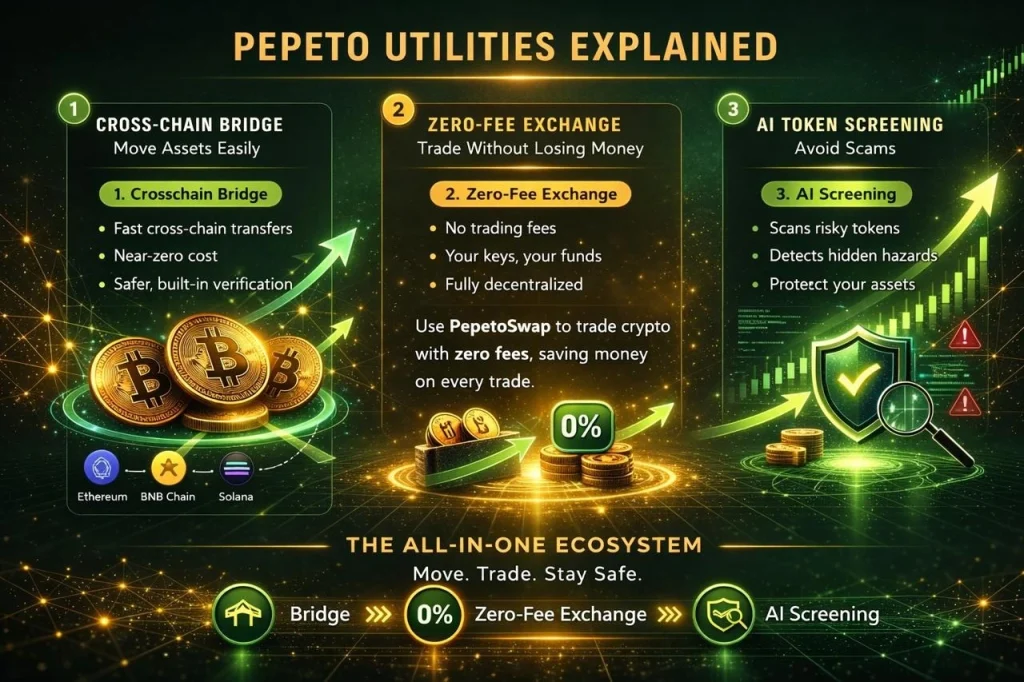
With an approaching Binance listing and a substantial amount raised from holders, Pepeto is positioned as a potentially life-changing opportunity for early investors. The project emphasizes that institutional involvement typically follows the capture of the largest returns, making early entry crucial.
While established cryptocurrencies like Solana (SOL) and Binance Coin (BNB) also saw gains, their growth trajectory differs from that of a presale project. Solana is trading near $91, having gained 8% following the ceasefire news, with analysts targeting $150-$200. BNB is priced around $637, with targets of $900-$1,000, supported by its SEC commodity classification and a steady ecosystem volume. However, these established assets are considered cycle holds rather than offering the concentrated early returns anticipated from a presale like Pepeto, which aims for a 100x return compressed into a single listing event.
The rapid market recovery following the Iran conflict fear underscores the importance of early investment. Whale wallets that invested in Pepeto during the fear phase are building positions expecting the Binance listing to significantly multiply their holdings. The distance between presale entry and listing is identified as the critical period for early holder success in the crypto space. Investors are encouraged to secure their positions on the Pepeto official website to capitalize on this opportunity before the Binance listing.
Source, catalyst, and sector overlap from the latest feed.
The rare two-block reorganization on the Bitcoin network near block height 941,880, involving major mining pools, highlights the inherent probabilistic nature of Nakamoto consensus. While a temporary fork occurred, experts confirm such shallow reorganizations are natural and do not indicate a protocol failure or security breach, reinforcing the network's resilience. This event serves as a reminder of the dynamic block discovery process in Proof-of-Work systems, where temporary chain splits are resolved by the longest chain rule, with no immediate market implications.
OneBullEx's launch of an AI-native futures trading platform integrates automated execution and strategy creation, aiming to bridge the gap for retail traders in the predominantly algorithmic institutional market. The platform's three-layer architecture (exchange, AI bots, natural-language strategy builder) addresses the historical trade-off between automation and accessibility in crypto derivatives. By emphasizing transparency and trader control, OneBullEx seeks to align with increasing regulatory scrutiny on AI in trading, potentially setting a precedent for future platform development. The introduction of AI-powered tools that reduce panic selling by 47% suggests a potential for improved retail trading outcomes and market stability if widely adopted.
Shiba Inu (SHIB) faces persistent downtrend pressure, with recent price action consolidating near $0.000005 and struggling to overcome resistance at $0.00000630. Fading interest in memecoins, as indicated by Santiment data, suggests a shift in social engagement towards AI narratives, potentially limiting SHIB's upside potential. A decisive breakout above the $0.00000680-$0.00000700 range is required for SHIB to confirm a bullish reversal and target $0.00000750, otherwise, it risks further downside toward $0.00000500.
BlackRock CEO Larry Fink's comparison of current crypto to the internet in 1996 signals a significant institutional shift towards embracing tokenization as a fundamental market transformation. The potential for tokenization to democratize investment access, as suggested by Fink, could drive substantial capital inflows into tokenized assets, impacting traditional finance and digital asset markets. While institutional validation is strong, concerns regarding regulatory clarity, custody risks, and potential power consolidation by large entities highlight ongoing challenges for mainstream adoption of tokenized assets.
A proposed U.S. bill could ban interest-like yield rewards on stablecoins, fundamentally altering their attractiveness as a savings vehicle and potentially impacting demand. The legislation aims to differentiate stablecoin issuers from traditional banks by prohibiting stablecoins from functioning as interest-bearing deposit products, signaling increased regulatory scrutiny on the stablecoin sector. While direct yield may be banned, activity-based or loyalty rewards could still be permitted, suggesting a nuanced regulatory approach that allows for user engagement incentives without mimicking traditional finance products. The crypto industry's mixed reactions highlight uncertainty regarding the interpretation and future enforcement of these proposed rules, creating a watchlist scenario for stablecoin platforms and users.
TRON DAO's significant expansion of its AI fund to $1 billion signals a strong commitment to capturing the emerging agentic economy, potentially driving demand for its network's high-throughput and low-cost transaction capabilities. The fund's focus on stablecoin rails, agent identity, tokenized RWAs, and developer tooling positions TRON to benefit from the anticipated growth in AI-driven commerce and machine-to-machine payments. By emphasizing its existing strengths in transaction volume and USDt circulation, TRON aims to differentiate itself from other blockchains like Ethereum in the race to become a primary infrastructure for AI agents.
Analyst Tom Lee's declaration of the end of a 'mini crypto winter' is reinforced by Bitmine's significant $140 million ETH accumulation, signaling potential smart money accumulation at perceived market bottoms. While large-cap assets like ETH and BTC are presented as recovery plays with moderate upside targets, the article emphasizes presale opportunities like Pepeto for potentially higher, compressed returns. The narrative suggests a divergence in market strategy, with institutional players like Bitmine accumulating established assets while retail is directed towards early-stage presale projects for exponential growth.
ADA has experienced a significant 90% price crash from its all-time high, currently trading near $0.25, indicating a period of substantial bearish pressure and potential for a slow recovery requiring significant upward movement. The SEC and CFTC classifying ADA as a commodity reduces regulatory risk, a positive development for institutional adoption, but the market's rapid capital rotation towards newer projects like Pepeto highlights a shift in investor sentiment towards higher-growth opportunities. Pepeto, a new exchange project with a Binance listing approaching and a presale that has raised over $8 million, is being positioned as a potential 100x to 300x opportunity, contrasting sharply with ADA's more modest recovery prospects. While ADA faces a challenging path to recovery, the narrative around Pepeto suggests a potential rotation of 'smart capital' seeking outsized returns in newer, high-potential projects, a common pattern observed in crypto market cycles.
Strategy is leveraging new equity and preferred stock offerings to raise substantial capital, signaling an aggressive intent to continue accumulating Bitcoin despite current market conditions. The company's strategy of using preferred stocks like STRC and STRK to fund Bitcoin purchases allows for continuous balance sheet growth without diluting common MSTR shareholders. With nearly 90,000 BTC added in Q1 2026, Strategy's ongoing accumulation represents a significant demand driver for Bitcoin, potentially influencing market sentiment and price action.
Strategy Inc. has filed for a massive $44.1 billion equity offering, signaling a significant intent to increase its Bitcoin holdings and potentially influence market demand. The company's commitment to its '42/42 plan' to acquire $84 billion in Bitcoin by 2027, funded through stock and debt, indicates a long-term bullish conviction despite market volatility. Past equity offerings by Strategy have preceded Bitcoin price surges, suggesting this large-scale offering could act as a bullish catalyst for BTC, especially given current market conditions. The substantial equity raise by a major Bitcoin treasury like Strategy Inc. represents a significant capital inflow into the asset, reinforcing its position as a corporate treasury asset.
Bitcoin ETFs are experiencing renewed institutional interest with $167 million in net inflows on March 23, signaling a potential shift in capital allocation towards established digital assets. Ethereum ETFs continue to see outflows totaling $16.2 million, indicating a divergence in institutional sentiment and a preference for Bitcoin's perceived stability over Ethereum's utility-driven narrative. The muted activity in Solana and XRP ETFs suggests that institutional investors are currently favoring Bitcoin and are not broadly increasing exposure to altcoins, highlighting a selective market approach. The observed ETF flow divergence points to a maturing crypto market where institutional capital is deployed with greater precision based on perceived risk and liquidity, rather than broad market enthusiasm.
OKX's launch of equity perpetual swaps using crypto collateral expands access to traditional markets for retail traders, potentially increasing demand for collateral assets like BTC and ETH. The offering provides synthetic exposure to major U.S. equities, allowing 24/7 trading and leveraging crypto assets that can continue to earn yield, a novel approach to bridging traditional and digital finance. This move by OKX, following its investment from ICE, signals a growing trend of crypto exchanges integrating real-world asset exposure, which could drive further innovation in derivatives and tokenized assets.
Reduced whale outflows from Binance to XRP Ledger suggest a pause in large holder accumulation, potentially increasing near-term selling pressure due to higher exchange liquidity. Despite cautious whale behavior, XRP Ledger shows robust on-chain activity with payments dominating transactions and stablecoin supply doubling, indicating growing ecosystem utility. The shift in whale behavior from accumulation to holding on exchanges, coupled with strong XRPL activity, presents a neutral near-term outlook for XRP, awaiting clearer directional signals.
The doubling of stablecoin supply on the XRP Ledger since December, reaching nearly $570 million, signals a significant increase in on-chain activity and demand for transactions on the network. The XRP Ledger's potential integration into traditional finance via tokenized collateral accepted by the European Central Bank positions it as a key infrastructure component, moving beyond a simple payments network. The emergence of AI-powered agent commerce on XRPL suggests a future of automated, intelligent financial flows, potentially expanding use cases and driving further network adoption.
Live Feed
Loading the broader stream in the same flow as the homepage feed.
SWIFT's new retail payments framework, set to launch in 2026, includes over 50 banks, many of which have existing ties to Ripple, suggesting a potential convergence rather than direct competition between traditional and blockchain-based payment systems. The inclusion of Ripple-linked banks in SWIFT's framework highlights the growing adoption of distributed ledger technology by traditional financial institutions to enhance cross-border payment efficiency and transparency. While SWIFT is modernizing its infrastructure, the article suggests that blockchain solutions like Ripple's are increasingly seen as complementary to, rather than replacements for, legacy systems, indicating a hybrid future for global payments.

Aave DAO's near-unanimous vote to advance Aave V4 to mainnet deployment signals a resolution of recent governance tensions, potentially stabilizing contributor relations and paving the way for protocol innovation. The Aave V4 upgrade introduces a modular architecture with 'Hubs' and 'Spokes' to enhance liquidity efficiency and risk management, aiming to support a wider array of financial use cases and new collateral types. Despite recent exits of key contributors like BGD Labs and Aave Chan Initiative due to governance disputes, the strong community backing for V4 suggests a unified path forward for the protocol's development.
Despite Cardano's average active wallet experiencing a 43% loss, the classification of ADA as a digital commodity by the SEC presents a potential long-term positive for regulatory clarity, though immediate market reaction remains muted. The high ratio of short positions on Binance suggests significant bearish sentiment among retail traders, potentially creating a short squeeze opportunity if market sentiment shifts. Cardano's DeFi ecosystem shows resilience with a 35.7% TVL growth in six months, indicating underlying network adoption despite current price underperformance.

The article argues that mass adoption and institutionalization of crypto are eroding its core cypherpunk principles of privacy and permissionless exchange. A shift towards centralized exchanges and compliance-heavy frameworks risks turning DeFi into a surveillance tool, alienating early adopters. The author suggests that reclaiming crypto's original vision requires prioritizing accessible financial tools and self-sovereignty over profit and institutional validation. The potential for blockchain in enabling self-governance, anonymous digital IDs, and decentralized communities is highlighted as a path to fulfilling the cypherpunk ethos.

Rising U.S. Treasury yields and swap spreads, particularly the 10-year yield approaching 4.5%-4.6%, could pressure the Trump administration to moderate its stance on the Iran conflict due to increased funding costs and potential economic strain. A sustained move in the 10-year Treasury yield above 5% is flagged as a critical point that could trigger a mini-financial crisis, potentially leading to Fed liquidity injections that could benefit risk assets like Bitcoin. Bitcoin traders should closely monitor Treasury market movements, as shifts in yields and swap spreads are identified as direct influencers of risk appetite and potential policy decisions impacting crypto markets.

Large ETH holders are accumulating, indicating smart money positioning ahead of a potential price surge. Technical analysis suggests Ethereum's price structure is tightening, with a break above $2,200-$2,250 potentially signaling a trend shift. Despite current sideways action, the confluence of whale accumulation, technical compression, and valuation support creates a high-probability setup for upward price discovery. The market's current focus on Bitcoin may be overlooking subtle accumulation signals in Ethereum, suggesting a potential for a rapid narrative shift if key resistance levels are reclaimed.

Cardano's ADA is experiencing significant investor stress, with most long-term holders in unrealized losses, indicating a bearish sentiment that could pressure prices lower. Rising bearish bets and dominant short positions in ADA derivatives suggest a potential for cascading liquidations if the price dips further, creating downside risk. Despite holding near $0.25, the prevailing negative sentiment and technical indicators point towards continued downward pressure on ADA in the short term.

The arrest of a suspect in the kidnapping and mutilation of a Ledger co-founder signals increased law enforcement focus on crypto-related violent crime, potentially impacting security perceptions for industry executives. While the arrest is a positive development for justice, it highlights ongoing risks within the crypto ecosystem, particularly for founders and executives, suggesting a need for enhanced personal security measures. The news, coupled with France's report of an uptick in crypto-linked violence, indicates a growing trend of targeted criminal activity against individuals in the digital asset space, which could lead to increased regulatory scrutiny or industry-wide security initiatives.

Bitcoin's recent 3% rise above $70K, driven by geopolitical relief, is overshadowed by analyst predictions of a potential drop to $40K by October 2026. Historical four-year cycles suggest Bitcoin may be entering a 'final discount' phase, with a potential buy zone identified between $41,500 and $45,000 before a new bull run. Declining retail transaction volume indicates smaller investors are exiting the market, a pattern historically seen during late-stage corrections and accumulation phases. The current market presents mixed signals: short-term recovery due to geopolitical easing, but weak retail participation suggests a potential near-term downside before a significant rally.
U.S. Bitcoin spot ETFs experienced a positive shift with $167 million in net inflows on March 23, breaking a three-day outflow trend and indicating renewed investor interest. BlackRock's iShares Bitcoin Trust was the primary driver of inflows, suggesting strong institutional demand for its product, while Grayscale's outflows continue to moderate. The contrasting performance of Bitcoin ETFs (inflows) versus Ethereum ETFs (outflows) highlights a divergence in institutional sentiment towards the two largest cryptocurrencies.

The resignation of the SEC's top enforcement official, reportedly due to disagreements over handling cases involving Justin Sun and Elon Musk, signals potential shifts in regulatory enforcement priorities and could impact market sentiment towards these specific assets and the broader crypto regulatory landscape. Disagreements within the SEC regarding the handling of high-profile cases like Justin Sun's settlement and Elon Musk's disclosure failures suggest internal friction that may influence future enforcement actions and the perceived stability of regulatory oversight. The reported clashes over cases involving Justin Sun (settled for $10M) and Elon Musk (in settlement talks) highlight the complex interplay between political appointees, enforcement strategy, and the evolving nature of crypto regulations, potentially creating uncertainty for market participants.
Signal context only. Validate with price action, liquidity, and risk limits before taking a position.
