
Navigating Crypto News

CoinFeather
Navigating Crypto News

Source, catalyst, and sector overlap from the latest feed.
Ripple CEO Brad Garlinghouse has positioned 2026 as a pivotal year, signaling aggressive expansion and AI integration to bolster its enterprise blockchain solutions. The company's global pivot, evidenced by recent international tours and acquisitions, suggests a strategic move to diversify operations beyond traditional US markets. Garlinghouse explicitly states XRP is central to Ripple's growth strategy, implying potential positive correlation between Ripple's business development and XRP's market performance.
RLUSD has achieved a $1 billion market capitalization less than a year after its launch, signaling strong adoption and demand for regulated stablecoins in cross-border payments. The 733% surge in stablecoin usage for cross-border B2B payments to $226 billion highlights a significant shift towards digital assets for international settlements, driven by reduced FX costs and increased efficiency. Ripple's recent burn of nearly $1 million RLUSD on Ethereum demonstrates a proactive supply management strategy aimed at increasing scarcity and potentially driving token value, a key factor for its growth.
Live Feed
Loading the broader stream in the same flow as the homepage feed.

Republican opposition to a US CBDC is creating legislative hurdles, potentially delaying a bipartisan housing affordability bill. The political standoff highlights a growing divide on digital currency policy, with privacy concerns being a primary driver for the opposition. This development elevates the CBDC debate from a niche technical discussion to a significant political bargaining chip, impacting future regulatory clarity. The linkage of CBDC policy to unrelated legislation like the housing bill suggests a strategic maneuver that could influence broader crypto regulatory discussions.
Soaring oil prices, driven by geopolitical tensions and potential Strait of Hormuz disruptions, are tightening global liquidity, which historically correlates with Bitcoin's end-of-cycle phases and suggests a bearish outlook for risk assets. The article highlights a direct link between energy market shocks and crypto cycles, indicating that rising oil prices could signal a challenging period for Bitcoin, necessitating macro-aware trading strategies and potential risk mitigation. Past oil rallies have preceded Bitcoin consolidation phases, implying that current price action in crude oil may cap further upside for BTC and potentially trigger a risk-off sentiment across the broader crypto market.

Kraken's xStocks platform is launching a points program, xPoints, to incentivize trading, liquidity provision, and DeFi usage of tokenized equities, signaling a potential future token launch to reward ecosystem participants. The tokenized equities sector is experiencing rapid growth, surpassing $1 billion in TVL and tripling in size over six months, with xStocks processing over $25 billion in volume since its launch, indicating strong market traction. The collaboration between Nasdaq and Kraken to distribute tokenized stocks outside the U.S. highlights increasing institutional interest and integration of blockchain infrastructure into traditional capital markets.

Dogecoin's futures market shows a significant liquidation imbalance favoring short sellers, indicating potential short-covering rallies or increased volatility. The price rebound in DOGE is currently driven by Bitcoin's contagion effect, suggesting a lack of strong independent catalysts for sustained upward momentum. Despite a recent price uptick, Dogecoin's long-term price action remains dependent on catalysts beyond the current Bitcoin rally, with ETF performance being a key area to watch.

China's development of a 96-core blockchain chip based on RISC-V architecture signifies a strategic move towards technological independence, potentially rerouting global financial infrastructure away from Western-controlled systems like SWIFT. The chip's deployment across 16 government ministries and 27 state enterprises, coupled with its high transaction processing speeds, indicates a practical application for real-world asset migration and cross-border trade, suggesting a significant shift in China's approach to international finance. While not a direct crypto asset event, the advancement in blockchain hardware by a major nation-state has implications for the underlying infrastructure of digital assets and could foster alternative financial networks, warranting a neutral sentiment but high impact due to its structural implications.

As regulation advances and institutions adopt blockchain settlement, stablecoins are expanding beyond crypto trading into payments infrastructure.
Shiba Inu's exchange reserves approaching 80 trillion SHIB present a critical supply threshold that could dictate its next significant price movement. Despite a persistent downtrend, recent substantial exchange outflows suggest holders are moving SHIB to private wallets, potentially tightening immediate supply and setting the stage for a recovery if demand emerges. While price action remains bearish with lower highs, consistent network activity and a slight increase in transaction counts indicate an engaged user base, providing a potential foundation for future price appreciation. The current price consolidation near $0.00000577, coupled with compressing resistance levels, suggests that a breakout above overhead zones will require a significant increase in buying volume.
The significant transfer of $130 million in BTC to Gemini wallets by the Winklevoss twins, while interpreted by some as a potential sell-off, coincides with strong institutional demand via ETF inflows and corporate buying, suggesting underlying support for Bitcoin's price above $71,000. Despite the large private transfer, Bitcoin's resilience above $71,000 is bolstered by consistent ETF inflows totaling $167 million and continued accumulation by entities like MicroStrategy, indicating sustained institutional interest that may offset potential selling pressure. The news highlights the interplay between large holder movements and broader market sentiment, with Bitcoin's ability to reclaim key price levels demonstrating its capacity to absorb significant transfers while benefiting from positive macro factors and ongoing accumulation.

Bitcoin's reclaim of the $70,000 level, supported by increasing buy volume and positive CMF readings, suggests a potential continuation of upward momentum. Rising USDT reserves on Binance to $4.77 billion indicate accumulating "dry powder," signaling that capital is preparing to enter the market and potentially fuel further price appreciation. The divergence between whale accumulation and lagging retail activity, coupled with improving technicals and stablecoin liquidity, suggests the market is primed for increased volatility and potential upside.

Trust Wallet's new address poisoning protection feature enhances user security by screening against known scam addresses across 32 EVM chains. This development addresses a rapidly growing threat in crypto, aiming to mitigate significant financial losses reported from address poisoning scams. The implementation by a major wallet provider signals a broader industry focus on improving user-level security against sophisticated phishing tactics.

Cardano's Bollinger Bands are tightening, indicating a period of low volatility and suggesting an imminent price breakout is likely. The price action is consolidating between $0.22 and $0.312, with a break above $0.27 and $0.30 potentially signaling a short-term trend change. Recent developments like the Programmable Tokens Platform and LayerZero integration provide fundamental support, potentially influencing the direction of the breakout.
Shiba Inu's 5.17% price surge, fueled by $38K in short liquidations, indicates a short-term bullish reversal after recent losses. The unwinding of bearish bets, with shorts making up the majority of liquidations, suggests a shift in market sentiment favoring upward price movement. Technical indicators like narrowing Bollinger Bands signal potential for a significant price move, with key resistance levels at $0.00000587 and $0.00000653. While short-term sentiment appears positive due to liquidations, broader market conviction remains cautious, suggesting traders are awaiting clearer direction.
Signal context only. Validate with price action, liquidity, and risk limits before taking a position.
Quick market read from this story
Adam Back suggests that institutional players are creating a "financial flywheel" by issuing debt and equity with high yields, then converting the raised liquidity directly into Bitcoin, potentially leading to a supply squeeze.
The article highlights that this accumulation strategy, potentially involving entities like MicroStrategy, is driving Bitcoin's price towards $72,000, indicating strong underlying demand from sophisticated market participants.
If Bitcoin consolidates above $72,000, it could signal a continuation of the bullish trend, potentially reaching new all-time highs not seen since early 2026, driven by this institutional buying pressure.
Deep Dive
Bitcoin is showing strong upward momentum, targeting the $72,000 mark, with Blockstream CEO Adam Back suggesting a unique "financial flywheel" is driving significant market orders and institutional accumulation. Back indicated that a substantial market dynamic is in play, potentially limiting the scope for deep price corrections.
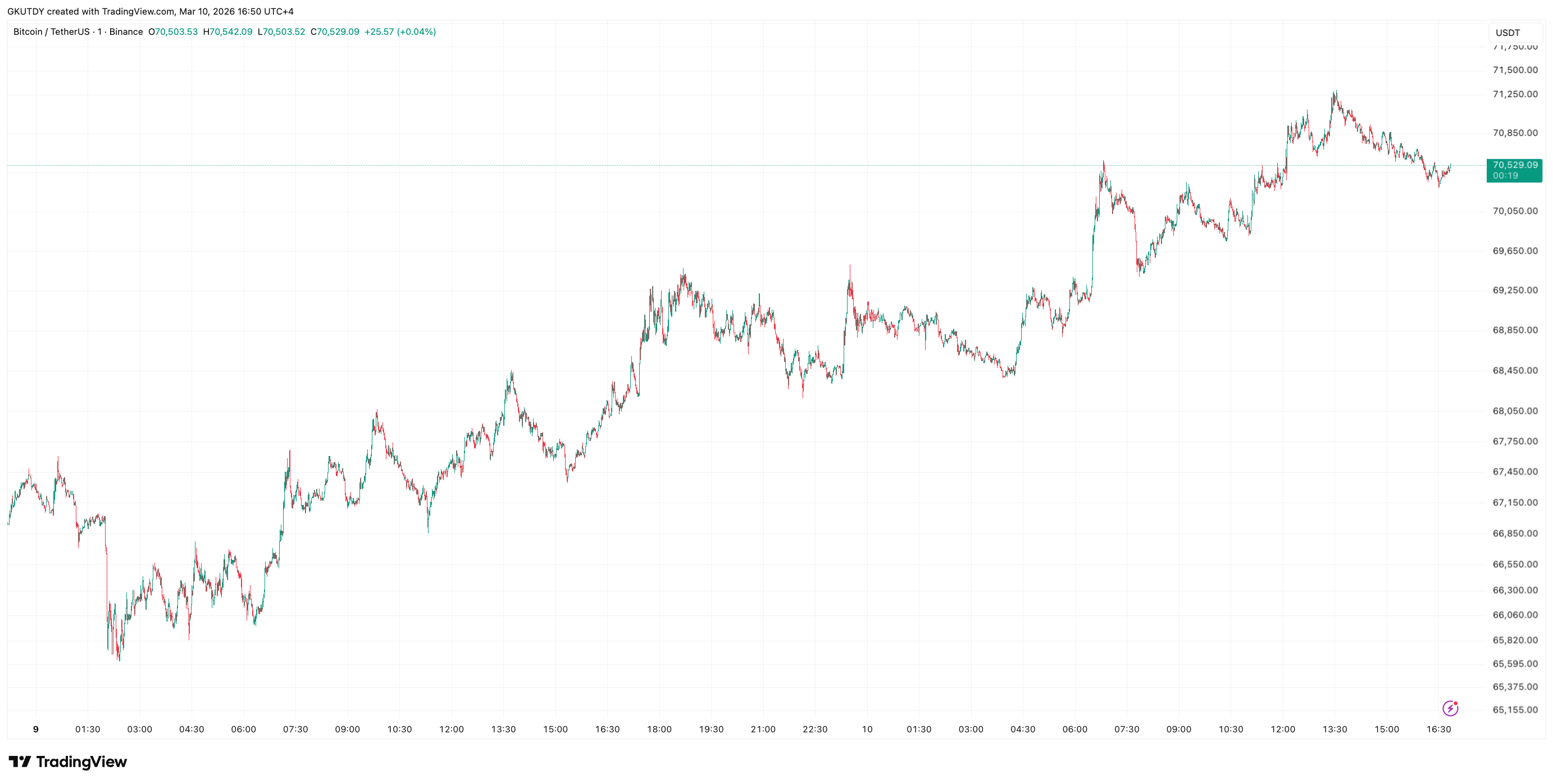
The current technical indicators for BTC/USDT support Back's observations. Following a significant price impulse, Bitcoin has surpassed the $71,000 psychological barrier and is now navigating a resistance zone. Back theorizes that purchases may be originating from entities like MicroStrategy, potentially through new instruments like the STRC network, or even direct market orders from figures like Michael Saylor.
Adam Back highlights that companies such as MicroStrategy have established a "financial flywheel." By issuing shares and debt instruments that offer substantial yields, these companies generate liquidity which is then converted into Bitcoin. This process could be creating a supply squeeze, where the demand from institutional investors outpaces the available reserves on exchanges.
As of the latest reports, Bitcoin is trading around $70,500. If buyers maintain the current support level, the next target is consolidation above $72,000. Achieving this level could pave the way for Bitcoin to reach price points not seen since early 2026.
