
Navigating Crypto News

CoinFeather
Navigating Crypto News
Quick market read from this story
Shiba Inu is approaching a critical 80 trillion token exchange reserve threshold, a level that could signal a shift in supply dynamics and potentially influence its next price movement.
Despite a persistent downtrend and weak price structure, on-chain data indicates substantial outflows from exchanges, suggesting a potential move towards accumulation or longer-term holding.
A decisive drop below the 80 trillion SHIB exchange reserve mark could tighten liquidity and create conditions for a price rebound, while a failure to hold nearby support levels risks further decline.
Network activity, including transfer counts, shows a slight increase, indicating continued ecosystem participation despite current price pressures.
Deep Dive
Shiba Inu (SHIB) is nearing a pivotal moment as on-chain metrics and price action converge around a significant supply level. The amount of SHIB held on exchanges is currently close to 80 trillion tokens, a figure that could heavily influence the asset's future price movements. Despite recent stabilization attempts, the broader market structure for SHIB remains precarious.
Over the past several months, Shiba Inu has been experiencing a consistent downtrend, characterized by a pattern of lower highs and repeated breakdowns from consolidation phases, indicating sustained selling pressure. The token is currently trading near the $0.0000057 range, where some short-term stabilization has emerged after a recent decline. However, recovery attempts have been limited and continue to face resistance.
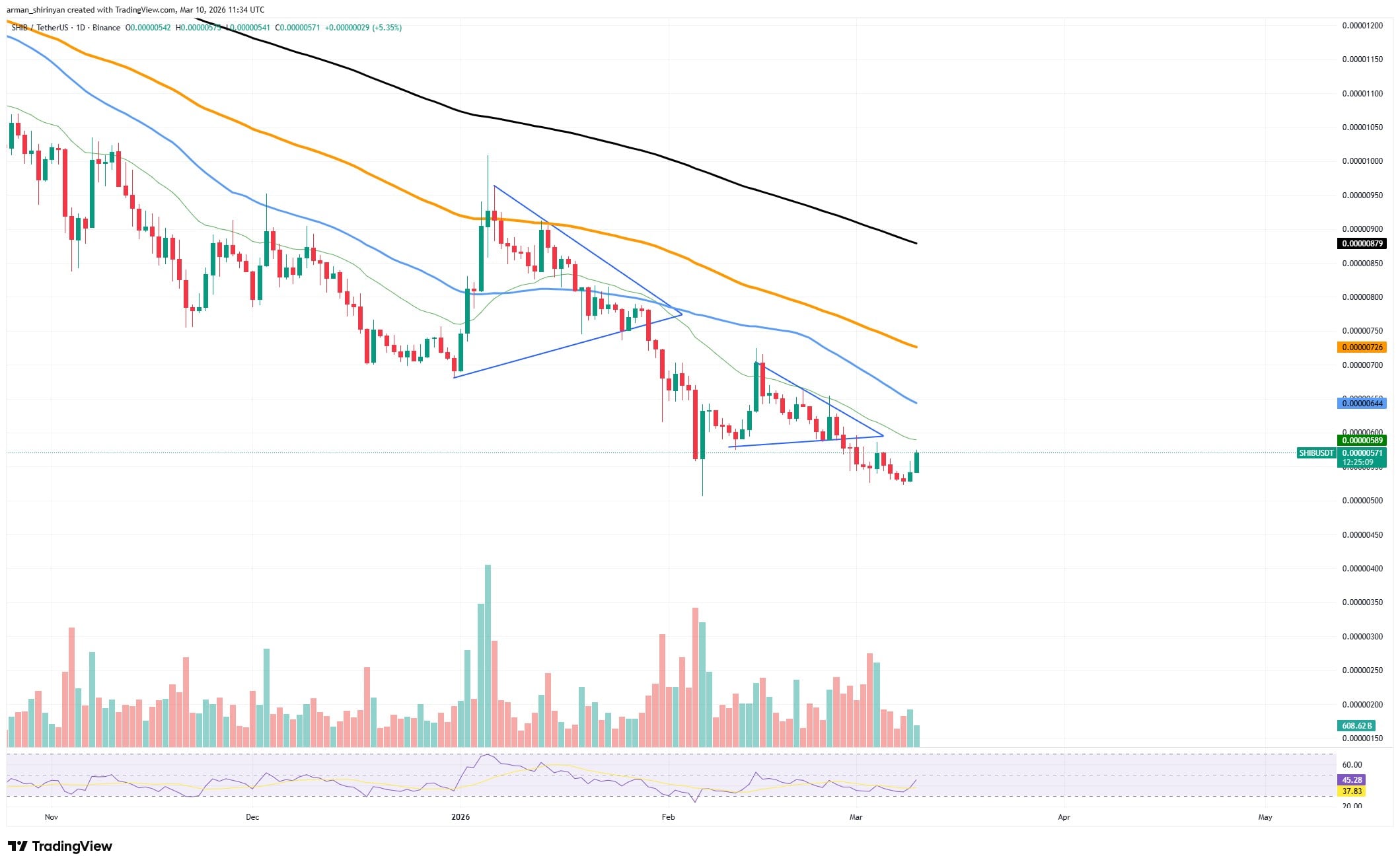
Despite the weak price trend, on-chain data reveals substantial outflows of SHIB from exchanges, with tokens being moved to private wallets. This trend can suggest accumulation or a shift towards longer-term holding, potentially reducing the supply available for immediate sale. Concurrently, network activity, including mean and total transfer counts, has seen a slight increase, indicating continued usage of the Shiba Inu network even as the price faces pressure.
The critical factor remains the 80 trillion SHIB exchange reserve threshold. A decisive drop below this level would signify a significant removal of supply from exchanges, potentially tightening liquidity and creating conditions for price rebounds. Conversely, a return of selling pressure could push reserves higher and, if the price breaks below nearby support zones, lead to further declines.
Source, catalyst, and sector overlap from the latest feed.
Ripple CEO Brad Garlinghouse has positioned 2026 as a pivotal year, signaling aggressive expansion and AI integration to bolster its enterprise blockchain solutions. The company's global pivot, evidenced by recent international tours and acquisitions, suggests a strategic move to diversify operations beyond traditional US markets. Garlinghouse explicitly states XRP is central to Ripple's growth strategy, implying potential positive correlation between Ripple's business development and XRP's market performance.
RLUSD has achieved a $1 billion market capitalization less than a year after its launch, signaling strong adoption and demand for regulated stablecoins in cross-border payments. The 733% surge in stablecoin usage for cross-border B2B payments to $226 billion highlights a significant shift towards digital assets for international settlements, driven by reduced FX costs and increased efficiency. Ripple's recent burn of nearly $1 million RLUSD on Ethereum demonstrates a proactive supply management strategy aimed at increasing scarcity and potentially driving token value, a key factor for its growth.
XRP has formed a golden cross on its hourly chart, indicating a potential short-term bullish trend that could lead to a retest of the $2 resistance level. While the hourly golden cross is a positive signal, the lack of confirmation on the daily chart suggests caution is warranted, making this a watchlist scenario rather than an immediate buy signal. The broader altcoin market sentiment shift and potential Bitcoin breakout could provide tailwinds for XRP, but its unique value proposition remains a key driver for potential upside.
XRP Ledger's RWA transfer volume surged by 1,282.6% to $139 million, indicating a significant increase in active capital deployment for securities and stablecoins like RLUSD and Ondo Finance. The substantial growth in RWA transfers, driven by active capital rather than just record-keeping, suggests a shift towards greater utilization of XRPL for institutional settlements and liquidity management. Despite the high transfer volume, the concentration among 22 large holders highlights XRPL's current role as a specialized infrastructure for a select group of institutional players, rather than broad retail adoption.
Binance is delisting four trading pairs (DODO/BTC, GMT/EUR, ARDR/USDT) and removing ARDR as a borrowable asset, indicating a focus on liquidity and market efficiency for these specific assets. The exchange is simultaneously listing new trading pairs for BCH, NEAR, and TRX, suggesting a strategic reallocation of resources and a potential shift in market focus towards these more active cryptocurrencies. These actions by Binance, a major exchange, can influence trading volume and liquidity for the affected assets, potentially impacting their short-term price action.
Dogecoin's futures market shows a significant liquidation imbalance favoring short sellers, indicating potential short-covering rallies or increased volatility. The price rebound in DOGE is currently driven by Bitcoin's contagion effect, suggesting a lack of strong independent catalysts for sustained upward momentum. Despite a recent price uptick, Dogecoin's long-term price action remains dependent on catalysts beyond the current Bitcoin rally, with ETF performance being a key area to watch.
Shiba Inu's exchange reserves approaching 80 trillion SHIB present a critical supply threshold that could dictate its next significant price movement. Despite a persistent downtrend, recent substantial exchange outflows suggest holders are moving SHIB to private wallets, potentially tightening immediate supply and setting the stage for a recovery if demand emerges. While price action remains bearish with lower highs, consistent network activity and a slight increase in transaction counts indicate an engaged user base, providing a potential foundation for future price appreciation. The current price consolidation near $0.00000577, coupled with compressing resistance levels, suggests that a breakout above overhead zones will require a significant increase in buying volume.
Shiba Inu's 5.17% price surge, fueled by $38K in short liquidations, indicates a short-term bullish reversal after recent losses. The unwinding of bearish bets, with shorts making up the majority of liquidations, suggests a shift in market sentiment favoring upward price movement. Technical indicators like narrowing Bollinger Bands signal potential for a significant price move, with key resistance levels at $0.00000587 and $0.00000653. While short-term sentiment appears positive due to liquidations, broader market conviction remains cautious, suggesting traders are awaiting clearer direction.
Dogecoin is trading near a historically significant support zone identified by analysts, marking the third instance of such a pullback which has preceded substantial upward moves in the past. The current price action shows Dogecoin consolidating between $0.0897 and $0.0923, with declining weekly Average True Range (ATR) suggesting a potential for a sharp directional move. A reclaim of the $0.1300 Fibonacci extension level is crucial for Dogecoin to signal a stronger upward structure, with potential targets at $0.167 and $0.197 if successful. Despite a broken critical structural point at $0.1300, an analyst projects a potential surge to $1.20 if the current support at $0.085 holds, based on historical precedents.
Over $6.3 billion worth of SHIB shorts were liquidated, indicating a significant shift in market sentiment as the price unexpectedly rose. The liquidation event suggests that bearish traders were caught off guard by the recent price recovery, potentially signaling a short-term bullish momentum for SHIB. While SHIB experienced substantial short liquidations, the broader crypto market also saw over $200 million in short positions liquidated, highlighting a general market-wide short squeeze. Technical indicators like contracting Bollinger Bands suggest SHIB may be consolidating for a larger move, with key resistance levels identified at $0.00000587 and $0.00000653.
Live Feed
Loading the broader stream in the same flow as the homepage feed.
Bitcoin is consolidating near $71,000, influenced by geopolitical tensions regarding Iran and a significant drop in expected Federal Reserve rate cuts, creating market uncertainty. The collapse of Fed rate cut expectations to near zero suggests a prolonged period of higher interest rates, which typically dampens speculative asset appetite and limits upside potential for Bitcoin. Geopolitical rhetoric concerning the Strait of Hormuz is failing to significantly impact oil prices, indicating that current market pricing may not fully reflect a major supply disruption risk, which in turn limits Bitcoin's safe-haven narrative strength. Derivatives market data shows significant liquidation zones above and below the current price, suggesting that short-term price action is likely to remain range-bound as liquidity is swept in both directions.

Solana ETFs are attracting significant institutional capital, with 49% of assets identified via 13F filings, indicating a strong preference from crypto-native investment firms and market makers despite recent token price declines. XRP ETFs show a contrasting investor profile, with only 16% of assets identifiable through 13F filings, suggesting a larger reliance on retail investors for demand and asset stability. The differing investor bases for Solana and XRP ETFs highlight evolving market dynamics, with Solana drawing more industry-specific institutional flows and XRP appealing more directly to retail sentiment.

Hyperliquid's HYPE token demonstrates significant strength, outperforming major altcoins due to its growing dominance in non-crypto derivatives trading, particularly oil perpetuals. The platform's upcoming portfolio margin upgrade signals a move towards supporting larger positions and reducing liquidation risk, potentially attracting more institutional or sophisticated traders. Hyperliquid's strategic pivot towards commodities and equities, with only a minority of its top markets being crypto, indicates a diversification strategy that could broaden its appeal beyond the traditional crypto user base. The substantial volume and open interest in tokenized oil on Hyperliquid highlight a significant trend of non-crypto assets finding liquidity on decentralized exchanges, suggesting a potential new avenue for market growth.
Republican opposition to a US CBDC is creating legislative hurdles, potentially delaying a bipartisan housing affordability bill. The political standoff highlights a growing divide on digital currency policy, with privacy concerns being a primary driver for the opposition. This development elevates the CBDC debate from a niche technical discussion to a significant political bargaining chip, impacting future regulatory clarity. The linkage of CBDC policy to unrelated legislation like the housing bill suggests a strategic maneuver that could influence broader crypto regulatory discussions.
Soaring oil prices, driven by geopolitical tensions and potential Strait of Hormuz disruptions, are tightening global liquidity, which historically correlates with Bitcoin's end-of-cycle phases and suggests a bearish outlook for risk assets. The article highlights a direct link between energy market shocks and crypto cycles, indicating that rising oil prices could signal a challenging period for Bitcoin, necessitating macro-aware trading strategies and potential risk mitigation. Past oil rallies have preceded Bitcoin consolidation phases, implying that current price action in crude oil may cap further upside for BTC and potentially trigger a risk-off sentiment across the broader crypto market.

Kraken's xStocks platform is launching a points program, xPoints, to incentivize trading, liquidity provision, and DeFi usage of tokenized equities, signaling a potential future token launch to reward ecosystem participants. The tokenized equities sector is experiencing rapid growth, surpassing $1 billion in TVL and tripling in size over six months, with xStocks processing over $25 billion in volume since its launch, indicating strong market traction. The collaboration between Nasdaq and Kraken to distribute tokenized stocks outside the U.S. highlights increasing institutional interest and integration of blockchain infrastructure into traditional capital markets.

China's development of a 96-core blockchain chip based on RISC-V architecture signifies a strategic move towards technological independence, potentially rerouting global financial infrastructure away from Western-controlled systems like SWIFT. The chip's deployment across 16 government ministries and 27 state enterprises, coupled with its high transaction processing speeds, indicates a practical application for real-world asset migration and cross-border trade, suggesting a significant shift in China's approach to international finance. While not a direct crypto asset event, the advancement in blockchain hardware by a major nation-state has implications for the underlying infrastructure of digital assets and could foster alternative financial networks, warranting a neutral sentiment but high impact due to its structural implications.

As regulation advances and institutions adopt blockchain settlement, stablecoins are expanding beyond crypto trading into payments infrastructure.
The significant transfer of $130 million in BTC to Gemini wallets by the Winklevoss twins, while interpreted by some as a potential sell-off, coincides with strong institutional demand via ETF inflows and corporate buying, suggesting underlying support for Bitcoin's price above $71,000. Despite the large private transfer, Bitcoin's resilience above $71,000 is bolstered by consistent ETF inflows totaling $167 million and continued accumulation by entities like MicroStrategy, indicating sustained institutional interest that may offset potential selling pressure. The news highlights the interplay between large holder movements and broader market sentiment, with Bitcoin's ability to reclaim key price levels demonstrating its capacity to absorb significant transfers while benefiting from positive macro factors and ongoing accumulation.
Bitcoin's reclaim of the $70,000 level, supported by increasing buy volume and positive CMF readings, suggests a potential continuation of upward momentum. Rising USDT reserves on Binance to $4.77 billion indicate accumulating "dry powder," signaling that capital is preparing to enter the market and potentially fuel further price appreciation. The divergence between whale accumulation and lagging retail activity, coupled with improving technicals and stablecoin liquidity, suggests the market is primed for increased volatility and potential upside.

Trust Wallet's new address poisoning protection feature enhances user security by screening against known scam addresses across 32 EVM chains. This development addresses a rapidly growing threat in crypto, aiming to mitigate significant financial losses reported from address poisoning scams. The implementation by a major wallet provider signals a broader industry focus on improving user-level security against sophisticated phishing tactics.

Cardano's Bollinger Bands are tightening, indicating a period of low volatility and suggesting an imminent price breakout is likely. The price action is consolidating between $0.22 and $0.312, with a break above $0.27 and $0.30 potentially signaling a short-term trend change. Recent developments like the Programmable Tokens Platform and LayerZero integration provide fundamental support, potentially influencing the direction of the breakout.
Signal context only. Validate with price action, liquidity, and risk limits before taking a position.
