



Economic Consequences of Prolonged Shutdown
US Treasury Secretary Janet Yellen has issued a stark warning regarding the escalating economic repercussions of the ongoing government shutdown. The shutdown, which is now projected to extend into November 2025, is causing significant stress on financial markets and impacting the livelihoods of federal workers.
The prolonged halt in federal operations threatens to diminish Gross Domestic Product (GDP), disrupt essential government spending, and undermine market stability. These factors contribute to broader economic risks and have already led to noticeable fluctuations in the prices of safe-haven assets.
As the US government shutdown enters its sixth week, Treasury Secretary Janet Yellen has emphasized the worsening economic conditions. The extended shutdown has not only stalled federal operations but has also compromised financial stability, leaving federal employees unpaid and critical government programs on hold.
The United States economy is bracing for substantial impacts from this protracted shutdown. The Congressional Budget Office has estimated that the shutdown could reduce Q4 2025 GDP by 1 to 2 percentage points. Financial markets have reacted to Yellen's warnings, exhibiting volatility in gold and the US dollar as investors express concern over fiscal uncertainties. Michael Feroli, Chief US Economist at J.P. Morgan, commented, "Each week, a shutdown subtracts about 0.1% from annualized GDP growth via reduced government activity. There could be a sentiment channel as well if the duration of the shutdown enters uncharted territory."
Janet Yellen, Secretary of the Treasury, US Department of the Treasury, stated, “With these determinations, the Treasury Department will suspend additional investments ... as expressly authorized by law.”
Bitcoin's Growing Prominence Amidst Financial Turmoil
The current US government shutdown has now surpassed the previous record set in 2018-2019, extending beyond 35 days. Historical disruptions of this nature have often resulted in considerable market fluctuations, including significant movements in major macro-assets.
Recent data from CoinMarketCap indicates that Bitcoin is trading at $103,061.43. The cryptocurrency's market capitalization stands at $2.06 trillion, representing a 59.37% market dominance. Over the past 24 hours, Bitcoin's trading volume has seen a decline of 35.6%. While BTC experienced a price increase of 1.45% in the last day, it has seen a 14.99% decrease over the past 30 days.
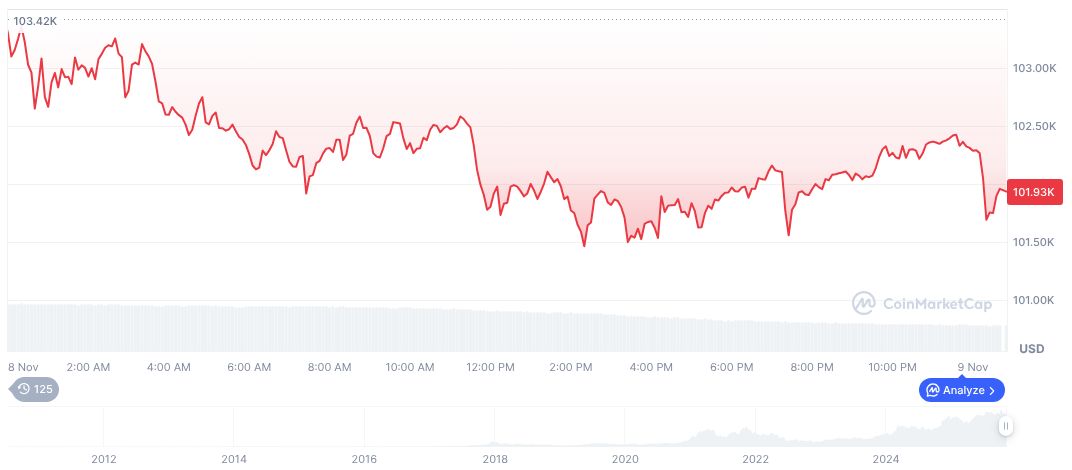
Research from the Coincu team suggests that the government's financial strain could potentially increase the appeal of cryptocurrencies as an alternative safe-haven asset. Historically, Bitcoin has garnered increased attention during periods of fiscal uncertainty. However, the broader digital asset market remains susceptible to prevailing macroeconomic influences.