
Navigating Crypto News

CoinFeather
Navigating Crypto News
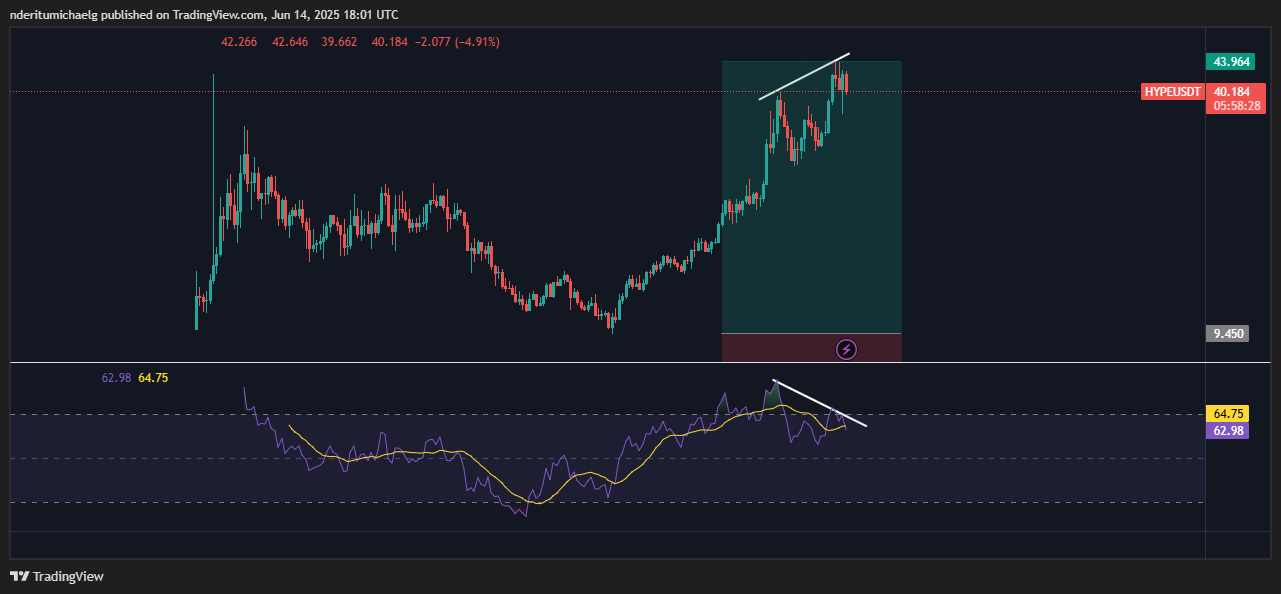
Quick market read from this story
Despite reaching a new all-time high, HYPE shows signs of bearish divergence and significant long liquidations, suggesting a potential pullback is imminent.
Robust utility and strong on-chain metrics like increasing TVL and DEX volume on the Hyperliquid network are currently propping up HYPE's price, creating a tug-of-war between bullish fundamentals and bearish technical signals.
The surge in derivatives volume and open interest, coupled with substantial long liquidations, indicates heightened market activity and potential volatility for HYPE in the short term.
While HYPE's price has rallied significantly, the increasing long liquidations and bearish RSI divergence suggest that the current upside momentum may not be sustainable without further fundamental catalysts.
Deep Dive
The native token of the Hyperliquid network, HYPE, has experienced a significant rally, reaching a new all-time high just above $44 on Wednesday, marking a 365% gain from its year-to-date lows. Despite this impressive performance, bulls are struggling to maintain upward momentum, evidenced by a bearish price-RSI divergence and a surge in long liquidations.
Recent data indicates a shift towards bearish expectations for HYPE. On Friday, long liquidations surged to $2.11 million, significantly outweighing short liquidations of less than $900 million. This trend of increased long liquidations over the past seven days, coupled with cooling short positions, suggests a notable change in market sentiment. Open interest also reached a new peak of $1.90 billion in the last 24 hours, increasing incentives for liquidations. Derivatives trading volume hit a high of $3.3 billion on June 14th, its highest recorded daily figure.
Despite the bearish signals, accumulation by whales and institutions has been sustaining HYPE's upside. The Money Flow Indicator (MFI) shows a surge in liquidity inflows over the last five days. The Hyperliquid network itself has seen substantial growth, with stablecoin liquidity reaching $3.88 billion and the total value locked (TVL) on its layer 1 network climbing to $1.795 billion. This growth is largely driven by the adoption of the Hyperliquid Decentralized Exchange (DEX), whose volume has surged from a low of $50.9 million on April 5th to over $735 million recently.
The robust demand for Hyperliquid and its ecosystem has positively impacted HYPE's price action. The HYPE token itself is utilized for various functions including payment transactions, governance, providing liquidity, and staking for passive rewards. The continued growth in key metrics like TVL and DEX volume is expected to influence HYPE's price movement in the coming weeks, potentially limiting downside if demand remains strong, or signaling a bearish outcome if these metrics decline.
Source, catalyst, and sector overlap from the latest feed.
Veteran trader Peter Brandt warns of a potential 75% Bitcoin crash, drawing parallels to the 2022 downturn, suggesting a significant risk of downside repricing if historical patterns repeat. On-chain indicators and derivatives market data suggest potential overheating, with rising liquidations and speculative interest signaling increased volatility and vulnerability for leveraged positions. Technical indicators like MACD and Awesome Oscillator show slowing bullish momentum, indicating Bitcoin may face resistance near $110K and potential pullback towards $108K-$108.5K support levels.
Ethereum has reclaimed its 200-day Moving Average, a technical indicator suggesting a potential bullish trend reversal and a move towards the $4,000 price target predicted by market experts. Consistent inflows into Ethereum ETFs, coupled with strong DeFi ecosystem performance and increasing whale accumulation, indicate growing institutional and retail confidence in ETH's upward trajectory. Significant whale activity, including a large SOL to ETH swap, suggests a strategic rotation into Ethereum, anticipating outperformance against other major altcoins like Solana. The resurgence of Ethereum's Layer-1 stablecoin market share and transaction volume highlights its foundational role in DeFi, reinforcing its market position and potential for further price appreciation.
Cardano's listing on Bitstamp via Robinhood significantly enhances its U.S. market access and global liquidity, potentially driving increased investor interest and trading volume. Analyst projections suggest a potential 585% surge for ADA to $5.36 in the next bull cycle, supported by technical indicators and recent positive market developments. Despite short-term resistance near $0.70, the MACD and RSI indicators suggest underlying bullish momentum for ADA, indicating potential for gradual gains. The acquisition of Bitstamp by Robinhood adds a layer of institutional backing and expanded regulatory compliance, which could positively influence ADA's perceived stability and accessibility.
Significant whale accumulation, evidenced by a 1,645% surge in net flows, suggests strong conviction for PEPE's potential price appreciation. Despite recent pullbacks and liquidations, PEPE's resilience above key Fibonacci support and a positive funding rate in derivatives indicate sustained trader optimism. While technical indicators like MACD and RSI show slowing momentum and neutrality, the underlying whale accumulation and bullish derivatives sentiment could precede a breakout, though the target of $0.0003 remains speculative.
A significant whale dump of 1 trillion PEPE tokens, coupled with a decrease in whale holdings and realized losses, indicates waning confidence and potential capitulation, suggesting a bearish outlook for the memecoin. Despite a surge in trading volume and open interest in derivatives markets, the formation of a bearish head and shoulders pattern on the PEPE chart signals a potential 53% price decline, targeting a significant drop to $0.000001011. While some short-term bullish indicators and a mixed long/short ratio exist, the overwhelming technical bearish signals and large-scale whale selling suggest a high probability of a significant price correction in the near term.
The cryptocurrency market is experiencing 'extreme fear' with the Fear and Greed Index in single digits, indicating widespread risk aversion and potential for a market bottom. Major assets like Bitcoin, Ethereum, and XRP are under significant pressure, exhibiting bearish price action with lower highs and failing recovery attempts, suggesting continued downside volatility. While extreme fear often precedes local bottoms, markets may continue to grind lower or sideways before a significant reversal, implying that current rallies are likely corrective without reclaimed key technical levels. Thinning liquidity and aggressive price movements due to forced liquidations amplify short-term bearish momentum, making sustained bounces unlikely without fundamental shifts or technical confirmations.
A significant ETH withdrawal from Binance to Aave by a whale linked to F2Pool suggests a strategy to earn yield on holdings rather than immediate selling pressure. The movement of 9,000 ETH ($17.86M) to a decentralized lending protocol indicates a potential shift in how large holders manage their assets, favoring DeFi yield generation. While this specific whale action is neutral, the broader context of other whales accumulating ETH and BlackRock depositing ETH to Coinbase suggests varied market sentiment among large players.
Cardano founder Charles Hoskinson alleges Ripple is leveraging the CLARITY Act to create a regulatory moat, potentially classifying most new blockchains as securities while exempting XRP, which could stifle ecosystem growth and innovation. Hoskinson's critique highlights concerns that the CLARITY Act, if passed in its current form, could impose significant legal liabilities on open-source developers, posing an existential threat to the decentralized development model. The dispute underscores a fundamental disagreement on regulatory strategy, with Hoskinson questioning Ripple's motives given its substantial premine and suggesting their lobbying efforts serve commercial interests rather than the broader crypto industry's well-being. The XRP community's pushback, accusing Hoskinson of jealousy, illustrates the difficulty in having nuanced policy discussions within crypto, often overshadowed by tribalism and personal attacks.
A White House advisor's warning suggests that industry resistance to the Clarity Act compromise could lead to significantly harsher regulations under a future Democratic administration, impacting stablecoin yields and DeFi. Coinbase's opposition to provisions limiting stablecoin yield payments highlights a key point of contention in the Clarity Act, potentially altering how exchanges offer interest-bearing products and impacting the stablecoin savings narrative. The ongoing legislative delays and internal industry disagreements over the Clarity Act create regulatory uncertainty, which could pressure crypto assets and exchanges if a more stringent regulatory framework is imposed.
Over $100 million in tokens are scheduled to unlock across ten projects between March 30 and April 5, introducing potential selling pressure to the market. Projects with the highest percentage unlocks relative to circulating supply, specifically Definitive's EDGE (13.8%), GUNZ (4.1%), and EigenCloud's EIGEN (2.04%), face the greatest risk of short-term price depreciation. Sui's SUI token unlock of $47.5 million on April 1 represents the largest single event, warranting close observation of its price action. The compressed timeframe of these unlocks across multiple assets could lead to increased volatility and trading opportunities for short-term focused participants.
Live Feed
Loading the broader stream in the same flow as the homepage feed.
A subtle social media interaction between Tether's CEO and a critic of Coinbase's stance on the CLARITY Act signals a significant internal industry division regarding stablecoin yield regulations. The CLARITY Act's upcoming stablecoin yield provisions are becoming a central point of contention, highlighting a strategic rift among crypto leaders on how to balance innovation with regulatory compliance. The differing approaches to stablecoin yields, championed by Coinbase and viewed with caution by Tether, could shape the future regulatory landscape for digital assets and impact market participant strategies.

Canada's proactive ban on crypto donations, despite minimal past usage, signals a growing regulatory trend to preemptively address perceived risks in political financing. The move by Canada and the UK to restrict crypto donations highlights a divergence in regulatory approaches, with the US having already integrated crypto into its political funding landscape. This regulatory action, while not directly impacting current market prices, indicates a broader push for stricter oversight as digital assets become more integrated into mainstream finance, potentially affecting future adoption narratives. By banning crypto donations, Canada is prioritizing traceability and control in political funding, setting a precedent for other jurisdictions considering similar measures.

BNP Paribas' expansion into crypto ETNs for retail clients in France signifies growing institutional acceptance and provides a regulated on-ramp for traditional investors seeking Bitcoin and Ether exposure. The offering of ETNs, rather than direct asset holding, highlights a strategy by traditional finance to bridge the gap for risk-averse retail investors, potentially increasing indirect demand for underlying crypto assets. This move by a major European bank, alongside other recent developments like the UK lifting its ban on crypto ETNs, indicates a broader trend of increasing accessibility and regulatory normalization for digital assets in Europe.

Pi Network mandates a Protocol 21 upgrade by April 6, with non-compliant nodes facing disconnection, signaling ongoing network development towards v23.0. Despite the technical upgrade, significant community frustration persists regarding unresolved KYC verification issues, impacting user access and sentiment. The mandatory upgrade highlights the critical role of node operators in Pi Network's ecosystem, while community concerns about declining participation raise questions about decentralization.
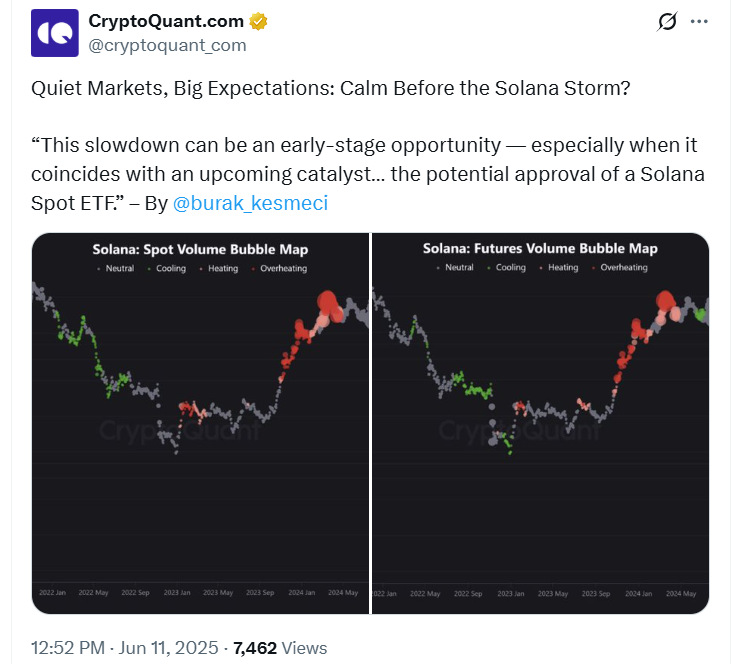
Solana's on-chain indicators suggest a cooling market phase, which analysts interpret as a potential precursor to a significant price breakout, driven by anticipation of a SOL ETF approval. The SEC's request for amendments to Solana ETF filings, with a decision potentially by mid-July or early August, represents a key regulatory catalyst that could unlock institutional capital and drive demand for SOL. The burgeoning Solana memecoin ecosystem, exemplified by Pump.Fun's rapid growth and high token launch volume, is contributing to positive sentiment and potential price appreciation for the SOL network.
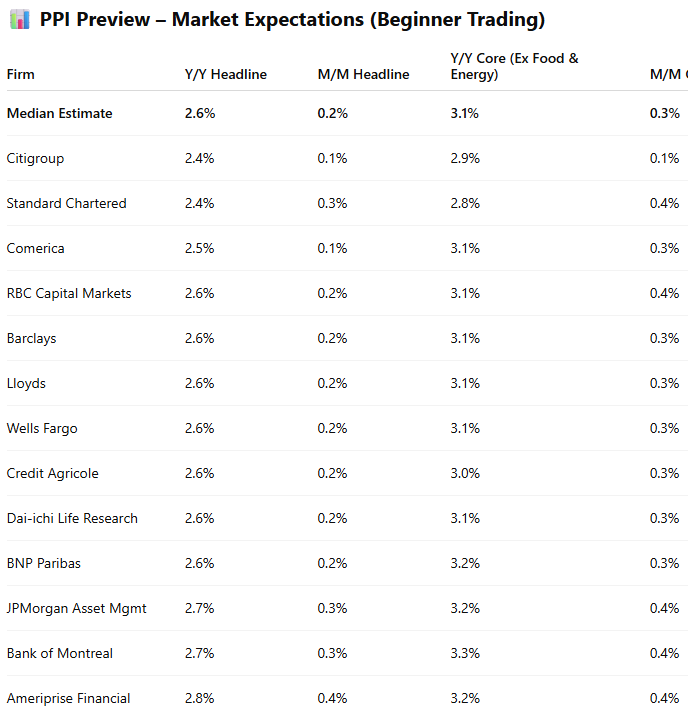
US PPI inflation at 2.6% aligns with forecasts, reinforcing market expectations for two Fed rate cuts this year, which could provide a tailwind for risk assets if realized. JPMorgan's warning of oil prices potentially reaching $120 due to Middle East tensions introduces a significant inflation risk that could derail dovish Fed expectations and pressure crypto markets. The upcoming expiration of substantial BTC and ETH options contracts, coupled with bearish put-call ratios and max pain points, suggests potential short-term price volatility and downside risk for major cryptocurrencies. Geopolitical tensions and renewed tariff discussions are contributing to broader market uncertainty, weighing on Bitcoin and other crypto prices despite the supportive inflation data.
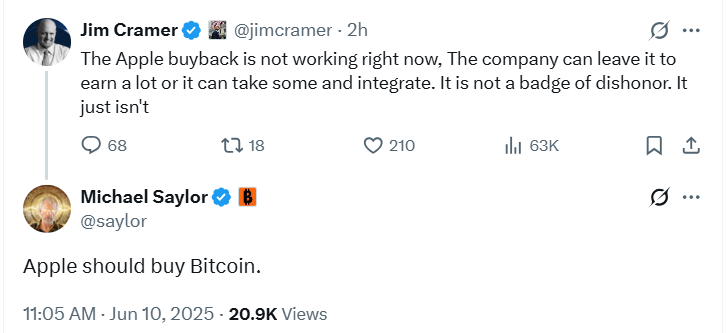
Michael Saylor's proposal for Apple to allocate cash reserves to Bitcoin instead of stock buybacks highlights a growing narrative around corporate treasury diversification and inflation hedging. While the direct impact on Apple's stock or Bitcoin's price is speculative, the repeated advocacy by a prominent figure like Saylor for major tech companies to adopt Bitcoin signals increasing institutional interest and potential future adoption trends. The online support for Saylor's idea, coupled with past instances of tech giants like Tesla making BTC purchases, suggests a growing sentiment among crypto advocates for broader corporate adoption, which could influence market perception.
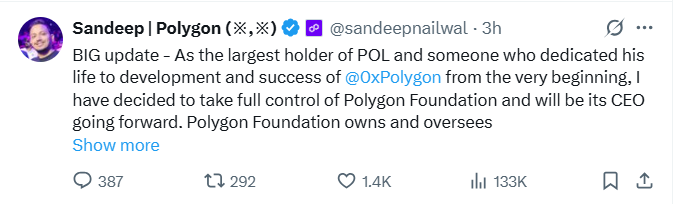
Sandeep Nailwal's assumption of CEO role at Polygon Foundation signals a strategic pivot towards Polygon PoS and Agglayer, potentially boosting POL's utility and investor confidence. The discontinuation of the zkEVM project by 2026 and focus on PoS and Agglayer indicates a consolidation of resources and a clearer development path, which could lead to improved transaction performance and new use cases like RWA and stablecoin payments. The SEC dropping its case against MATIC, coupled with Nailwal's active leadership and plans for POL staker airdrops, creates a more favorable environment for POL price appreciation, contingent on the successful execution of the Agglayer roadmap. Internal leadership changes and a shift to a more agile, startup-like approach aim to accelerate decision-making and adapt to market dynamics, suggesting a potential for faster innovation and value creation for POL holders.
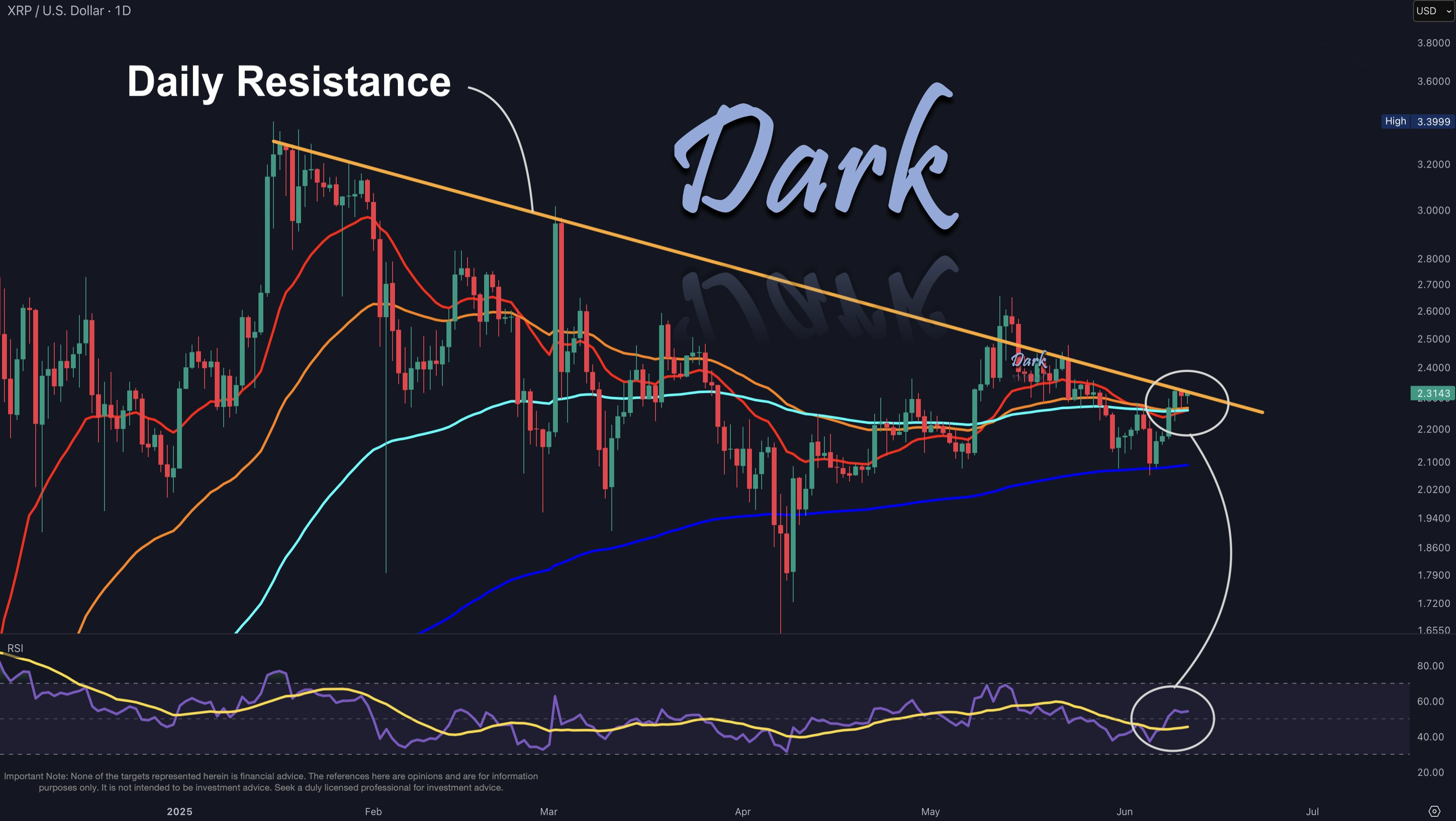
The Ripple vs. SEC lawsuit remains a critical overhang for XRP, with a former SEC lawyer outlining four potential settlement scenarios that could impact the asset's price and Ripple's future IPO plans. The ongoing legal battle, particularly the injunction against Ripple, directly hinders its ability to pursue an IPO, making its resolution a key driver for potential upside and market clarity. While the lawsuit's outcome is uncertain, recent analyst predictions suggest a bullish outlook for XRP price, contingent on breaking key resistance levels, indicating potential short-term trading opportunities.
Signal context only. Validate with price action, liquidity, and risk limits before taking a position.
