



Elon Musk has launched Grokipedia, an AI-generated encyclopedia intended to challenge Wikipedia and disrupt access to information. This ambitious project, combined with the billionaire's considerable influence, has the potential to reshape the landscape of knowledge and, particularly, financial markets. This analysis explores an innovation with far-reaching repercussions.
In brief
- •Elon Musk has launched Grokipedia, an AI encyclopedia that promises neutral and transparent information, aiming to rival Wikipedia.
- •The Grokipedia project has generated divided opinions; it is praised by some for its innovative approach while criticized by others for a perceived conservative orientation.
- •Grokipedia also holds the potential to influence the crypto market, with a particular focus on Dogecoin, Musk's favored memecoin.
Grokipedia: Elon Musk’s AI-Generated Encyclopedia is Online
Elon Musk officially launched Grokipedia on October 27, 2025. This online encyclopedia is entirely generated by artificial intelligence and was developed by xAI. The platform presents itself as an alternative to Wikipedia, offering nearly 900,000 articles at its launch. Despite initial technical challenges, the site is now accessible and aims to revolutionize access to information.
To achieve this, Grokipedia utilizes the Grok AI, a chatbot trained on extensive data to produce content in real time. Elon Musk has announced that a version 1.0, described as "ten times better" than the current iteration, will be deployed soon. This project aligns with his ongoing criticisms of Wikipedia, which he accuses of bias and a lack of neutrality.
The objective is clear: to provide a more objective source of information, free from human bias. However, some experts question whether an AI can guarantee absolute neutrality, particularly given that its training data may inherently contain biases.
Wikipedia VS Grokipedia: Who Will Win the Battle of Truth?
Elon Musk asserts that Grokipedia embodies "the truth, the whole truth, nothing but the truth." This statement contrasts sharply with his repeated criticisms of Wikipedia, which he believes is too influenced by activists. The question remains whether this promise of neutrality is realistic.
Prominent figures, such as the Russian ideologue Alexander Dugin, have praised Grokipedia's apparent neutrality, suggesting that articles about him are more balanced on the platform. Conversely, media outlets like The Washington Post have highlighted that the platform might favor far-right discourse, with content already drawing criticism for its political orientation.
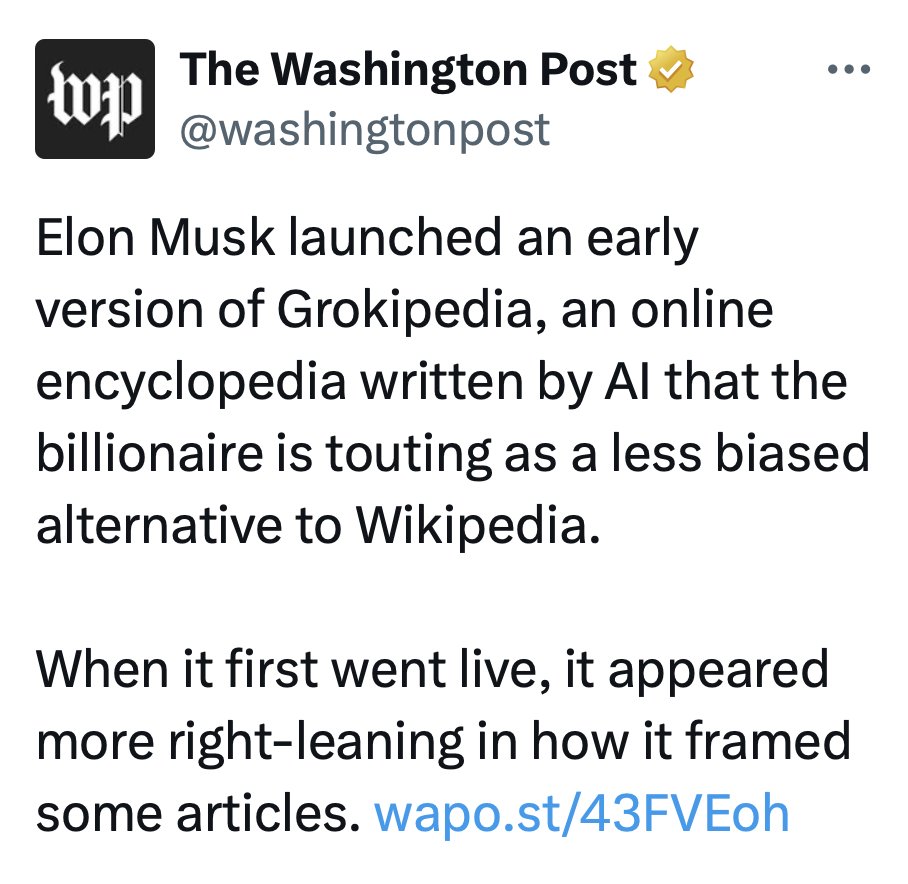
The debate over whether an AI-generated encyclopedia can truly escape bias is ongoing. While algorithms operate automatically, they are fundamentally dependent on the data they are trained on. Wikipedia, despite its acknowledged imperfections, benefits from a global community of contributors, which provides a degree of resilience against manipulation.
Grokipedia and Dogecoin: A Potential Impact on Musk’s Favorite Crypto?
Elon Musk is well-known for his significant influence on cryptocurrencies, most notably Dogecoin. Historically, any announcement or project associated with this memecoin has led to fluctuations in its price. Therefore, the question arises whether Musk's launch of Grokipedia could become a new catalyst for DOGE. As of now, no substantial increase in Dogecoin's value has been observed since Grokipedia's debut.
Nevertheless, speculation remains rife. If the platform incorporates positive mentions of Dogecoin, it could enhance the memecoin's visibility and, consequently, its appeal to crypto investors.
Observers of the crypto market are closely monitoring Grokipedia's development. Widespread adoption could trigger a "Musk effect," potentially boosting Dogecoin's price as seen in the past. Conversely, if the project experiences limited success, its impact on financial markets may be constrained.
Just a few months after Musk's AI was found to be generating hateful discourse, the Tesla CEO has unveiled another innovation: Grokipedia. This project raises fundamental questions concerning algorithmic neutrality and its influence on cryptocurrencies. One certainty remains: AI and crypto will continue to shape our future. However, the critical question for the digital age is: who will ultimately define truth?