


The debate over decentralized stablecoins has returned to the center of the crypto world, and this time, it carries a sharper edge. Vitalik Buterin’s latest analysis has sparked renewed urgency across developer circles, academic researchers, on-chain analysts, and students exploring financial technology. His message is direct: the stability layer of DeFi is fragile, and systems built today may not survive the test of time.
This reminder appears at a moment when stablecoins support billions in daily settlement volume, as confirmed by recent on-chain market studies. The long-term health of the digital economy depends on solving deeper design flaws that many protocols still overlook.
Supply of stablecoins hovered around $300 billion in early 2026, but most liquidity was tied to centralised issuers, independent blockchain analysts say. This sort of dependence shapes how decentralized applications manage risk, liquidity and value lockup.
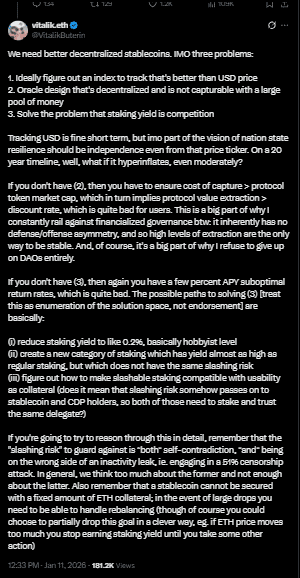
Buterin argues that because decentralized finance revolves around stable value–as collateral, base currency, and so on–the community needs to revisit what “stable” actually means. His comments from January 11, 2026 point fingers at benchmarks, oracles and the kinds of incentives that shape action across an entire ecosystem.
A Fragile Foundation: Why the Dollar Peg No Longer Works for Decentralized Systems
The first concern highlights how the current benchmark for stability creates a structural weakness. Many decentralized stablecoins link their value to the US dollar, either through soft or explicit pegs.
The result appears dependable and easy to understand, yet centralization of DeFi is exposed as if to suffer from bad taste. Over time, the dollar’s value shifts due to inflation, interest rate changes, and geopolitical events. DeFi inherits these shifts without any control over their direction.
Maker’s DAI, one of the most referenced decentralized assets, uses a $1 target price based on its publicly available system design documents. While effective in the short term, it does not guarantee long-term sustainability.
Indeed, Buterin has speculated that future stablecoins may well harness wider indicators, from consumer purchasing power to a multi-currency basket. Global models, such as synthetic reserve assets, show how diversified pegs reduce dependence on a single currency.
The Oracle Problem: Why Data Feeds Remain DeFi’s Weakest Link
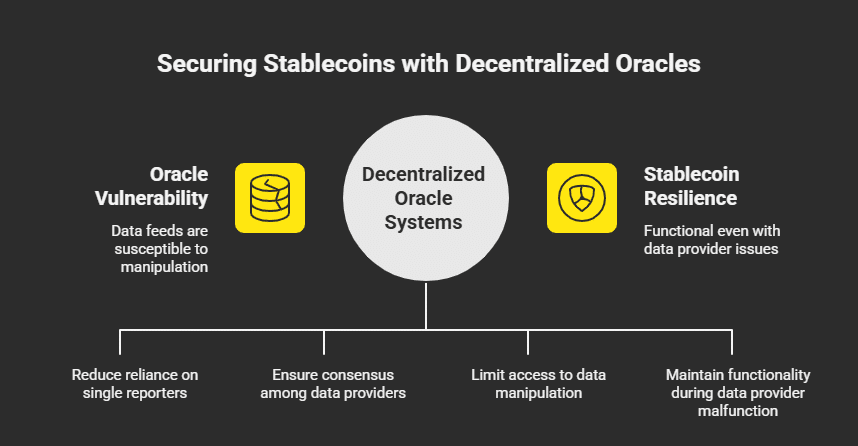
It is crucial to have correct data for stablecoins, whether they are tracking fiat prices, commodity values, or synthetic indices. Oracles act as conduits between the real world and blockchain worlds. Yet no oracle system remains free from capture risk.
A well-capitalized attacker could attempt to distort data feeds to trigger forced liquidations or mint unbacked supply. Such events have appeared before during oracle manipulation incidents across various lending protocols.
Systems that use medianized models with allowed reporters, quorum requirements, and permissioned controls reduce risk but do not remove it. Future decentralized stablecoins must aim for oracle systems that reduce reliance on a single actor, minimize attack incentives, and respond gracefully when feeds fail. A stablecoin must remain functional even if some of its data providers malfunction.
Financial analysts often compare this issue to how legacy markets handle price reporting. Traditional exchanges use regulated surveillance and circuit breakers. On-chain systems need their own safeguards. Without them, even strong protocol designs can collapse during stress.
The Yield Dilemma: How Ethereum Staking Competes with Stablecoin Models
Ethereum staking plays a crucial role in network security, but it also creates economic competition inside DeFi. When staking yields offer returns higher than those available to stablecoin users or issuers, capital tends to migrate. This movement affects liquidity, collateral depth, and stability. Staking yields often fluctuate based on network activity and participation.
Buterin outlines several possibilities for future protocol models. One scenario involves reducing yields to near-zero levels, where staking becomes a public good rather than a profit-driven investment. Another model introduces tiered staking, where one category offers lower risk but also lower returns.
This issue grows more complex as broader crypto markets shift. When network rewards rise, collateral may exit stablecoin protocols. When rewards fall, incentives may not support long-term stability. These cycles introduce pressure points that developers must consider when designing next-generation assets.
Run Scenarios: Understanding How Stablecoins Behave Under Stress
Financial students and analysts often study bank runs to understand liquidity risk. A similar pattern appears in decentralized markets. Stablecoins can lose value quickly during market shocks. If the price of collateral falls or confidence erodes, redemptions are pressed. Stablecoins based purely on the level of confidence in them can run out of control, with the result that their sell-off is accelerated once the value plunges.
Historical examples of algorithmic stablecoin failures show how fragile incentive-based models can be. Economic research explains how these designs can unravel within hours. Buterin stresses that decentralized stablecoins must include mechanisms to restore value through collateral or automated recovery actions, not emotional sentiment.
Developers examine liquidity across decentralized exchanges to measure how markets absorb forced selling. During volatility, liquidity thins. If a protocol assumes normal market conditions during crises, the model may fail. Strong design requires testing under extreme scenarios.
Benchmark Design: Searching for Stability Beyond a Single Dollar
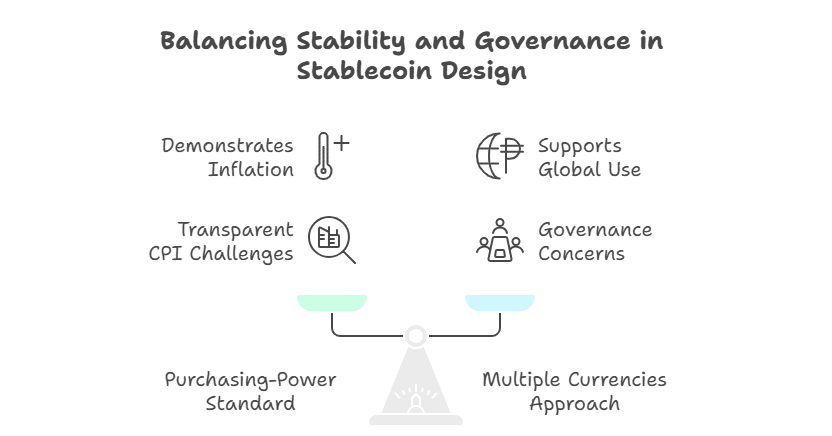
One debated proposal is to create new benchmarks that reflect real economic value. A purchasing-power standard could track the cost of essential goods. This method demonstrates inflation and changes in buying power.
However, creating a transparent, decentralized CPI presents many challenges. Developers must choose items, update prices, and manage disagreements.
A second approach uses multiple currencies to reduce exposure to a single government. This method supports global use. The primary concern is governance. Who sets the weights? How often do they change? How can manipulation be prevented?
Data Integrity: The Backbone of Reliable Stablecoin Performance
Accurate data drives pricing, liquidation, and settlement. Without trustworthy inputs, stablecoins cannot remain reliable. Developers propose multi-layer models in which oracle networks submit data, and systems reject outliers.
Other researchers are exploring cryptographic proofs that verify data without revealing it. Zero-knowledge oracle approaches aim to reduce the risk of manipulation.
Transparency remains vital for user trust. On-chain researchers rely on analytics dashboards to track liquidity, flows, and collateral. These tools help identify early risks and improve system accountability.
The Market Narrative: How Ecosystem Trends Influence Stablecoin Dynamics
Social media analysts highlight how discussions on fast-growing chains influence stablecoin adoption. Topics include speed, low fees, or new financial primitives. Community discussions often shape user expectations and liquidity flows. Analysts track these shifts to understand how sentiment affects stablecoin behavior.
A New Roadmap: Building the Next Phase of Stable Stability
The stable layer of DeFi needs more than short-term fixes. It requires clear benchmarks, strong data systems, and incentive models that endure stress. Future stablecoins may combine diversified pegs, trust-minimized oracles, and resilient reward structures.
Developers study liquidation engines, governance frameworks, and automated systems that adjust to market shifts without manual intervention.
The future means a combination of input from both economists and regulators, technological and academic. Stablecoins stand at the juncture where cryptography converges with economic theory. We must address these quandaries in order to have a decentralized finance worthy of the next decade. Buterin’s message outlines the direction: build durable systems that support long-term growth, not temporary convenience.
Conclusion
At a critical moment for DeFi, Vitalik Buterin discusses how benchmarks, data sources, and incentive systems can each contain hidden risks. With this call for models that are never identical but all work together well, data that cannot be broken or shut down permanently at any whim whatsoever and incentives to winnings or losses–the stage is set for a new generation of decentralized stablecoins.
As the ecosystem expands, so too does the need for dependable digital currency. The industry must rise to that challenge now! This article is for educational purposes only and does not provide financial guidance. Markets, regulation, and technology continue to develop.
This article is for educational purposes only and does not provide financial advice. Markets, regulations, and technology will continue to evolve.
Glossary of Key Terms
Oracle: A system that feeds real-world data into blockchain applications.
Collateralization: The process of backing an asset with other assets to maintain stability.
Purchasing Power: Over time, the amount of physical goods and services available that money can buy remains fixed.
Death Spiral: A sudden drop in value and panic-driven sales.
Basket Peg: A valuation method based on multiple currencies or assets.
Zero-Knowledge Proof: A technique for verifying information without disclosing who sent it or its specific information to the public.
Liquidation: Selling off assets when debt obligations fall below levels required by lenders.
Slashing: A penalty applied to stakers who violate network rules.
Benchmark: A standard that preserves stability.
On-Chain Governance: A form of governance in which token holders vote on changes to the protocols.
Frequently Asked Questions
1. Why do decentralized stablecoins rely on oracles?
They need real-time data such as fiat prices or asset valuations. Oracles supply this information, allowing protocols to update collateral levels and maintain stability.
2. What makes USD-pegged stablecoins risky long-term?
USD value changes over time. This exposes decentralized systems to external economic factors, including inflation and central bank policies.
3. How does Ethereum staking affect stablecoins?
Staking yields compete with stablecoin incentives. When yields rise, collateral may leave stablecoin systems, reducing liquidity and stability.
4. Are basket-pegged stablecoins more stable?
They reduce reliance on a single currency but introduce complexity in measurement, governance, and on-chain data sourcing.