



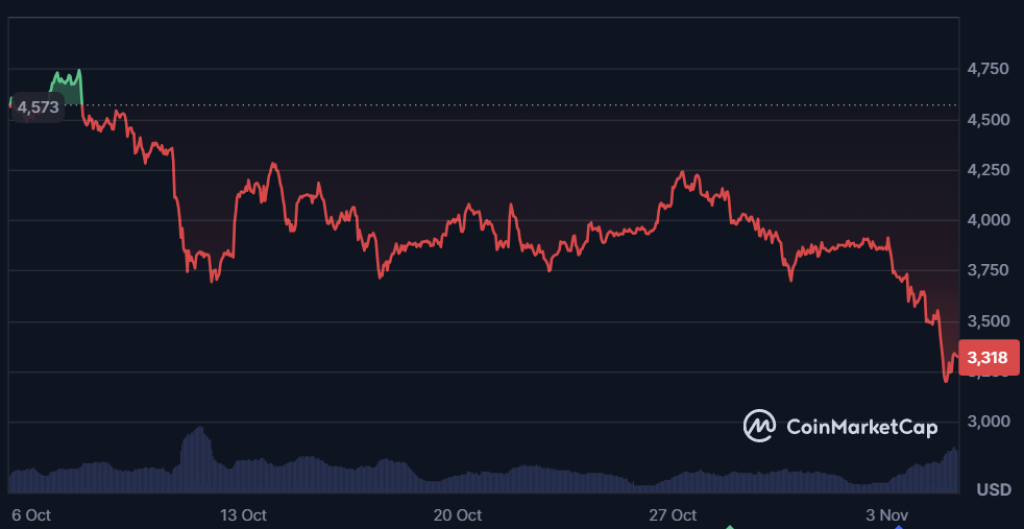
The crypto market has experienced a challenging start to November. Bitcoin has retreated towards the $100,000 mark, Ethereum has fallen below $3,400, and major altcoins such as Solana, XRP, and Cardano are all showing declines. Collectively, the cryptocurrency market capitalization has decreased by over $1 trillion since October 6.
Despite strong long-term fundamentals, widespread adoption, and advancements in regulation, prices are experiencing a significant downturn. The primary drivers behind this sell-off are not fundamentally based but stem from the confluence of three potent forces impacting the market simultaneously.
Crypto ETF Outflows Impacting the Market
One of the most significant pressures currently stems from U.S. spot ETFs. On November 4 alone, significant net outflows were recorded:
- •Bitcoin ETFs experienced net outflows totaling $577.7 million.
- •Ethereum ETFs saw $219 million withdrawn.
- •BlackRock's ETHA was the largest seller, with over $111 million withdrawn.
This marks the fifth consecutive day of redemptions, representing the most severe stretch since August. The substantial volume of money exiting ETFs is a clear indication that traditional finance investors are adopting a "risk-off" posture. This sentiment is also reflected in market correlations:
- •Bitcoin's correlation with the Nasdaq-100 has risen to 0.76, its highest point since June.
When technology stocks decline, the cryptocurrency market tends to fall in tandem.
Key Indicator to Watch: If upcoming Consumer Price Index (CPI) inflation data shows cooling trends, ETF flows could potentially shift back to a bullish trajectory.
Rising Macroeconomic Fear Affecting Bitcoin
The U.S. government shutdown has led to the postponement of crucial economic reports, creating an environment of uncertainty and nervousness in the markets. Traders are uncertain about the Federal Reserve's next moves, and this ambiguity is detrimental to speculative assets like cryptocurrencies.
- •The Crypto Fear & Greed Index has plummeted to 20, indicating "Extreme Fear."
- •Bitcoin has lost its $100,000 support level, prompting trend-following traders to sell.
- •The ETH/BTC ratio has dropped by 1.3%, as traders sought safety in Bitcoin.
This behavior is characteristic of recessionary periods, where investors prioritize certainty, a sentiment that the current crypto market is not providing.
Key Indicator to Watch: The FOMC minutes, scheduled for release on November 7, may offer insights into potential interest rate cuts in December.
Leverage Amplifies the Crypto Crash
The current market situation is exacerbated by extremely high levels of leverage, which magnifies every market movement.
Within a 24-hour period:
- •Crypto liquidations reached $2.1 billion.
- •Approximately 80% of these liquidations were long positions.
- •Ethereum alone saw $921 million in liquidations.
- •Funding rates turned negative as open interest declined by 6%.
Ethereum's Relative Strength Index (RSI) fell to 29, a deep oversold territory, but a significant bounce did not materialize due to cautious spot buyers.
This trend is not isolated to a single event:
- •An average of 300,000 traders are being liquidated daily.
- •Markets are reacting instantaneously to every news headline.
- •Leverage is transforming price dips into significant collapses.
An analyst accurately described the situation:
“Leverage is a wild drug.”
The million dollar question:
— The Kobeissi Letter (@KobeissiLetter) November 4, 2025
What is happening crypto right now?
Crypto markets have now officially erased over -$1 TRILLION of market cap since October 6th.
But why?
The answer to this question seems to be more technical than fundamental.
That is, crypto adoption is still…
Long-Term Strength Amidst Short-Term Volatility
The underlying fundamentals of the cryptocurrency market remain robust:
- •Adoption rates continue to increase.
- •The introduction of ETFs marks a significant development.
- •Demand for AI and blockchain integration is growing.
- •Regulatory frameworks are becoming more supportive.
However, the current reality is that:
Until leverage is fully unwound and ETF flows stabilize, we should anticipate increased volatility in both upward and downward market movements.
The most severe market pain often precedes the next significant recovery. Savvy investors recognize this pattern. For the time being, patience and avoiding excessive leverage may be the most prudent strategies.