


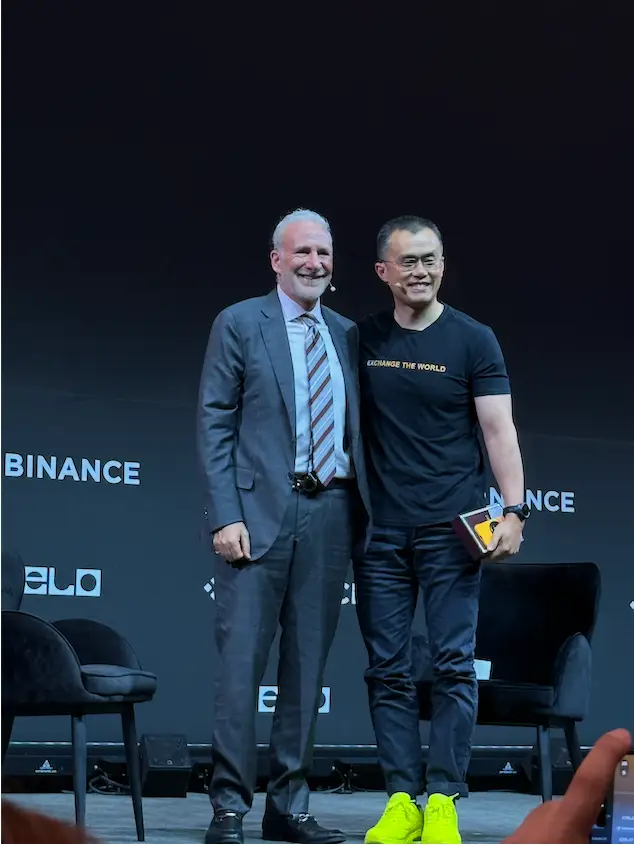
The highly anticipated debate between Bitcoin and tokenized gold culminated on the second day of Binance Blockchain Week, featuring prominent figures CZ and Peter Schiff. Taking the Main Stage, they presented their respective arguments for each asset in a cordial discussion.
Key Points of the Bitcoin vs. Tokenized Gold Debate
The core arguments presented during the debate between CZ and Peter Schiff revolved around several critical aspects of digital assets and traditional stores of value.
Gold and Tokenized Gold: Ownership and Representation
Peter Schiff initiated the discussion by emphasizing the tangible ownership associated with physical gold, which is stored in a vault, making it an allocated asset. In contrast, tokenized gold was presented as a digital representation of gold. Schiff noted that while all gold tokens are fungible, this is simply because "gold is gold."
Authenticity Verification: Gold vs. Bitcoin
CZ illustrated a point by presenting a piece of metal, stating it was gold received from the President of Kyrgyzstan. Schiff questioned the authenticity of this gold. CZ countered that the gold was genuine and did not require verification, adding that in some countries, carrying real gold could lead to legal trouble. CZ further elaborated that while gold's authenticity requires a specialist's verification, Bitcoin's authenticity can be instantly confirmed through blockchain technology. Schiff acknowledged that tokenized gold also offers this verification capability. The consensus was that both Bitcoin and tokenized gold offer verifiable authenticity, whereas physical gold necessitates expert examination.
The Value of Intangible Assets
Schiff consistently argued that despite being priced in fiat currency, Bitcoin lacks intrinsic value. CZ, advocating for Bitcoin's value, drew parallels with intangible online platforms like Google, the X platform, and the Internet, highlighting their significant monetary worth. He explained that Bitcoin represents transaction records on the blockchain, and its value is not diminished by its intangible nature. Schiff concurred that intangibility does not preclude value, citing Binance as an example.
Binance: A Global Crypto Exchange
Binance, described as the world's largest crypto exchange, boasts approximately 300 million users globally. Since its inception in 2017, the platform has demonstrated resilience amidst challenges and FUD, attributed to its strong culture and unwavering principles. Binance has also secured official licenses worldwide, signifying regulatory acknowledgment. Despite operating without a physical headquarters, the exchange has been instrumental in educating people globally about cryptocurrency and blockchain technology, offering valuable insights into broader life principles. This mirrors Bitcoin's journey, gaining acknowledgment from institutions like the IMF, numerous global players, and even governments, despite its unseen, intangible nature.
Defining Money: A Broader Perspective
CZ challenged Schiff's definition of money, suggesting a narrower viewpoint. He differentiated between price and value, noting that while Schiff claimed no one quotes wages in Bitcoin and that individuals still think in dollars even if paid in BTC, CZ shared his personal experience of being paid in BTC in the early days, and that Binance still has contracts and salaries denominated in BTC.
Scarcity: A Defining Feature
The debate also addressed scarcity. Schiff posited that gold's scarcity, due to its precious metal properties, contributes to its value. He noted gold's role in backing currencies, its status as a monetary reserve asset, and central banks' demand for it. However, CZ pointed out that many countries no longer back their national currencies with gold, and central banks' money printing leads to currency devaluation and inflation. As previously highlighted, Bitcoin's scarcity is absolute, with a finite supply capped at 21 million by Satoshi Nakamoto, unlike gold, for which new sources can still be discovered. Bitcoin's value is underpinned by predictability, programmability, and mathematics, further reinforced by periodic halving events. CZ also touched upon the importance of unpredictability in life, drawing a parallel that if life were predictable and eternal, time would lose its value.
Bitcoin's Value Measured Against Gold
Schiff presented data indicating that Bitcoin's value, when measured in gold, had decreased by 40% over the preceding four years. According to the BTC to XAU Chart on December 4, 2021, BTC was valued at over 30 XAU, whereas on December 4, 2025, it was valued at over 22 XAU, based on official data. However, the chart also revealed that since December 2015, the value of BTC measured in gold has increased by over 5,874%.

The Speed and Convenience of Payments
CZ highlighted how crypto transfers simplify transactions, noting that before Bitcoin, transfers took days, whereas blockchain technology enables payments in minutes. He also mentioned the convenience of using a Binance card for crypto payments. Schiff countered that crypto card payments still result in the receiver getting fiat after conversion, implying crypto is used as collateral rather than a direct payment method. CZ responded by stating that an increasing number of merchants globally are now accepting direct crypto payments without fiat conversions.
Speculation vs. Fundamental Value
Schiff reiterated his view that Bitcoin lacks intrinsic value, deriving its worth solely from perceived value. He characterized it as a risky asset, akin to a lottery ticket that could collapse if demand wanes. CZ, conversely, argued that the Bitcoin ecosystem comprises more than just speculators, including true believers, builders, and developers, supported by growing global adoption. It is noteworthy that despite numerous predictions of Bitcoin's demise since its inception, the digital asset has consistently defied these forecasts.
Securing the Future for Children
The discussion extended to the savings preferences of future generations. Schiff predicted that younger generations would favor gold. Binance, however, is focusing on crypto for children's financial futures, recently launching the "Crypto for Kids Program" to enable parents to invest securely for their children through Binance Junior.
The debate between CZ and Peter Schiff served as a demonstration of how influential figures from traditional finance and decentralized finance can engage in a polite discourse despite their differing viewpoints. The discussion concluded amicably, with CZ expressing hope for gold's success and even offering assistance in tokenizing the precious metal. Nevertheless, he maintained his conviction that Bitcoin would ultimately outperform gold and tokenized gold.