



X402 enables direct, machine-to-machine crypto payments at the HTTP layer, removing human and centralized intermediaries from online transactions.
It bridges Web2 and Web3, letting websites natively accept blockchain-based value transfers, similar to how HTTPS enabled secure data exchange.
The protocol faces major technical, security, and adoption challenges, but represents a foundational shift in the AI + Crypto infrastructure narrative.
X402 bridges Web2 and crypto, enabling machines to make direct payments online without human help—redefining how value flows through the internet.
When discussions about X402 first emerged, the concept might have seemed complex, especially for those without a deep technical background.
However, after thorough investigation, the significance of X402 becomes clear, suggesting its potential for substantial future impact.
This explanation aims to break down X402 in simple terms, detailing its power, the challenges it confronts, and its relevance within the crypto investment landscape.
What is X402?
X402 is an open protocol introduced by the Base team, the same entity behind Coinbase's Layer 2 network.
The concept originated from a fundamental observation:
“HTTP made information flow freely, but money is still trapped in the old system.”
This highlights a key difference: while the internet excels at transmitting data, it struggles with the seamless transfer of value.
Currently, accessing online content or services, even streaming videos or calling APIs, still relies on traditional payment methods like credit cards, banks, and centralized gateways.
Coinbase's vision with X402 is to fundamentally alter this dynamic.
They aim to enable the internet itself to process payments natively, eliminating the need for accounts, credit cards, or intermediaries.
HTTP and API: A Simple Explanation
Understanding X402 requires a grasp of two core concepts: HTTP and API.
HTTP (Hypertext Transfer Protocol) is the communication protocol used by web browsers to interact with websites; it functions as the language of the internet for machine communication.
An API (Application Programming Interface), conversely, is how different software programs communicate with each other.
For instance, when a mobile weather application displays the current forecast, it doesn't collect the data directly.
Instead, it interfaces with a Weather API, sending a request like, “What is the current weather information?”
This exemplifies machine-to-machine communication.
When these two concepts, HTTP and API, are combined, they form the foundational structure for how the internet exchanges information.
This model underpins nearly all online operations.
However, the critical limitation is that monetary transactions are not integrated into this system.
Why Traditional Payment Logic is Inadequate
Presently, an AI agent or program seeking to access a paid online service cannot do so autonomously.
The conventional process typically involves several steps:
- A human user accesses a website.
- The website prompts for account creation.
- The user registers, links a payment method, funds an account, and generates an API key.
- Only then can the AI or application utilize the service.
This dependency means AI systems are reliant on human intervention for managing their access to services.
If an AI's balance is depleted, a human must manually log in and replenish it.
This setup is not indicative of true autonomous intelligence; rather, it represents an AI with restricted capabilities.
X402 is designed to address this limitation.
The Innovation of X402
X402 facilitates direct payments at the HTTP layer for machines, bypassing the need for human intervention.
This eliminates the requirement for:
- •Accounts
- •Credit cards
- •Billing systems
AI agents, bots, and APIs can now conduct payments as naturally as humans, enabling direct machine-to-machine transactions.
The practical application of this is illustrated by the following comparison:
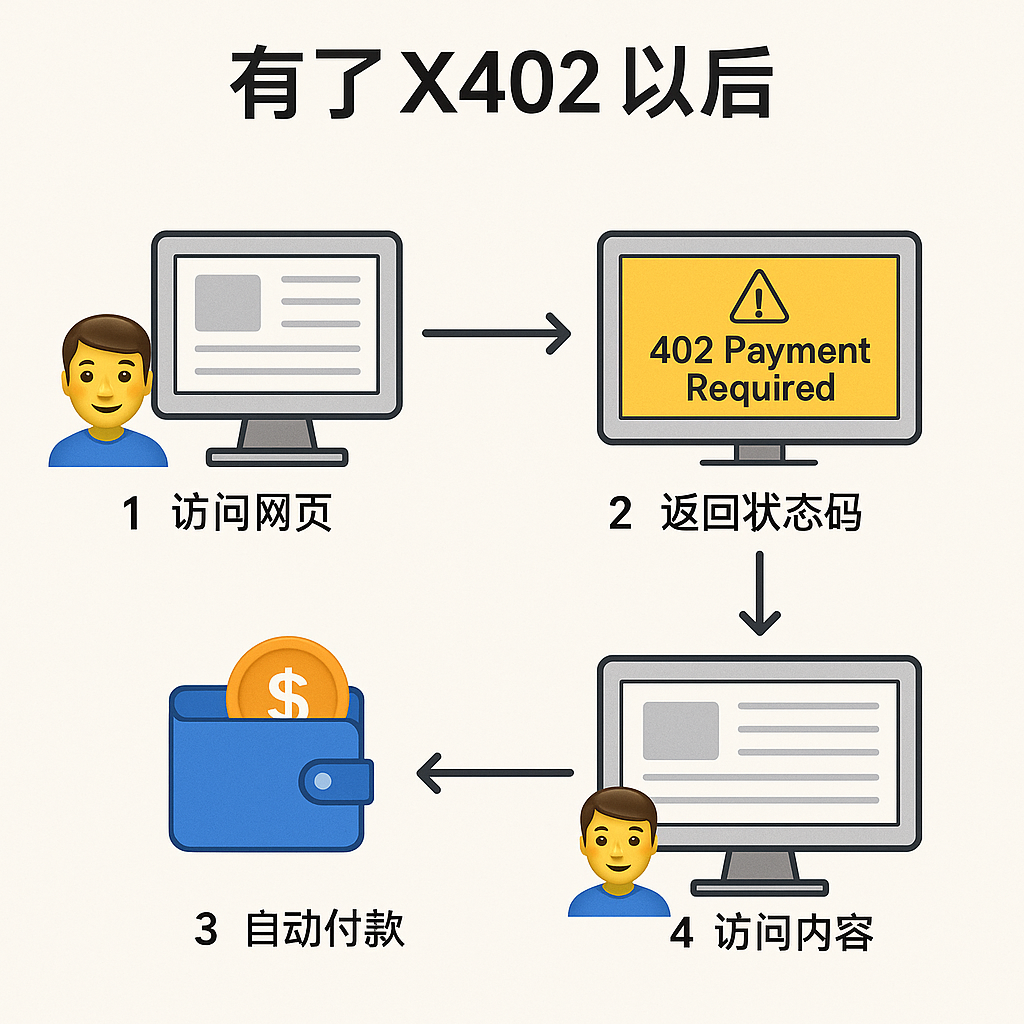
- •Without X402: The process involves registration, linking a card, generating an API key, and manual recharging when usage limits are reached.
- •With X402: An AI makes a request, the server responds with a "Payment Required" notice specifying the amount (e.g., 0.01 USDC), the AI pays instantly, and the requested data is delivered immediately.
This streamlined, automated, and decentralized approach aims to make crypto-native payments as universal as secure communication became with HTTPS.
AI and Crypto: The Broader Context
X402 can be viewed as the foundational "payment language" for the AI-Crypto ecosystem—the crucial standard that empowers machines to initiate and complete financial transactions independently.
Its significance lies in its ability to connect Web2 (the traditional internet) with Web3 (the blockchain ecosystem).
With X402, any website could natively accept cryptocurrency payments, mirroring the ease with which it currently handles HTTP requests.
Blockchain technology is essential for X402's functionality, as it provides the underlying infrastructure for secure and verifiable value transfers.
Therefore, X402 is more than just another cryptocurrency protocol; it serves as a vital link between digital currency and the fundamental architecture of the internet.
Challenges and Risks
The implementation of X402 is not without its hurdles.
Integrating payment logic directly into the internet's core infrastructure presents substantial technical and regulatory challenges.
Firstly, universal infrastructure is required; developers, browsers, and APIs must all adopt the same payment standard.
Secondly, security is a paramount concern. Autonomous payment systems for machines necessitate robust safeguards to prevent fraudulent activities or theft.
Finally, widespread adoption will require overcoming a significant learning curve. Similar to how HTTPS evolved over years to become standard, X402 will need time, comprehensive education, and the establishment of trust to achieve mainstream acceptance.
Potential Investment Angles
From an investment perspective, X402 represents a key component of the AI + Crypto narrative, specifically focusing on the infrastructure that facilitates value exchange between intelligent agents.
The most direct investment opportunity would likely be within the Base ecosystem, given Coinbase's leadership in this initiative.
Projects centered on AI payments, decentralized computing, or autonomous agent frameworks could also experience indirect benefits from this transformative shift.
It is crucial to acknowledge that this technological domain is still in its nascent stages.
Just as early internet protocols required years to mature, X402 will undergo multiple developmental phases before widespread adoption is achieved.
Concluding Thoughts
In essence, X402 transcends mere technology; it represents a fundamental redefinition of the internet's operational logic.
Having already achieved the free flow of information, the focus now shifts to enabling the equally effortless movement of value.
The concept of machines making payments to each other without human intervention may seem futuristic, but it marks the genesis of the next era of the internet—the machine economy.
Consequently, when encountering discussions about X402, it should be viewed not merely as another cryptocurrency buzzword.
Instead, consider it a pivotal moment when the internet begins to natively handle financial transactions—securely and autonomously.