


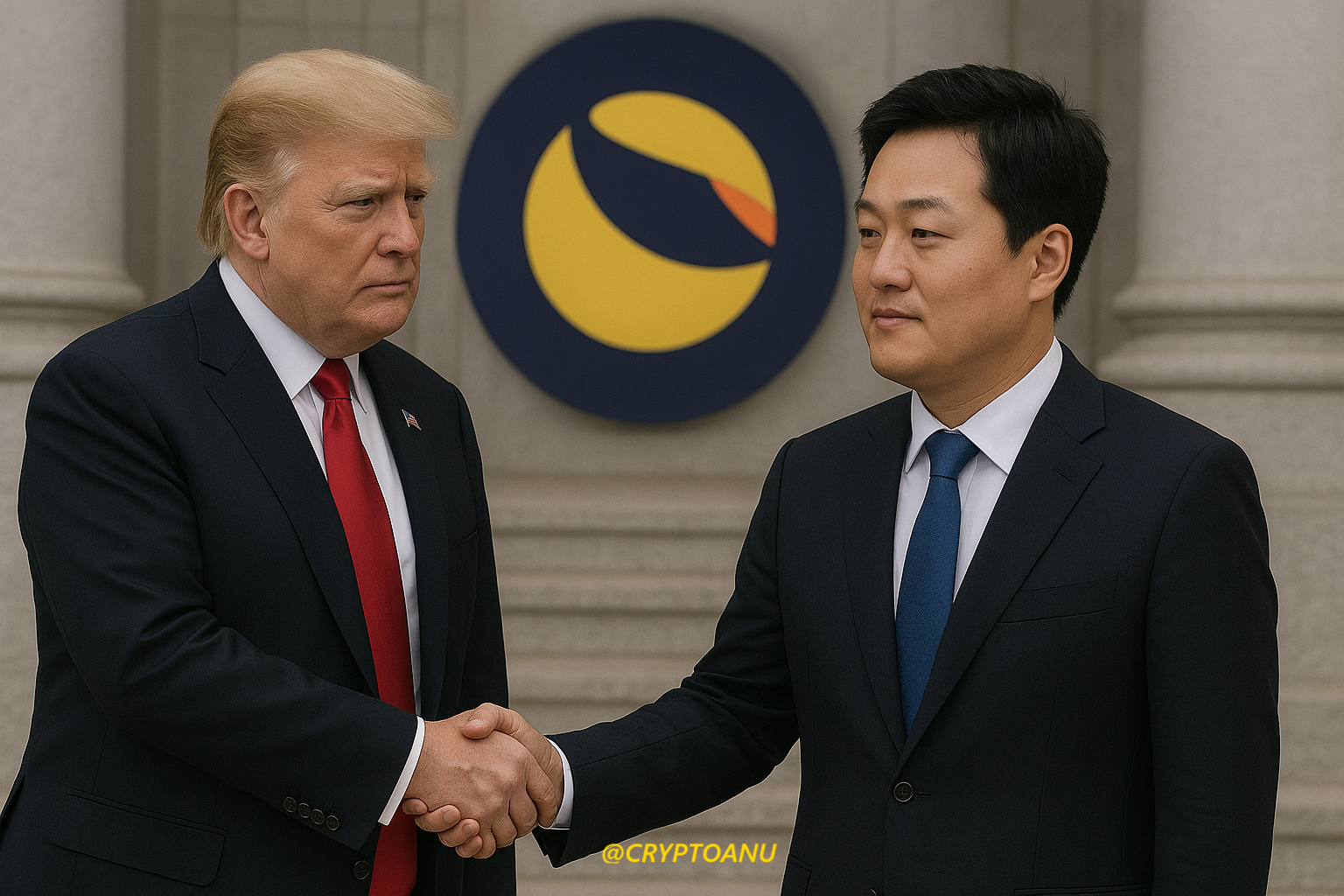
When news broke that Binance founder Changpeng Zhao (CZ) was officially pardoned by President Trump, the crypto world collectively exhaled. For the first time in years, regulation and policy weren’t about punishment — they were about recognition. Recognition that crypto, for all its chaos and controversy, had matured into infrastructure. But one question now echoes through the community:
If CZ can be pardoned, what would happen if Do Kwon was too?
The Return of the Builders
CZ’s release wasn’t just a legal story — it was symbolic. It marked the political normalization of crypto, a signal that the U.S. was ready to bring blockchain innovation back under its roof. If this philosophy extends to other founders, then Do Kwon’s case becomes less about fraud — and more about unfinished innovation. A pardon could reframe him not as the villain of crypto’s darkest day, but as the catalyst for the next iteration of decentralized monetary design.
Terra: The Experiment That Never Truly Died
Terra’s collapse in 2022 remains one of the most defining moments in financial history — a $40B implosion that reshaped regulation, risk modeling, and DeFi narratives forever. But beneath the ashes of that collapse, something remarkable survived:
- •$LUNC (Terra Classic) – still traded, still governed, still burning supply.
- •$USTC – still seeking re-peg through community-led DeFi initiatives.
- •Developers – still building L2 extensions and AI-driven liquidity concepts on-chain.
In other words: Terra didn’t die. It decentralized.
Why Do Kwon Still Matters
Love him or hate him — Do Kwon represented something crypto rarely sees: an attempt at decentralized monetary policy. The idea behind UST wasn’t a scam. It was an experiment — a test of whether algorithms could sustain a stable global currency without government backing. It failed spectacularly — but failures, in tech, often become prototypes for revolutions. If Do Kwon were ever allowed to re-enter the space, it could mark the start of the “forgiveness era” of crypto — a time where lessons learned matter more than reputations lost.
The Political Message Behind CZ’s Pardon
CZ’s pardon is more than a personal victory — it’s policy in motion. It shows that the U.S. is ready to reintegrate the builders it once exiled. Crypto is no longer an outsider economy — it’s the next layer of digital capitalism. And forgiveness, in this context, isn’t weakness — it’s strategic alignment. If that same philosophy were extended to Terra’s founder, it could trigger a massive revival in community-led ecosystems like LUNC, rekindling institutional curiosity and developer interest.
What It Could Mean for $LUNC and $USTC
For Terra Classic, a Do Kwon pardon wouldn’t just be emotional — it’d be structural.
- •Renewed Legitimacy — Institutional partners would re-evaluate LUNC’s long-term potential.
- •Governance Momentum — A unified community could push forward LUNC’s DeFi and AI-integrated DEX vision.
- •Liquidity Infusion — New listings and on-chain integrations could reignite trading volumes.
In short, a pardon could transform “the fallen coin” into a comeback story.
From Collapse to Evolution
If CZ’s return symbolizes stability, Do Kwon’s potential redemption could symbolize evolution. Crypto is a system built on trial and error — a network that punishes greed, but rewards persistence. Terra Classic’s resilience proves that decentralized communities can outlive their founders. But bringing those founders back — under oversight, collaboration, and innovation — could accelerate the evolution of autonomous finance faster than any regulation ever could.
The Human Side of Decentralization
Forgiveness in crypto isn’t about erasing the past. It’s about acknowledging that code isn’t infallible, and neither are we. Every collapse — from Mt. Gox to Luna — pushed the industry forward. Every pardon or policy shift brings builders back into the conversation. Do Kwon’s story, if reopened, could close one of the biggest psychological loops in crypto’s history: turning tragedy into transformation.
Beyond Redemption — The Next Chapter
2021 was euphoria. 2022 was destruction. 2023–2025 is reconstruction. If CZ’s pardon marks the beginning of political acceptance, a Do Kwon pardon could mark the beginning of moral acceptance — the moment where crypto accepts its past to shape its future. And perhaps, somewhere between $LUNC burns, AI-driven DEX development, and on-chain treasuries like WLFI, the dream of a self-healing, decentralized financial network might finally come true.
Final Thoughts
Crypto was never meant to be perfect — it was meant to evolve. Redemption isn’t a weakness of decentralization — it’s its proof of life. CZ walked back in. If Do Kwon ever does too, the Terra story won’t just be remembered as a failure — it will be remembered as the experiment that built the next phase of decentralized finance.