



Key Concerns Regarding Kevin Hassett's Potential Nomination
Wall Street insiders are advising President Trump against appointing Kevin Hassett as the Federal Reserve Chairman, citing significant risks to market stability and the independence of the Federal Reserve. The primary concerns revolve around Hassett's potential impact on inflation, interest rates, and the overall credibility of the central bank.
An appointment of Hassett could contribute to rising inflation and interest rates, which would have repercussions across both traditional financial markets and the cryptocurrency ecosystem. The increasing sensitivity of assets to policy shifts underscores the importance of a stable and independent Federal Reserve.
Market Apprehension and Potential Economic Impacts
The prospect of Kevin Hassett being nominated as the next Federal Reserve Chair has generated considerable apprehension among Wall Street and U.S. corporate insiders. Alongside other potential candidates like Kevin Warsh and Christopher Waller, Hassett's nomination raises significant questions about the independence and market credibility of the Federal Reserve.
Should Hassett be appointed, there is a strong possibility that long-term interest rates could increase, potentially exacerbating inflation pressures and causing disruption within financial markets. Rates for mortgages and consumer loans, which are closely linked to the 10-year Treasury yield, are particularly vulnerable to a significant rise.
Market participants, including leaders and investors in the cryptocurrency space, have reacted with caution to these developments, anticipating potential fallout. Raoul Pal, CEO of Real Vision, has highlighted the critical role of Federal Reserve independence in maintaining macroeconomic stability.
Bitcoin's Performance Amidst Federal Reserve Speculation
Historical Federal Reserve appointments made during politically sensitive times have often been followed by increased market volatility, affecting both traditional and digital assets. This pattern emphasizes the crucial need for central bank independence to ensure market stability.
As of December 3, 2025, Bitcoin's price stood at $92,271.69, with a market capitalization of approximately 1.84 trillion dollars. This represents a 1.51% increase over the preceding 24 hours, according to data from CoinMarketCap. Recent performance data indicates that Bitcoin has seen a 5.09% rise over the past seven days, despite experiencing longer-term declines.
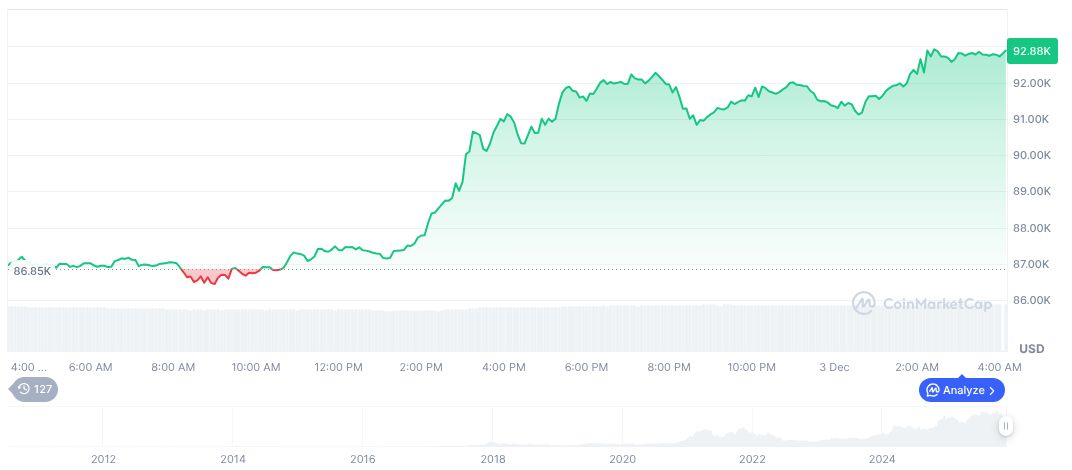
Research from Coincu indicates that a Federal Reserve influenced by political considerations could lead to heightened economic volatility. Historical trends suggest that rising interest rates under such circumstances typically result in tighter liquidity conditions, which can adversely affect not only traditional assets but also the rapidly evolving crypto markets.